Table of Contents >> Show >> Hide
- What a Water Pressure Regulator Valve Does (and Why It Matters)
- What PSI Should You Set Your Home Water Pressure To?
- Before You Adjust Anything: Test Your Water Pressure Correctly
- Where to Find the Water Pressure Regulator Valve
- How to Adjust a Water Pressure Regulator Valve at Home
- How Much Should You Turn the Regulator?
- Common Mistakes to Avoid
- When Adjusting the PRV Does Not Solve the Problem
- Safety and Code Notes Homeowners Should Know
- Quick Example: A Practical Adjustment Scenario
- Final Thoughts
- Extended Experience Notes (500+ Words): Real-World Lessons From Homeowners Dealing With PRV Adjustments
If your shower feels like a fire hose one day and a sad drizzle the next, your home’s water pressure regulator valve (also called a pressure reducing valve, or PRV) may need attention. The good news: in many homes, adjusting it is a manageable DIY task. The even better news: you do not need to be a master plumber with a truck full of mysterious tools. You need a pressure gauge, a wrench, a little patience, and the discipline to make small changes instead of “one giant turn for mankind.”
This guide walks you through how to adjust a water pressure regulator valve at home safely, how to test water pressure the right way, what PSI range to aim for, and how to tell when the regulator is not “out of adjustment” but simply worn out. We will also cover common mistakes, troubleshooting tips, and real-world homeowner experiences so you can avoid turning a quick fix into a wet weekend.
What a Water Pressure Regulator Valve Does (and Why It Matters)
A water pressure regulator valve sits on the main water line and reduces incoming municipal water pressure to a safer, more usable level for your home. City water pressure can vary by neighborhood, elevation, and time of day. Homes in lower elevations often get higher pressure, and pressure may rise at night when demand drops.
Without a properly working PRV, excessive pressure can stress pipes, fixtures, and appliances. That can lead to dripping faucets, noisy valves, water hammer, running toilets, shortened appliance life, or leaks that show up at the worst possible time (usually after you have already changed into pajamas).
Signs Your Water Pressure May Need Adjustment
- Shower spray feels unusually harsh or “needle-like”
- Faucets splash aggressively even when barely opened
- Banging pipes (water hammer) when fixtures shut off
- Toilets refill loudly or quickly
- Frequent appliance hose leaks or fixture drips
- Pressure seems low throughout the whole house, not just one fixture
- Pressure changes noticeably at different times of day
Important note: if low pressure affects only one sink or one shower, the problem is often a clogged aerator, showerhead, angle stop, or fixture cartridgenot the whole-house regulator.
What PSI Should You Set Your Home Water Pressure To?
There is no single “magic” number for every house, but most homeowners do well in the 45–60 PSI range, with 50–60 PSI being a common comfort target. Many pros and manufacturers ship residential PRVs factory-set around 50 PSI.
In general:
- Below 40 PSI: Often feels weak for showers and multi-fixture use
- 45–60 PSI: Excellent target range for many homes
- 60–80 PSI: May still function, but can increase wear and water use
- Over 80 PSI: Too high for many homes and commonly triggers code concerns
Always follow local plumbing code and manufacturer guidance. If you are on a well system, do not confuse a PRV adjustment with a well pressure switch setting. Those are different components with different procedures.
Before You Adjust Anything: Test Your Water Pressure Correctly
The most common DIY mistake is adjusting a PRV based on “feel.” Your shower is not a calibrated instrument. A $10–$20 hose-thread pressure gauge is.
Tools You’ll Need
- Water pressure gauge (hose bib / laundry faucet type)
- Adjustable wrench or wrench set
- Screwdriver, Allen key, or nut driver (depends on PRV model)
- Pen and paper (or phone notes) to track readings
- Flashlight (if the PRV is in a crawlspace, garage corner, or utility closet)
- Gloves (optional but helpful)
How to Measure Static Water Pressure
- Make sure no water is running anywhere in the house (sinks, showers, dishwasher, washer, irrigation, etc.).
- Attach the pressure gauge to a hose bib, laundry cold-water faucet, or another threaded outlet downstream of the PRV.
- Open the faucet fully.
- Read the gauge and record the PSI.
- Test again at different times of day (morning, afternoon, night) because pressure can fluctuate.
If your reading is high (especially above 80 PSI), adjusting or servicing the PRV is a smart next step. If your reading is low but stable, the PRV may be set too lowor you may be dealing with another issue such as a partially closed main shutoff valve, clogging, or a failing regulator.
Where to Find the Water Pressure Regulator Valve
In most homes with city water, the PRV is located on the main water line shortly after the main shutoff valve, often near where the water service enters the home. Common locations include:
- Basement near the foundation wall
- Crawlspace near the front of the house
- Garage wall near the water heater area
- Utility closet
- Near the meter (in some setups)
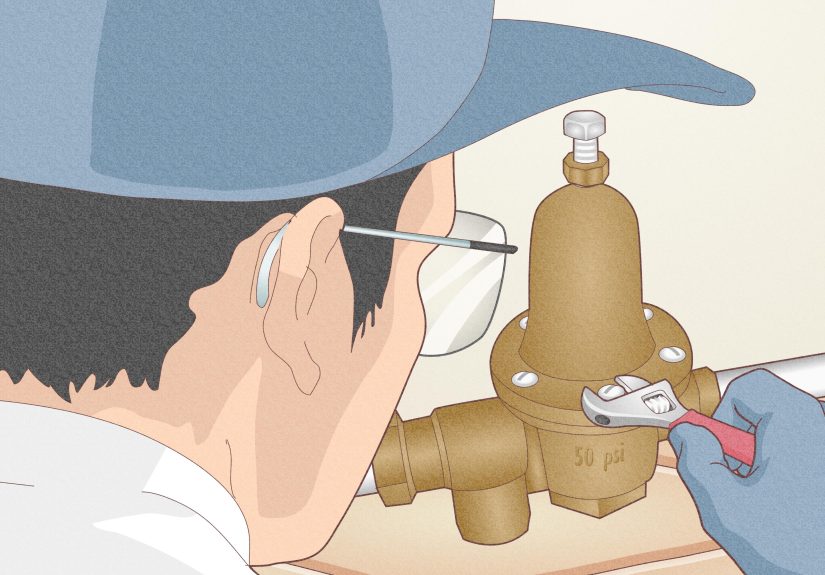
It usually looks like a bell-shaped brass valve with a top adjustment point and a locknut. Some models use a screw, while others use a bolt/nut arrangement. If you do not see one, your home may not have a PRV installed at all.
How to Adjust a Water Pressure Regulator Valve at Home
Here is the step-by-step method most homeowners can use safely. The exact hardware shape varies by brand, but the process is similar.
Step 1: Confirm the Current Pressure
Take a baseline pressure reading with your gauge before touching the valve. Write it down. This gives you a “start point” and helps you avoid guessing later.
Step 2: Locate the Adjustment Mechanism
On top of the PRV, you will usually see one of the following:
- An adjustment screw with a locknut
- A bolt head / adjustment stem with locknut
- A cap that must be removed before adjustment
If your valve has a protective cap, remove it first and set it aside where it will not roll into another dimension (under the water heater).
Step 3: Loosen the Locknut
Use a wrench to loosen the locknut that secures the adjustment setting. You do not need to remove it completelyjust loosen it enough so the adjustment screw or stem can turn.
Step 4: Make Small Adjustments Only
Turn the adjustment point in small increments, then retest pressure.
- Clockwise typically increases downstream pressure.
- Counterclockwise typically decreases downstream pressure.
Start with 1/4 turn at a time. Some valves respond quickly; others are more gradual. Big turns are how people accidentally go from “shower issue” to “why is my toilet hissing like a snake?”
Step 5: Retest With the Gauge After Each Adjustment
After each small adjustment:
- Tighten the adjustment point lightly if needed
- Check the pressure gauge reading
- Repeat until you reach your target PSI (commonly 50–60 PSI)
If you are trying to lower pressure and the gauge does not immediately drop, open a faucet briefly to relieve downstream pressure, then check again. Some systems hold pressure until water is drawn.
Step 6: Tighten the Locknut
Once the setting is where you want it, hold the adjustment screw/stem in place and tighten the locknut so the setting does not drift.
Step 7: Final Test in Real Use
Run a few fixtures:
- Shower
- Kitchen sink
- Bathroom faucet
- Toilet refill
You are looking for a good balance: comfortable flow, no violent splashing, and no obvious pressure spikes. Check again later in the day to confirm the setting remains stable.
How Much Should You Turn the Regulator?
There is no universal “1 turn = X PSI” rule across all PRV models. Some homeowners expect a precise ratio and get frustrated when it is not consistent. Different brands, internal spring ranges, wear level, and incoming pressure all affect response.
A safe approach is:
- Adjust in 1/8 to 1/4 turn increments
- Retest after every adjustment
- Stop when the gauge is in range, not when the handle “looks right”
Common Mistakes to Avoid
1) Adjusting Without a Gauge
This is like baking without measuring cups and then blaming the oven. A pressure gauge is essential.
2) Turning the Wrong Component
Do not confuse the PRV adjustment with nearby shutoff valves, water heater controls, or well system components.
3) Making Huge Turns
Large adjustments can overshoot the target, create unstable pressure, or mask a failing valve.
4) Ignoring a Failing PRV
If pressure will not change, drifts back quickly, or swings unpredictably, the valve may be fouled with debris or worn internally. Adjustment alone will not fix a damaged diaphragm, spring, or seat.
5) Assuming Low Pressure Is Always the PRV
Low pressure throughout the house can be caused by a partly closed main valve, mineral buildup, leaks, municipal supply issues, softener problems, or clogged aerators. Diagnose before replacing parts.
When Adjusting the PRV Does Not Solve the Problem
Sometimes the regulator is not out of adjustment; it is simply at the end of its useful life or blocked internally. Consider these scenarios:
Pressure Stays High Even After Adjustment
- PRV may be stuck or failed internally
- Debris may be preventing proper regulation
- You may be reading pressure upstream instead of downstream
- Thermal expansion may be causing spikes in a closed system
Pressure Is Low Everywhere
- Main shutoff valve not fully open
- PRV set too low
- Failing PRV spring/diaphragm
- Mineral buildup in older pipes
- Municipal supply issue or neighborhood pressure variation
Pressure Fluctuates a Lot
- Normal city demand changes (common at peak use times)
- PRV wear or instability
- Water heater thermal expansion (especially with backflow prevention)
- Well system pressure switch/tank issue (if on private well)
If you suspect thermal expansion, especially after installing a PRV or backflow device, ask a licensed plumber whether an expansion tank is needed. Pressure control and expansion control are related, but they are not the same fix.
Safety and Code Notes Homeowners Should Know
- Many plumbing codes require pressure regulation when supply pressure exceeds 80 PSI.
- A PRV is usually on the homeowner side of the meter and is typically the homeowner’s responsibility.
- If you are uncomfortable working on the main water line, call a licensed plumber.
- If the valve leaks externally after adjustment, stop and schedule service.
- Do not force a stuck adjustment screw; you can strip it or crack older parts.
DIY adjustment is reasonable for many homeowners, but replacement, major repairs, or code-related upgrades are good jobs for a proespecially if your system includes backflow prevention, expansion tanks, booster pumps, or older piping.
Quick Example: A Practical Adjustment Scenario
Let’s say your hose-bib gauge reads 88 PSI at night and 78 PSI during the day. You notice faucet splashing and a washing machine hose that recently started weeping. You locate the PRV near the main shutoff in the garage.
- Baseline reading: 88 PSI
- Loosen locknut
- Turn adjustment screw counterclockwise 1/4 turn
- Open a faucet briefly, close it, recheck gauge
- Gauge drops to 74 PSI
- Repeat in small increments until gauge reads 58 PSI
- Tighten locknut and retest shower + kitchen sink
Result: smoother flow, less splash, and lower stress on fixtures. That is a great outcome for a small amount of effort.
Final Thoughts
Learning how to adjust a water pressure regulator valve at home is one of those skills that feels surprisingly empowering. It is not glamorous, and no one will post your locknut technique on social media, but your pipes, appliances, and utility bill may thank you.
The key is simple: measure first, adjust slowly, retest often. If the PRV responds and pressure stabilizes, you are done. If it does not, that is valuable information tooit means the next step is repair or replacement, not more random turning.
Extended Experience Notes (500+ Words): Real-World Lessons From Homeowners Dealing With PRV Adjustments
One of the most common real-life stories goes like this: a homeowner starts noticing “weirdly aggressive” water pressure after moving into a different neighborhood. The shower feels powerful at first (which seems great), but then little problems begin to stack up. A toilet fill valve gets noisy. A kitchen faucet starts dripping even after a cartridge replacement. A washing machine hose bulges a little more than it should. The homeowner assumes these are unrelated issues, but a pressure gauge test shows the house is sitting at around 90 PSI at night. After a careful PRV adjustment down to the mid-50s, the faucet splash calms down, the toilet becomes quieter, and the homeowner finally stops feeling like the sink is trying to spray the backsplash on purpose.
Another common experience happens in the opposite direction: a homeowner turns the regulator too far while trying to “save water” and ends up with a shower that feels like a polite apology. Dishes take longer to rinse, and running two fixtures at once becomes annoying. This is where having a gaugeand writing down each readingmakes all the difference. In many cases, people discover they overshot the sweet spot and can fix the problem by bringing pressure back up from, say, 35 PSI to around 50–55 PSI. The lesson is not “never adjust the PRV,” but rather “do not make giant turns and hope for the best.”
Homeowners in older houses also report a very specific frustration: they adjust the PRV, but the pressure still feels uneven in only one bathroom or one sink. This often leads to the mistaken conclusion that the regulator “doesn’t work.” In reality, the whole-house pressure may be fine, while a clogged aerator, mineral-packed showerhead, corroded galvanized branch line, or partially closed stop valve is choking flow locally. A useful experience-based habit is to compare multiple fixtures before blaming the PRV. If one bathroom is weak but the hose bib pressure is normal, the issue is likely downstream in that branch or fixture.
A more advanced but very real scenario involves homeowners who install or adjust a PRV and then notice intermittent pressure spikes or a dripping water heater temperature-and-pressure relief line. This can happen when the plumbing system becomes more “closed” and thermal expansion raises pressure after water heating cycles. Many people assume the new regulator is defective when the actual issue is expansion management. In these cases, a plumber may recommend an expansion tank if the system has a backflow preventer or otherwise traps expanding water. The homeowner experience here is important: pressure control is not only about the incoming city pressure; it is also about what happens inside the house after the water is heated.
There are also plenty of success stories from homeowners who make PRV checks part of routine maintenance. They test pressure once or twice a year, especially before winter or after municipal work in the neighborhood. This habit helps catch creeping pressure changes early. Instead of waiting for a hose burst, a leaking ice maker line, or a mysterious drip under a sink, they spot a reading that is drifting and take action. These homeowners often describe the process as “boring but satisfying,” which is honestly the highest compliment in plumbing.
The biggest shared lesson across all these experiences is simple: do not guess, do not rush, and do not force old parts. A pressure regulator valve adjustment is usually a small job, but it sits at the front door of your home’s plumbing system. Treat it with a little respect, use a gauge, make small moves, and you will get better results than the classic DIY strategy of turning things until the noise changes.