Table of Contents >> Show >> Hide
- Why the First Message Matters (and Why “Hey” Usually Doesn’t)
- The Golden Rules of Online Conversation Etiquette
- A Simple First-Message Formula That Works Almost Anywhere
- Conversation Starters That Don’t Feel Cringe
- Examples of Good First Messages (Plug-and-Play)
- What to Avoid in a First Message (Even If You’re Tempted)
- How to Keep the Conversation Going After They Reply
- When (and How) to Suggest Moving to a Call or Meet-Up
- Extra Tips for Adult Dating Apps (18+) Like OkCupid
- Conclusion
- Experiences and Real-World Scenarios: What It Feels Like When It Works (and When It Doesn’t)
Note: Some dating apps (including OkCupid) are intended for adults 18+. The conversation principles below are general, work across many platforms, and focus on respectful communication and safety.
Starting a conversation online can feel like walking onto a stage where the spotlight is a typing cursor. You want to be confident, interesting, and charmingwithout sounding like a spam bot, a job recruiter, or someone who just discovered the “copy/paste” feature and never looked back.
The good news: great first messages aren’t magic. They’re a mix of attention (you noticed something real), clarity (you’re easy to respond to), and kindness (you’re not trying to win; you’re trying to connect). Below is a practical etiquette guide, plus examples you can adapt to your own style so you sound like a human… because you are one.
Why the First Message Matters (and Why “Hey” Usually Doesn’t)
First messages are like movie trailers: they don’t need to tell the whole story, but they do need to make someone want to hit “play.” A single “Hey” often puts all the work on the other person to invent a topic, a tone, and a direction. Some people will respond anyway, but many won’tespecially if they receive lots of messages.
A better opener does one simple thing: it gives them an easy next step. The fastest path to a reply is to ask a question that’s specific, friendly, and answerable without writing a novel.
The Golden Rules of Online Conversation Etiquette
1) Personalizebut keep it light
Personalization doesn’t mean writing a 300-word essay about their favorite band. It means showing you read somethinganythingbeyond their name. One detail is enough.
2) Be respectful and non-demanding
Good energy: “If you’re up for it, what’s your go-to comfort movie?”
Not-so-good energy: “Prove you’re worth my time.”
3) Avoid comments about someone’s body or “hotness”
Even if you mean it as a compliment, it can land as generic, uncomfortable, or too intense for a first message. Compliment something they chose (a hobby, a photo setting, a prompt answer, a playlist, a book) instead of something they can’t control.
4) Keep it short enough to read on a phone
Most people skim. Aim for 1–3 sentences and a question. If the conversation flows, you can go longer later.
5) Don’t interrogate; invite
Rapid-fire questions can feel like a form. Use one question at a time, and share a small detail about yourself too.
6) Match tone and pace
If they reply with one sentence, don’t respond with a six-paragraph memoir. If they’re playful, you can be playful. If they’re more direct, keep it simple.
7) Be mindful about safety and boundaries
Don’t push for personal contact info, location, or private details early. If someone sets a boundary (“I’m not comfortable with that”), respect it immediately. A respectful “No worries!” is surprisingly attractive.
A Simple First-Message Formula That Works Almost Anywhere
If you want a reliable structure, use this three-part opener:
- Observation: Notice something specific (profile prompt, shared interest, vibe from a photo).
- Connection: Relate it to yourself in one line (so it’s not an interview).
- Question: Ask a question that’s easy to answer.
Example:
“Your photo at the farmers’ market is a vibe. I’m a weekend produce wanderer toowhat’s your ‘I can’t walk past it’ item?”
Conversation Starters That Don’t Feel Cringe
Here are openers organized by style. Swap details so they fit your voice.
Profile-Based Openers (Best for Replies)
- “You mentioned you’re learning to cookwhat’s the dish you’re proudest of so far?”
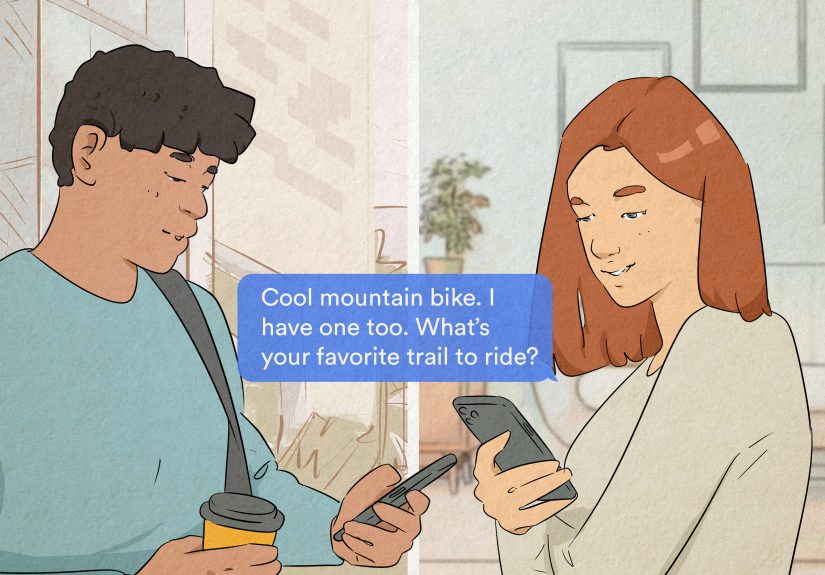
- “You’ve got a photo on a trailwas that a ‘planned hike’ or a ‘wrong turn that became a story’ hike?”
- “Your taste in books looks dangerous (in a good way). What’s the last book you couldn’t stop talking about?”
- “I saw you’re into live musicwhat’s the best concert you’ve been to?”
- “Your travel photo is epic. What’s one place you’d go back to tomorrow if you could?”
Low-Stakes “This or That” Questions
- “Quick vote: pancakes or waffles? This is important for… science.”
- “Are you a ‘coffee first, talk later’ person or a ‘let’s chat immediately’ person?”
- “Team beach day or team mountain air?”
- “Would you rather have a perfect playlist or perfect snacks for a road trip?”
- “Best kind of movie night: comedy, thriller, or ‘I will cry and pretend I’m fine’?”
Playful Openers (Without Trying Too Hard)
- “I’m testing a theory: the best conversations start with a random question. What’s your oddly specific favorite smell?”
- “You seem like someone who has strong opinions on fries. Curly, waffle, or classic?”
- “If your week had a theme song, what would it be?”
- “Important: do you think cereal is a meal or a snack pretending to be a meal?”
- “You get one superpower, but it must be mildly useful. What are you picking?”
Shared-Interest Openers
- “Fellow gym personwhat’s your ‘I don’t want to go but I’m glad I did’ workout?”
- “You like [hobby]. How did you get into it?”
- “I saw you’re into [music genre]. Any artist you’d recommend to someone who’s trying to expand their playlist?”
- “You’re a dog personwhat’s your dream dog (or the dog you’d adopt tomorrow)?”
- “Your profile gives ‘outdoors but also loves a cozy day’ energy. What’s your ideal weekend?”
Examples of Good First Messages (Plug-and-Play)
Use these as templates. The key is to swap in a detail from their profile so it doesn’t read like a mass text.
Friendly and Simple
- “Hi [Name]! I liked your answer about [topic]. What made you choose that?”
- “Your photo at [place/activity] looks funwhat was the best part of that day?”
- “You seem like someone with great taste in weekend plans. What’s your perfect Saturday?”
Confident (Not Cocky)
- “I’m pretty sure we could have a solid conversation about [shared interest]. What’s your top recommendation?”
- “Your profile made me smileespecially the part about [detail]. What’s the backstory there?”
- “You give off ‘good stories’ energy. What’s something funny that happened to you recently?”
Warm Compliments (About Choices, Not Bodies)
- “You have a really friendly vibe in your photos. What’s something you’re excited about right now?”
- “Your sense of humor in your prompts is top-tier. What’s your favorite ‘bad joke’?”
- “I like how you talk about [hobby/goal]. What got you into that?”
What to Avoid in a First Message (Even If You’re Tempted)
1) “Hey” / “Hi” with nothing else
Not eviljust a missed opportunity. Add a simple question and you’re instantly more reply-friendly.
2) Copy-paste paragraphs
Long messages can feel overwhelming, especially early on. Save the deeper stories for laterafter you’ve built a little momentum.
3) Negging, sarcasm that could be misread, or “tests”
Online tone is fragile. If your joke could look rude to someone who doesn’t know you yet, skip it.
4) Sexual comments or intense flirting right away
Many people find this uncomfortable from a stranger. If the conversation becomes flirty later and it’s mutual, greatbut start respectful.
5) Pressure for quick replies
“Why aren’t you answering?” is the fastest way to become the person they don’t answer.
How to Keep the Conversation Going After They Reply
A good first message gets a reply. A good follow-up builds a rhythm.
Use the “Answer + Add + Ask” method
Answer their question (or react to what they said), Add one detail about you, then Ask a new question.
Example:
Them: “I’m a beach day person.”
You: “Samegive me sun and snacks and I’m happy. I’m also the person who always brings extra water like a mini lifeguard. What’s your ideal beach day: relaxing or doing something active?”
Follow the thread they give you
If they mention a hobby, ask about how they got into it. If they mention a place, ask what they loved about it. This shows you’re listening, not just waiting to talk.
When (and How) to Suggest Moving to a Call or Meet-Up
There’s no perfect timeline. A common approach is to move off the app only after you’ve exchanged a few solid back-and-forth messages and the vibe feels comfortable.
Keep it casual and give them an easy “no”:
- “If you’d ever rather chat by call for a few minutes, I’m open to itno pressure either way.”
- “This has been fun. Want to keep talking over a quick coffee sometime? Totally fine if you’d rather message more first.”
Extra Tips for Adult Dating Apps (18+) Like OkCupid
If your audience includes adult-only dating platforms, the same etiquette appliesplus a few extras:
- Be clear about intention: You don’t need a manifesto, but being straightforward (casual dating vs. long-term) can reduce confusion.
- Respect identity and preferences: Use inclusive language, avoid assumptions, and don’t argue with someone’s stated boundaries.
- Lead with curiosity, not evaluation: First messages aren’t auditions. They’re invitations to talk.
- Keep it kind if it’s not a match: Silence happens. If you choose to decline, a brief polite message is better than a lecture.
Conclusion
Starting a conversation online is less about having the perfect line and more about being a person someone feels comfortable replying to. A great opener is short, specific, respectful, and easy to answer. Pick one detail from their profile, connect it to something genuine, and ask a simple question. If you can do that consistently, you’re already ahead of the “hey” crowd.
Experiences and Real-World Scenarios: What It Feels Like When It Works (and When It Doesn’t)
People often imagine online conversation like a single do-or-die moment: you send one message, the universe judges you, and a scoreboard appears. In real life, it’s messierand oddly comforting once you accept it.
Scenario 1: The “I Noticed You” Message
Someone writes, “I saw you mentioned you’re learning guitarwhat are you practicing?” It’s simple, but it lands because it feels like you were actually seen. Most people don’t want a performance; they want recognition without pressure. The conversation flows because the question is easy, and the tone is friendly. Even if the reply is short (“Mostly chords, I’m struggling!”), it gives you a path forward: you can empathize, share a small story, and ask a follow-up.
Scenario 2: The Overcooked Opener
Now imagine the opposite: a message so long it requires a scroll bar, plus a dramatic “I’ve never met anyone like you.” That can feel intense when you haven’t even exchanged hellos. Even if the sender is genuinely kind, the receiver may hesitate because the message suggests expectations: “If I reply, am I signing up for a whole emotional novel right now?” Often, shorter feels safer.
Scenario 3: The Interview Trap
Sometimes conversations stall not because the first message was bad, but because the follow-ups turn into a questionnaire: “What do you do? Where do you live? How many siblings? What’s your five-year plan?” It’s not that curiosity is wrong. It’s that curiosity without warmth can feel transactional. The fix is simple: add little pieces of yourself. “I work in design, which means I’m always noticing fonts in the wild. What kind of work keeps you busy?” That tiny self-detail turns an interview into a conversation.
Scenario 4: The Joke That Didn’t Translate
Humor is greatuntil it isn’t. Online, tone has no facial expression, no voice, no “I’m kidding” smile. A sarcastic opener can read as rude, even if you meant it playfully. If you’ve ever reread a message and thought, “Wait… does that sound mean?” trust that instinct. A safer route is light humor that doesn’t target the other person. Jokes about your own habits (“I’m the person who brings snacks like it’s my job”) usually land better than jokes that could sound like judgment.
Scenario 5: The Slow Reply Spiral
Many people have had the experience of sending a message, waiting, and feeling their brain start writing a tragic movie soundtrack. The truth is: slow replies often have nothing to do with you. People get busy, notifications get buried, and sometimes the timing just isn’t right. The healthiest “experience-based” move is to avoid double-texting with pressure. If you follow up, make it light: “No rushhope your week’s going well. Also, I have to ask: best comfort food?” Then let it be. Confidence is attractive, and calm is even better.
Scenario 6: The Conversation That Clicks
When it works, it feels effortlessbut it’s usually built on small skills: asking a good question, reacting like you actually care, and offering little details about yourself so the other person isn’t carrying the whole chat. The most satisfying conversations tend to have a ping-pong rhythm: one person shares, the other responds and adds, then asks something that keeps the thread alive.
The best part? You don’t need to reinvent yourself to start better conversations. You just need a repeatable approach: notice, connect, ask. Do that, and you’ll consistently sound like the kind of person others want to talk tobecause you make it easy, respectful, and genuinely human.