Table of Contents >> Show >> Hide
- Quick checklist: what you’ll need
- Before you start: 3 rules that prevent “cleaning accidents”
- Step 1: Empty the dishwasher and remove obvious debris
- Step 2: Clean the filter (this is the “secret level”)
- Step 3: Wipe the door gasket and edges (where funk hides)
- Step 4: Check spray arms (because water has to… spray)
- Now choose your cleaning route
- Option A: Clean a Whirlpool dishwasher with vinegar
- Option B: Clean a Whirlpool dishwasher with Affresh
- Troubleshooting: what your dishwasher is trying to tell you
- Maintenance schedule (the low-effort way to stay ahead)
- Hard water: the villain behind “why is everything cloudy?”
- Conclusion: vinegar vs. Affresh (what I’d actually do)
- Real-life experiences: what actually happens when you clean a Whirlpool dishwasher (and what worked)
- SEO tags (JSON)
Your Whirlpool dishwasher works hard. It also collects… souvenirs: invisible grease, detergent residue, tiny food bits,
and hard-water minerals that slowly turn “sparkling clean” into “why does my glass look dusty?”
The good news: you can fix most stink, spots, and sluggish cleaning with a simple routine using either
white vinegar (the pantry MVP) or Affresh (the purpose-built option).
Below is a practical, step-by-step cleaning plan that’s safe, specific, and not weirdly complicated. We’ll cover
how to clean the filter, wipe the gaskets, clear spray arms, and then run either a vinegar cycle or an Affresh cycle.
I’ll also explain when each method makes the most sensebecause “vinegar fixes everything” is a myth
(a delicious myth, but still).
Quick checklist: what you’ll need
- Distilled white vinegar (5% acidity)
- Baking soda (optional, for deodorizing)
- Affresh Dishwasher Cleaner tablets (optional alternative to vinegar)
- Soft toothbrush or small nylon brush
- Microfiber cloth or soft sponge
- Warm water + a little dish soap
- Toothpick (for spray-arm holes)
- Rubber gloves (optional, but your hands may vote “yes”)
Before you start: 3 rules that prevent “cleaning accidents”
1) Don’t mix cleaners
Especially: never combine bleach with vinegar or other acids. That can create toxic chlorine gas.
If you’re using vinegar, stick to vinegar (and maybe baking soda in a separate cycle).
2) Check your model basics
Many Whirlpool dishwashers have a removable filter. Some older models and some designs differ. If you’re not sure,
look up your model’s care instructions and confirm where the filter and spray arms are located.
3) Vinegar is “sometimes,” not “every day”
Vinegar is great at dissolving mineral film and cutting light funk, but frequent acid exposure can be rough
on rubber parts over time in some appliances. Think of vinegar as a periodic helper, not your dishwasher’s full-time job.
If you want a dedicated cleaner designed for dishwashers, Affresh is the safer routine pick.
Step 1: Empty the dishwasher and remove obvious debris
Start with an empty machine. Pull out the bottom rack and look around the drain area for food scraps, labels
(yes, that produce sticker), or a rogue popcorn kernel living its best life.
Wipe the bottom with a damp cloth. If there’s standing water or chunky debris, remove what you can by hand
(gloves help) before doing anything else.
Step 2: Clean the filter (this is the “secret level”)
If your Whirlpool has a removable filter, cleaning it is often the difference between “meh” and “wow.”
A clogged filter can cause bad smells, cloudy glasses, and gritty dishes.
How to clean the Whirlpool dishwasher filter
- Locate it: Usually at the bottom of the tub near the base of the spray arm.
- Remove it: Twist/unlock and lift out (most are designed for tool-free removal).
- Rinse: Run warm water over it to flush loose debris.
-
Brush gently: Use a soft toothbrush/nylon brush with warm, soapy water.
Focus on mesh screens and crevices. - Reinstall: Seat it properly and lock it back in place.
How often? If you run the dishwasher daily or cook a lot, clean the filter about once a month.
If you’ve been blessed with hard water and a chaotic kitchen, you might do it every 2–3 weeks.
Step 3: Wipe the door gasket and edges (where funk hides)
Dip a cloth in warm soapy water and wipe:
- the rubber door gasket
- the inner door edges
- the bottom lip of the door (crumb city)
If you see mildew or grime in folds, use a soft brush. Avoid harsh abrasivesthis area is important for sealing,
and it doesn’t need to be sanded like a deck.
Step 4: Check spray arms (because water has to… spray)
If dishes are coming out dirty, spray arm holes may be clogged by mineral scale or tiny food bits.
Most Whirlpool spray arms can be removed for cleaning (varies by model).
Simple spray-arm cleaning
- Remove the spray arm if your model allows.
- Rinse under warm water.
- Use a toothpick to clear clogged holes.
- Reinstall securely so it spins freely.
Pro tip: If you frequently see chalky residue in the holes, you’re probably dealing with hard water.
(More on that in a minute.)
Now choose your cleaning route
At this point your dishwasher is physically de-gunked. The final step is a cleaning cycle to dissolve film and refresh
the interior. Pick one:
- Vinegar great for mineral haze and light odor
- Affresh designed for limescale/mineral buildup and routine maintenance
Option A: Clean a Whirlpool dishwasher with vinegar
Vinegar works because it’s mildly acidic. That helps loosen detergent film, grease residue, and mineral deposits.
Use it occasionally, not constantly.
Vinegar cycle (Whirlpool-friendly method)
- Make sure the dishwasher is empty.
-
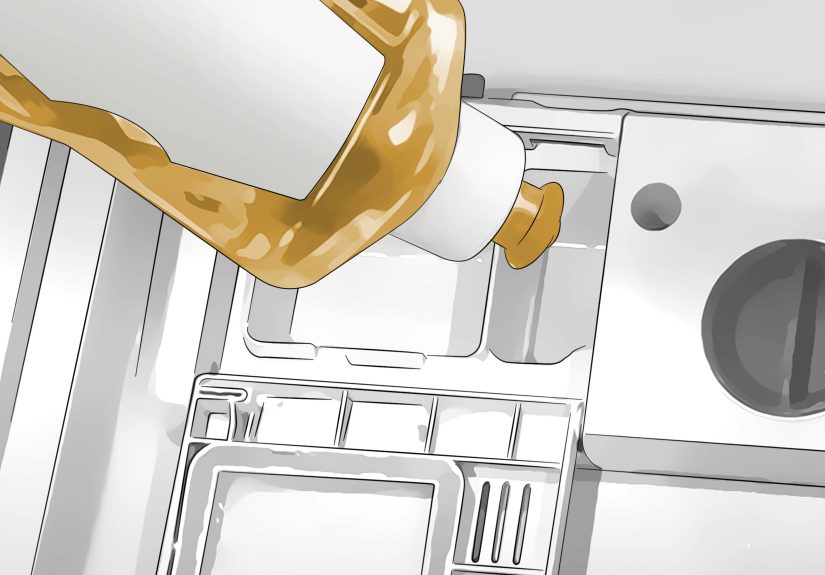
Pour 1–2 cups of distilled white vinegar into a dishwasher-safe container (measuring cup or bowl).
Keep it upright. - Place the container on the top rack (or as your model’s guidance suggests).
- Run the hottest normal or heavy cycle. Skip detergent for this cycle.
- When done, crack the door open for 30–60 minutes so moisture can escape.
Optional “freshen” cycle with baking soda (separate cycle)
If odors linger or you want extra sparkle:
- Sprinkle 1 cup baking soda across the bottom of the empty dishwasher.
- Run a short/hot cycle.
Important: Don’t run vinegar and baking soda in the same cycle. They react and foam,
and you’ll spend your evening cleaning your cleaning project. Iconic, but not recommended.
When vinegar is the best choice
- You notice a light musty odor
- Glassware has a hazy film (especially with hard water)
- You want a budget-friendly clean between deeper maintenance routines
When to skip vinegar
- You’re tempted to do it weekly forever (please don’t)
- Your manual warns against acidic cleaners
- You suspect heavy mineral scale and want a product formulated for descaling
Option B: Clean a Whirlpool dishwasher with Affresh
Affresh Dishwasher Cleaner tablets are formulated specifically to tackle limescale and mineral buildup and are
designed to be safe for the dishwasher’s internal components. If you have hard water or want a consistent,
“set it and forget it” routine, Affresh is the easy win.
Affresh instructions (simple version)
- Remove large food scraps (and ideally clean the filter first).
- Place one Affresh tablet in the bottom of the dishwasher (not the detergent dispenser).
- If you’re washing dishes too, put your detergent in the normal dispenser as usual.
- Run a normal wash cycle (use heated water if available).
- After the cycle, leave the door slightly ajar so the interior dries fully.
When Affresh is the best choice
- You have hard water (white spots, chalky buildup, cloudy glass)
- You want routine maintenance without worrying about acids and rubber parts
- Your dishwasher smells fine but performance has gotten “meh”
How often should you use Affresh?
A good baseline is monthly, especially for hard water or frequent dishwasher use. If you run only a
few loads a week and your water is soft, every 6–8 weeks may be enough. Your dishwasher will tell you:
if glasses are cloudy and the interior looks dull, it’s time.
Troubleshooting: what your dishwasher is trying to tell you
Problem: “My dishwasher smells like a damp gym bag”
- Clean the filter and drain area first.
- Wipe the gasket/door edges.
- Run a vinegar cycle or an Affresh cycle.
- After each load, crack the door open for airflow (especially if your kitchen is humid).
Problem: “White film on glasses (or gritty residue)”
That’s often hard-water minerals. Solutions:
- Use Affresh monthly for descaling.
- Consider a rinse aid to reduce spotting.
- Make sure you’re using a detergent suited for hard water.
Problem: “Dishes still dirty after a cycle”
- Don’t overload; water has to reach surfaces.
- Check spray arms for clogs and free spinning.
- Clean the filter.
- Run hot water at the sink for a minute before starting so the first fill is hot.
Problem: “Standing water at the bottom”
- Remove debris around the drain and filter.
- Confirm the filter is installed correctly.
- If it persists, check your garbage disposal (if connected) and drain hose for clogs.
Maintenance schedule (the low-effort way to stay ahead)
- Weekly: quick wipe of door edges + check for trapped food bits
- Monthly: clean the filter + run Affresh (or a vinegar cycle occasionally)
- Every 2–3 months: inspect spray arms, wipe gasket thoroughly, deep clean racks if needed
Hard water: the villain behind “why is everything cloudy?”
Hard water contains higher levels of minerals like calcium and magnesium. Those minerals can leave deposits in appliances
and reduce detergent performanceso you use more detergent, get more residue, and the cycle continues (literally).
If you live in a hard-water area, a dishwasher cleaner designed to remove mineral buildup (like Affresh) is usually the
most reliable routine. Vinegar can help in a pinch, but a dedicated descaler tends to be more consistent long-term.
Conclusion: vinegar vs. Affresh (what I’d actually do)
If your Whirlpool dishwasher is mildly stinky or has a little haze, a vinegar cycle is a quick refreshjust don’t do it so often
that your dishwasher starts filing complaints with HR.
If you want the simplest, most repeatable methodespecially with hard wateruse Affresh monthly, keep the filter clean,
and wipe the gasket now and then. That combo prevents the most common dishwasher drama: odors, cloudy glassware,
and the “why is there sand on my plates?” mystery.
Real-life experiences: what actually happens when you clean a Whirlpool dishwasher (and what worked)
I’ve noticed most dishwasher problems don’t arrive with fireworksthey sneak in. One week everything is fine, and the next,
your glasses look slightly foggy and the dishwasher has a faint smell that can best be described as “warm aquarium.”
Here are a few real-world-style scenarios that match what people commonly run into, plus what tends to work best.
Experience #1: The “cloudy glasses after a dinner party” moment
After a heavy weekend of cooking (think: baked pasta, creamy sauce, and enough plates to qualify as a ceramics exhibit),
you might notice a white haze on glassware. It’s tempting to blame the detergent immediately, but the usual culprit is
mineral residueespecially if the water is hard. In this situation, cleaning the filter first makes a surprising difference.
The filter often holds onto tiny bits of food and greasy film, and that gunk can recirculate in ways that leave dishes looking dull.
What worked best here: a filter scrub + an Affresh cycle. The tablet approach feels almost too easy, but it consistently lifts the “chalky”
film that vinegar sometimes only partly improves. Then, adjusting routine habitslike using rinse aid and not overfilling the detergent cup
helped keep the glassware clearer between cleanings.
Experience #2: The “smells fine… until you open it” surprise
Some dishwashers only smell bad at the exact moment you open the doorlike the odor was waiting behind the gasket
with a tiny air horn. That’s commonly a mix of moisture + residue in the door seals and the bottom edge of the door.
People deep-clean the tub and forget the edges, which is basically like showering and skipping your armpits. (Please don’t.)
What worked best: wiping the gasket and door edges with warm soapy water first, then running a vinegar cycle.
Vinegar is great for neutralizing light odors when the physical grime is already removed. If the smell comes back quickly,
it’s usually a sign the filter needs more frequent cleaning or that there’s debris near the drain area.
Experience #3: The “dishes still dirty” panic (even with a fancy detergent)
When dishes come out still gritty or with dried-on bits, people often upgrade detergent first. But performance problems are
frequently mechanical: a clogged spray arm hole, a filter that’s overdue, or loading that blocks water flow.
A classic example is a tall cutting board or sheet pan on the bottom rack that stops the spray arm from spinning.
Another is seeds (sesame seeds are suspiciously talented at clogging things) stuck in spray-arm jets.
What worked best: a quick spray-arm inspection, clearing holes with a toothpick, and a filter rinse. After that,
running hot water at the sink before starting the dishwasher improved results noticeably, because the cycle begins with
truly hot water instead of a lukewarm first fill. Once the basics were fixed, then the detergent choice mattered again.
Experience #4: The “vinegar fixed it… but I overdid it” lesson
Vinegar is popular online because it’s cheap and effective. The mistake is turning it into a weekly ritual for months.
Many people get away with it, but some don’tespecially in appliances where rubber seals and hoses take repeated exposure.
The better strategy: use vinegar occasionally as a refresh, and rely on a product designed for the job (like Affresh) for routine descaling,
particularly in hard-water areas.
Bottom line from these experiences: the most reliable results come from a simple combo
clean the filter, wipe the gasket, keep spray arms clear, and run a monthly cleaner cycle.
Whether you choose vinegar sometimes or Affresh routinely, the real magic is consistency.
Your dishwasher doesn’t need spa day energy every week. It just needs you to stop letting the filter become a tiny compost bin.