Table of Contents >> Show >> Hide
- Why Paragraph Endings Matter More Than You Think
- The Anatomy of a Great Paragraph Conclusion
- The 14 Steps to Conclude a Paragraph Like a Pro
- Step 1: Identify the paragraph’s “job” in one phrase
- Step 2: Echo the topic sentence without copying it
- Step 3: Summarize the evidence in a single takeaway
- Step 4: Answer the “So what?” question (briefly)
- Step 5: Connect the paragraph back to the main argument
- Step 6: Use a closing signal (subtle, not dramatic)
- Step 7: Avoid introducing brand-new ideas
- Step 8: Hint at what’s coming next (when needed)
- Step 9: Choose the right concluding sentence type
- Step 10: Use a “key term + meaning” formula
- Step 11: Keep it proportional to the paragraph length
- Step 12: Make the last sentence feel inevitable
- Step 13: Add a touch of style (parallelism, rhythm, or a punchy line)
- Step 14: Read the paragraph aloud and revise for flow
- Concluding Sentence Starters (Use, Don’t Abuse)
- Before-and-After Examples
- Common Mistakes When Ending a Paragraph
- Quick Checklist: A Great Paragraph Ending Should…
- Conclusion
- Experience: What I’ve Learned From Ending Thousands of Paragraphs (And Surviving)
Ending a paragraph is like sticking the landing in gymnasticsyour readers might not clap out loud,
but they’ll definitely notice if you wobble, stumble, and faceplant into the next idea.
A strong paragraph conclusion does three things at once: it closes the point you just made,
it signals what that point means, and it guides the reader forward without yanking the steering wheel.
In this guide, you’ll learn exactly how to conclude a paragraph in a way that feels natural (not robotic),
reads smoothly, and helps your writing sound confidentwhether you’re drafting a blog post, an essay,
a report, or an email that needs to sound like you didn’t write it at 1:58 a.m.
Why Paragraph Endings Matter More Than You Think
Most writers obsess over introductions. Fair. Intros are the “hello.” But paragraph endings are the “got it.”
They’re where the reader decides whether your point made sense, whether it mattered, and whether they’re willing
to keep going. If your final sentence fizzles, your reader subconsciously pausesand not always in a good way.
A good concluding sentence isn’t just a summary. It’s a small moment of clarity: it reminds the reader of the
paragraph’s main idea, shows why the details you gave are important, andwhen neededsets up the next paragraph.
The Anatomy of a Great Paragraph Conclusion
- Closure: It feels finished (no loose ends dangling like headphone wires in a pocket).
- Meaning: It answers “So what?” in a sentence-sized way.
- Momentum: It points toward what comes next without repeating itself.
The 14 Steps to Conclude a Paragraph Like a Pro
Use these steps as a menu, not a mandatory tasting course. Some paragraphs need only a simple wrap-up.
Othersespecially longer onesbenefit from a more deliberate close.
Step 1: Identify the paragraph’s “job” in one phrase
Before you write the last sentence, name the paragraph’s purpose in plain English:
“Explain the benefit,” “prove the point,” “show the downside,” “compare options,” etc.
If you can’t describe the job, your conclusion will probably ramble.
Step 2: Echo the topic sentence without copying it
Your ending should feel connected to your beginning. Reuse a key term or idea,
but swap the phrasing. If your topic sentence is the headline, your conclusion is the mic drop.
Same messagenew delivery.
Step 3: Summarize the evidence in a single takeaway
Don’t re-list every detail. Compress your support into one “therefore” idea. Think:
“Taken together, these examples show…” or “This pattern suggests…” The goal is synthesis, not replay.
Step 4: Answer the “So what?” question (briefly)
The fastest upgrade you can give a paragraph ending: state why the point matters.
If the paragraph explains what, the conclusion hints at why it matters.
Even one short phrase can do the trick: “which is why consistency beats intensity.”
Step 5: Connect the paragraph back to the main argument
In essays, you connect to the thesis. In blog posts, you connect to the main promise of the article.
In business writing, you connect to the goal. Your paragraph shouldn’t feel like a fun side quest
unless you’re writing actual fantasy fiction (in which case, carry on).
Step 6: Use a closing signal (subtle, not dramatic)
Some readers appreciate a gentle “we’re wrapping up” cue:
Ultimately, In short, As a result, That’s why.
Keep it natural. If it sounds like a courtroom speech, dial it back.
Step 7: Avoid introducing brand-new ideas
Your concluding sentence isn’t the place to launch a new argument, add fresh evidence,
or casually introduce a plot twist. If it’s important, it deserves its own paragraph.
If it’s not important… congratulations, you’ve found something to delete.
Step 8: Hint at what’s coming next (when needed)
Not every paragraph must “bridge,” but when the next paragraph changes angle, your last sentence can guide the turn:
“But efficiency isn’t the only factorcost matters too.” That single line reduces reader whiplash.
Step 9: Choose the right concluding sentence type
Pick the ending that fits your paragraph’s job:
- Summary close: Restates the main point with added clarity.
- Significance close: Explains why the point matters.
- Transition close: Sets up the next paragraph’s idea.
- Implication close: Shows a consequence or takeaway.
- Mini-call-to-action close: Suggests what the reader should do/consider next (use sparingly).
Step 10: Use a “key term + meaning” formula
When your paragraph includes a concept the reader needs to remember, end with a short definition or meaning:
“That’s the difference between being busy and being productive.” This makes the idea sticky.
Step 11: Keep it proportional to the paragraph length
A short paragraph doesn’t need a grand finale. One clean sentence is enough.
Longer paragraphs often benefit from a stronger wrap-up because the reader has traveled farther.
Match the weight of the ending to the weight of the paragraph.
Step 12: Make the last sentence feel inevitable
The best paragraph conclusions feel like the only logical next step.
If the ending seems random, it’s usually because the middle didn’t build toward it.
In that case, revise the bodyor choose a conclusion that matches what you actually proved.
Step 13: Add a touch of style (parallelism, rhythm, or a punchy line)
You don’t need to be poetic, but you can be intentional. Parallel structure, a short punchy sentence,
or a clean contrast can make the ending memorable. Just don’t force it. Readers can smell “trying too hard.”
(It’s like too much colognesuddenly the room is about your cologne.)
Step 14: Read the paragraph aloud and revise for flow
Your ear catches what your eyes forgive. If the last sentence sounds clunky,
it probably reads clunky. Smooth it out. Cut extra words. Replace vague language.
Make it clear enough that your reader doesn’t have to re-park their brain to understand it.
Concluding Sentence Starters (Use, Don’t Abuse)
These sentence starters help signal closure and improve coherencejust sprinkle them in naturally:
- To sum up: (best for longer paragraphs)
- In short:
- As a result:
- Ultimately:
- This matters because:
- In other words:
- That’s why:
- Which means:
Before-and-After Examples
Example 1: Weak vs. Strong Paragraph Conclusion
Topic: Why sleep improves learning
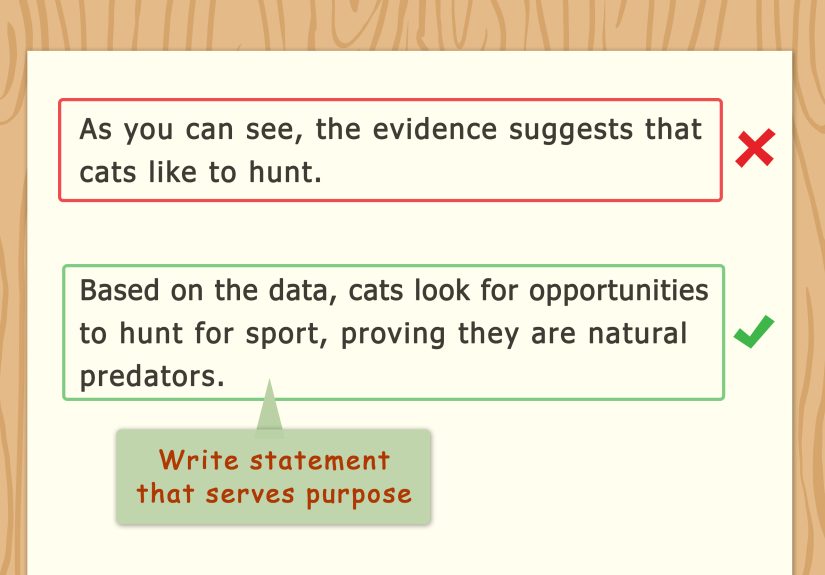
Weak ending (meh):
Stronger ending (clear + meaningful):
Notice what changed: the improved concluding sentence doesn’t just repeat “sleep is important.”
It explains how the evidence matters and gives the reader a takeaway they can remember.
Example 2: A Transitioning Conclusion That Sets Up the Next Paragraph
Topic: Choosing between freelance and in-house designers
That last sentence closes the comparison and tees up the next idea. Smooth handoff. No reader neck brace required.
Common Mistakes When Ending a Paragraph
- Copy-pasting the topic sentence: It feels lazy and adds no value.
- Ending with new evidence: It confuses the reader about what the paragraph was “about.”
- Using filler lines: “This is very important” is not a conclusion; it’s a cry for help.
- Over-explaining: A conclusion should tighten the point, not expand into a new paragraph.
- Ending mid-thought: If your last sentence needs the next paragraph to make sense, it’s not finished.
Quick Checklist: A Great Paragraph Ending Should…
- Remind the reader what the paragraph proved
- Show why it matters (even briefly)
- Feel complete and confident
- Optionally set up what’s next
- Avoid brand-new ideas or evidence
Conclusion
If you want your writing to feel sharper instantly, stop treating the end of a paragraph like an afterthought.
A good concluding sentence is your chance to lock in meaning: echo the main idea, compress the evidence,
answer “so what,” and guide the reader onward. Do that consistently and your paragraphs won’t just end
they’ll land.
Experience: What I’ve Learned From Ending Thousands of Paragraphs (And Surviving)
The first time I really understood how to conclude a paragraph, it wasn’t because I read a rule. It was because
someone stopped mid-page and said, “I’m not lost… but I’m not sure why I should keep reading.” Ouch. Fair. And
incredibly useful.
Here’s what that moment taught me: readers don’t only need informationthey need orientation. When a paragraph ends,
the reader is silently asking three questions: “Did I get it?” “Did that matter?” and “Where are we going next?”
If your last sentence answers even one of those, your writing feels smoother. If it answers two, it feels confident.
If it answers all three, your reader starts trusting you. And trust is the currency of good writingblogs, essays,
sales pages, newsletters, all of it.
In practical terms, the biggest improvement I’ve seen (in my own drafts and in edits for other writers) comes from
swapping “summary endings” for “meaning endings.” Newer writers often end with something like, “This shows X is
important.” That’s technically a conclusion, but it’s not satisfying. A meaning ending goes one notch deeper:
“This is why X matters when you’re trying to do Y.” Suddenly the paragraph feels useful instead of merely accurate.
That one move also helps SEO content, because it naturally adds context and related terms without stuffing keywords.
Another real-world lesson: your conclusion should match your paragraph’s shape. If a paragraph is short,
a long concluding sentence feels like wearing a tuxedo to take out the trash. If a paragraph is longespecially if it
includes examples, statistics, or a multi-step explanationskipping the conclusion can feel abrupt, like a movie ending
right before the final scene. I’ve learned to let paragraph length dictate how much “closing energy” I need.
Finally, the most reliable editing trick I use is painfully simple: I read the last sentence and ask,
“Could this be the end of any paragraph?” If yes, it’s probably too generic. Great conclusions are specific to
the paragraph’s evidence and wording. They reuse a keyword or concept from earlier in the paragraph, then add a final
layer of meaning. That’s why “In conclusion, this is important” dies on the editing table, while
“That consistency is what turns occasional effort into real progress” survives and thrives.
So if you take nothing else from these 14 steps, take this: don’t let your paragraph limp across the finish line.
Give it a last sentence that feels earned. Your reader will feel iteven if they can’t explain whyand they’ll be more
likely to keep going.