Table of Contents >> Show >> Hide
- Pick the Right Leg of Lamb (and the Right Amount)
- Flavor Strategy: Seasoning That Actually Gets Into the Meat
- Gear You Need (and What You Can Fake)
- Know Your Temperatures: The Doneness Map
- Method 1: Classic Roast (High Heat Then Lower Heat)
- Method 2: Slow Roast + Reverse Sear (Ultra-Even Doneness)
- Don’t Skip the Rest (It’s Not Optional, It’s Physics)
- How to Carve Leg of Lamb Without Stress-Sweating
- Pan Sauce or Gravy: Make the Drippings Work Overtime
- What to Serve With Your Feast
- Troubleshooting: Save the Roast (and Your Reputation)
- Leftovers That Don’t Feel Like Leftovers
- Extra Experiences: What Cooking a Leg of Lamb Really Feels Like (500+ Words)
A leg of lamb is the kind of centerpiece that makes a regular dinner feel like a celebration. It’s dramatic, it’s delicious,
and it smells like you hired a professional chefwhen really you just turned on your oven and tried not to panic.
The good news: cooking a leg of lamb is more method than mystery. Get the cut right, season with confidence,
roast to the correct internal temperature, rest it long enough to keep the juices where they belong (inside the meat),
and carve like you mean it.
This guide covers bone-in and boneless legs, classic roasting and reverse-sear options, timing strategies that won’t betray you,
and sauces that turn “nice roast” into “please invite me back.” Let’s cook a feast.
Pick the Right Leg of Lamb (and the Right Amount)
Bone-in vs. boneless
- Bone-in leg of lamb: Classic presentation, great flavor, and the bone can help keep the roast juicy. Carving takes a little more attention.
- Boneless leg of lamb: Easier carving and more even cooking. Often butterflied, then rolled and tied (or sold already tied).
How much lamb per person?
A good rule of thumb is about 3/4 to 1 pound per person for a bone-in leg (because bone weight doesn’t feed anyone),
or 1/2 to 3/4 pound per person for boneless. If you want leftovers for sandwiches, salads, and “I deserve this” midnight bites,
round up.
Flavor Strategy: Seasoning That Actually Gets Into the Meat
Start with salt (your future self will thank you)
If you have time, dry brine by salting the lamb and letting it rest uncovered in the fridge for several hours or overnight.
This seasons deeper and helps the surface dry slightly, which encourages better browning. If you’re short on time,
salt it at least 45–60 minutes before roasting (or right before it goes in the ovenstill worth doing).
Build a “big flavor” rub
Lamb loves bold aromatics. A classic combo is garlic + rosemary + lemon, and it’s classic for a reason: it works every time.
Try one of these approaches:
- Garlic-rosemary paste: minced garlic, chopped rosemary, lemon zest, olive oil, black pepper.
- Mustard-herb coat: Dijon mustard plus herbs and a little olive oil. Mustard helps the crust cling.
- Herb-breadcrumb crust (optional): herbs + breadcrumbs + Parmesan for a savory, crunchy top layer.
- “Secret weapon” add-ins: anchovy (for savory depth), cumin and coriander (warm spice), or fennel (sweet aromatic lift).
Make little flavor pockets
For bone-in legs, use a small knife to cut shallow slits all over the surface and tuck in thin slices of garlic or a dab of herb paste.
Don’t turn it into Swiss cheesejust enough pockets to distribute flavor without drying the roast out.
Gear You Need (and What You Can Fake)
- Meat thermometer: The single best upgrade for lamb success. Guessing is for game shows, not roasts.
- Roasting pan + rack: A rack helps air circulate. No rack? Use thick onion slices, halved lemons, or carrots as a “vegetable rack.”
- Kitchen twine: If your boneless leg is loose or uneven, tie it so it cooks evenly.
- Sharp carving knife: Lamb is tender, but you still want clean slicesno need to wrestle dinner.
Know Your Temperatures: The Doneness Map
For the juiciest leg of lamb, most people prefer medium-rare to medium. Use internal temperature as your compass,
and remember carryover cooking: the temperature can rise several degrees as the roast rests.
Common pull temperatures (then rest)
- Medium-rare: pull around 125–130°F
- Medium: pull around 130–135°F
- Medium-well: pull around 140–145°F
Food safety note: U.S. food-safety guidance for whole cuts of lamb lists 145°F plus a rest time.
If anyone at your table is pregnant, immunocompromised, very young, older, or simply prefers well-done, cook to that guidance.
(You can still keep it tastymore on that below.)
Method 1: Classic Roast (High Heat Then Lower Heat)
This is the “holiday table” approach: a good crust, a tender interior, and a kitchen that smells like you should be charging admission.
It works for bone-in or boneless.
Step-by-step
- Preheat the oven to 425°F.
- Prep the lamb: Pat dry. Salt. Add your rub/paste. Tie boneless lamb if needed so it’s an even shape.
- Set up the pan: Place lamb fat-side up on a rack (or vegetable “rack”). Add a splash of water or broth to prevent scorching drippings.
- Blast for browning: Roast at 425°F for 15–25 minutes to start the crust.
- Lower and finish: Reduce heat to 325–350°F and roast until the thickest part hits your target internal temp.
- Rest: Tent loosely with foil and rest 15–30 minutes. Bigger roasts can rest longer without trouble.
Timing guidelines (but don’t marry them)
At 325°F, many roasts land around 20–25 minutes per pound for medium-rare to mediumbut thickness, shape,
starting temperature, and oven quirks matter. Use time as a plan, and temperature as the truth.
A real-world example: 6-pound bone-in leg
- Season: Salt and herb paste (ideally a few hours ahead).
- Roast: 425°F for ~20 minutes, then 350°F until thermometer reads ~125–130°F for medium-rare.
- Rest: 20–30 minutes.
- Carve + serve: With pan sauce or gravy, plus something green to make the plate look “intentional.”
Method 2: Slow Roast + Reverse Sear (Ultra-Even Doneness)
If you love a consistently pink interior (instead of a wide gray ring), reverse searing is your best friend.
You roast low and slow first, then finish hot for a crisp exterior. This is especially great for a rolled boneless leg.
How it works
- Roast at 275°F until the lamb is about 10°F below your final goal (for medium-rare, think ~120°F).
- Rest briefly while the oven heats to 475–500°F.
- Blast to brown for 10–15 minutes, watching closely to avoid burning your beautiful crust.
- Rest again 15–30 minutes before carving.
This method takes longer, but the payoff is a roast that looks like it came from a restaurantwithout you having to whisper,
“Please don’t be overcooked,” at the oven door.
Don’t Skip the Rest (It’s Not Optional, It’s Physics)
Resting lets the juices redistribute and the temperature settle. Slice too early and you’ll create a cutting board soup.
Tent with foil, keep it warm, and use that time to finish sides, warm plates, and pretend you’re relaxed.
How to Carve Leg of Lamb Without Stress-Sweating
For bone-in leg
- Place the lamb so the bone runs horizontally.
- Find the seam where the meat meets the bone and slice along it to remove large sections.
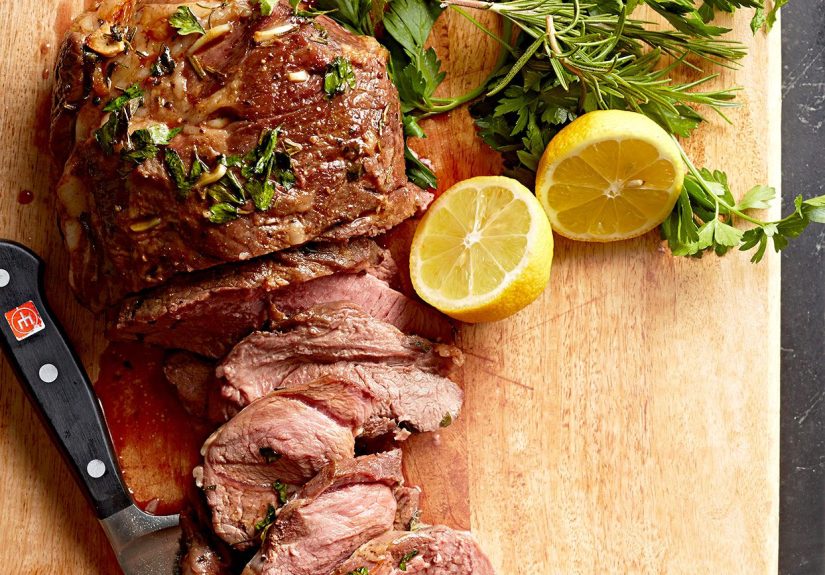
- Slice those sections across the grain into thin slices.
For boneless rolled leg
- Remove the twine.
- Slice into 1/4- to 1/2-inch slices.
- Serve the “end pieces” to the people you like the mostor to yourself, the chef.
Pan Sauce or Gravy: Make the Drippings Work Overtime
While the lamb rests, pour off excess fat, leaving the browned bits. Set the roasting pan over medium heat,
add broth (or a splash of red wine), and scrape up the flavorful fond. Simmer, then thicken if you want:
a teaspoon of flour whisked into a little fat (or a cornstarch slurry) will do the job.
Finish with a squeeze of lemon or a pat of butter for shine.
Quick flavor boosters
- Mint sauce vibes: stir in chopped mint and a tiny splash of vinegar.
- Mediterranean: lemon zest + oregano + garlic.
- Bold and savory: a spoon of Dijon or a pinch of cumin.
What to Serve With Your Feast
Leg of lamb plays well with a lot of side dishes. Aim for one starchy, one green, and one bright element:
- Starchy: roasted potatoes, mashed potatoes, couscous, or buttery rice.
- Green: asparagus, green beans, a big salad, or roasted Brussels sprouts.
- Bright: lemony vinaigrette, salsa verde, pickled onions, or a cucumber-yogurt sauce.
Troubleshooting: Save the Roast (and Your Reputation)
“It’s cooking too fast on the outside.”
Lower the heat and tent loosely with foil. If the outside is browning too quickly, you’re better off finishing gently
than turning the crust into a charcoal audition.
“It’s done… and dinner is in an hour.”
Good news: lamb can rest longer than you think. Tent it, keep it warm, and slice closer to serving.
(If you must hold it, keep the slices in warm drippings or a little broth so they stay juicy.)
“It’s overcooked.”
First: you’re not doomed. Slice it thin, spoon pan sauce over the top, and serve with something creamy or saucy
(mashed potatoes, yogurt sauce, gravy). Also, bookmark “thermometer” for next timeit’s the real hero here.
“It tastes too ‘lamb-y.’”
Strong lamb flavor is often more noticeable when lamb is cooked further toward well-done.
For a milder experience, aim for medium-rare, use bright flavors (lemon, herbs), and consider a mustard-herb crust or
a salsa verde to balance richness.
Leftovers That Don’t Feel Like Leftovers
- Lamb sandwiches: warm slices + arugula + yogurt sauce or mustard.
- Shepherd’s-pie-inspired skillet: chopped lamb + gravy + mashed potatoes on top.
- Grain bowl: lamb + couscous + cucumbers + feta + lemon dressing.
- Breakfast flex: lamb hash with potatoes and a runny egg (bragging rights included).
Extra Experiences: What Cooking a Leg of Lamb Really Feels Like (500+ Words)
Cooking a leg of lamb tends to come with a specific emotional arcone that many home cooks recognize the moment the roast
hits the pan. It often starts with confidence (“I’ve got this”), moves quickly into suspicion (“Is it supposed to look like that?”),
and ends in pride (“I should host holidays now”). One of the most common experiences is the seasoning moment,
when you realize lamb isn’t shy. This isn’t the time for a single pinch of salt and a polite sprinkle of pepper. Lamb wants bold:
garlic that doesn’t apologize, herbs that smell like a garden, and enough salt to make the flavor pop. A lot of cooks remember
the first time they used a mustard-herb coating and saw how it helped create a crust that looked genuinely restaurant-level.
Another classic experience is the thermometer awakening. Plenty of people begin their lamb journey by relying on
timing aloneminutes per pound, confident math, crossed fingers. Then they cook one roast that finishes early, or stalls forever,
or somehow does both, and they discover the truth: a thermometer is less a tool and more a lifestyle. Once you’ve watched the
internal temperature climb, slow down, and finally land right where you want it, it’s hard to go back to guessing. There’s also
a strangely satisfying moment when you pull the lamb a few degrees early and trust carryover cooking to finish the job. It feels
like culinary wizardry, but it’s just heat doing what heat does.
The resting period is its own emotional event. You’ll be tempted to carve early because the kitchen smells incredible,
your sides are ready, and someone is hovering in the doorway “just checking.” Many cooks learnsometimes the hard waythat resting
isn’t optional. The first time you wait, carve, and see slices stay juicy instead of flooding the cutting board, you understand why
every good roast tutorial insists on it. A useful “experience-based” tip: use that rest time to warm your serving platter, finish your
sauce, and set the table. It transforms waiting from “ugh” into “I’m on top of this.”
Then comes carvingoften the most intimidating part for first-timers. With bone-in legs especially, the experience is less about perfect
deli slices and more about finding the natural seams. Most home cooks get noticeably better after the first attempt because lamb practically
teaches you where it wants to come apart. A fun observation: people also learn quickly that the end pieces (the crusty,
well-seasoned edges) disappear first. If you’re hosting, consider carving a few slices and then leaving the rest as a “carve-as-you-go”
centerpiece. It stays warmer, it looks impressive, and it gives you an excuse to wander back to the kitchen for “quality control.”
Finally, there’s the afterglow: the realization that leg of lamb is not an everyday roast, but it’s also not a once-in-a-lifetime challenge.
Once you’ve done it, you start imagining variationsGreek-style with lemon and oregano, a fennel-forward rub with salsa verde, or a slow roast
with a final blast of heat for crackling edges. Many cooks say the biggest surprise is how flexible lamb is: it can be elegant for a holiday,
casual for a Sunday dinner, and downright genius as leftovers. And yesif you nail it once, you may find yourself volunteering to cook it again,
which is either a sign of growth or a sign you enjoy receiving compliments. Possibly both.