Table of Contents >> Show >> Hide
- Birdhouse vs. Nesting Box: Same Idea, Different Label
- Where to Hang a Birdhouse for the Best Results
- Best Mounting Methods for a Birdhouse or Nesting Box
- How to Hang a Birdhouse and Mount a Nesting Box: Step-by-Step
- Species-Specific Placement Examples (Quick Reference)
- Maintenance and Monitoring Without Being “That Neighbor”
- Troubleshooting: Why Birds Still Aren’t Using the Box
- Common Backyard Experiences With Birdhouse Hanging and Nest Box Mounting (Extended Practical Notes)
- Conclusion
If you’ve ever hung a birdhouse, stepped back proudly, and then watched birds completely ignore it for weeks… welcome to the club. Birds are adorable, but they are also extremely picky real estate shoppers. The good news? A well-placed birdhouse or nesting box can work beautifully when you match the box, the location, and the mounting method to the species you’re trying to attract.
This guide breaks down exactly how to hang a birdhouse and mount a nesting box the right waywithout turning your backyard into a wind tunnel, predator buffet, or tiny bird condo in the wrong neighborhood. We’ll cover the best height, direction, spacing, mounting methods, safety upgrades, and species-specific examples so your nest box setup actually has a chance of becoming occupied.
Birdhouse vs. Nesting Box: Same Idea, Different Label
In everyday conversation, people often use birdhouse and nesting box interchangeably. That’s totally fine. In birding circles, “nest box” usually refers to a box designed with species-specific dimensions, ventilation, drainage, and monitoring access.
In other words: a decorative birdhouse can be cute, but a nesting box is built like a functional starter home.
Start with the Right Expectation
Not every backyard bird uses birdhouses. Cavity-nesting species are the main customers here, including birds like bluebirds, chickadees, wrens, nuthatches, tree swallows, and some owls or ducks (with much larger boxes). If you’re hoping a cardinal moves in, your birdhouse may sit empty because cardinals usually don’t nest in cavities.
The biggest rule of success is simple: right bird, right house, right place. If the entrance hole, box size, habitat, and placement are off, birds may pass on your listing.
Where to Hang a Birdhouse for the Best Results
Birdhouse placement matters as much as the box itself. Think of placement as the combination of habitat, direction, sunlight, wind, and privacy.
1) Match the Habitat to the Species
This is the part many people skip. A bluebird box in dense woods is like opening a beach resort in a parking garage. Even a perfect box won’t help if the surrounding habitat is wrong.
- Bluebirds: Prefer open or semi-open areas such as field edges, orchards, pastures, or large yards with scattered trees.
- Chickadees: Usually prefer wooded areas, forest edges, or yards with mature trees.
- Tree swallows: Often do best in open areas, especially near water.
- Wrens: Commonly use boxes near gardens, shrubs, and brushy cover.
Before you mount a nesting box, ask: “Does the bird I want actually nest in this kind of spot?” That one question can save you an entire season of confusion.
2) Face the Entrance Away from Harsh Wind and Afternoon Heat
In many regions, a birdhouse entrance facing east, northeast, or southeast works well because it can catch gentler morning sun while avoiding the hottest late-afternoon sun and prevailing winds. There is some regional variation, so local conditions matter, but this is a strong starting point.
A practical rule of thumb: avoid a west-facing entrance if it gets blasted by hot afternoon sun. Baby birds are small; they do not need a sauna.
3) Choose a Protected, Low-Traffic Spot
Birds want a location that feels safe. Place the box where adult birds can approach and leave easily, but where there isn’t constant human, pet, or feeder traffic.
- Avoid placing nest boxes directly beside busy patios or doors.
- Keep birdhouses away from areas where cats lounge or jump.
- Don’t place a nest box too close to bird feeders if there’s lots of activity and commotion.
4) Give Multiple Boxes Enough Space
Many nesting birds are territorial. If you mount several boxes too close together, birds may fight over themor simply avoid them.
General spacing depends on species, but a good backyard rule is to avoid crowding. Some sources suggest spacing many small birdhouses at least 25–50 feet apart, while bluebird boxes are often placed much farther apart (for example, around 100 yards / 300 feet) unless paired strategically for bluebirds and tree swallows.
Best Mounting Methods for a Birdhouse or Nesting Box
There are four common ways to mount a birdhouse: pole, tree, building/fence post, and hanging. Each can work, but they are not equally bird-friendly.
Pole Mounting (Usually the Best Option)
If you’re wondering how to mount a nesting box for safety and monitoring, pole mounting is usually the top choice. Smooth metal poles (or conduit/PVC setups) are often preferred because they’re stable and easier to equip with predator guards like baffles.
Why pole mounting works so well:
- Better stability than freely swinging boxes
- Easier to add a predator baffle
- Easier height control
- Easier seasonal cleaning and monitoring
Tree Mounting (Common, but Often Less Ideal)
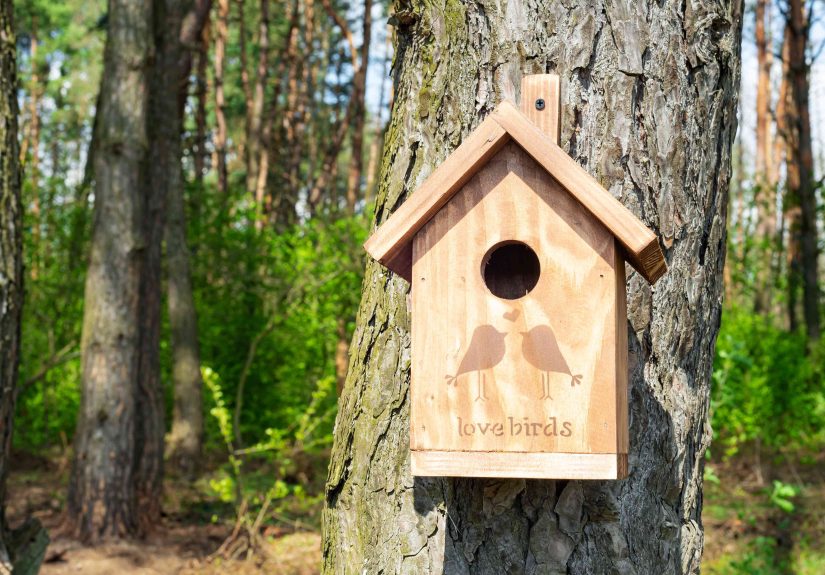
Mounting a birdhouse to a tree trunk is popular because it looks natural, but trees also make climbing access easy for raccoons, snakes, squirrels, and other predators. If you use a tree, predator protection becomes even more important.
Also, try not to damage the tree. Use tree-safe mounting methods when possible and avoid strangling growth with tight wire around the trunk.
Fence Posts and Buildings (Can Work in the Right Setting)
Some species will use boxes on posts, under eaves, or attached to structures. The main considerations are still the same: correct height, habitat, entrance direction, and predator control.
For example, wrens may use boxes under eaves, while open-country species such as bluebirds often do better on poles in open habitat rather than attached to a busy building wall.
Hanging a Birdhouse (Use Carefully)
Yes, you can hang a birdhousebut stability matters. Freely swinging birdhouses are often less attractive to many nesting birds. If you hang one, use a short chain and place it in a sheltered location where wind won’t turn it into a tiny amusement-park ride.
If your goal is maximum occupancy rather than “looks charming in a photo,” choose a mounted box over a freely hanging one.
How to Hang a Birdhouse and Mount a Nesting Box: Step-by-Step
Step 1: Pick a Target Species
Don’t start with the box you bought on impulse because it matched your patio cushions. Start with the bird species you realistically have in your area, then choose or build a box with the correct dimensions and entrance hole size.
Step 2: Confirm the Box Is Functional
Before installation, make sure the nest box has:
- Proper entrance hole size for your target bird
- Drainage holes in the floor
- Ventilation near the top
- A sloped roof or overhang to shed rain
- An opening side or top for cleaning/monitoring
- No exterior perch below the entrance
Birds don’t need a perch, but predators and invasive competitors may appreciate one. Don’t furnish the problem.
Step 3: Select the Right Location
Match habitat, reduce traffic, avoid pesticide-heavy areas, and make sure the flight path to the entrance is reasonably open. If the birds can’t comfortably approach the box, they may skip it.
Step 4: Set the Correct Height
There is no single “perfect birdhouse height” because different species prefer different ranges. But for many small backyard cavity nesters, 5 feet or higher is a practical baseline, with common ranges often running roughly 5–15 feet depending on species.
Examples (always verify for your target bird):
- Bluebirds: Often around 3–6 feet or 5–10 feet depending on source and conditions; many people mount around eye level for monitoring.
- Chickadees: Commonly around 5–15 feet.
- Tree swallows: Often placed on posts in open areas, around 4–15 feet depending on habitat and local guidance.
- Kestrels/owls: Much higher, often 10–30 feet or more depending on species.
Step 5: Mount It Securely
Whether you use a pole, post, tree, or structure, the box should be secure enough to handle wind and weather without wobbling, tilting, or slipping. A loose nest box can stress adults and may cause nest failure.
Mount the box so it is level or slightly tilted forward (never backward), which helps rain drain away from the entrance.
Step 6: Add Predator Protection
This is one of the biggest upgrades you can make. Predator guards and baffles can improve nest success. Common options include:
- Stovepipe baffle on a pole
- Cone baffle below the box
- Entrance hole guard/extender to reduce reach-in predation
- Metal hole plates to prevent enlargement by woodpeckers or squirrels
If you only change one thing this season, make it this one.
Step 7: Wait Patiently (Seriously)
Birds may not move in right away. Sometimes it takes a seasonor longerfor birds to discover and accept a new box. An empty birdhouse in week two is not a failure. It’s just a slow-open house.
Species-Specific Placement Examples (Quick Reference)
These are practical examples to help you visualize what “good placement” looks like. Exact dimensions and heights vary by region and species, so always use a species-specific chart for your local birds.
Bluebird Nest Box Example
- Location: Open field edge, pasture, orchard, or large yard
- Mounting: Pole preferred, with baffle
- Height: Commonly around 5–6 feet (or similar eye-level range)
- Orientation: Often east/northeast, away from prevailing wind
- Spacing: Often much farther apart than general small boxes (around 100 yards / 300 feet is common guidance)
Chickadee Nest Box Example
- Location: Wooded edge or yard with mature trees
- Mounting: Pole or tree (predator protection strongly recommended)
- Height: Often 5–15 feet
- Special note: Some guidance recommends a little wood shavings/chips for certain species and box styles
Tree Swallow Box Example
- Location: Open area, often near water
- Mounting: Post or pole in open flight path
- Height: Often mid-range placement (varies by source and habitat)
- Spacing: Can vary; swallows are sometimes more tolerant of nearby boxes than many species
Wren Box Example
- Location: Garden edge, shrubs, brushy yard, or near cover
- Mounting: Post, tree, or sheltered spot (including some eave placements)
- Height: Often 5–10 feet
- Note: Wrens can be bold little tenants once they approve the address
Maintenance and Monitoring Without Being “That Neighbor”
A good nest box is not a “set it and forget it” project. It needs occasional checks and seasonal care.
During Nesting Season
- Monitor from a distance when possible.
- If you check the box, be gentle and brief.
- Avoid repeated disturbance, especially during cold, wet, or very hot conditions.
- Watch for predator activity or invasive species pressure.
Some bluebird guidance recommends weekly monitoring, but the right frequency depends on species, local guidance, and your ability to do it responsibly.
After the Season
- Open the box and remove old nesting material.
- Inspect for loose screws, leaks, cracks, or wasp nests.
- Clean and dry the interior before the next season.
- Replace wood shavings/chips if the target species needs them.
Bonus tip: A box that opens easily for maintenance is easier to keep in service for years. Your future self will thank you in late winter.
Troubleshooting: Why Birds Still Aren’t Using the Box
The Box Is in the Wrong Habitat
This is the most common issue. If the surrounding yard doesn’t match the species’ nesting preferences, the box may stay empty no matter how nice it looks.
The Entrance Hole Size Is Wrong
Too big can invite competitors or predators. Too small can exclude the target species. Entrance size should be exact, not “close enough.”
The Box Is Too Hot, Too Exposed, or Too Busy
Boxes facing harsh afternoon sun, strong wind, or constant human/pet traffic can be less attractive. Repositioning can make a huge difference.
The Box Is Too Wobbly
If the box swings or rattles in wind, many birds will reject it. Stability is not optional.
It’s Just Too New
Sometimes the answer is simply patience. Birds may take a while to find a new nesting box, especially if natural cavities are still available nearby.
Common Backyard Experiences With Birdhouse Hanging and Nest Box Mounting (Extended Practical Notes)
Here’s the part most how-to articles skip: what actually happens after you mount the box. In real backyards, birdhouse success often comes from a few rounds of trial, observation, and small adjustments rather than one perfect installation on day one.
A very common experience is that the first location feels “obviously right” to the homeowner and “absolutely not” to the birds. For example, many people mount a birdhouse near a patio because they want a good view. Then they realize the grill, the back door, the dog, and the kids’ soccer ball have basically turned the nesting area into a busy airport. Moving the box just 20–30 feet to a quieter edge of the yard can completely change the outcome.
Another frequent experience: the box gets inspected, but not occupied. People will see a bird perch nearby, peek into the entrance hole, and then disappear for days. That’s normal. Birds often investigate multiple sites before choosing one. This “window shopping” phase can be surprisingly long, and it doesn’t mean your setup failed. In fact, inspection activity is usually a good sign that your box is at least on the shortlist.
Wind is another lesson that shows up fast. A box that seemed stable while installing may wobble noticeably after the first storm. Homeowners often report better results after adding a stronger bracket, tightening screws, shortening a hanging chain, or switching from hanging to pole mounting. The difference is dramatic: once the box stops moving like a porch lantern, birds are more likely to commit.
Predator protection is the “I wish I had done this sooner” upgrade. Many people only add a baffle after seeing a squirrel or raccoon investigate the pole. Installing predator guards from the start usually saves stress later. The same goes for removing decorative perches. They may look cute, but the birds do not leave five-star reviews for them.
People also learn that height is a balancing act. Mounting too high can make monitoring and cleaning hard, which means the box may be neglected. Mounting too low can increase predator risk. A practical, species-appropriate eye-level setup often works well because it encourages regular maintenance without turning every check into a ladder event.
One more real-world pattern: the “wrong” bird may move in first. Maybe you hoped for bluebirds and wrens show up, or tree swallows claim the box before anything else. That doesn’t necessarily mean the box is bad. It may mean your habitat favors a different cavity nester. Many successful birdhouse keepers eventually shift from “I must get species X” to “I’ll support the native cavity nesters my yard naturally attracts.” That mindset usually leads to better long-term successand a lot less frustration.
And yes, sometimes nothing happens the first year. Then suddenly, in year two, the box is occupied. This is one of the most common backyard birdhouse experiences of all. The box we think birds ignored may simply have needed better timing, a slight rotation away from wind, a predator guard, or just a full season for local birds to notice it. In birdhouse projects, patience is not just a virtueit’s part of the installation process.
Conclusion
Learning how to hang a birdhouse and mount a nesting box is really about creating a safe, species-appropriate nesting sitenot just putting a wooden box somewhere convenient. Focus on habitat first, then use a stable mounting method (ideally a pole), choose the right height for your target species, face the entrance away from harsh wind and afternoon heat, and add predator protection.
Do that, and your birdhouse becomes more than yard decor. It becomes a useful nesting site that birds may return to season after season. And if they don’t move in immediately? Don’t panic. Adjust, observe, and try again. Backyard birding rewards patient landlords.