Table of Contents >> Show >> Hide
- What Makes a Rock Metamorphic?
- Step 1: Start With Texture, Not Color
- Step 2: Check for Foliation
- Step 3: Notice the Grain Size
- Step 4: Look for Shine, Sheen, or Sparkle
- Step 5: Identify Banding Versus Simple Layering
- Step 6: Test How the Rock Breaks
- Step 7: Figure Out Whether It Is Foliated or Non-Foliated
- Step 8: Use Hardness as a Reality Check
- Step 9: Watch for Mineral Clues
- Step 10: Think About the Parent Rock
- Step 11: Consider the Metamorphic Setting
- Step 12: Put the Clues Together Before Naming the Rock
- Common Mistakes People Make When Identifying Metamorphic Rocks
- A Quick Cheat Sheet for Common Metamorphic Rocks
- Conclusion
- Field Experiences and Real-World Lessons From Identifying Metamorphic Rocks
- SEO Tags
If rocks could talk, metamorphic rocks would probably say, “I’ve been through a lot.” And honestly, they would not be exaggerating. These rocks started life as something else, then got squeezed, baked, buried, bent, and chemically nudged into a whole new identity. The result is a group of rocks that can look elegant, confusing, glittery, striped, sugary, or like they are trying very hard to pretend they are not rocks at all.
Learning how to identify metamorphic rocks is less about memorizing a giant chart and more about spotting a pattern of clues. Texture matters. Mineral alignment matters. Hardness matters. Sometimes the answer is in the sparkle, and sometimes it is in the lack of sparkle. In other words, metamorphic rock identification is part science, part observation, and part resisting the urge to judge a specimen by its color alone.
This guide breaks the process into 12 practical steps, so you can move from “interesting rock” to a much smarter guess. Whether you are studying geology, collecting rocks, hiking in the field, or just trying to tell marble from quartzite without embarrassing yourself in front of a hand lens, this walkthrough will help.
What Makes a Rock Metamorphic?
Metamorphic rocks form when preexisting rocks are changed by heat, pressure, chemically active fluids, or a combination of all three. The original rock, called the protolith, stays solid during the process. It does not melt. Instead, its minerals recrystallize, grow, flatten, rotate, or reorganize into new textures and mineral combinations. That is why metamorphic rocks often look more organized than sedimentary rocks and less bubbly or glassy than igneous rocks.
Before jumping into the steps, keep one idea in mind: texture is usually the fastest route to identification. In metamorphic rocks, texture often tells you more than color ever will. So let’s start where geologists usually start: by looking closely.
Step 1: Start With Texture, Not Color
Color can be helpful, but it is also a notorious trickster. A gray rock can be slate, quartzite, or something that has absolutely no interest in being metamorphic. Texture is the better first clue. Ask yourself whether the rock looks layered, banded, glittery, crystalline, massive, or finely compacted.
Metamorphic textures often fall into two broad camps: foliated and non-foliated. Foliated rocks show some kind of planar fabric, such as thin layers, aligned minerals, or visible banding. Non-foliated rocks do not show that internal alignment. Right away, that split narrows your options dramatically.
Step 2: Check for Foliation
Foliation is one of the classic signs of metamorphism. It happens when pressure acts more strongly in one direction, causing minerals to align perpendicular to that stress. In plain English, the minerals get organized. The rock ends up with layers, planes, or bands that can be subtle or dramatic.
If your sample breaks into flat sheets, shows silky surfaces, sparkly platy minerals, or alternating light and dark bands, you are probably looking at a foliated metamorphic rock. Common foliated examples include slate, phyllite, schist, and gneiss. If the rock looks dense and massive with no visible layering, it may be non-foliated instead.
Step 3: Notice the Grain Size
Grain size helps you estimate metamorphic grade and sort similar-looking rocks. Low-grade metamorphic rocks usually have very fine grains. High-grade rocks tend to have larger crystals and more obvious mineral separation.
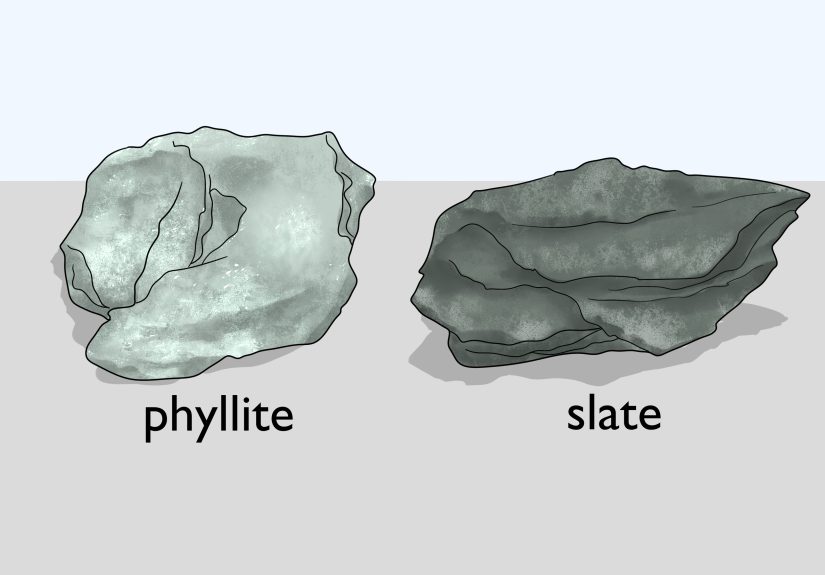
For example, slate is so fine-grained that individual minerals are hard to see. Phyllite is still fairly fine, but it develops a silky sheen. Schist has larger visible mica grains, and gneiss usually has coarse crystals with distinct banding. Think of it like the rock version of turning up the resolution: the higher the metamorphic grade, the more obvious the crystals often become.
Step 4: Look for Shine, Sheen, or Sparkle
This is where your eyes earn their paycheck. Some metamorphic rocks have a dull, matte look. Others gleam like they know they are photogenic. That shine usually comes from mica minerals such as muscovite or biotite.
If the rock has a flat, dull cleavage and splits into thin plates, it may be slate. If it has a satiny or silky shine on wavy surfaces, phyllite is a strong contender. If it looks noticeably sparkly because the mica grains are large enough to see easily, you may be holding schist. In geology, a little sparkle can be a big clue.
Step 5: Identify Banding Versus Simple Layering
Not all layers mean the same thing. Sedimentary rocks often show original bedding. Metamorphic rocks, especially high-grade ones, may show gneissic banding, which is a segregation of light and dark minerals into stripes or bands.
If you see alternating pale and dark mineral bands that look coarse and crystalline rather than sedimentary and crumbly, gneiss should jump high on your list. Gneiss is one of the easiest metamorphic rocks to recognize once you know what to look for. It is basically the overachiever of visible metamorphic texture.
Step 6: Test How the Rock Breaks
Breakage patterns matter. Foliated rocks often split along planes of weakness created by aligned minerals. Slate tends to split into thin, flat sheets. Phyllite may split along wavy surfaces. Schist can break along schistosity planes because its micas are aligned. Gneiss, despite its banding, does not usually split as neatly as slate.
If a rock breaks in a blocky, tough way with no obvious foliation, it may be a non-foliated metamorphic rock such as quartzite, marble, or hornfels. Hornfels in particular can look dense, hard, and fine-grained, often with a blocky or splintery fracture. It is the kind of rock that seems determined to be uncooperative.
Step 7: Figure Out Whether It Is Foliated or Non-Foliated
By now, you should be able to place the sample in one of two buckets.
Common foliated metamorphic rocks
- Slate: very fine-grained, dull, splits into thin sheets
- Phyllite: fine-grained, silky sheen, often wavy foliation
- Schist: medium to coarse-grained, visibly sparkly mica-rich texture
- Gneiss: coarse-grained, light and dark mineral bands
Common non-foliated metamorphic rocks
- Marble: crystalline calcite or dolomite, softer than quartzite
- Quartzite: very hard, fused quartz grains, often scratches glass
- Hornfels: dense, fine-grained, tough, usually formed by contact metamorphism
This simple split solves a surprising amount of the puzzle.
Step 8: Use Hardness as a Reality Check
Hardness is one of the most useful follow-up tests in metamorphic rock identification. Quartz-rich rocks are hard. Calcite-rich rocks are much softer. That matters a lot when you are deciding whether a pale, non-foliated rock is marble or quartzite.
Quartzite is made mostly of quartz, so it is usually very hard and can scratch glass. Marble is made mostly of calcite or dolomite, so it is softer. If a specimen looks sugary and crystalline but feels surprisingly hard, quartzite becomes more likely. If it is softer and easier to scratch, marble moves ahead.
Hardness is not magic, but it is a terrific lie detector for rocks trying to pass as something else.
Step 9: Watch for Mineral Clues
Some metamorphic minerals are excellent hints about what happened to the rock. Micas suggest foliation. Garnet crystals in a schist often point to metamorphism at higher temperatures and pressures than slate or phyllite experienced. Minerals such as staurolite, kyanite, and sillimanite are classic metamorphic indicators in certain rocks.
You do not need to identify every mineral perfectly to make progress. Even recognizing broad categories helps. Platy, aligned mica suggests foliation. Interlocking quartz grains suggest quartzite. Coarse calcite crystals suggest marble. Mineral clues turn a rock from a mystery object into a geological confession.
Step 10: Think About the Parent Rock
Many metamorphic rocks preserve hints of their origin. Knowing the likely protolith can help you narrow the name.
- Shale or mudstone can metamorphose into slate, then phyllite, then schist, then gneiss.
- Limestone commonly metamorphoses into marble.
- Sandstone commonly metamorphoses into quartzite.
- Various fine-grained rocks near magma intrusions can become hornfels.
If the sample still hints at old bedding, sedimentary origin, or a quartz-rich or calcite-rich composition, that history matters. Metamorphism changes rocks, but it does not always erase every breadcrumb.
Step 11: Consider the Metamorphic Setting
There are two broad settings that often leave different fingerprints. Regional metamorphism happens over large areas during mountain building and usually produces foliated rocks because of strong directed pressure. Contact metamorphism happens near hot magma and often produces non-foliated rocks because heat dominates and directional stress may be limited.
So if you have a foliated rock like slate, schist, or gneiss, regional metamorphism is a likely backstory. If you have marble, quartzite, or hornfels with little or no foliation, contact metamorphism may fit better. The setting does not identify the sample by itself, but it adds a useful chapter to the story.
Step 12: Put the Clues Together Before Naming the Rock
Good rock identification is cumulative. Do not base the whole decision on one trait. Use a checklist:
- Is it foliated or non-foliated?
- What is the grain size?
- Does it have sheen, sparkle, or banding?
- How does it break?
- Is it hard like quartzite or softer like marble?
- Do you see index minerals or mica?
- What protolith makes sense?
Once the clues line up, then name the rock. That sequence saves you from the classic beginner mistake of seeing one shiny surface and shouting “schist!” at a rock that turns out to be something else entirely.
Common Mistakes People Make When Identifying Metamorphic Rocks
Mistake one: relying on color alone. Color varies with impurities, weathering, and mineral content, so it is not enough by itself.
Mistake two: confusing sedimentary layering with metamorphic foliation. True foliation usually reflects mineral alignment or recrystallization, not just original deposited layers.
Mistake three: mixing up marble and quartzite. They can look surprisingly similar in hand sample, but hardness and composition help separate them.
Mistake four: assuming all metamorphic rocks are foliated. They are not. Marble, quartzite, and hornfels are important reminders that metamorphism does not always make stripes.
Mistake five: naming the rock before observing the texture. Texture first, confidence later. That is the safer order.
A Quick Cheat Sheet for Common Metamorphic Rocks
- Slate: dull, very fine-grained, flat cleavage, low-grade metamorphism
- Phyllite: silky sheen, fine-grained, wavy foliation
- Schist: visible mica, sparkly, medium to coarse-grained
- Gneiss: coarse-grained, banded, light and dark mineral layers
- Marble: crystalline calcite or dolomite, softer, non-foliated
- Quartzite: very hard, fused quartz, non-foliated
- Hornfels: dense, hard, fine-grained, non-foliated, often contact metamorphic
Conclusion
Identifying metamorphic rocks gets much easier when you stop looking for a single magic feature and start reading the whole rock. Texture, foliation, grain size, sheen, hardness, mineral clues, and parent-rock history all work together. Once you learn that logic, the big categories begin to make sense, and the common names become easier to remember.
The best part is that metamorphic rocks reward patience. At first they seem like a pile of gray, shiny, banded confusion. Then one day you spot slaty cleavage, silky sheen, schistose sparkle, or gneissic banding, and suddenly the specimen introduces itself. That is when rock identification gets fun. Also, yes, “gneiss” is still pronounced like “nice,” which is a small but lasting gift from geology.
Field Experiences and Real-World Lessons From Identifying Metamorphic Rocks
One of the most memorable things about learning how to identify metamorphic rocks is how often beginners change their minds halfway through the process. A rock that looks boring from three feet away can become fascinating the second you hold it in sunlight. Plenty of students first pick up a dull gray sample and assume it is nothing special, only to tilt it slightly and notice a silky sheen racing across the surface. That tiny flash of reflected light is often the moment phyllite stops being a vocabulary word and starts being a real object.
Another common experience happens with schist. In a classroom tray or field bag, it may seem easy enough to recognize. But outdoors, mixed with weathered rocks, mud, dust, and uneven lighting, schist can fool you. Some specimens glitter immediately. Others hide their mica until you rotate them just right. Many people remember the first time they saw garnets embedded in schist because it feels like discovering the rock came with accessories. Suddenly the sample is no longer just shiny. It has visible mineral growth that hints at pressure, temperature, and a deeper geological story.
Quartzite and marble create another classic learning moment. They often look more alike than beginners expect. Both can be light-colored, crystalline, and deceptively elegant. The surprise usually comes when a student learns that one is a quartz-rich tank and the other is a calcite-rich softie by comparison. That contrast tends to stick. People may forget a dozen definitions, but they remember the shock of realizing that two rocks that look like cousins can behave very differently during identification.
Field trips also teach patience in a way that diagrams cannot. On paper, the sequence from slate to phyllite to schist to gneiss looks neat and orderly. In real life, samples can be weathered, fractured, mixed, or altered enough to blur the transitions. That is not failure. That is geology being geology. Rocks do not care that your lab handout wants crisp categories. Learning to identify metamorphic rocks often means learning to work with imperfect evidence and still make a thoughtful interpretation.
There is also a practical satisfaction in noticing how location changes expectation. In mountain belts and regions with deep tectonic history, metamorphic rocks begin to feel more predictable. Once you understand the setting, you start expecting foliation, deformation, and recrystallization. Even before naming a specimen, you get better at asking the right questions. That habit is one of the most valuable skills geology teaches: observe first, interpret second.
For many rock enthusiasts, the real turning point comes when they stop trying to memorize isolated names and start comparing textures. That is when identification becomes less stressful and much more enjoyable. Instead of panicking over whether a sample is slate or phyllite, they ask how fine the grains are, whether the surface has sheen, and how the rock splits. Those small observations build confidence fast. Over time, the process becomes intuitive. You begin to trust your eyes, your hands, and your sequence of clues.
And that may be the best experience of all: realizing that metamorphic rocks are not impossible to identify. They just demand attention. Once you slow down and let the rock tell its story through texture, minerals, and structure, the mystery gets a lot smaller. The rock may still be old, stubborn, and occasionally rude, but at least now it is readable.