Table of Contents >> Show >> Hide
- What “Smart Storage” Really Means in a Small Closet
- Step 1: Empty the Closet (Yes, All of It)
- Step 2: Measure Your Closet (So You Don’t Buy the Wrong Stuff)
- Step 3: Sort by Category Before You Put Anything Back
- Step 4: Build Zones That Fit Your Closet Type
- Step 5: Use Smart Storage Tools That Multiply Space
- 1) Slim, matching hangers (the easiest “instant upgrade”)
- 2) Double-hang rods (when your closet has more height than width)
- 3) Shelf dividers (because stacks love to collapse)
- 4) Matching bins (to hide the “small stuff” without losing it)
- 5) Over-the-door organizers (the closet door is free real estate)
- 6) A slim drawer unit or rolling cart (for folded items and accessories)
- 7) Hooks and wall rails (tiny tools, huge payoff)
- Step 6: Put Items Back Strategically (Hang, Fold, and Store Like a Pro)
- Shoes, Bags, and Accessories: The Usual Trouble-Makers
- Small Closet Organization Mistakes to Avoid
- A Simple Maintenance Plan (So It Stays Organized)
- Quick Smart Storage Checklist
- Real-World Experiences: What Actually Works in a Small Closet (and Why)
- Experience #1: The “I tried bins… and created a bin graveyard” phase
- Experience #2: The “I can’t maintain it” realization (and the fix)
- Experience #3: The “shared closet negotiation” (aka closet diplomacy)
- Experience #4: The “I have plenty of space… but I still can’t find anything” problem
- Experience #5: The seasonal swap that finally makes the closet feel bigger
- Experience #6: The “small upgrade, big difference” surprise
A small closet is basically a tiny studio apartment where your clothes, shoes, and accessories are all
roommatesand none of them signed the chore chart. The good news: you don’t need a bigger closet.
You need a better system. With smart storage (the kind that uses vertical space, door space, and “why is this shelf so empty?”
space), you can make even a cramped closet feel calm, functional, and surprisingly roomy.
This guide walks you through a practical, step-by-step method to organize a small closetplus the storage tools that actually
earn their keep. No gimmicks. No “buy a mansion” solution. Just real-life strategies that make mornings easier and
“I can’t find anything” moments rarer.
What “Smart Storage” Really Means in a Small Closet
Smart storage isn’t about stuffing more into the same space. It’s about matching storage to how you actually live:
what you wear most, what you need quickly, and what can be stored higher or farther away without ruining your day.
In a small closet, “smart” usually means:
- Using vertical space (up high for seasonal items, mid-level for daily use).
- Doubling hanging room (when your closet layout allows it).
- Creating zones so every category has a home.
- Reducing visual clutter so you can see what you own.
- Preventing re-clutter with simple maintenance habits.
Step 1: Empty the Closet (Yes, All of It)
Organizing on top of a mess is like putting a fresh coat of paint on a wall you haven’t cleaned: it looks better for about
nine minutes. Start strong:
- Pull everything outclothes, shoes, bags, random mystery items.
- Wipe down shelves and vacuum the floor.
- Put a hamper or laundry bag nearby (this will matter later, trust me).
Make three piles: Keep, Donate/Sell, Recycle/Trash
The fastest way to organize a small closet is to store less in it. Be honest about what you wear, what fits, and what you
actually like. If you’re stuck, try a simple question: “Would I be happy to wear this tomorrow?”
If the answer is “not really,” it doesn’t deserve premium closet real estate.
Step 2: Measure Your Closet (So You Don’t Buy the Wrong Stuff)
Smart storage starts with measurements. Grab a tape measure and note:
- Closet width, depth, and height
- Rod length and height from the floor
- Shelf height between levels
- Door clearance (so bins and hooks don’t smash into the frame)
This takes five minutes and saves you from the classic mistake of buying bins that are “almost” the right sizealso known as
“future clutter containers.”
Step 3: Sort by Category Before You Put Anything Back
Sorting by category is the secret to a closet that stays organized. Group items like:
- Tops
- Bottoms
- Dresses / jumpsuits
- Outerwear
- Work clothes
- Athleisure
- Shoes
- Bags
- Accessories (belts, scarves, jewelry, ties)
Create a “Prime Real Estate” zone
Your most-used items should live where your hands naturally reachroughly eye to waist level.
Seasonal and rarely used items can go higher or in bins.
The goal is to stop climbing, digging, and recreating the hunger games every morning.
Step 4: Build Zones That Fit Your Closet Type
Most small closets are either reach-in closets (common in bedrooms) or coat closets (often near entryways). The zoning is similar,
but the emphasis changes.
Reach-in small closet zoning (simple and effective)
- Left side: everyday hanging items (tops, work pieces)
- Center: most-used shoes or drawers/bins
- Right side: categories you wear less (formal wear, backups)
- Top shelf: off-season items, bedding, or labeled bins
- Floor: 1–2 shoe rows max, or a slim shelf unit
Coat closet zoning (entryway sanity saver)
- Upper rod: coats and jackets (keep only what you wear now)
- Door space: hooks/pockets for gloves, hats, scarves
- Lower zone: daily shoes, a small bin for dog gear or umbrellas
- Top shelf: seasonal accessories (winter gear in summer and vice versa)
Step 5: Use Smart Storage Tools That Multiply Space
You don’t need twenty gadgets. You need a few high-impact closet organizers that solve common small-closet problems:
not enough hanging space, messy shelves, and accessories that migrate like they’re trying to start a new life.
1) Slim, matching hangers (the easiest “instant upgrade”)
Bulky hangers waste space and make your closet feel packed. Switching to slim, uniform hangers creates more breathing room
and makes the closet look calmer. Bonus: clothes slide less when you use non-slip styles.
2) Double-hang rods (when your closet has more height than width)
If most of what you hang is shirts, blouses, skirts, or folded-over pants, a double-hang setup can nearly double your hanging capacity.
Put shorter items on two levels, and keep one section for longer pieces (dresses, coats).
Renter-friendly option: use a hanging rod extender or a tension rod below the main rod (as long as it’s secure and doesn’t bow).
3) Shelf dividers (because stacks love to collapse)
Stacked sweaters and jeans tend to topple. Shelf dividers keep piles upright and separated by categoryso you don’t pull one hoodie and
trigger an avalanche.
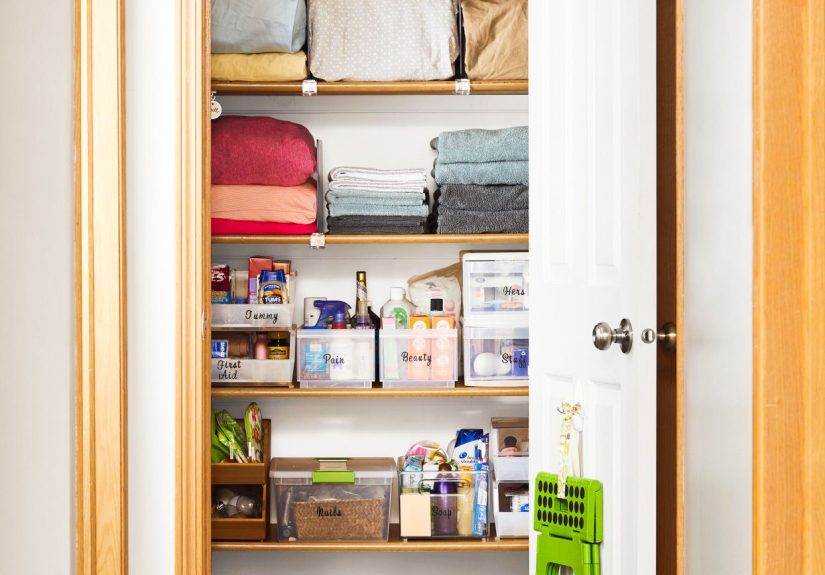
4) Matching bins (to hide the “small stuff” without losing it)
Bins are best when they’re:
- Right-sized to your shelves (measure first!)
- Consistent (matching sizes stack neatly)
- Labeled so you don’t open five bins to find one scarf
Clear bins are great for visibility. Opaque bins are great for visual calm. Choose based on what makes you more likely to stay organized.
5) Over-the-door organizers (the closet door is free real estate)
The back of the door can store shoes, accessories, or daily essentials. Look for:
- Pocket organizers for small items
- Hook racks for bags, belts, and hats
- Narrow baskets for lotions, lint rollers, or hair tools (if your closet is also a getting-ready zone)
6) A slim drawer unit or rolling cart (for folded items and accessories)
If your closet has empty floor space but chaotic shelves, a narrow drawer unit can hold underwear, socks, workout gear, or tees.
Rolling carts work well for small accessories, and they’re easy to pull out when you need them.
7) Hooks and wall rails (tiny tools, huge payoff)
Hooks are perfect for bags, caps, scarves, and tomorrow’s outfit. A small wall rail with hooks can keep frequently used items visible
without taking up shelf space.
Step 6: Put Items Back Strategically (Hang, Fold, and Store Like a Pro)
Hang what wrinklesand what you wear often
Hanging keeps items visible and ready. Prioritize:
- Blazers, dresses, button-down shirts
- Work outfits and uniforms
- Outerwear you actually wear in the current season
Fold what stacks welland store it vertically if you can
T-shirts, jeans, sweaters, and workout clothes often do better folded. If you have drawers, store items “file style”
(upright) so you can see everything at once instead of stacking.
Use “like with like” (and consider color within categories)
First group by category. If you want extra speed, organize within categories by color. It’s not just prettyit reduces the time you spend
hunting for “the black top that isn’t that black top.”
Shoes, Bags, and Accessories: The Usual Trouble-Makers
Shoes: limit what lives in the closet
Shoes are space hogs. Keep only your current-season, most-worn pairs in the closet. Store the rest in labeled bins on the top shelf,
under the bed, or in a separate space.
- Small shoe rack: good for daily pairs
- Stackable clear boxes: good for protecting nicer shoes
- Door shoe organizer: good for flats and sandals
Bags: give them structure so they don’t slump into chaos
Bags collapse and become a pile fast. Try:
- Hooks for everyday bags
- Shelf bins for clutches and small purses
- Stuffing infrequently used bags with soft items to help them hold shape
Accessories: contain them by type
Accessories do best when they’re separated and visible:
- Belts on a belt hanger or hooks
- Scarves on ring hangers
- Jewelry in small trays or drawer dividers
- Hats on wall hooks or a top-shelf bin
Small Closet Organization Mistakes to Avoid
- Keeping “maybe” clothes: if it doesn’t fit or you don’t wear it, it’s taking space from what you love.
- Ignoring vertical space: the top shelf should work for you, not collect dust in silence.
- Buying storage before decluttering: that’s how you end up with expensive containers full of items you don’t want.
- No categories: without zones, everything slowly turns into “miscellaneous.”
- No maintenance plan: a perfect closet with no routine will relapse. Closets are dramatic like that.
A Simple Maintenance Plan (So It Stays Organized)
The 60-second reset
Once a day (or a few times a week), do a quick reset:
- Put stray items back in their zones
- Hang up what belongs on hangers
- Move laundry to the hamper
- Put shoes back on the rack
The “one in, one out” rule
When a new item comes in, a similar item should leave. This prevents your closet from slowly expanding like it pays rent.
Seasonal swap (twice a year)
When seasons change, rotate clothing. Off-season items go in labeled bins up high or out of the closet entirely.
Keep the current season in the prime zone.
Quick Smart Storage Checklist
- Slim matching hangers
- One double-hang section (if possible)
- Shelf dividers for stacks
- Two to four labeled bins for small categories
- Over-the-door organizer for accessories
- Hooks for bags and frequently used items
- A small shoe rack or a dedicated shoe zone
Real-World Experiences: What Actually Works in a Small Closet (and Why)
Here’s the part most “perfect closet” photos skip: real closets are used by real people who are busy, tired, and occasionally
convinced that the floor is a perfectly acceptable storage system. So let’s talk about the lived reality of organizing a small closetwhat
tends to work, what tends to fail, and how to adapt smart storage to your everyday routine.
Experience #1: The “I tried bins… and created a bin graveyard” phase
A common first attempt is buying a bunch of bins and hoping they magically fix everything. The problem is that bins without categories become
“where stuff goes to forget its name.” What works better is using fewer bins with clearer purpose: one for winter accessories,
one for workout gear, one for handbags, one for backups (extra linens, travel pouches, etc.). Labeling helps, but the real win is keeping
categories tight. If a bin starts collecting random items, it’s a sign the closet needs a new zonenot more bins.
Experience #2: The “I can’t maintain it” realization (and the fix)
People often think organization fails because the system wasn’t good enough. More often, it fails because the system takes too many steps.
If you have to open three containers to put away one belt, you’re going to toss it on a shelf. The fix is to make the “put away” step
ridiculously easy: hooks for daily bags, a small tray for jewelry, a hamper that’s actually reachable, and a shoe spot that doesn’t require
Tetris-level precision. In small closets, friction is the enemy. Reduce friction and your closet will behave.
Experience #3: The “shared closet negotiation” (aka closet diplomacy)
When two people share a small closet, organization becomes a peace treaty. The simplest solution is dividing space by
zones and height. For example: one person gets the left rod area and half the shelves, the other gets the right rod area and the
other half. Shared items (like linens or cleaning extras) go in labeled bins up high. Hooks on the door can be splittop hooks for one person,
bottom hooks for the other. The best shared closets aren’t the prettiest; they’re the ones where everyone knows what belongs where, so nobody
“borrows” space by accident.
Experience #4: The “I have plenty of space… but I still can’t find anything” problem
Sometimes the closet isn’t packedit’s just un-zoned. People often store by “where it fits” instead of “what it is.” Smart storage fixes this
by giving every category a home. One real-world trick is creating a “launch pad” spot: a hook or small shelf for items you grab daily
(a hoodie, a gym bag, a belt, a lint roller). This prevents the daily essentials from drifting into random piles. Another helpful habit is the
weekly five-minute reset: return stray items, toss laundry into the hamper, and do a quick scan for anything that doesn’t belong.
Experience #5: The seasonal swap that finally makes the closet feel bigger
The moment many people feel real relief is when they commit to seasonal rotation. Keeping heavy coats, chunky sweaters, or multiple boot styles
in a small closet year-round is like parking an SUV in a studio apartment. When off-season items move into labeled bins on the top shelf (or out
of the closet entirely), daily items suddenly have room to breathe. The closet becomes easier to navigate, outfits are easier to see, and the
overall stress level drops. The trick is simple labeling (“Winter Sweaters,” “Summer Sandals”) so the swap doesn’t turn into a scavenger hunt.
Experience #6: The “small upgrade, big difference” surprise
One of the most consistent “why didn’t I do this sooner?” changes is switching to slim matching hangers and adding a few hooks. It sounds too
basic to matter, but it often does. Slim hangers reduce crowding; matching hangers reduce visual noise; hooks catch bags and accessories before
they hit the shelf. People also report that lighting (even a simple battery-powered stick-on light) changes how they use the closetbecause they
can actually see what’s in it. Smart storage isn’t always dramatic. Sometimes it’s just removing the little annoyances that cause clutter in the
first place.