Table of Contents >> Show >> Hide
- Start With Your “Hand Blueprint” (Yes, You Have One)
- The Most Popular Nail Shapes (And Who They Flatter Best)
- Round: the low-drama, high-flattery option
- Oval: instant “longer fingers,” no magic wand required
- Square: crisp, modern, and unapologetically bold
- Squoval (soft square): the “everyone looks good in this” compromise
- Almond: elegant, lengthening, and slightly “main character”
- Coffin/Ballerina: trendy, tapered, and made for nail art
- Stiletto: dramatic, pointed, and not here to be subtle
- Lipstick (optional): the “fashion editor at 9, grocery run at 10” shape
- Choose Based on Your Lifestyle (Because Your Nails Have a Schedule)
- Choose Based on Nail Strength (Your Nails Aren’t Weak, They’re Just Honest)
- A Simple “Pick Your Shape” Cheat Sheet
- How to Shape Your Nails at Home (Without Turning It Into a Craft Project)
- Nail Health Basics That Make Any Shape Look Better
- Common Problems (And Fixes That Actually Help)
- How to Talk to Your Nail Tech (So You Both Get What You Want)
- Real-Life Experiences: What People Learn After a Few Manicures (About )
- Conclusion: Your Best Shape Is the One You’ll Actually Keep
- SEO Tags
Picking a nail shape sounds like a tiny decisionuntil you realize your hands are basically your personal “close-up camera” all day long.
You wave, you type, you hold coffee, you scroll, you point at menus like you’re directing a very serious documentary about brunch.
The right nail shape can make fingers look longer, nail beds look more balanced, and your manicure look instantly more polishedeven before color or nail art enters the chat.
The secret: the best nail shape for your hands isn’t a universal trend. It’s a match between your natural nail bed, finger proportions,
nail strength, and how you actually live. (If you’re opening soda cans with your nails… we need a separate talk.)
Below is a practical, flattering, and slightly funny guide to choosing a nail shape you’ll love looking atand can actually keep.
Start With Your “Hand Blueprint” (Yes, You Have One)
Before you pick square, almond, or coffin, look at three things: nail bed width, finger length, and your cuticle curve.
These details decide whether a shape will feel effortless or constantly look “off” (like a haircut that only behaves on Tuesdays).
1) Nail bed width: wide, narrow, or “somewhere in the middle”
- Wide nail beds often look most balanced with shapes that soften or taper the sides (round, oval, squoval, almond).
- Narrow nail beds can handle crisp edges and structure (square, squoval, ballerina/coffin) without looking bulky.
- Medium nail beds are the lucky middle children: most shapes can work, so lifestyle becomes the deciding factor.
2) Finger length: short, average, or long
The visual trick is simple: rounded or tapered tips elongate, while flat tips emphasize width.
If you want fingers to look longer, reach for oval or almond. If you love a bold, modern look, square or squoval can look incredibly chicespecially on longer fingers.
3) Cuticle curve: your built-in guide
Your cuticle shape (more rounded vs. flatter) is the “blueprint” for what will look natural. When the nail tip echoes the curve at the base,
everything looks more harmonious. It’s like matching your eyeliner wing to your eye shapetiny detail, big payoff.
The Most Popular Nail Shapes (And Who They Flatter Best)
Let’s break down the classic shapes you’ll actually ask for at a salon. For each one, you’ll get: what it looks like, who it flatters, and how high-maintenance it is.
Round: the low-drama, high-flattery option
What it looks like: A soft curve that follows the fingertip, with no corners to snag.
Best for: Short nails, wide nail beds, and anyone who wants a clean, natural look.
Why it works: No corners means fewer break pointsgreat if your nails are thin or you’re rough on your hands.
Maintenance level: Low. Round is basically the “I have things to do” nail shape.
Oval: instant “longer fingers,” no magic wand required
What it looks like: Like round, but slightly elongatedan egg shape at the tip.
Best for: Shorter fingers or hands you’d like to visually elongate, and nail beds that need softening.
Why it works: Oval gives length without being fragile like super-pointy shapes can be.
Maintenance level: Medium-low. You’ll file more than with round, but it’s still beginner-friendly.
Square: crisp, modern, and unapologetically bold
What it looks like: Straight sidewalls and a flat, sharp tip.
Best for: Long fingers and narrower nail beds; also great if you love a graphic, clean manicure style.
Watch-outs: Corners can catch and chip, especially if nails are weak.
Maintenance level: Medium. It looks best when the edges are precise and symmetrical.
Squoval (soft square): the “everyone looks good in this” compromise
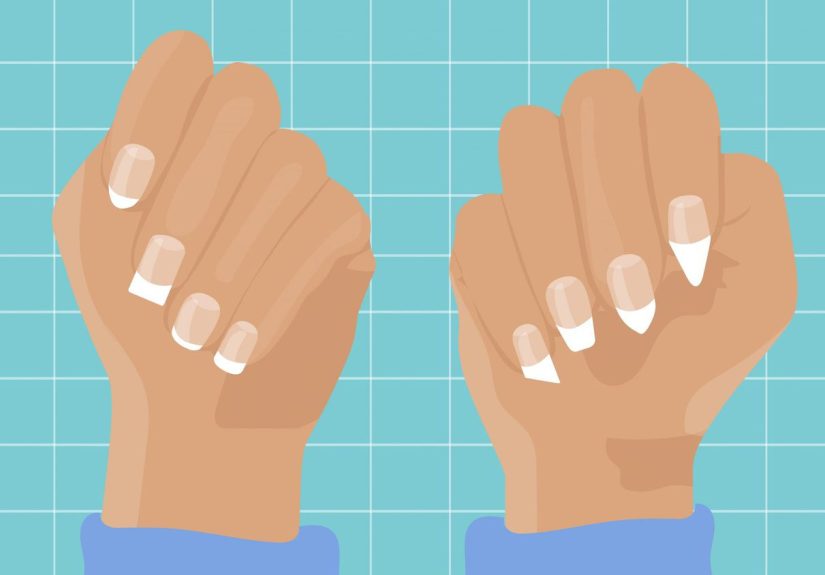
What it looks like: Square with gently rounded cornersstructured but not sharp.
Best for: Pretty much everyone, especially if you want durability and a tidy look.
Why it works: You keep the clean lines of square without the snaggy corners.
Maintenance level: Low-medium. It’s forgiving if you DIY, and it grows out nicely.
Almond: elegant, lengthening, and slightly “main character”
What it looks like: Tapered sides with a soft pointlike an almond (shocking, I know).
Best for: Short fingers, wide nail beds, or anyone who wants a sleek, elongating silhouette.
Watch-outs: Almond needs some length to look right. Very short nails may struggle to taper without looking stubby.
Maintenance level: Medium-high. It’s not hard, but you’ll need consistent filing to keep the taper even.
Coffin/Ballerina: trendy, tapered, and made for nail art
What it looks like: Tapered sides with a flat, squared-off tip (like a ballet slipper).
Best for: Longer nails (often with gel or extensions) and fingers you want to emphasize with a fashion-forward shape.
Watch-outs: Needs strength and length. On weak natural nails, the tip can become a break zone.
Maintenance level: High. Gorgeous, but not a “set it and forget it” shape.
Stiletto: dramatic, pointed, and not here to be subtle
What it looks like: Long, sharp, and very pointed.
Best for: Special occasions, statement manicures, and people who love drama (in nails only, ideally).
Watch-outs: High break risk on natural nails; many people use enhancements for this shape.
Maintenance level: Very high. Also, proceed with caution around tights, sweaters, and your own eyeballs.
Lipstick (optional): the “fashion editor at 9, grocery run at 10” shape
What it looks like: A diagonal, slanted tiplike the top of a lipstick bullet.
Best for: If you want something unique and artsy and don’t mind explaining it at least once per week.
Maintenance level: High. This is best done by a skilled tech if you want it sharp and balanced.
Choose Based on Your Lifestyle (Because Your Nails Have a Schedule)
A nail shape can be flattering and still be wrong for you if it fights your daily life. Be honest about your routines:
are you typing all day, doing hands-on work, caring for kids, lifting weights, cooking constantly, or wearing contact lenses?
If you want “practical but pretty”
- Best picks: round, squoval, short oval
- Why: fewer corners, fewer snags, less breakage, and easy maintenance
If you want “elevated everyday”
- Best picks: oval, almond (medium length), soft square
- Why: elongating shapes that still function in real life
If you want “statement nails”
- Best picks: coffin/ballerina, stiletto, lipstick
- Reality check: you’re choosing vibe over convenienceand that’s valid, just budget time for upkeep
Choose Based on Nail Strength (Your Nails Aren’t Weak, They’re Just Honest)
Your nail strength matters as much as your hand shape. Thin, bendy nails usually do best with rounded shapes that don’t create stress points.
If you’re prone to peeling or splitting, square corners can become break magnets.
Best shapes for weak or brittle nails
- Round (most durable)
- Oval (durable and elongating)
- Squoval (structured but less snaggy than square)
If you love almond/coffin but your nails break
You don’t have to give up on your dream shapeyou may just need a strategy:
keep the length moderate, don’t make the tip too sharp, and consider strengthening routines or a supportive overlay (like builder gel) if you work with a professional.
A Simple “Pick Your Shape” Cheat Sheet
Use this like a quick decision tree when you’re torn between three screenshots and a vibe.
- Want fingers to look longer? Choose oval or almond.
- Have wide nail beds? Choose round, oval, squoval, or almond.
- Have long fingers and narrow beds? Square or coffin can look ultra sleek.
- Breakage is your villain? Choose round or squoval, keep length practical.
- You want trendy + nail art space? Coffin/ballerina is your canvas.
- You want “I mean business” nails? Square or soft square.
How to Shape Your Nails at Home (Without Turning It Into a Craft Project)
You don’t need a salon degree to shape nails wellbut you do need the right approach. The biggest DIY mistake is filing aggressively back and forth until your nail looks like a tiny mountain range.
Slow down. Your future self (and your sweaters) will thank you.
Tools that make it easier
- Nail clippers for removing length evenly
- A quality file (a gentle grit; many pros like mid-range grits for shaping)
- Optional: a glass file for smoother edges, especially if your nails are prone to splitting
The most flattering shaping method: match both hands, not just one nail
- Trim first so all nails start roughly the same length.
- File in small passes, checking symmetry after every few strokes.
- Shape the sides first, then refine the tip. This helps prevent accidental “one nail is almond, one nail is mystery.”
- Compare hands by holding them up togetheryour eyes catch mismatches faster this way.
Quick shaping tips by shape
- Round: file corners down into a smooth curve, following the fingertip shape.
- Oval: taper the sides slightly, then round the tip into an elongated curve.
- Square: file straight across the tip, then straighten the sidewalls.
- Squoval: create a square tip first, then soften the corners just enough that they don’t feel sharp.
- Almond: taper the sides evenly toward the center, then round the point (think “soft peak,” not “dagger”).
- Coffin: taper the sides, then file the tip flatkeep both sides symmetrical, or it will look crooked fast.
Nail Health Basics That Make Any Shape Look Better
Even the perfect nail shape won’t look great if nails are peeling, painfully dry, or constantly breaking.
The good news: small habits make a big difference. Think of it like skincare for your handsless dramatic than a 12-step routine, but still effective.
Respect your cuticles (they’re security guards, not decorations)
Cuticles help protect the area where nails grow. Cutting or aggressively pushing them back can increase irritation and risk of infection.
If you want a cleaner look, hydrate the cuticle area and gently tidy hangnails instead of “removing everything in sight.”
Moisture is not optional
Nails and surrounding skin do better when they’re hydrated. Hand cream plus cuticle oil can reduce dryness and improve the overall look of your manicure.
Cuticle oil isn’t a magic growth potion, but it supports the skin barrier around the nail, which helps keep the area healthier.
Use gloves for chores (your manicure isn’t dishwasher-safe)
Hot water, cleaning products, and constant soaking can leave nails brittle and prone to splitting. A simple pair of gloves can protect nails and help polish last longer.
Also: you’ll feel like a responsible adult, which is a fun bonus.
Don’t use your nails as tools
If you’re prying open packages with your manicure, your nails will eventually respond with consequences.
Use a key, a tool, or the corner of your dignity. Save the nails for looking cute.
Common Problems (And Fixes That Actually Help)
“My nails look crooked after shaping.”
- Check length firstone nail might be longer, making the shape look off.
- File in smaller passes and compare nails side-by-side, not one at a time.
- For tapered shapes, make sure both sidewalls narrow evenly before refining the tip.
“Square nails always break at the corners.”
- Switch to squoval or soft square.
- Keep the length shorter until nails strengthen.
- Ask for a supportive base (like a strengthening base coat or a pro overlay if you get salon services).
“Almond looks weird on me.”
- You may not have enough lengthtry oval first, then graduate to almond.
- Your taper might be too aggressive; soften the point.
- If your nail beds are very short, a subtle oval often looks more natural than a dramatic taper.
How to Talk to Your Nail Tech (So You Both Get What You Want)
The fastest way to get a shape you love is to be specific. Instead of “almond,” try:
“Medium almond, not too pointy,” or “short squoval with soft corners.”
Better yet, describe your lifestyle: “I type all day” or “I’m rough on my nails” helps a tech recommend a shape that won’t betray you by Thursday.
Pro move: say what you don’t want. Example: “I like square, but I hate sharp corners,” or “I want coffin, but not super long.”
Your nail tech is not a mind reader (unless they are, in which case please ask them to predict lottery numbers, not your manicure preferences).
Real-Life Experiences: What People Learn After a Few Manicures (About )
If you’ve ever changed your nail shape and immediately felt like your hands belonged to a different person, you’re not alone.
Here are a few common “salon chair experiences” people run intoshared as typical scenarios you’ll recognize, not as one-size-fits-all rules.
Experience #1: The Square-to-Squoval Conversion. A lot of people start with square nails because the look is clean, modern, and satisfying in the same way a perfectly aligned bookshelf is satisfying.
Then reality arrives: corners snag on hair, corners chip, corners catch on pockets, corners start to look like they survived a tiny bar fight.
The “aha” moment is switching to squoval. You keep the structured look, but the softened corners stop acting like little hooks.
People who type all day often describe squoval as the first shape that looks polished and behaveslike the adult version of “fun but responsible.”
Experience #2: Oval is the “I didn’t know my fingers could look like that” surprise. This is especially common for anyone with shorter fingers or wider nail beds who has always assumed they’re stuck with one look.
The first time someone tries oval (even at a modest length), they often notice their hands look more elongated in photos and in motion.
It’s not that oval is “better”it’s that the curved, slightly extended tip creates a visual line that can make the whole hand look more streamlined.
The funny part is how quickly oval becomes a default: people try it for a wedding, a trip, or “just to see,” and then suddenly every future manicure request becomes,
“Can we do that same shape again?”
Experience #3: Almond confidence… plus an adjustment period. Almond nails have that elegant, slightly glamorous vibe that makes even a plain nude polish look intentional.
But the first few days can be an adjustment. People often realize they do more “tiny fingertip tasks” than they thought: digging a card out of a wallet, opening soda tabs,
peeling stickers, popping open a stubborn key ring. Almond doesn’t make these impossible, but it changes how you approach them.
Many people end up choosing a moderate almondsoft point, not super longbecause it keeps the flattering effect without turning daily errands into a competitive sport.
Experience #4: The “Statement Nails vs. My Actual Life” negotiation. Coffin and stiletto shapes look incredible, especially with bold nail art.
But in real life, people often discover they need a support system: stronger products, more frequent fills or reshaping, and a willingness to baby their hands a bit.
The takeaway isn’t “don’t do it”it’s “do it with eyes open.”
A common compromise is saving dramatic shapes for vacations, events, or times when you want that extra sparkle, while keeping a round, squoval, or short oval shape for everyday life.
In other words: have a “weekday nail shape” and a “weekend nail shape,” like shoes.
Ultimately, the best nail shape for your hands is the one that makes you look down at your manicure and think, “Yep. That’s me.”
If it also survives your laundry, your keyboard, and your snack packaging, that’s not just a winthat’s a miracle.
Conclusion: Your Best Shape Is the One You’ll Actually Keep
Trends come and go, but flattering nail shapes are surprisingly personal. Start with your natural nail bed and cuticle curve,
decide whether you want to elongate or emphasize structure, then match your choice to your daily life and nail strength.
If you’re unsure, squoval and short oval are the most reliable “looks good on almost everyone” starting points.
From there, you can level up to almond or coffin when you’re ready for more lengthand more commitment.