Table of Contents >> Show >> Hide
- First: Honing vs. Sharpening (They’re Not the Same)
- The Best Way to Sharpen Kitchen Knives (For Most Home Cooks)
- Choosing Your Sharpening Tool
- Knife Angles: 15°, 20°, and “Don’t Panic”
- How to Sharpen a Kitchen Knife with a Whetstone (Step-by-Step)
- What you’ll need
- Step 1: Set up a safe, stable sharpening station
- Step 2: Prep the stone (soak or splash)
- Step 3: Find your sharpening angle
- Step 4: Create a burr (this is your progress meter)
- Step 5: Use a smooth stroke pattern
- Step 6: Switch sides and repeat
- Step 7: Refine with a finer grit (optional, but nice)
- Step 8: Deburr (the step people skip… and then blame the stone)
- Step 9: Clean, dry, and test
- How to Use a Honing Rod the Right Way
- Stropping: The Cheat Code for a Cleaner Edge
- How Often Should You Sharpen Kitchen Knives?
- Common Knife Sharpening Mistakes (and How to Fix Them)
- Care Tips That Keep Knives Sharp Longer
- Which Method Should You Choose?
- Conclusion: Sharp Knives Make Cooking Easier (and Safer)
- Extra: Real-World Sharpening Experiences (The Stuff People Don’t Mention Enough)
A sharp kitchen knife is like a well-trained dog: it does what you ask, doesn’t bite you (as often), and makes you feel like you’ve got your life together.
A dull knife, on the other hand, is that shopping cart with one rogue wheelloud, stubborn, and weirdly dangerous.
This guide breaks down the best way to sharpen kitchen knives at homewithout turning your countertop into a medieval forge.
We’ll cover what “sharp” actually means, the tools that matter, step-by-step sharpening with a whetstone (the gold standard),
when an electric sharpener is totally fine, and how to keep your edge longer so you’re not sharpening every time you look at an onion.
First: Honing vs. Sharpening (They’re Not the Same)
If knife care had a relationship status, “honing” and “sharpening” would be: it’s complicated.
They work together, but they don’t do the same job.
Honing: edge alignment (daily/weekly maintenance)
Honing (with a honing steel or ceramic rod) mostly realigns the microscopic “teeth” of your blade that bend during normal cutting.
It doesn’t remove much metal. Think of it like combing bedheadnot a haircut.
Sharpening: edge creation (metal removal)
Sharpening actually grinds metal to recreate the bevel and apex (the true cutting edge). If honing no longer helps,
you need sharpening. That’s the haircut.
The Best Way to Sharpen Kitchen Knives (For Most Home Cooks)
The best all-around approach is:
- A water stone (whetstone) for real sharpening (typically a 1000 grit, plus an optional finer stone)
- A honing rod (steel or ceramic) to keep the edge performing between sharpenings
- A simple strop (optional, but amazing) to clean up the edge and boost slicing performance
Why this combo? It gives you control, works on most kitchen knives, and can produce scary-sharp results without permanently
chewing up your blade the way some aggressive pull-through gadgets can.
Choosing Your Sharpening Tool
Option A: Whetstone (Best results, best control)
Whetstones (especially water stones) let you shape and refine an edge precisely. They’re slower than electric sharpeners,
but they’re kinder to good knives and can get them genuinely sharpnot just “butter-knife cosplay.”
Option B: Electric sharpener (Fast and consistent)
If you want speed and repeatability, a quality electric sharpener can be a great choiceespecially for busy households
using mostly Western-style stainless knives. The tradeoff is that machines remove more metal over time and offer less finesse.
Option C: Pull-through/manual sharpener (Convenient, but use thoughtfully)
Manual pull-through sharpeners are convenient for inexpensive knives, but they can be harsh on edgesespecially on harder
Japanese-style knives. If you use one, go gentle, follow the tool’s instructions, and avoid grinding your blade like you’re
trying to start a campfire.
Option D: Professional sharpening (Zero learning curve)
If you have very expensive knives, chipped blades, or simply don’t want a new hobby, professional sharpening is a legit option.
Many services exist locally and by mail. It’s also a great “reset” if your edges have gotten wonky.
Knife Angles: 15°, 20°, and “Don’t Panic”
Many knives sharpen well in the 15–20° per side range. Western knives often live closer to ~20°,
while many Japanese knives run closer to ~15° (sometimes lower, depending on design).
Here’s the secret: consistency matters more than perfection. A steady angle beats a “perfect” angle you can’t hold.
If you’re new, an angle guide can help you build muscle memory.
How to Sharpen a Kitchen Knife with a Whetstone (Step-by-Step)
What you’ll need
- A whetstone (great starter: 1000 grit or a 1000/3000 combo)
- A towel or non-slip mat
- Water (for water stones)
- Optional: angle guide, strop, and a finer polishing stone (4000–6000+)
Step 1: Set up a safe, stable sharpening station
Put the stone on a damp towel or non-slip mat. If the stone slides, your knife will also slide… and your fingers will
file a complaint.
Step 2: Prep the stone (soak or splash)
Some water stones need soaking; others are “splash-and-go.” Follow your stone’s instructions.
Either way, keep the surface wet while sharpening to float away metal particles (that gray slurry is normal).
Step 3: Find your sharpening angle
Start around 15–20°. A simple way to visualize:
hold the blade at 90° to the stone, tilt to 45°, then tilt halfway again (about 22°), then slightly lower.
You’re in the zone.
Step 4: Create a burr (this is your progress meter)
Sharpen one side until you form a burra tiny wire of metal that flips to the opposite side.
The burr tells you you’ve reached the apex.
Use light fingertip pressure to feel for it (carefully, moving from spine toward edgenever along the edge).
If you don’t feel a burr after many passes, you’re likely not holding the angle consistently or not spending enough time
on the dullest section (often near the heel).
Step 5: Use a smooth stroke pattern
Place the heel of the knife on the far end of the stone. With steady pressure, move the blade so the contact point travels
from heel to tip as you slide across the stone. You can push, pull, or do bothwhat matters is:
- Stable angle
- Even contact along the edge
- Consistent pressure (start moderate; finish light)
Do a set of strokes (say 8–12), check for burr formation along the full edge, and adjust. Don’t rush. The stone is doing math.
Step 6: Switch sides and repeat
Once the burr runs along most of the edge, switch to the other side and do the same until the burr flips back.
Try to match the work you did on the first side so your bevels stay balanced.
Step 7: Refine with a finer grit (optional, but nice)
A 1000 grit edge is already kitchen-sharp. If you want smoother slicing (especially for tomatoes and herbs),
move to a finer stone (3000–6000). Use lighter pressure than before.
Step 8: Deburr (the step people skip… and then blame the stone)
A burr left hanging can make the knife feel sharp for five minutes and then suddenly awful.
To remove it:
- Do very light alternating strokes on the stone (one per side)
- Then do a few edge-leading strokes with feather-light pressure
- Optional: strop lightly (more on that below)
Step 9: Clean, dry, and test
Rinse and dry your knife completely. Then test sharpness safely:
- Paper test: should slice cleanly without snagging
- Tomato test: should bite the skin with minimal pressure
- Onion test: should cut without cracking layers or needing brute force
Skip the “shave your arm hair” test if you like having arm hairor if you’re already committed to winter sweaters.
How to Use a Honing Rod the Right Way
Honing is quick and effective when done correctly. The safest method for most home cooks:
- Hold the rod vertical with the tip planted on a folded towel or cutting board.
- Set the blade at about 15–20° against the rod.
- Swipe down and slightly toward you, moving from heel to tip.
- Alternate sides for 6–10 light strokes total (you’re aligning, not grinding).
Use light pressure. If your rod is screaming like a haunted violin, you’re pressing too hard (and also possibly summoning a chef ghost).
Stropping: The Cheat Code for a Cleaner Edge
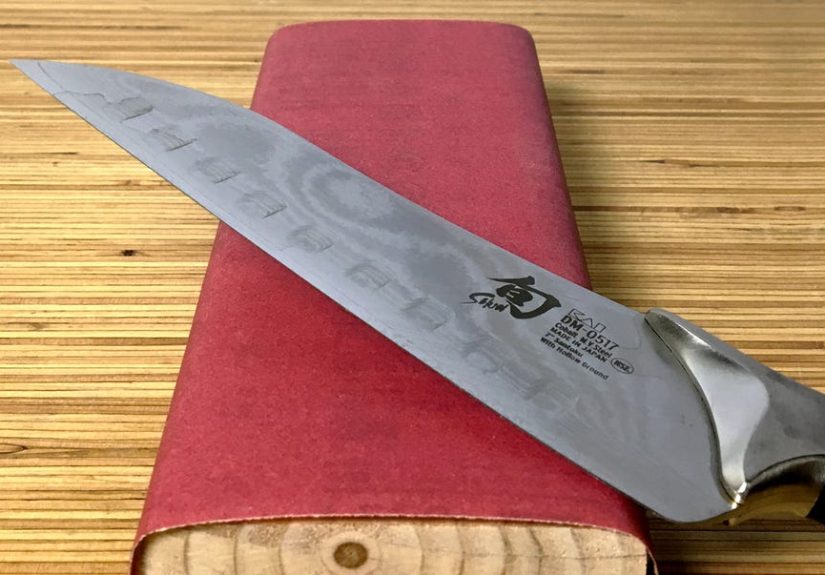
Stropping (on leather, denim, or a purpose-made stropsometimes with polishing compound) helps remove micro-burrs and refine the edge.
It’s especially satisfying after a stone because it makes the edge feel smoother and cut more cleanly.
Key tip: strop at a slightly lower angle than you sharpened, and pull the blade spine-first (never edge-first)
to avoid cutting into the strop.
How Often Should You Sharpen Kitchen Knives?
It depends on how much you cook, your cutting board, and your knife steel. A practical rule:
- Hone: every few uses (or weekly if you cook less often)
- Sharpen: a few times a year for typical home kitchens
- Sharpen sooner: if the knife slips on tomato skins, crushes herbs, or fails the paper test
Common Knife Sharpening Mistakes (and How to Fix Them)
Mistake 1: Changing angles mid-stroke
Fix: slow down. Focus on keeping the spine height consistent. Consider an angle guide while learning.
Mistake 2: Never forming a burr
Fix: you’re likely too high on the angle (not reaching the edge), using too light pressure on a very dull knife,
or not spending enough time on the coarse stage. Start with a coarser grit if the knife is truly dull.
Mistake 3: Over-sharpening the tip or ignoring the heel
Fix: consciously cover the full edge. Many people accidentally sharpen only the middle because it “feels” easiest.
Mistake 4: Pressing too hard
Fix: let the abrasive do the work. Heavy pressure can create uneven bevels and bigger burrs that are harder to remove.
Finish with very light strokes.
Mistake 5: Dulling the edge immediately after sharpening
Fix: stop using glass cutting boards (yes, they’re pretty; no, your knife doesn’t care). Use wood or quality plastic.
Also: don’t toss knives loose in a drawer like they’re auditioning for a clanging sound-effects album.
Care Tips That Keep Knives Sharp Longer
- Use the right cutting board: wood or quality plastic beats glass, stone, or metal every time.
- Hand wash and dry: dishwashers are rough on edges and handles.
- Store smart: magnetic strip, knife block, edge guards, or a dedicated drawer insert.
- Don’t misuse your knife: no prying, no frozen foods, no bones (unless the knife is designed for it).
Which Method Should You Choose?
If you want the “best way” in terms of edge quality and long-term knife health: whetstone + honing + (optional) strop.
If you want fast and easy and don’t mind a bit more metal removal over time: a high-quality electric sharpener.
If you’re maintaining inexpensive knives and value convenience above all: a gentle manual sharpener.
Conclusion: Sharp Knives Make Cooking Easier (and Safer)
Learning to sharpen kitchen knives is one of those rare adult skills that pays you back immediately.
Better cuts, less effort, fewer slips, and a weird sense of calmlike organizing a junk drawer, except the junk drawer can julienne.
Start simple: a solid 1000-grit stone, consistent angle, form a burr, deburr properly, and hone between sessions.
Once your knife glides through tomatoes like they owe it money, you’ll wonder why you waited.
Extra: Real-World Sharpening Experiences (The Stuff People Don’t Mention Enough)
The first time most people try sharpening with a whetstone, there’s a specific emotional arc. It starts with optimism:
“How hard can it be? I watched a 90-second video.” Then it quickly transitions into mild confusion:
“Am I sharpening or just giving my knife a spa day?” And finallyafter you feel your first burrpure, unfiltered victory:
“I HAVE SUMMONED THE EDGE.”
One common experience is discovering that “dull” doesn’t always mean “needs sharpening.” Sometimes a knife feels dull because
the edge has rolled slightly. You do a careful honing session, and suddenly the blade bites again. It’s like finding out your Wi-Fi
wasn’t brokenyou just needed to unplug the router (the router is your honing rod; your frustration is the blinking red light).
That’s why honing regularly makes sharpening feel dramatically easier: you’re not rebuilding a neglected edge from scratch every time.
Another classic moment: realizing your cutting board has been sabotaging you. Plenty of home cooks sharpen a knife,
get it performing well, then immediately dull it by chopping on glass, granite, or a board that might as well be a polished tombstone.
When you switch to a friendlier surfacewood or a good plastic boardyou notice something almost magical:
the knife stays sharp longer, and your cutting feels smoother. This is especially noticeable with thin-bladed chef’s knives
and Japanese-style knives that can be wicked sharp but don’t love abuse.
People also tend to underestimate how much “angle anxiety” slows learning. At first, your brain wants a perfect number:
15 degrees! 18 degrees! 20 degrees! But in real kitchens, consistency beats geometry. Many home sharpeners report that once they stop
chasing an exact angle and instead focus on repeating the same hand position, the results improve quickly.
Angle guides can help early on, but the real upgrade is muscle memoryyour hands learning the motion the way they learn typing:
not by math, but by repetition.
Here’s a relatable experience: sharpening one knife goes okay, and then you try a second knife and everything feels different.
That’s normal. A thick German chef’s knife won’t feel like a thin Japanese gyuto. The thicker knife may take longer to form a burr,
especially if it’s been neglected. The thinner knife might form a burr quickly but also “over-burr” if you press too hard.
Many home cooks eventually develop a simple rule: moderate pressure to build the edge, then progressively lighter pressure to refine it
finishing strokes that feel almost too gentle, like you’re trying not to wake a sleeping cat.
There’s also the “why is it sharp but still kinda not?” phase. This often comes down to deburring.
A knife can pass a quick test right after sharpening, then disappoint you during actual prep because a wire burr is still clinging on.
The fix usually isn’t more sharpeningit’s better cleanup: alternating light strokes, a few very gentle finishing passes, and
(if you have it) a strop. Many people say stropping is the moment their edges go from “good” to “wow.”
It doesn’t have to be fancy, either: a simple leather strop, denim, or even a piece of cardboard can help refine a kitchen edge
when used carefully.
A final real-world note: sharpening becomes oddly satisfying once you stop treating it like a performance.
You don’t need a mirror-polished bevel or a samurai-level edge for Tuesday night tacos.
You need a knife that cuts cleanly, safely, and predictably. If your chef’s knife glides through onions without cracking layers,
slices tomatoes without crushing, and makes prep fastercongrats. That’s the point.
And if you accidentally get it sharp enough to slice paper in midair… well, enjoy your brief career as a kitchen magician.