Table of Contents >> Show >> Hide
- Why Stretching Your Lower Back Matters
- Important Safety Check Before You Stretch
- How to Use These 7 Lower Back Stretches
- The 7 Best Moves to Ease Lower Back Stiffness
- 1. Child’s Pose: The “Back Hug” Stretch
- 2. Cat–Cow: Wake Up Your Spine
- 3. Single and Double Knee-to-Chest: Reset for a Tight Low Back
- 4. Supine Trunk Rotation: Gentle “Windshield Wipers”
- 5. Pelvic Tilt: Small Move, Big Impact
- 6. Sphinx Pose: Gentle Back Extension
- 7. Figure-Four Stretch: Target Tight Hips to Help the Back
- How Often Should You Stretch Your Lower Back?
- Everyday Habits That Support a Happier Lower Back
- Common Questions About Lower Back Stretching
- Real-Life Tips and Experiences With Lower Back Stretching
- The Bottom Line
If your lower back feels like it’s made of rusted hinges instead of muscles and joints, you’re not alone. Lower back stiffness is one of the most common everyday complaints, especially for people who sit a lot, lift heavy things, or simply exist as humans in the 21st century.
The good news: gentle, consistent lower back stretches can help ease stiffness, improve mobility, and support long-term spine health when used alongside movement, strength work, and good posture habits. The key is to stretch smart, not aggressively, and to listen to your body instead of trying to win a flexibility contest with your younger self.
Why Stretching Your Lower Back Matters
When muscles around your spine, hips, and core get tight, they can tug on the lower back and make simple movements feel stiff or uncomfortable. Research suggests that exercise and movement (including stretching, strengthening, and mind–body approaches) can help reduce pain and improve function in people with chronic low back pain compared with doing nothing or usual care. It’s not magic, but it is meaningful when practiced regularly over time.
Stretching isn’t the whole story strengthening your core and hip muscles also plays a big role in supporting the spine but gentle mobility work can:
- Improve your range of motion so bending, twisting, and walking feel more natural.
- Help muscles relax after long periods of sitting or standing.
- Support better posture, which reduces stress on the lumbar spine.
- Pair nicely with walking, yoga, or physical therapy as part of a full back-care routine.
Think of stretching as the “lubrication” for your joints: small, consistent doses go a long way. Overdoing it once a month? Not so helpful.
Important Safety Check Before You Stretch
Before we dive into the seven lower back stretches, a quick reality check: not every back problem is a “just stretch it” situation. Gentle stretching is usually fine for everyday stiffness, but you should talk with a healthcare professional before trying these if you:
- Recently had a fall, accident, or direct injury to your back.
- Have severe pain that’s getting worse instead of better.
- Notice numbness, tingling, or weakness in your legs or feet.
- Have trouble controlling your bladder or bowels.
- Have a history of serious spine conditions or recent back surgery unless your doctor or physical therapist approves these moves for you.
Even if none of those apply, it’s still smart to ease into stretching. Move slowly, stay in a pain-free range, and stop any stretch that causes sharp, shooting, or burning pain. Mild tension or gentle pulling is okay; pain is your “nope” signal.
How to Use These 7 Lower Back Stretches
You can do these stretches individually or as a quick routine. A simple starting plan:
- Perform each stretch for 15–30 seconds, 2–3 times.
- Breathe slowly, in through your nose and out through your mouth.
- Try the routine once or twice per day many people like morning and evening.
- On busy days, even 2–3 moves are better than nothing.
Wear comfortable clothes, use a yoga mat or soft surface, and keep a pillow or folded towel nearby for extra support if needed.
The 7 Best Moves to Ease Lower Back Stiffness
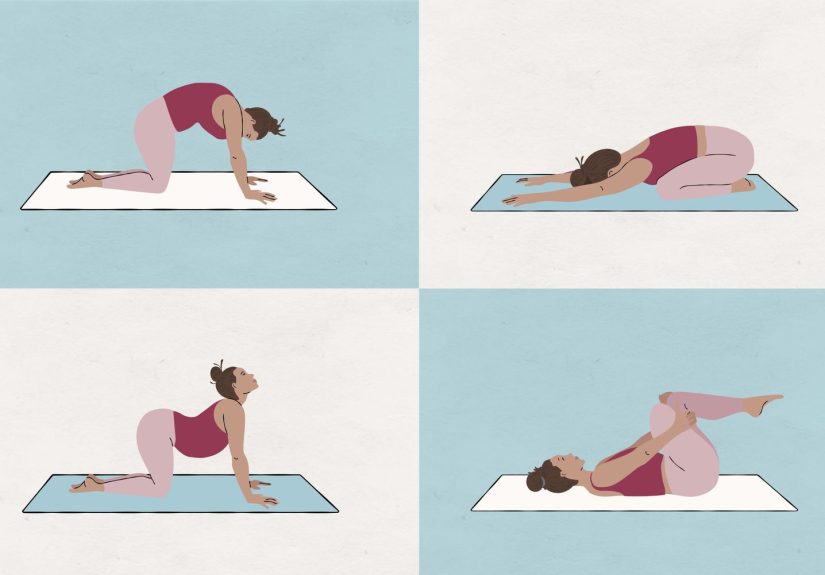
1. Child’s Pose: The “Back Hug” Stretch
This gentle yoga pose helps lengthen your spine and relax the muscles around your lower back and hips. It’s like sending your back to a mini spa no appointment needed.
- Start on your hands and knees (tabletop position) on the floor or a bed.
- Touch your big toes together and gently widen your knees as far as is comfortable.
- Slowly sit your hips back toward your heels as you stretch your arms forward, lowering your chest toward the floor.
- Let your forehead rest on the mat, a pillow, or your hands.
- Breathe deeply and hold for 20–30 seconds, easing deeper as your body relaxes.
Make it easier: Place a cushion between your hips and heels, or keep your knees closer together if your hips are tight.
What you should feel: A gentle stretch along the sides of your back, your lower back, and possibly your hips no pinching or sharp pain.
2. Cat–Cow: Wake Up Your Spine
Cat–Cow is a slow, controlled movement that helps your spine move through flexion (rounding) and extension (arch). It’s especially helpful if you sit all day and your back feels “locked.”
- Begin on your hands and knees with your wrists under shoulders and knees under hips.
- On an inhale, gently arch your back, lifting your tailbone and chest while letting your belly relax toward the floor (Cow).
- On an exhale, round your spine toward the ceiling, tucking your tailbone and gently drawing your chin toward your chest (Cat).
- Move slowly between these positions for 8–10 cycles, syncing movement with your breath.
Tips: Keep the movement smooth. Think of “gliding” through the positions instead of snapping between them. If your wrists complain, you can rest your forearms on yoga blocks or the edge of a couch.
3. Single and Double Knee-to-Chest: Reset for a Tight Low Back
This classic lower back stretch gently relaxes the muscles around your lumbar spine and can feel wonderful after a long day of standing, walking, or travel.
- Lie on your back with your knees bent and feet flat on the floor.
- Bring one knee toward your chest, holding it with both hands just below the knee.
- Gently pull the knee closer until you feel a mild stretch in your lower back and glutes.
- Hold for 15–30 seconds, then switch sides.
- For a double knee-to-chest stretch, bring both knees toward your chest, hugging them in without lifting your head off the floor.
Make it easier: If your hips feel tight, hold the back of your thigh instead of the front of your shin.
What you should feel: A pleasant stretch through the lower back, maybe wrapping into the buttocks. If your tailbone or hips feel pinched, ease off.
4. Supine Trunk Rotation: Gentle “Windshield Wipers”
This move improves mobility in your spine and hips while stretching the muscles along the sides of your lower back.
- Lie on your back with your knees bent and feet flat, hip-width apart.
- Extend your arms out to the sides at shoulder height, palms up.
- Engage your core lightly (imagine zipping up a snug pair of jeans).
- Slowly let your knees fall to one side while keeping your shoulders on the floor.
- Turn your head gently to the opposite side for an added stretch.
- Hold for 15–30 seconds, then bring your knees back to center and repeat on the other side.
Make it easier: Place a pillow or folded blanket under your knees so they don’t drop all the way down.
What you should feel: A gentle twist through your low back and hips, not a dramatic “crack.” Ease into the rotation; don’t force it.
5. Pelvic Tilt: Small Move, Big Impact
Pelvic tilts look almost too simple, but they help activate your deep core muscles and teach your lower back to move in a controlled, pain-free way.
- Lie on your back with your knees bent and feet flat on the floor, hip-width apart.
- Let your arms rest by your sides.
- Take a deep breath in. As you exhale, gently tighten your abdominal muscles and flatten your lower back against the floor by tilting your pelvis slightly toward your ribs.
- Hold for 5–10 seconds while breathing normally.
- Relax to your neutral spine (a small natural curve) and repeat 8–12 times.
Make it easier: Imagine your pelvis is a bowl of water. As you tilt, you’re tipping the water slightly toward your face. The movement is subtle no need to lift your hips off the floor.
Why it helps: This movement can reduce stiffness and teaches your lower back to move gently while your core supports it, a core piece of long-term back health.
6. Sphinx Pose: Gentle Back Extension
Where many stretches focus on rounding the back, Sphinx Pose gives you a mild arch that can help counteract hours of slouching and promote healthy extension when it feels comfortable for you.
- Lie on your stomach with your legs extended behind you, tops of feet on the floor.
- Place your forearms on the floor, elbows under shoulders, forearms parallel.
- Press gently into your forearms to lift your chest and upper torso off the floor while keeping your hips and thighs grounded.
- Draw your shoulders away from your ears and look slightly forward (not all the way up).
- Hold for 15–20 seconds, breathing steadily, then lower down and rest.
Skip or modify if: Extension (arching) increases your pain, causes numbness or tingling, or you’ve been told to avoid backward bending because of a specific spine condition. In that case, stick with flexion-friendly moves like Child’s Pose and knee-to-chest instead.
7. Figure-Four Stretch: Target Tight Hips to Help the Back
Sometimes your lower back is complaining because your hips are doing absolutely nothing to help. Tight glutes and piriformis muscles can pull on the low back, and this stretch helps them loosen up.
- Lie on your back with both knees bent and feet flat on the floor.
- Cross your right ankle over your left thigh, just above the knee, making a “4” shape.
- Thread your right hand through the opening between your legs and interlace your fingers behind your left thigh.
- Gently pull your left leg toward your chest until you feel a stretch in your right hip and glute.
- Hold for 20–30 seconds, then switch sides.
Make it easier: If lifting your leg is too intense, keep your left foot on the floor and simply press your right knee away from you for a milder stretch.
What you should feel: A deep but comfortable stretch in the buttock and outer hip, not in the knee.
How Often Should You Stretch Your Lower Back?
Consistency beats intensity every time. For everyday stiffness, many people do well with:
- Daily stretching: 5–10 minutes per day is a realistic starting point.
- Warm-up first: A few minutes of walking, marching in place, or gentle movement can help your muscles respond better to stretching.
- Short “movement snacks”: One or two stretches after long periods of sitting such as Cat–Cow or a quick trunk rotation can keep stiffness from building up.
For chronic or recurring low back pain, it’s especially helpful to combine stretching with strengthening exercises for your core, hips, and glutes, plus regular low-impact cardio (like walking, swimming, or cycling). Stretching alone is a piece of the puzzle, not the whole picture.
Everyday Habits That Support a Happier Lower Back
Lower back stretches work best when they’re not fighting against your daily habits. A few small tweaks can make a big difference:
- Upgrade your sitting posture: Keep your feet flat on the floor, hips slightly higher than your knees, and your screen at eye level. Use a small rolled towel or lumbar pillow behind your lower back for support.
- Take micro-breaks: Stand, walk, or stretch for 1–2 minutes every 30–45 minutes of sitting.
- Lift smarter: Bend at your hips and knees, keep objects close to your body, and avoid twisting while carrying heavy loads.
- Sleep setup: If you sleep on your back, try a pillow under your knees. If you sleep on your side, place a pillow between your knees to keep your spine aligned.
- Move most days: Regular walking or gentle exercise helps keep blood flowing to spinal structures and reduces stiffness.
Common Questions About Lower Back Stretching
Can stretching alone cure my lower back pain?
Probably not by itself but it can be a powerful helper. For many people, the best results come from a combination of stretching, strengthening, cardiovascular activity, and lifestyle changes (like better ergonomics and sleep). If pain persists for more than a few weeks, or keeps returning, it’s worth getting a personalized plan from a healthcare provider or physical therapist.
When is the best time to stretch my lower back?
Whenever you can do it consistently. Many people like gentle stretches in the morning to shake off overnight stiffness and again in the evening to unwind from the day. If your back gets tight at work, sprinkling in one or two moves during breaks can be a game changer.
Are these stretches safe during pregnancy?
Some stretches, like Child’s Pose or Cat–Cow, can often be modified for pregnancy, but the safest choice is to ask your prenatal care provider or a prenatal physical therapist first. As your body changes, you may need specific adjustments for comfort and safety.
What if stretching makes my pain worse?
Stop and reassess. Back off any move that increases pain during or after stretching. You may be going too deep, moving too fast, or these particular positions may not be right for your condition. That’s your cue to get a professional evaluation rather than forcing it.
Real-Life Tips and Experiences With Lower Back Stretching
On paper, these stretches look simple. In real life, building a back-friendly habit can be a little messier especially when you’re busy, tired, or your back already feels cranky. Here are some “from-the-trenches” style insights people often discover when they actually commit to stretching their lower back.
1. Your back loves tiny routines, not heroic efforts. Most people don’t stick with 45-minute stretching sessions, but they can commit to 5–10 minutes. One office worker might start by doing Cat–Cow and Child’s Pose right after shutting down the computer each evening. Another person might do knee-to-chest stretches before they scroll on their phone in bed (phone habits: now slightly less guilty).
Over time, these small “movement rituals” become automatic. The body starts to recognize: “Oh, it’s that time we stretch now.” That’s when the real payoff begins: morning stiffness that eases faster, less soreness after long car rides, and fewer “why did I twist like that?” moments.
2. The stretch you don’t like is often the one you need most. It’s common to have a favorite stretch maybe Child’s Pose feels heavenly and a move you secretly hate, like pelvic tilts or figure-four. Interestingly, the “annoying” stretch often targets muscles that have been quietly slacking off or staying tight for years. When people keep those moves in their routine (even if they grumble about them), they often report bigger gains in mobility and comfort.
For example, someone with desk-related low back pain may discover that figure-four stretching, aimed at the hips and glutes, does more for their back than endless forward bends. The back may be where the pain shows up, but the hips are where the tension lives.
3. Breathing is the secret stretch booster. Many people unconsciously hold their breath when they move into a stretch, especially if they’re worried it might hurt. The nervous system reads that as stress and tightens up even more. When you consciously take slow, deep breaths in through the nose, out through the mouth your body gets a clear “it’s safe to relax” message.
Try this experiment: get into a gentle knee-to-chest stretch and take five slow breaths, counting to four on the inhale and six on the exhale. Most people notice that by the final breath, their muscles soften and they can ease just a bit deeper into the stretch without forcing anything.
4. Stretching works best when you pair it with movement. People who get the most relief from low back stiffness rarely rely on stretching alone. They tend to also walk more, strengthen their core and hips, and adjust their everyday setup for example, raising their laptop to eye level or choosing a chair with better lumbar support.
One common success pattern: a short walk, followed by a few stretches, followed by a couple of simple strength moves like bridges or bird dogs (when cleared by a professional). The walk warms up the body, the stretches improve mobility, and the strength work helps your back stay supported between sessions.
5. Progress can be slow and that’s okay. Lower back stiffness rarely appears overnight, and it rarely disappears overnight either. People often notice subtle shifts first: getting out of bed feels a bit smoother, or they can stand in line a little longer without fidgeting. Over weeks and months, those small improvements add up.
It can help to measure progress in practical terms instead of chasing “perfect flexibility.” Can you turn to check your blind spot more easily while driving? Sit through a meeting without constant shifting? Pick something up from the floor without wincing? Those are quiet wins that mean your stretches and habits are working.
Above all, the most important “experience tip” is this: be curious, not judgmental, about your body. Some days your back will feel open and cooperative; other days it may be grumpy and tight. Show up anyway, adjust what you need, and keep your stretches gentle and consistent. Your lower back doesn’t need perfection it just needs regular, kind attention.
The Bottom Line
Stretching your lower back with these seven moves Child’s Pose, Cat–Cow, knee-to-chest, trunk rotations, pelvic tilts, Sphinx Pose, and figure-four can help ease stiffness, improve flexibility, and support everyday comfort. When you pair these stretches with stronger core and hip muscles, regular movement, and thoughtful posture habits, you give your spine a much better chance at feeling supported instead of strained.
Go slowly, listen carefully to your body, and get personalized guidance if your pain is severe, persistent, or complicated. You don’t have to live with a back that feels like it’s permanently on “mute” a few minutes a day of smart, gentle stretching can help your lower back move and feel more like itself again.