Table of Contents >> Show >> Hide
- What Is a Character Reference?
- Before You Start Writing
- How to Write a Character Reference: 7 Steps
- Step 1: Start With a Professional Header and Greeting
- Step 2: Introduce Yourself and Explain Your Relationship
- Step 3: State the Purpose of the Letter
- Step 4: Highlight 2–3 Strong Character Traits
- Step 5: Add Specific Examples or Short Anecdotes
- Step 6: Connect Their Qualities to the Opportunity
- Step 7: Close With a Clear Recommendation and Contact Information
- Character Reference Template (Copy and Customize)
- Common Mistakes to Avoid
- Quick Example: A Strong Character Reference Paragraph
- Experience-Based Lessons That Make Character References Better (Extended Section)
- Conclusion
If someone asks you to write a character reference, congratulationsyou’ve officially been promoted to “trusted human.” That’s a big deal. A character reference (also called a personal reference) can help someone land a job, rent an apartment, get into a program, or strengthen an application when a resume alone doesn’t tell the full story.
The tricky part? A lot of people sit down to write one and suddenly forget every adjective in the English language. “They are…nice?” Helpful, but not exactly powerful. A strong character reference goes beyond generic praise and shows who the person is, how you know them, and why your words should carry weight.
In this guide, you’ll learn exactly how to write a character reference in 7 clear steps, plus a template, common mistakes to avoid, and practical examples. Whether you’re writing for a job, school, volunteer role, or rental application, this article will help you create a letter that sounds professional, specific, and human.
What Is a Character Reference?
A character reference is a letter written by someone who knows a candidate personally or professionally (but not necessarily as their direct manager) and can speak to their character, values, and interpersonal strengths. Think reliability, integrity, teamwork, communication, and judgment.
Unlike a standard employment reference, a character reference focuses less on job titles and technical achievements and more on how the person behaves in real life. It helps the reader answer questions like:
- Can this person be trusted?
- Do they show good judgment?
- How do they treat others?
- Will they fit the team or community?
Character references are commonly used for:
- Job applications (especially entry-level, career changes, or trust-based roles)
- Apartment or rental applications
- Academic programs and scholarships
- Volunteer positions
- Community organizations and other applications that need a credibility boost
Before You Start Writing
Before you type “To Whom It May Concern” and hope for the best, take a minute to set yourself up for success.
Make Sure You’re the Right Person
Only agree to write the letter if you truly know the person well enough to speak positively and specifically about them. If you barely know them, or you can’t honestly recommend them, it’s better to decline politely than write a vague letter that hurts their chances.
Ask for the Basics
Request a few details so you can tailor the letter:
- The role, program, or opportunity they’re applying for
- The deadline and submission instructions
- The recipient’s name (if available)
- An updated resume or background summary
- Any traits they’d like you to highlight (if appropriate)
This is not “cheating.” It’s smart. A character reference should match the opportunity, not read like a generic “nice person certificate.”
How to Write a Character Reference: 7 Steps
Step 1: Start With a Professional Header and Greeting
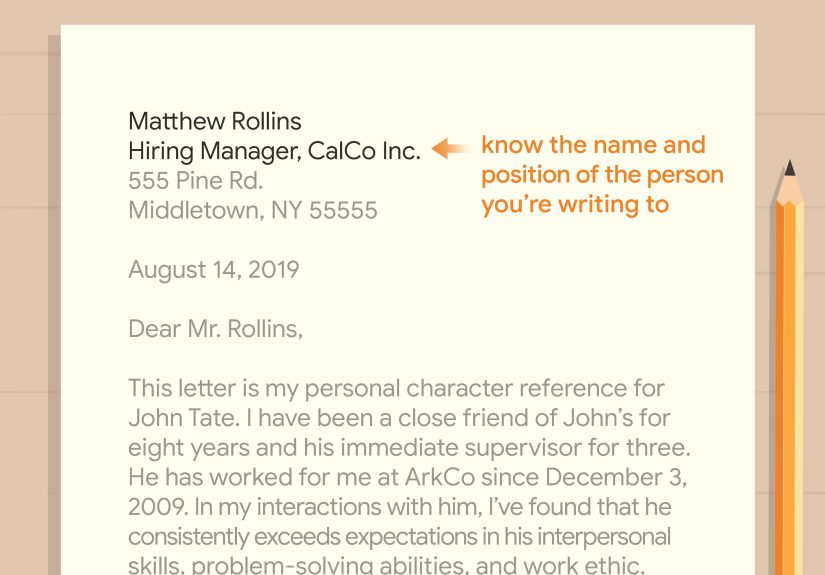
Even though this is a personal reference, the format should still look professional. Use a business-letter style layout when possible. Include your contact information, the date, and a proper greeting.
If you know the recipient’s name, use it. If not, a safe option is Dear Hiring Manager or To Whom It May Concern.
Why this matters: A clean format signals credibility. It tells the reader this isn’t a casual favorit’s a thoughtful recommendation.
Step 2: Introduce Yourself and Explain Your Relationship
In the opening paragraph, establish who you are, how you know the candidate, and how long you’ve known them. This gives your opinion context.
Good character references are not mysterious. The reader should immediately understand why you’re qualified to comment.
Example:
“I am pleased to recommend Maria Lopez, whom I have known for six years through our neighborhood youth mentoring program, where I serve as volunteer coordinator.”
Be specific. “I know him socially” is weak. “We worked together on a weekly food bank volunteer team for three years” is much stronger.
Step 3: State the Purpose of the Letter
Next, explain why you’re writing and what you are recommending the person for. Keep it short and direct.
This step helps the reader understand what lens to use. A reference for a rental application will emphasize responsibility and reliability. A reference for a healthcare job may highlight compassion and professionalism.
Example:
“I am writing in support of Daniel Reed’s application for the customer service position at your company.”
If you don’t know the exact role, you can still write a broader endorsement, but try to get this information first.
Step 4: Highlight 2–3 Strong Character Traits
This is the heart of the letter. Pick two or three traits that are genuinely true and relevant to the opportunity. Avoid writing a long list of buzzwords like a broken motivational poster.
Strong character traits often include:
- Integrity
- Reliability
- Work ethic
- Teamwork
- Communication
- Compassion
- Maturity
- Initiative
- Accountability
Choose traits you can actually prove. The best letters are focused, not stuffed with compliments.
Pro tip: Ask yourself, “What three words would I use if this person’s future depended on my answer?” Then build your letter around those words.
Step 5: Add Specific Examples or Short Anecdotes
This is the step most people skipand it’s exactly what makes a reference memorable.
Don’t just say the person is reliable. Show it.
Weak: “James is hardworking and responsible.”
Better: “During our community fundraiser, James arrived early for every planning session, managed volunteer sign-ins, and stayed late to help clean up without being asked.”
A good anecdote doesn’t need to be dramatic. It just needs to be real. One or two examples are enough. The goal is to give the reader proof, not a novel.
Try this simple formula:
Trait + Situation + Action + Result
Example: “Sofia is exceptionally dependable. When our school PTO lost two volunteers the morning of a fundraiser, she reorganized the setup team, covered the registration table herself, and kept the event running on time.”
Step 6: Connect Their Qualities to the Opportunity
Now tie everything together. Explain why the traits you described make the person a strong fit for the job, program, or application they’re pursuing.
This is where your letter becomes strategic. The reader should not have to guess why your story matters.
Example (job):
“Because this role requires patience, communication, and trustworthiness, I believe Hannah would be an excellent addition to your team.”
Example (rental):
“Based on my experience with Marcus over the past five years, I believe he would be a respectful and responsible tenant.”
Example (school/volunteer):
“Her maturity, consistency, and genuine commitment to helping others would make her a strong candidate for your program.”
Step 7: Close With a Clear Recommendation and Contact Information
End the letter with a direct statement of recommendation, then invite the reader to contact you for more information.
Don’t be shy here. If you support the person, say so clearly.
Strong closing examples:
- “I recommend Tyler without hesitation.”
- “I am confident that Priya would be a valuable addition to your organization.”
- “I strongly support Evelyn’s application and would be happy to provide additional details.”
Finish with a professional sign-off such as Sincerely, Best regards, or Respectfully, followed by your full name and contact information.
Character Reference Template (Copy and Customize)
Common Mistakes to Avoid
1) Being Too Generic
If your letter could describe literally anyone, it won’t help much. “Nice, kind, hardworking” is a start, but it needs examples and context.
2) Writing Too Much
A character reference is usually one page. Keep it concise, focused, and easy to scan. The reader probably has a stack of applications.
3) Including Private or Sensitive Details
Don’t mention personal struggles, family issues, health matters, or anything the candidate didn’t ask you to share. A reference is not a documentary.
4) Exaggerating
Be honest. If you oversell or make claims you can’t support, the letter loses credibility fast. Specific and sincere beats dramatic every time.
5) Forgetting to Tailor the Letter
A letter for an apartment application should not sound identical to a letter for a leadership role. Adjust your examples and wording to match the opportunity.
Quick Example: A Strong Character Reference Paragraph
“I have known Ashley Kim for more than four years as a volunteer coordinator at our local animal rescue. Ashley is one of the most dependable people on our team. Last summer, when we had a last-minute staffing shortage during an adoption event, she reorganized volunteer assignments, greeted families, and stayed two extra hours to ensure every animal was properly documented. Her calm communication style, attention to detail, and genuine care for others make her someone I trust completely.”
Notice what makes this work:
- Clear relationship
- Specific timeline
- Real example
- Relevant traits tied to behavior
Experience-Based Lessons That Make Character References Better (Extended Section)
Here’s something people rarely talk about: the best character references are usually written by people who have actually seen the candidate in an ordinary, unglamorous moment.
Not the interview day. Not the polished LinkedIn version. The everyday version.
For example, a supervisor might remember the employee who stayed late to help train a new hire without being asked. A coach might remember the player who encouraged a struggling teammate after a loss. A volunteer leader might remember the person who quietly handled a messy problem while everyone else panicked. These moments are gold in a character reference because they reveal judgment, attitude, and values.
One common experience is writing a reference for someone changing careers. This can feel tricky because you may not be able to speak to the new field directly. But that’s exactly where a character reference becomes powerful. If someone is moving into healthcare, education, or customer support, your letter can highlight patience, empathy, consistency, and communication. Those qualities transfer across industries better than many technical skills.
Another real-world situation is writing for someone early in their career. Maybe they don’t have a long resume yet. In that case, your examples matter even more. Did they show up on time every week for a community project? Did they follow through when others forgot? Did they communicate respectfully when plans changed? These details may sound small, but they are often the reason someone gets trusted with a first opportunity.
There’s also a lesson in what not to do. People often think a character reference should sound overly formal, like it was written by a robot in a blazer. It shouldn’t. Professional, yes. Stiff, no. A natural tone is better because it feels real. A sentence like “I would trust Jordan to handle sensitive responsibilities and represent our team well” is much more convincing than a paragraph packed with generic corporate phrases.
Timing is another experience-driven issue. Many weak letters are rushed. If you’ve ever written one the night before a deadline, you already know the result: vague wording, no anecdotes, and a lot of “very excellent person” energy. Give yourself enough time to think. Even 20 extra minutes to remember one concrete example can transform the letter.
Finally, a strong character reference respects both the candidate and the reader. It doesn’t overshare. It doesn’t ramble. It doesn’t make the reader hunt for the point. It clearly says: “I know this person. Here’s how. Here’s what I’ve seen. Here’s why I recommend them.”
That’s the whole game.
When you write from honest experience, your letter does more than praise someoneit helps someone else trust them. And in hiring, housing, education, and community roles, trust is often the deciding factor.
Conclusion
Writing a character reference is not about using fancy language or sounding like a legal contract. It’s about giving a truthful, specific, and professional picture of someone’s character.
If you follow these 7 stepsformat the letter professionally, explain your relationship, state the purpose, highlight relevant traits, add examples, connect those traits to the opportunity, and close with a clear recommendationyou’ll write a letter that actually helps.
And that’s the goal: not just to say someone is great, but to show why they’re a strong choice for what comes next.