Table of Contents >> Show >> Hide
- Why NYC Is a Poster Wonderland (and a Little Bit a Paper Jungle)
- Where the Weird Posters Live
- A Field Guide to NYC’s Weirdest Poster Genres
- How to Photograph Weird Posters in NYC Like They’re Tiny Exhibits
- The Not-Boring Legal & Ethical Stuff
- Turning Your Poster Photos Into a Story People Actually Want to Follow
- Conclusion: Keep Your Eyes Up, Your Camera Ready
- of NYC Poster-Hunting Experiences (Because This City Never Runs Out of Material)
New York City doesn’t just talkit prints. It announces itself in layers: taped to plywood, wheat-pasted
to construction walls, zip-tied to fences, tucked into community boards, and occasionally clinging for dear life to a
lamppost like it missed its stop on the F train.
I started photographing the weirdest posters I find in NYC for the same reason people start collecting subway cards,
matchbooks, or vintage menus: it’s a little unhinged, mildly wholesome, and extremely New York. Posters are public
diary entries. They’re evidence that someone out there is tryingtrying to find a lost cat, sell a couch, start a band,
launch a one-night “experimental sound bath,” or convince you that their method of learning Italian in three days is
definitely not just “watching mob movies with subtitles.”
If you’ve ever wondered why photographing weird posters in NYC feels like a scavenger hunt inside an art exhibit inside
a comedy sketch, grab a camera (or your phone) and let’s talk about how the city’s paper trail turns into a story you can
actually see.
Why NYC Is a Poster Wonderland (and a Little Bit a Paper Jungle)
A city built for messages
NYC has two secret superpowers: foot traffic and urgency. People walk everywhere, and everyone is always trying to get
someone else’s attention in about two seconds. Posters are the original “Hey, look at me!”cheap, fast, and visible
until rain, wind, or a newer, louder poster steals the same square foot of space.
That’s why you’ll see everything from polished event flyers to handwritten pleas that look like they were composed
during a bumpy bus ride. The more chaotic the city feels, the more creative the messaging gets. And the more creative
the messaging gets, the more your camera starts whispering, “You’re not going home yet.”
Posters as a living archive
Posters aren’t just advertisingthey’re cultural snapshots. They show what neighborhoods care about, what people are
worried about, what they’re celebrating, and what they’re trying to sell without calling it “selling.” Even when a poster
is objectively bizarre, it’s still a clue. A clue about taste, trends, politics, humor, and the eternal human desire to
staple a dream to a wall and hope for the best.
In a city where public space has always been contested and expressive, posters sit right at the intersection of art and
everyday life. They borrow from protest graphics, street art energy, vintage design language, and the modern obsession
with fonts that scream, “I am definitely important!” even when the message is, “Free cucumbers. Ask for Gary.”
Where the Weird Posters Live
Construction plywood and scaffolding
If NYC had an official mascot, it might be a sheet of plywood wearing a hard hat. Construction sites create big, flat
surfaces that attract posters like magnets attract fridge poetry. And because the city is constantly changing, the
posters change fast toonew layers every week, sometimes every day.
The best part? Posters rarely appear alone. You get clusterscollages of competing announcements that accidentally
become one giant artwork. A comedy show sits next to a missing-dog flyer sits next to a minimalist art poster sits next
to a very confident handwritten note that simply says, “STOP LYING.”
Community boards and storefront windows
Bulletin boards in cafés, laundromats, bookstores, and community centers are where weird posters go to be polite. The
vibe is less “paper riot” and more “organized chaos.” Here you’ll find local events, tutoring offers, band auditions,
and the occasional masterpiece of passive-aggressive communication (“To the person who keeps taking my umbrella…”).
Storefront windows can be a goldmine too, especially when a business is closed for renovations, changing ownership, or
just embracing the “temporary” lifestyle that somehow lasts nine months.
Subway corridors and station-adjacent surfaces
NYC’s subway stations are full of official ads and signage, but the area around entrances and nearby corridors often
becomes a magnet for unofficial paper cultureespecially where community notices and street-level announcements
spill into the commuter flow.
Photographically, the subway is also where poster-hunting becomes a lighting challenge, a timing challenge, and an
“excuse me, sorry, thank you, sorry” endurance test. Worth it.
A Field Guide to NYC’s Weirdest Poster Genres
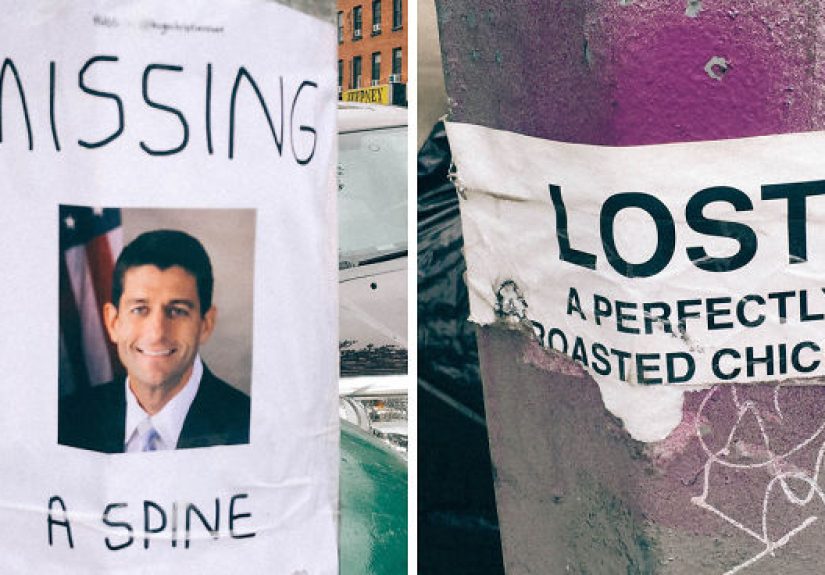
Lost & found: pets, objects, and occasionally… dignity
Lost pet posters are the emotional core of NYC poster culture. They’re earnest, detailed, and often include a photo so
adorable it should come with a warning label. From a photography standpoint, these posters can be visually striking:
bold headlines, big faces, tear-off tabs, and lots of handwritten additions (“LAST SEEN NEAR THE BAGEL SHOP!!!”).
Then there’s “lost object” territory, which ranges from plausible (“lost keys”) to philosophical (“lost my will to
attend networking events”). Sometimes you’ll find a missing-item poster that reads like a short story, complete with a
plot twist and a villain.
Services & side hustles
NYC side hustles have their own visual language: phone numbers, strong claims, and a sense of urgency that implies the
poster itself is running late. You’ll see tutoring, moving help, language lessons, pet sitting, cleaning services,
guitar instruction, and the occasional “I will fix your computer” flyer that looks like it was designed in 2003 and
refuses to apologize.
These are great subjects because they reveal how people market themselves in the most analog way possibletwo fonts,
one paper color, and pure determination.
One-night-only happenings and DIY culture
Comedy shows, basement concerts, gallery openings, zine fairs, pop-ups, experimental theater, and events that sound
like they were generated by a very artistic raccoon (“Ambient Flute Meditation in a Basement”). NYC event posters
often go big on typography and mood. They’re not just selling a showthey’re selling an identity.
Photographing these posters in contexttaped to a door, layered over older flyers, lit by a neon signadds to the
story. The poster is the invitation, but the street is the envelope.
Political flyers and protest ephemera
Posters have long been tools for public persuasionannouncements, calls to action, arguments in bold letters. In NYC,
you’ll find political flyers and protest graphics that borrow from historical print traditions: strong contrasts, direct
language, and visuals designed to be understood fast by people walking by.
For photography, these posters can be powerful subjectsbut they also ask for care. Context matters. So does
presentation: avoid cropping that changes meaning, and be mindful about how you share images that include personal
details about private individuals.
Surreal humor and accidental poetry
My personal favorite category is the “Is this a joke?” posterthe ones that are either performance art, a prank, or a
sincere message that happens to be hilarious. These include:
- Overly dramatic warnings about everyday things (“DO NOT TRUST THE PIGEONS”).
- Handwritten manifestos that feel like a subway monologue, but on paper.
- Minimalist posters with one cryptic sentence and no explanation.
- Tear-off tabs advertising something so niche you can’t tell if it’s real.
These posters are why I keep photographing weird posters in NYC. They’re tiny, unplanned comedy stages. They’re also
reminders that public space is a conversationand sometimes the conversation is simply, “Who printed this??”
How to Photograph Weird Posters in NYC Like They’re Tiny Exhibits
Use the gear that keeps you nimble
You don’t need a massive camera to do great NYC poster photography. A phone works. A compact camera works. A small
mirrorless camera works. What matters is how quickly you can shoot without blocking the sidewalk or turning your hobby
into an unsolicited performance for strangers.
If you’re using a dedicated camera, a moderate wide-to-normal focal length is ideal because it lets you capture the
poster and the city context. Posters are rarely “alone,” and the surrounding environment often makes the image more
interesting than the poster itself.
Win the glare battle
Posters are often taped behind glass, protected by plastic, or covered in glossy prints. Translation: glare. Try moving
slightly left or right, tilt your camera, and look for an angle where reflections fade. If you’re shooting at night, be
careful with bright signage that can create hot spots.
A good trick is to shoot two versions: one “clean” frame focused on readability, and one wider frame that shows the
poster’s environmentbrick texture, torn edges, old tape, overlapping flyers, and whatever street weirdness is happening
nearby.
Frame it three ways: poster, poster-plus, and poster-in-the-world
Think of your poster photos as a mini series:
- The document shot: Straight-on, readable, minimal distortion.
- The texture shot: Close-up of torn paper, staples, marker edits, and weather damage.
- The context shot: Wider view showing street life, architecture, and neighborhood clues.
That trio turns a random flyer into a story. It’s also helpful if you ever want to post a carousel onlinepeople love
seeing the “before and after” of the city’s paper layers.
Build an archive (because you will forget, and your camera roll will not help)
NYC poster photos multiply fast. One day you have eight images. The next day your phone is politely asking if you’d like
to delete “2,491 similar items,” and you realize the items are all “POSTER THAT SAYS FREE HUGS BUT IN A THREATENING FONT.”
Use albums by neighborhood or theme (Lost & Found, Comedy Flyers, Strange Services, Cryptic Notes). Add quick notes:
cross street, date, anything that helps you remember why you stopped in the first place.
The Not-Boring Legal & Ethical Stuff
Yes, you can generally photograph things visible from public spaces
In the U.S., photographing what you can see from public places is widely recognized as a protected activity. That
includes buildings, signs, and all kinds of everyday street scenes. If someone questions you, staying calm and polite
goes a long wayespecially in NYC, where the mood can change faster than a crosswalk signal.
But “public” and “open to the public” aren’t always the same
Some locationsmuseums, certain buildings, and specific siteshave their own rules. Many allow personal photography but
limit equipment like tripods, lights, or anything that disrupts others. Libraries and museums often have explicit
policies about non-commercial use and certain restricted areas. The easy rule: if there’s a sign, respect it.
Posters themselves can be posted legally or illegallydon’t be the problem
A lot of posters you see on public property in NYC aren’t supposed to be there. City agencies even provide ways to
report illegal postings. You don’t have to be the poster police, but you also don’t want your hobby to turn into
“influencing” people to vandalize public space.
Photographing weird posters in NYC is about documenting what’s already happeningnot adding to it.
Privacy matters: blur the personal stuff
The most ethical poster photography habit I’ve developed is simple: if a poster includes a personal phone number,
address, or identifying info for a private person, don’t broadcast it. Crop it, blur it, or rewrite it in a caption
without the details. The poster might be public, but the person doesn’t deserve extra risk because you thought their
tear-off tabs were aesthetically pleasing.
Turning Your Poster Photos Into a Story People Actually Want to Follow
Pick a theme (your future self will thank you)
Weird poster photography becomes addictive when it’s not just random imagesit’s a collection with a point of view.
Try themes like:
- Neighborhood diaries: “One month of posters in the East Village.”
- Typography madness: Fonts that feel like they’re yelling.
- Public confessions: Posters that accidentally reveal too much.
- NYC problem-solving: Flyers offering help, hope, or hustle.
Write captions like a human, not a brochure
The best captions add context without stealing the poster’s thunder. Keep it short, funny when appropriate, and
respectful when it’s personal. A good caption doesn’t explain the jokeit points at it and lets the audience do the
satisfying “Wait… what?” moment themselves.
Remember: the street is part of the composition
NYC is not a studio. You’ll shoot in rain. You’ll shoot in harsh sun. You’ll shoot while someone asks, “Is that my
poster?” (Answer: “Yes, and I love it,” is usually correct.) The imperfections are the point. A poster curled at the
edges is a poster that has survived. A poster half-covered is a poster in conversation with time.
Conclusion: Keep Your Eyes Up, Your Camera Ready
Photographing the weirdest posters I find in NYC has turned me into the kind of person who slows down for tape marks on
plywood and gets excited about a well-placed staple. It’s street photography with a built-in punchline: the city writes
the script, and you just show up with a lens.
And the best part? Weird posters are democratic. You don’t need an invitation. You don’t need a ticket. You just need a
little curiosityand enough patience to wait for the glare to disappear.
of NYC Poster-Hunting Experiences (Because This City Never Runs Out of Material)
The first “weird poster” I ever photographed in NYC wasn’t even trying to be weird. That was the problem. It was taped
to a construction wall like it belonged in a board meeting, except the headline read like a message from a time traveler.
Below it was a block of text that confidently explained something I couldn’t fully understand, followed by a single,
lonely tear-off tab that had already been taken. Whatever the poster was offering, it was apparently irresistible to at
least one person with quick hands and questionable curiosity. I took the photo and kept walking, but my brain stayed
behind, trying to finish the story.
After that, I started noticing patterns. Mornings are for practical posters: tutoring, cleaning, dog walking, furniture
giveaways. Even the fonts feel caffeinatedbold, efficient, no time to waste. Afternoons get more social: comedy shows,
bands, pop-ups, “meet your neighbors” events that always sound wholesome until you see the venue is a basement. Nights
are when the truly strange flyers appear, like mushrooms after rain. You’ll round a corner and see a brand-new sheet of
paper that feels too specific to be real: a “club” for an extremely niche hobby, a “support group” for people who hate a
particular kind of sandwich, or a flyer that looks like an ad for a product that doesn’t exist yet.
My favorite poster-hunting weather is a light drizzle, because it adds drama. The paper curls, ink smudges, tape turns
glossy, and every image looks like it’s starring in an indie film. One rainy evening I found a cluster of flyers
overlapping so perfectly they became accidental poetry: the top line of one poster read “NEED HELP,” the next visible
fragment said “WITH YOUR,” and the last poster’s headline finished the sentence with “DECISIONS.” I laughed out loud
like the posters had personally roasted me. A passerby looked at me like I was having a moment. I was.
The subway entrances are where I get the best “NYC in one frame” shots. You’ll have official signage, polished
advertising, and thensomehowan unofficial flyer squeezed into the visual ecosystem like a little rebel note. I shoot
fast there, because people are moving and nobody loves a sidewalk bottleneck. But when it works, it really works: you
get a poster’s message plus the hum of the city around it. Sometimes you even get the perfect background detaila
puddle reflection, a streak of light, a blur of motionthat makes the image feel alive.
The real joy is that poster-hunting trains your attention. You stop walking on autopilot. You start seeing the city as a
constantly updating bulletin board, where every layer of paper is a new chapter. And even when the posters are
ridiculous, they’re still evidence of people trying to connectasking for help, offering something, making a joke,
starting a scene, building a community. NYC can be loud and impatient, but its posters are oddly sincere. They say,
“Hey. I’m here.” And now my camera says it back.