Table of Contents >> Show >> Hide
- Meet the Mind Behind the Mood: Takashi Yanai, California Modernism, and Japanese Calm
- Why “LA Noir” Starts Outside: The Matte-Black Exterior That “Erases” the House
- The Garden Isn’t DecorationIt’s the Point
- The Big Move: A Wall of Glass and a Threshold That Changes Daily Life
- Humble Materials, Elevated: Plywood, White Walls, and the Art of Editing
- The Kitchen: Minimal, Sculptural, and Weirdly Comfortable
- Mid-Century Anchors, Japanese Sensibility: Furniture and Art That Doesn’t Shout
- What Makes This Renovation Feel So Good: The Psychology of “Outside-In” Living
- Steal the LA Noir Vibe: Specific Moves You Can Apply (Without Copy-Pasting the House)
- Small, Minimal, and Family-Friendly: The Real Flex of LA Noir
- Experience Notes: What Living With the “LA Noir” Mood Can Feel Like (About )
- Conclusion: The LA Noir Takeaway
Los Angeles has a special talent for reinvention. A strip mall becomes a sushi omakase. A former gas station becomes a coffee temple.
And a very normal 1950s ranch house? It becomes “LA Noir”a matte-black, humble-materials, high-calm bungalow that feels part SoCal and part
Kyoto daydream. If you’ve ever wanted your home to whisper instead of shout (while still looking ridiculously cool in photos), architect
Takashi Yanai’s modest, minimalist renovation is basically a masterclass.
Featured in Creative Spaces from Poketo’s founders and toured by Remodelista, the house is small by LA standardsabout 1,500 square feet
yet it manages to feel expansive, grounded, and quietly dramatic. The trick isn’t expensive finishes. It’s restraint, smart edits, and a lot of
attention to how you move between inside and outside. In other words: humble-chic, but with serious architectural discipline.
Meet the Mind Behind the Mood: Takashi Yanai, California Modernism, and Japanese Calm
Takashi Yanai is a partner at Ehrlich Yanai Rhee Chaney Architects (EYRC) and leads the firm’s residential practice. His background reads like
a design novel: time in Tokyo, experience as an editor at the residential architecture magazine GA Houses, and later a Harvard Graduate School of
Design architecture degreethen years of building modern California houses that treat the outdoors like a co-star, not a backdrop.
That hybrid identityJapanese formal clarity plus barefoot California easeshows up everywhere in LA Noir. The home doesn’t try to cosplay as a
traditional Japanese house, and it doesn’t try to be a glossy “mid-century remake,” either. Instead, it takes principles (simplicity, thresholds,
framed views, material honesty) and uses them to make a basic ranch house feel intentional.
Why “LA Noir” Starts Outside: The Matte-Black Exterior That “Erases” the House
The first thing you notice is the exterior: black, graphic, and almost stealthy. In Sunset’s coverage of Yanai and fellow architect (and spouse)
Patricia Rhee’s remodeled Mar Vista-area ranch, Yanai describes the black paint as a kind of “vanishing act”a way to make the architecture recede
so the garden and the experience can lead.
Remodelista frames the dark exterior as a nod to the Japanese tradition often referred to in the U.S. as shou sugi ban (more accurately,
yakisugi): charring wood to preserve it and create that deep, ink-like tone. Even if the house isn’t literally charred timber, the visual
idea lands: black that feels elemental rather than trendy, like a sketch line drawn around a calmer life.
Design bonus: black exteriors make greenery look extra alive. The lawn becomes less “suburbia” and more “gallery courtyard.” Your plants suddenly
look like they hired an agent.
The Garden Isn’t DecorationIt’s the Point
LA Noir’s landscape was designed with David Godshall of Terremoto, a Los Angeles– and San Francisco–based landscape architecture studio known for
gardens that feel cultural, ecological, and intentionally “not suburban.” Multiple features note the garden’s Japanese spirit with a distinctly
Californian vibethink bamboo, grasses, and a retreat-like atmosphere rather than a manicured front lawn.
This matters because Yanai’s whole approach is “outside-in.” When the landscape is treated as architecture, the interior no longer needs to perform
for attention. It can be quieter. Cleaner. More honest. Instead of buying your personality in furniture form, you let light, shadow, and plants do
the talking.
The Big Move: A Wall of Glass and a Threshold That Changes Daily Life
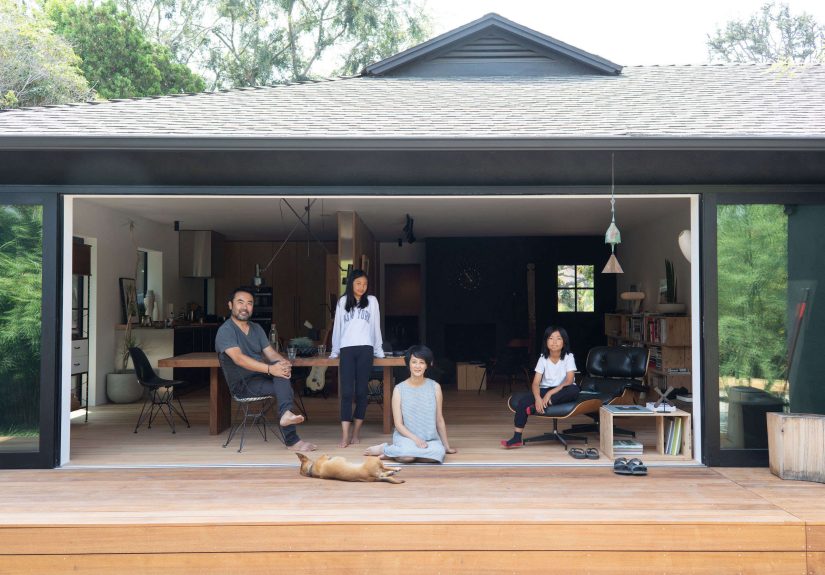
If the black exterior is the mood-setter, the rear opening is the lifestyle changer. Dwell describes how French doors were removed in favor of a
commanding sliding glass doorabout 18 feet wideso the living space can dissolve into the backyard. When that door opens, the house stops feeling
like a box and starts feeling like a pavilion.
Outside, the transition is handled with a minimalist deck made of marine-grade plywood, which Dwell notes also calls to mind the engawaa
porch-like threshold common in Japanese architecture. Remodelista similarly highlights the platform-like deck as the bridge between indoors and out.
It’s not a fussy “outdoor room” with a rug that will inevitably become a science experiment. It’s a simple plane: step out, breathe, reset.
And that threshold isn’t just poeticit’s practical. Marine-grade plywood is designed to hold up better in moisture and demanding conditions thanks
to high-quality veneers and waterproof adhesives. Used thoughtfully, it’s a humble material that performs like a grown-up.
Humble Materials, Elevated: Plywood, White Walls, and the Art of Editing
The interiors aren’t trying to win a luxury arms race. The palette is restrained: white walls, warm wood, black accents, and the occasional iconic
mid-century piece. The secret sauce is editingremoving what doesn’t add meaning.
Dwell notes that trim and crown molding were removed, and downlights were reduced to keep surfaces plain and calm. ArchDaily’s project description
of Kingsland Residence (the family’s home renovation) emphasizes a modest-budget, high-impact strategy: paint the exterior matte black to neutralize
the building, simplify the interior, and let the landscape and spatial moves carry the experience.
This is where “humble-chic” becomes more than a cute phrase. Plywood can look cheap when it’s treated like a temporary solution. It looks luxe when
it’s detailed cleanly, repeated consistently, and paired with restraint. The house doesn’t sprinkle plywood around like garnishit uses it as a
coherent language.
A quick “humble-chic” checklist (that isn’t about buying stuff)
- Choose one hero material (here: plywood) and use it with intention.
- Reduce visual noise by simplifying trim, lighting clutter, and fussy transitions.
- Frame views so the outdoors becomes the artwork.
- Keep the palette tight so small spaces feel orderly, not busy.
The Kitchen: Minimal, Sculptural, and Weirdly Comfortable
If you want the most concentrated dose of Yanai’s thinking, the kitchen delivers. Remodelista’s later deep-dive on his galley kitchen describes a
space that’s small (the kind of kitchen that politely asks you to stop collecting appliances as a hobby), yet highly efficient.
After stripping the living area “to its bare bones,” Yanai introduced a marine-plywood-finished partition that divides the kitchen from the living
room. The kitchen itself is a single-sided galley built with Bulthaup componentslinoleum-faced cabinets paired with a stainless-steel counter and
sinkkept handle-free for a minimal, sculptural effect. Yanai explicitly connects the clean, object-like quality to Donald Judd’s influence.
Then comes one of the smartest “no-template” ideas in the whole house: instead of forcing an island into a modest footprint, the room becomes
dual-purpose. A bookshelf and a desk create a study zone, turning the kitchen area into a work hub without adding square footage. It’s the kind of
move that feels obvious only after you see it done well.
The backsplash that isn’t a backsplash
In a world where backsplashes can become entire personalities, Yanai goes the opposite direction. Remodelista notes there isn’t even a backsplash;
instead, a deep marine-plywood sill and ledge behind the counter does the jobcreating a place for the most-used utensils, spices, and a few
favorite objects. It’s functional, calm, and visually integrated.
Lighting is also treated as an edit, not an upgrade spree. Remodelista notes Yanai replaced a grid of recessed lights with a few well-placed
spotlights. The goal is less “brightness everywhere” and more “light where you need it,” so the ceiling can stay quiet.
Mid-Century Anchors, Japanese Sensibility: Furniture and Art That Doesn’t Shout
LA Noir is a study in choosing fewer things that matter more. Remodelista’s original tour points out that the house was built in the 1950s, and
Yanai nods to that era with mid-century classics like Eames dining chairs and an Eames storage unit. The pieces aren’t used as retro props; they’re
functional, durable, and visually simpleperfect companions to a minimal envelope.
Art and books do a lot of the emotional work. ArchDaily’s Kingsland Residence write-up notes the family’s art includes pieces by artists such as
Hiroshi Sugimoto and Daido Moriyamafigures Yanai has cited as inspirations. The home also features extensive custom casework that runs the length
of the living room, turning books into both storage and atmosphere.
This is a subtle but important point: minimalism doesn’t mean “blank.” It means the objects that remain get to breathe. A single photograph can
feel like a window. A shelf of books can feel like a biography, not clutter.
What Makes This Renovation Feel So Good: The Psychology of “Outside-In” Living
Plenty of houses look good in pictures. LA Noir feels good because it’s designed around experience. In interviews and profiles, Yanai consistently
frames architecture as a medium between people and their environmentemphasizing views, light, and the cultural context of a site. The house’s
standout moves (the dark exterior, the sliding wall of glass, the deck threshold, the garden-first approach) are all experience-driven decisions.
Even the dining table placement becomes meaningful. ArchDaily’s description of the project notes the dining table sits adjacent to the backyard
frame created by the pocketing door, turning everyday meals into the “stage” for daily life. That’s the core of humble-chic: you invest in the
moments, not the marble.
Steal the LA Noir Vibe: Specific Moves You Can Apply (Without Copy-Pasting the House)
1) Use color strategicallyespecially outside
A dark exterior isn’t just aesthetic; it can simplify a messy façade and make planting pop. If you’re not ready for full noir, start with a front
door, trim, or a garden fence. The point is contrast: a neutral “frame” for landscape and light.
2) Make one big indoor-outdoor connection
You don’t need an 18-foot door to improve flow. A wider opening, better sightlines, or a more usable threshold (a simple deck or landing) can
change how often you actually go outside.
3) Choose humble materials, then detail them like you mean it
Plywood, oak, stainless steel, and plain paint can look either temporary or timeless. The difference is consistent edges, aligned planes, fewer
competing finishes, and a refusal to over-decorate.
4) Replace “more lighting” with “better lighting”
The LA Noir approach is less ceiling clutter and more purposeful light. Consider a few key sources: task lighting where you work, warm ambient light
where you relax, and darkness where you don’t need illumination. (Yes, darkness is allowed. It’s not a villain. It’s a design tool.)
5) Let storage become architecture
Built-ins and long runs of shelving can make small homes feel composed. When books and daily objects have a home, the room stops looking like it’s
mid-move.
Small, Minimal, and Family-Friendly: The Real Flex of LA Noir
It’s easy to romanticize minimalism until you remember: people live there. Kids live there. Life happens there. What’s compelling about LA Noir is
that it’s not a museum; it’s a working family home built on smart planning and durable choices.
The kitchen doubles as a study. The deck is a daily threshold, not a seasonal set piece. The garden is designed to be looked at and lived with,
not constantly tamed. Even the material palettewood, white walls, black accentsages better than fussy trends because it’s rooted in fundamentals.
In the end, the house is “noir” only in color. In spirit, it’s bright: open to air, light, plants, and the simple pleasures of a space that doesn’t
demand your attention 24/7.
Experience Notes: What Living With the “LA Noir” Mood Can Feel Like (About )
Imagine waking up in a house that doesn’t greet you with visual chatter. The walls are calm. The edges are clean. Your eye isn’t immediately dragged
to ten competing finishes; it lands where it’s supposed to landon light, on a view, on the day’s weather moving through the garden. In the morning,
the black exterior does something unexpected: it makes the outside feel quieter, like the house is intentionally stepping back so the landscape can
take the lead.
A sliding door that opens wide changes your habits. It turns “going outside” from an event into a default. You stop treating fresh air like a
weekend activity and start treating it like part of the floor plan. Coffee can migrate outdoors without a big production. A quick break between
tasks becomes a step onto the deckmore threshold than patiowhere the garden feels close enough to read like a page.
In a humble-chic space, materials have personalities. Plywood doesn’t pretend to be anything else. Stainless steel doesn’t apologize for being
utilitarian. A simple ledge behind the counter becomes the place where daily tools live, and you start noticing how much calmer cooking feels when
the kitchen isn’t auditioning for a magazine cover. It’s not sterile; it’s edited. You begin to appreciate the quiet satisfaction of putting
something away because there’s actually a place for it.
The “no backsplash” move is surprisingly experiential, too. Without a busy pattern behind the counter, your attention goes to the things you touch:
the handleless cabinet fronts, the texture of wood, the weight of a mug. Even the way light hits a plain wall starts to feel like décor. You might
find yourself noticing shadows and reflections the way you’d notice artworkbecause the room has given them permission to show up.
Hosting in a space like this can feel different. Instead of guests orbiting the kitchen island (because there isn’t one), they naturally drift
toward the thresholdhalf inside, half outsidewhere conversation spreads out. The boundary becomes social architecture. Kids can do homework at the
desk area while someone cooks, and nobody is isolated. A small house feels bigger when every zone can do more than one job without looking chaotic.
There’s also a maintenance reality that feels oddly freeing. A tight palette means fewer decisions. A simplified interior means less dust-catching
ornament. A garden designed to be a landscaperather than a lawn that must behavecan shift your relationship with “yard work” from obligation to
engagement. And yes, a black exterior makes a statement, but it can also make the house feel composed in a way that stays satisfying long after the
novelty fades. The experience isn’t about living in a trend; it’s about living with fewer distractions and more intention.
Conclusion: The LA Noir Takeaway
“LA Noir” isn’t just a black-painted bungalow. It’s a set of design choices that turn a modest 1950s ranch into a calm, flexible, modern home:
landscape first, thresholds that invite daily outdoor living, humble materials used beautifully, and a ruthless commitment to editing. The result is
minimalist without being cold, stylish without being precious, and deeply livable without needing more square footage.