Table of Contents >> Show >> Hide
If you’ve ever walked into a pet shop “just to look,” fully intending not to bring anyone home, this story may be dangerous for you. It starts with a man, a forgotten parrot egg the size of a marble, and a simple question: “What if I try to save it?”
That tiny “what if” turned into one of the sweetest rescue stories on the internet: an abandoned parrot egg, carefully incubated and hand-raised, growing into a bright, chatty little budgie who thinks humans are just very large, slightly clumsy flockmates. Along the way, the story also reveals a lot about how fragile parrot eggs are, how intense hand-rearing can be, and what it really takes to care for a budgie once it hatches.
So grab a cup of coffee, imagine the faint peeping of a baby bird in the background, and let’s walk through this “tiny egg, big feelings” journeyplus what you should know if you ever find yourself staring at an abandoned bird egg.
The Day a Tiny Egg Changed Everything
Finding the forgotten parrot egg
Our story begins in a pet shop, where cages full of parakeets (a.k.a. budgies) chatter away like feathery gossip columnists. A man browses the birds and notices something odd in the corner of one cage: a single small egg, sitting there with no mother in sight.
As it turns out, the mother bird had just been sold. In the shuffle of daily business, no one realized she’d laid an egg. Without a parent to keep it warm, that egg was basically on a countdown clock. Most customers would never even have noticed it. But this guy didand he couldn’t walk away.
He asked to take the egg home. The staff agreed, probably assuming nothing would come of it. After all, the egg had been sitting for a while and might not even be fertile. But our accidental bird dad decided that as long as there was the tiniest chance of life, he was going to try.
Turning a spare room into a mini bird NICU
Back home, the man did what any modern animal lover does when faced with a mystery: he researched like his search history depended on it. He learned that parakeet (budgie) eggs typically take around 18 days of incubation before hatching and need stable warmth, gentle turning, and the right humidity to develop properly.
He set up a small incubator, carefully adjusted the temperature, and placed the egg inside. Several times a day, he turned the egg so the growing embryo wouldn’t stick to the shell. He even used a tiny light to “candle” the egg and check for signs of developmentveins, movement, that faint, miraculous shadow of life inside.
For days, nothing obvious happened. Just an egg, sitting under warm light. But slowly, the signs appeared: a darker shape, a bit of movement, and then one day, a crack.
The moment the budgie hatched
Hatching is not a dramatic “pop” like in cartoonsit’s a slow, exhausting workout. The chick inside uses its egg tooth (a tiny temporary bump on its beak) to break the shell, resting between bursts of effort. It can take hours.
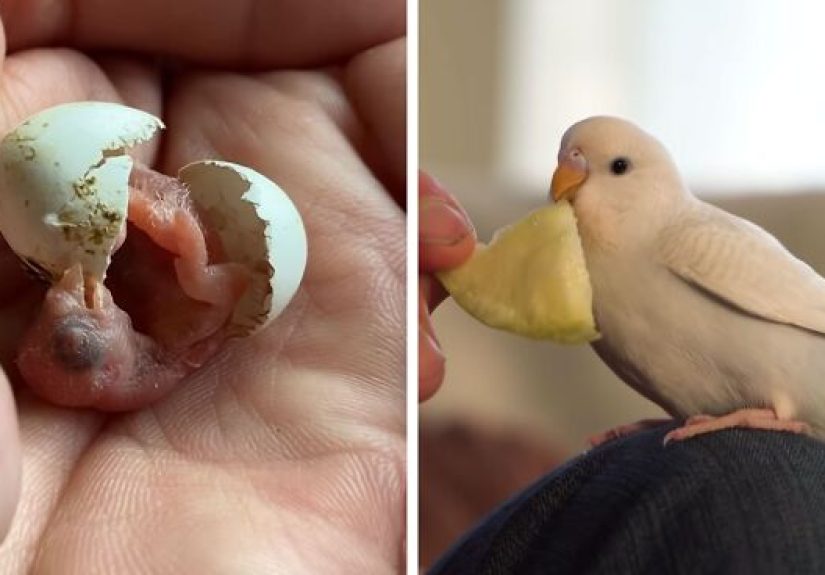
Finally, the shell broke open enough to reveal what looked, frankly, like a pink alien raisin with a beak. This was the baby budgie: featherless, eyes closed, wobbly, and completely dependent on the big human hands that had taken a chance on a leftover egg.
From that point on, the real work began. The man now had to become the chick’s surrogate parent, providing warmth, food, and constant care around the clock.
Hand-Raising a Budgie: Adorable, Intense, and Not for the Faint of Heart
Feeding a bird the size of a thumb
Newly hatched budgies are tinythink “could nap comfortably on a teaspoon.” In the wild, their parents feed them partially digested food straight from the crop. In this case, the chick’s “parent” was a human with a spoon and specialized hand-feeding formula.
For the first weeks, he had to feed the chick frequently throughout the day, often starting as many as seven to eight times daily. Each feeding involved warming the formula, checking the chick’s crop (a small pouch where food temporarily stores), and carefully offering just the right amount. Too cold, too hot, or too much food could be dangerous.
It wasn’t just feeding, either. The chick needed warmth, clean bedding, and monitoring to be sure it was growing at a healthy rate. Over time, the baby budgie’s eyes opened, its pinfeathers appeared like tiny quills, and then suddenlyalmost overnightit looked like a real parakeet with soft, colorful feathers.
When a budgie thinks you’re Mom (or Dad)
Because the man was there from the moment the chick hatched, the budgie essentially imprinted on him. To the little bird, the giant human who provided warmth, food, and safety was the trusted figure. This kind of imprinting is common in hand-reared parrots and can make them unusually tame, affectionate, and comfortable around people.
As the budgie grew, it followed him around, perched on his hands, and interacted with him like a feathered roommate. Eventually, he even tracked down the chick’s biological father at the pet shop, brought him home, and introduced the two. The adult budgie and the hand-raised youngster formed a bond, giving the little bird both human company and bird companionship.
The flip side of “too tame”
Hand-raised birds are undeniably adorable and often easier to handle than birds raised only by their parents. But experts also point out that heavy human imprinting can lead to behavior issues later in lifeover-bonding with one person, separation anxiety, or confusion about whether they’re a bird or a tiny feathery human. Responsible caregivers balance human interaction with opportunities for the bird to socialize, play, and be a bird among its own kind when possible.
From Egg to Companion: What a Budgie Actually Needs
Budgie basics: small bird, big needs
Whether your budgie starts as a surprise egg or arrives in a cage with a “Hello!” at the pet store, their long-term needs are the same. Budgies are small parrots with big personalities and lifespans that can reach 10–15 years or more with good care. That tiny egg isn’t just a cute weekend projectit’s a decade-plus commitment.
Housing: more than a decorative cage
Budgies need room to move, stretch their wings, and climb. A common recommendation is a minimum cage size around 18 x 18 x 18 inches for a single budgie, with horizontal bars for climbing and plenty of perches, toys, and chewable items. Bigger is always better, especially if the bird spends a lot of time inside.
The cage should be placed in a draft-free area where the family spends time (budgies are social), but away from fumes from kitchens, aerosols, or candles, which can be dangerous to their sensitive respiratory systems.
Diet: seeds are the “French fries” of the bird world
In the wild, budgies forage for a wide variety of seeds, grasses, and plant materials. In captivity, many people make the mistake of feeding only seed mix, which is kind of like feeding a kid only fries and calling it “vegetable-adjacent.” A healthier diet centers on high-quality pellets formulated for parakeets, making up most of their daily intake.
Fresh vegetables (like leafy greens, carrots, and bell peppers) and small portions of fruit can be added for variety and vitamins. Seeds become more of a treat or training reward than the main course. Clean, fresh water is a must, and food and water dishes should be washed regularlythink “restaurant kitchen,” not “college dorm sink.”
Mental health: toys, flight time, and social life
Budgies aren’t just pretty decor; they’re intelligent, active, and easily bored. A happy budgie needs:
- Varied toys (swings, chew toys, shreddable paper, foraging items).
- Regular out-of-cage time in a safe, bird-proofed room.
- Daily interactiontalking, whistling, training, or just hanging out.
- Companionship, either from their human flock, another budgie, or both.
That rescued budgie from the story didn’t just need warmth and formula. As he grew, he needed a cage upgrade, toys to explore, and eventually another bird to interact with. Saving an egg is heroic; giving the resulting bird a rich, stimulating life is the long-term love story.
Should You Try to Hatch an Abandoned Bird Egg?
A heartfelt story… and a serious responsibility
It’s hard to watch the video or read the story of this man and his tiny rescued budgie without feeling your heart melt straight through the floor. But it’s also important to say this clearly: hatching and hand-raising a bird isn’t a casual DIY project.
In most situations, the best thing for an egg is to be incubated and cared for by its bird parents. For pet birds that have laid eggs, avian veterinarians and experienced breeders usually recommend leaving eggs alone until it’s clear they’ve been abandoned or are non-viable. For wild birds, it is often illegal to take eggs or raise wildlife without permits, and wildlife rehabbers are the best people to call.
The man in this story succeeded because he did his research, used proper equipment, and devoted a huge amount of time to one tiny life. It’s beautifulbut it’s also very demanding, stressful, and not guaranteed to work. If you ever do stumble on an abandoned egg, the first step should always be to consult a professional: a vet, a licensed rehabber, or an experienced bird organization.
What This Tiny Budgie Teaches Us (Experience & Reflections)
Beyond the cute photos and viral video views, this story hits a deeper emotional note: a reminder that compassion often shows up in small, quiet actions. Nobody asked this man to rescue that egg. There was no applause waiting if it failed. He simply saw something fragile and decided to give it a chance.
That decision reshaped his daily routine. Suddenly, his schedule revolved around feedings, temperature checks, and tiny milestones: the first time the chick lifted its head, the first fuzzy feathers, the first sleepy chirps. It’s the kind of commitment that teaches patience in a very real waybecause you can’t rush growth, whether it’s a budgie or a human learning responsibility.
There’s also something uniquely humbling about watching an animal go from absolute helplessness to full independence. When a bird that once fit in your palm takes its first strong flight across the room, it’s a reminder that your job as a “parent,” human or otherwise, is partly to work yourself out of a job. You keep them warm, fed, and safe so that one day they no longer need you quite so much.
For people who already live with budgies or other parrots, this story is a gentle nudge to look at our birds with fresh eyes. That “just a small parakeet” in the corner of the room is actually a complex, social, long-lived creature with a rich inner world. They remember routines, recognize voices, form attachments, and can experience stress, loneliness, and joy. The same dedication that man brought to one egg is the kind of mindful care these birds quietly deserve every day.
This rescue also sparks an important conversation about preparedness. Many people bring home birds because they’re colorful, inexpensive, or take up less space than a dog. But the reality is that parrotsyes, even pocket-sized ones like budgiesrequire time, enrichment, vet care, and thoughtful housing. If a spontaneous act of kindness toward one egg can grow into a lifelong relationship with a bird, it’s worth pausing to ask: Am I ready for that?
Another powerful takeaway is the value of curiosity and learning. The man in this story didn’t start out as a professional breeder. He started with questions and a willingness to learn from experts. He read about incubation, chick development, feeding schedules, and behavior. He observed, adjusted, and respected the bird’s needs even when it meant being uncomfortable or tired. That combination of humility and curiosity is exactly what makes for better animal caretakers in general.
Finally, there’s the simple joy factor. Watching a tiny, abandoned egg grow into a confident, chirping budgie is the sort of thing that pulls people out of their daily stress for a moment and reminds them that small acts matter. In a world that often feels overwhelming, this story is proof that you don’t need to save an entire species to make a difference. Sometimes, changing one tiny life is more than enough.
The next time you see a budgie preening on a perch, whistling at its reflection or chattering at you from across the room, remember that somewhere out there is a little bird who almost never hatched at all. One person looked down, noticed a forgotten egg, and said, “I’ll try.” And that was all it took to give the world one more happy, fluttering splash of color.