Table of Contents >> Show >> Hide
- Quick Answer: How Far Is Mercury From the Sun?
- Mercury’s Orbit: The Real Reason the Distance Matters
- Mercury’s Size and “What It’s Made Of”
- A Day on Mercury: The Calendar Is Broken (and the Thermostat Too)
- Mercury’s Surface: Craters, Cliffs, and the Famous Caloris Basin
- Can You See Mercury From Earth?
- How We Know All This: Mercury Exploration in Plain English
- Mercury Fun Facts (Because Science Deserves Snacks)
- FAQ: Mercury Distance and Common Questions
- Conclusion: Mercury’s Distance Is the Key That Unlocks the Planet
- Experiences: of Mercury-Inspired Moments (That You Can Actually Have)
Mercury is the Solar System’s ultimate “close talker.” It’s the closest planet to the Sun, it moves fast, and it refuses to do anything the easy way
(including having a normal-length day). If you came here for one simple answerhow far Mercury is from the Sunyou’ll get it in the next section.
But stick around, because Mercury’s distance explains a lot of its weirdness: wild temperature swings, a sky where the Sun can seem to “pause,” and
a planet that’s basically a cratered iron-rich sprinting pebble with a magnetic field.
Quick Answer: How Far Is Mercury From the Sun?
Average distance (the number most people mean)
On average, Mercury is about 36 million miles (about 58 million kilometers) from the Sun. In astronomy terms, that’s roughly
0.4 AU (astronomical units), where 1 AU is the average Earth–Sun distance.
Closest and farthest distance (because Mercury’s orbit is not a perfect circle)
Mercury’s orbit is noticeably oval-shaped (elliptical), so its Sun-distance changes a lot:
- Closest (perihelion): about 29 million miles (~47 million km)
- Farthest (aphelion): about 43 million miles (~70 million km)
That’s a swing of roughly 14 million miles. For perspective, Earth’s whole “yearly wobble” is far smallerMercury is playing the eccentric-orbit game on hard mode.
Bonus distance fact: sunlight gets there fast
Light from the Sun takes only about 3.2 minutes to reach Mercury on average. On Earth, that trip takes about 8 minutes. Mercury basically gets “fresh Sun” delivered express.
Mercury’s Orbit: The Real Reason the Distance Matters
Mercury is the speedster of the inner Solar System
Mercury completes one orbit around the Sun in about 88 Earth days. That’s why it’s often called the fastest planetits average orbital speed is higher than any other planet’s.
If planets wore sneakers, Mercury’s would always look brand-new because it never stops running laps.
Elliptical orbit 101 (without the headache)
An ellipse means the Sun sits slightly off-center in Mercury’s orbital path. The practical result: Mercury sometimes gets significantly closer to the Sun (perihelion)
and sometimes significantly farther away (aphelion). Because sunlight intensity increases rapidly as distance shrinks, Mercury experiences big changes in how much solar energy hits it
over the course of a year.
Specific example: why a few million miles is a big deal
Imagine standing near a campfire. Step a little closer and it’s noticeably hotter. Now scale that up to a star. When Mercury swings toward perihelion, sunlight becomes dramatically more intense than
when it’s near aphelion. That changing solar “blast level” helps drive Mercury’s extreme surface conditions.
Mercury’s Size and “What It’s Made Of”
Small planet, big personality
Mercury is the smallest planet in our Solar Systemonly slightly larger than Earth’s Moon. Its radius is about 2,440 km (about 1,516 miles).
A fun mental image used in education: if Earth were the size of a nickel, Mercury would be about the size of a blueberry.
Built like a cannonball (scientifically speaking)
Mercury has an unusually large metallic core compared with its overall size, which helps explain its relatively high density for such a small planet.
One surprising outcome: Mercury has a global magnetic field (much weaker than Earth’s, but real). That’s a big deal, because many small rocky worlds don’t keep much magnetism for long.
A Day on Mercury: The Calendar Is Broken (and the Thermostat Too)
How long is a day on Mercury?
Here’s where Mercury becomes the Solar System’s most confusing timekeeper:
- One rotation (sidereal day) is about 58.6 Earth days.
- One sunrise-to-sunrise “solar day” is about 176 Earth days.
That long solar day happens because Mercury is locked into a 3:2 spin–orbit resonance: it rotates three times on its axis for every two trips around the Sun.
Net result: your “noon” schedule would be chaos, and your weekend plans would require a spreadsheet.
Mercury’s temperature extremes (yes, it’s that dramatic)
Mercury doesn’t have a thick, heat-trapping atmosphere. So when sunlight hits the surface, it heats up intensely; when the Sun is gone, heat escapes quickly.
Daytime temperatures can reach around 800°F (~430°C), while nighttime temperatures can drop to around -290°F (~-180°C).
Plot twist: Mercury can have ice
Even this Sun-hugging planet can shelter water icenot out in the open, but deep inside permanently shadowed polar craters.
If a crater floor never sees sunlight, temperatures can stay low enough for ice to persist.
Mercury’s Surface: Craters, Cliffs, and the Famous Caloris Basin
A world that looks like it got hit… because it did
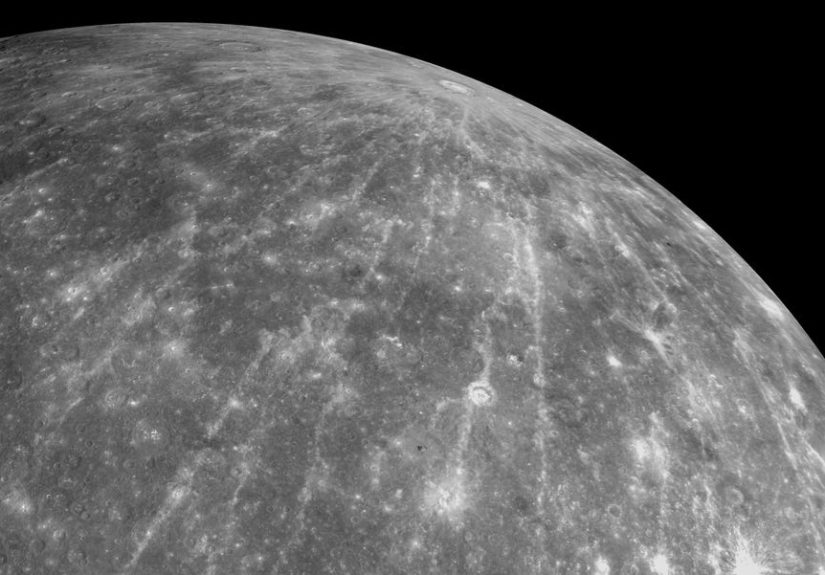
Mercury’s surface is heavily cratered, resembling the Moon in many ways. Impacts have been a major sculptor of its landscape.
But Mercury isn’t just “the Moon with better PR.” It also shows signs of volcanic activity in its past and planet-wide shrinking that created long cliffs (scarps).
Caloris Basin: the giant “bullseye”
One of Mercury’s most famous landmarks is the Caloris Basin, a massive impact basin. Spacecraft imagery and research indicate the basin and surrounding terrains were later modified by
volcanism and deformationevidence that Mercury’s geological story includes more than just getting pummeled.
Why distance from the Sun shows up in the geology
Mercury’s closeness to the Sun means stronger solar heating and powerful solar tides compared with what Earth experiences. Over long timescales, those factors interact with Mercury’s interior,
its cooling history, and surface evolution. The “how far from the Sun” question isn’t just triviait’s part of why Mercury is the way it is.
Can You See Mercury From Earth?
Yesbut it’s a twilight specialist
Mercury stays close to the Sun in our sky, so it’s usually visible only shortly after sunset or shortly before sunrise, low on the horizon.
Skywatchers look for times when Mercury reaches a large “elongation” (its apparent separation from the Sun).
Safety note (because the Sun is not a toy)
If you’re trying to spot Mercury with binoculars or a telescope, never point optics near the Sun. Use reputable skywatching guides, and observe only when the Sun is safely below the horizon.
How We Know All This: Mercury Exploration in Plain English
Spacecraft changed Mercury from a dot to a world
Early telescopes couldn’t reveal much detail on Mercury because it’s often drowned in sunlight glare. Space missions transformed Mercury science by mapping the surface, measuring chemistry,
and observing the magnetic field and exosphere.
MESSENGER: the mission that rewrote the Mercury fact sheet
NASA’s MESSENGER spacecraft orbited Mercury and returned a huge library of images and data. The mission ended with an expected impact on
April 30, 2015. Along the way, MESSENGER helped confirm Mercury’s complex geology, improved global maps, and deepened our understanding of how a small planet can still be geologically interesting.
Mercury Fun Facts (Because Science Deserves Snacks)
- Not the hottest planet: Mercury is closest to the Sun, but Venus is hotter overall because Venus traps heat with a thick greenhouse atmosphere.
- No moons, no rings: Mercury keeps it minimalist.
- Fast year, slow day: Mercury finishes a year in 88 days, but a solar day takes 176 daysyes, that means your “birthday” could happen twice before your next “noon.”
- Big-core energy: Mercury’s outsized metallic core helps explain its density and magnetic field.
- Ice where the Sun never shines: Permanently shadowed polar craters can preserve ice despite the planet’s proximity to the Sun.
FAQ: Mercury Distance and Common Questions
Is Mercury always 36 million miles from the Sun?
No. 36 million miles is the average. Mercury ranges from about 29 million to 43 million miles because its orbit is elliptical.
How far is Mercury from the Sun in astronomical units (AU)?
About 0.4 AU on average. That’s roughly two-fifths of the Earth–Sun distance.
Why isn’t Mercury the hottest planet if it’s closest to the Sun?
Mercury gets blasted with sunlight, but it can’t hold onto heat well because it lacks a thick atmosphere. Venus, on the other hand, traps heat efficientlyso it wins the “hottest planet” title.
Does Mercury have seasons?
Mercury’s axial tilt is extremely small, so it doesn’t have strong Earth-like seasons driven by tilt. Its biggest “seasonal” changes come from its changing distance to the Sun during its orbit.
Could humans ever visit Mercury?
In theory, humans could visit, but the engineering challenges are intense: extreme temperatures, high solar radiation, and the difficulty of operating near the Sun.
Most realistic near-term exploration remains robotic.
Conclusion: Mercury’s Distance Is the Key That Unlocks the Planet
Mercury’s average distance from the Sunabout 36 million miles (about 58 million km, or 0.4 AU)is the headline number.
But the full story is better: Mercury swings between about 29 million and 43 million miles from the Sun, and that range helps shape its extreme environment.
Combine that with its bizarre day-length math, cratered and volcanic history, and surprising polar ice, and you get a planet that’s way more than a trivia question.
Mercury is proof that “small and close” can still mean “complicated and fascinating.”
Experiences: of Mercury-Inspired Moments (That You Can Actually Have)
You don’t need a spacecraft (or a heatproof spacesuit) to have a memorable “Mercury experience.” The best ones start with something simple: stepping outside at the right time and realizing
you’re looking at a planet that’s practically hugging our star.
One classic experience is trying to spot Mercury during twilight. It’s not like Jupiter, shouting from the sky all night long. Mercury is more like a shy celebrity who only appears
near the exit when the party’s already ending. You check a skywatching app, pick a clear evening, and scan low on the horizon just after sunset. When you finally catch that tiny, steady point of light,
it feels like you earned it. And then your brain does the fun part: you imagine that dot sitting tens of millions of miles closer to the Sun than we are, racing around in an 88-day year.
Another surprisingly powerful experience is doing a scale demonstration. NASA educators sometimes describe a “football field” Solar System where the inner planets become tiny grains of sand.
Try your own version: mark the Sun at one end of a long field or park path, place Earth at 100 “steps,” and put Mercury at about 40. Even that rough walk changes how you feel about distance.
Mercury stops being an abstract number (“0.4 AU”) and becomes a physical spot you can point to and say, “That’s where the Sun starts feeling intense.”
Mercury also sparks great classroom or family experiments with heat and light. Shine a lamp on two surfacesone dark and one reflectiveand watch how quickly they warm.
Then talk about Mercury’s lack of a thick atmosphere and why its surface can bake in sunlight and freeze in darkness. It’s the kind of hands-on moment where the “how far from the Sun” question
becomes a story about energy: what gets absorbed, what gets reflected, and what gets retained.
If you want a more immersive experience, visit a planetarium show or watch a detailed mission video that uses real spacecraft imagery. Seeing Mercury’s craters, bright ejecta streaks,
and giant basins makes it feel like a place rather than a dot. And that’s the real magic: Mercury turns from a distance fact into a world you can imagine standing onone where a “day”
lasts longer than half a year, shadows can hide ice, and the Sun dominates the sky like a spotlight that never learned personal boundaries.