Table of Contents >> Show >> Hide
- Why “Couple Differences” Comics Go Viral (And Feel Weirdly Comforting)
- What Relationship Research Says About Being Different
- Solvable problems vs. perpetual problems: why the same fight keeps returning
- The “5:1” idea: why small positives matter more than you think
- Active listening: the underrated superpower that makes people feel loved
- Mindfulness and flexibility: staying present instead of escalating
- Humor (the good kind) can be a relationship maintenance tool
- The Secret Ingredient: Respect (Because Differences + Contempt = Disaster)
- How to Turn Your Relationship Into 30 Comics (Without Starting a War)
- 30 Comic Ideas: The Everyday Differences That Make Up a Love Story
- What These Comics Actually Teach (Beyond “Haha, That’s Us”)
- Posting Relationship Comics Online: A Quick “Don’t Be Weird” Checklist
- Bonus: of Relatable Experiences (The Stuff Couples Recognize Immediately)
- Conclusion: Different Can Be Better (If You Stay on the Same Team)
People will tell you, “Marry your best friend,” like that means you should also marry your clone. But if you’ve ever
lived with another human for more than three grocery trips, you know the truth: love is often a long-running sitcom
starring two wildly different characters who share a bathroom.
That’s why relationship comics hit so hard. They’re tiny mirrors. A few panels can capture the exact moment you realize
your spouse loads the dishwasher like they’re playing Tetris… emotionally. And yet, somehow, you’re still in love.
The genre thrives on a simple premise: we’re different, we clash, we laugh, we choose each other anyway.
In this article, we’ll unpack why “we’re opposites but in love” comics resonate, what relationship research says about
differences (spoiler: they’re not a bug; they’re a feature), and how you can translate everyday couple chaos into 30
comic-worthy momentswithout turning your marriage into a captioned argument.
Why “Couple Differences” Comics Go Viral (And Feel Weirdly Comforting)
1) They normalize the stuff couples think they’re “the only ones” dealing with
One partner is a planner; the other free-styles life like a jazz solo. One loves talking it out; the other needs a
timeout and a snack before they can form a sentence. When comics show these contrasts as common (and survivable),
they replace shame with, “Oh good, we’re normal.”
2) They tell the truth quickly: love is built in the small moments
Relationship satisfaction doesn’t live only in anniversaries and vacations. It lives in the daily “turning toward”:
the inside jokes, the repair attempts after a snippy comment, the tiny gestures that say, “I’m still on your team.”
Comics work because they’re small enough to match real life.
3) Humor makes conflict feel less like a courtroom
When a couple can laugh (kindly) about differences, it can lower the temperature. Not in a “laugh it off and ignore
it” waybut in a “we can see the pattern without hating each other” way. The best comics don’t mock a partner; they
mock the situation.
What Relationship Research Says About Being Different
Here’s the grown-up version of the romantic myth: compatibility matters, but differences are inevitable.
The question isn’t “How do we erase differences?” It’s “How do we handle them without becoming roommates who resent
each other’s breathing?”
Solvable problems vs. perpetual problems: why the same fight keeps returning
Relationship research popularized by the Gottman Institute describes two broad categories: solvable problems (the kind
you can actually fix with a decision and follow-through) and perpetual problems (the ones tied to personality, values,
or lifestyle preferences). The goal with perpetual problems isn’t a magical “solution”it’s learning how to keep them
from turning into gridlock. Translation: you don’t have to agree on everything; you do need a workable way to talk
about it.
The “5:1” idea: why small positives matter more than you think
You’ve probably heard a version of the “magic ratio” conceptmore positive interactions than negative ones help steady
a relationship. Even when couples need to raise hard topics, the everyday positives (warmth, appreciation, play,
generosity) create the emotional budget that lets tough conversations happen without bankrupting the bond.
Active listening: the underrated superpower that makes people feel loved
Plenty of couples argue about facts (“I said 7:00!” “No, you said 7-ish!”). But what people often want is to feel
heard. Research on active listening suggests that when someone perceives they’re being listened to, it can shape
emotional appraisal in a more positive direction. In real-life terms: “I get why that bothered you” can do more
than a five-slide presentation titled Actually, Here’s Why I’m Right.
Mindfulness and flexibility: staying present instead of escalating
Studies have linked mindfulness with higher relationship satisfaction and more constructive responses to relationship
stress. You don’t have to become a mountain monk. Mindfulness in couples can be as simple as noticing you’re getting
flooded, taking a pause, and coming back with curiosity instead of a verbal flaming sword.
Humor (the good kind) can be a relationship maintenance tool
Humor isn’t a cure-allespecially if it’s sarcastic, dismissive, or weaponized. But shared laughter and play can be
part of a couple’s “we” identity. Think: rituals, inside jokes, and the ability to gently de-escalate. The best
relationship comics capture exactly that: the laugh that says, “We’re okay. We’re us.”
The Secret Ingredient: Respect (Because Differences + Contempt = Disaster)
You can be different and thrive. You can also be different and miserable. The dividing line often isn’t the
differenceit’s how you interpret it. If your partner is tidy and you’re relaxed, you can interpret that as
“They’re trying to control me,” or “They feel calmer when the space is predictable.” Those two stories lead to very
different marriages.
This matters in comics, too. The funniest relationship comics punch up at the moment, not down at the person. They
don’t frame a partner as “broken.” They frame them as “delightfully, predictably themselves.”
How to Turn Your Relationship Into 30 Comics (Without Starting a War)
Step 1: Choose “relatable,” not “revenge”
If the goal is to connect, aim for moments that make both of you smile. If the goal is to win an argument publicly,
congratulationsyou’ve invented a new way to sleep on the couch.
Step 2: Get consent and set boundaries
Not everything is content. Decide what stays private (health issues, family conflicts, anything that could embarrass
your partner at work). A simple rule: if you wouldn’t tell the story at a dinner party with them sitting there,
don’t post it.
Step 3: Use patterns, not specific accusations
“My wife is always…” is a trap. “In our house, the thermostat is a political office” is comedy. Patterns feel playful;
accusations feel personal.
Step 4: End with connection (or at least a truce)
Many beloved comics land on affection: a hug, a wink, a “fine, you win,” a compromise, or an honest “we’re learning.”
That’s not just cuteit’s emotionally true for healthy couples. Conflict isn’t the enemy. Disconnection is.
30 Comic Ideas: The Everyday Differences That Make Up a Love Story
Below are 30 prompts you can illustrate (or simply use as a writing outline). They’re designed to be specific,
visual, andmost importantlykind.
- Morning mode: One person pops out of bed; the other negotiates with the snooze button like it’s a hostage situation.
- Coffee logic: One measures grounds precisely; the other free-pours and calls it “art.”
- Texting styles: Paragraphs vs. “k.” (A horror story in two letters.)
- Thermostat diplomacy: One wants “arctic,” the other wants “tropical resort.”
- Directions: One trusts GPS; the other trusts vibes and a vague memory from 2014.
- Grocery shopping: List-followers vs. impulse-adopters (why do we own three kinds of mustard?).
- Cooking: Recipe purist vs. “I added cinnamon because it felt right.”
- Spice tolerance: “This is mild” vs. “My ancestors are disappointed.”
- Snacking: One saves treats; the other finishes them “to reduce clutter.”
- Chores: One cleans as they go; the other does a dramatic weekend “reset.”
- Laundry: Sorting by color vs. “the machines will decide our fate.”
- Dishes: Dishwasher Tetris champion vs. “it fits if I close the door fast.”
- Time: Early is on time vs. on time is “basically early.”
- Social battery: Extrovert “one more hang” vs. introvert “I need to become a blanket burrito.”
- Small talk: “Let’s mingle!” vs. “Let’s locate the nearest quiet corner.”
- Phone habits: Screen-free dinner vs. “I’m just checking one thing” (famous last words).
- Photos: One takes 100 pictures; the other asks, “Are we documenting or living?”
- Vacations: Itinerary spreadsheet vs. “we’ll figure it out when we get there.”
- Packing: Packed 3 days early vs. packing 3 minutes before leaving.
- Gift giving: Sentimental surprise vs. practical “here’s the thing you actually need.”
- Money styles: Budget hawk vs. “it was on sale!” (for something we didn’t need).
- Conflict rhythm: One needs to talk now; the other needs a pause to calm down.
- Apology languages: “I’m sorry” vs. “I brought snacks and fixed the thing.”
- Decision making: Fast decider vs. careful researcher who reads 47 reviews.
- Movies: One rewatches comfort films; the other needs something new every time.
- Music: One loves upbeat; the other lives in melancholy playlists (but romantically).
- Pets: Strict rules vs. “the dog is our baby and can do anything.”
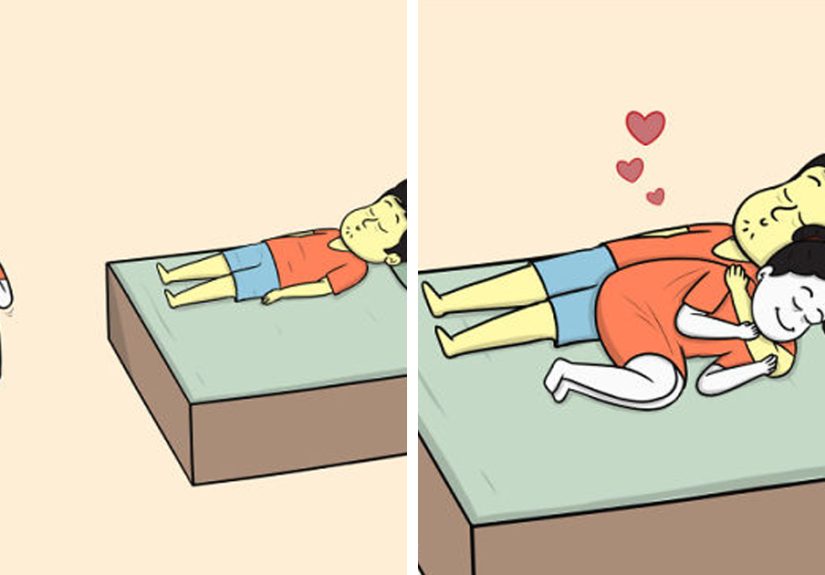
- Bedtime: Early sleeper vs. night owl who says, “I’ll come to bed soon.” (Narrator: they won’t.)
- Affection styles: Hand-holding person vs. “I show love by doing chores (and existing near you).”
- Make-up moments: The silly ritual that repairs everythinglike a secret handshake, a code word, or a hug that says, “Reset?”
What These Comics Actually Teach (Beyond “Haha, That’s Us”)
They turn friction into data
When you draw (or write) the moment, you step back from it. You see the pattern: “Ohour fights aren’t about the
dishes. They’re about feeling unsupported.” That awareness is the first step toward doing something different.
They invite empathy without requiring a lecture
A comic can show two internal worlds at once: the partner who needs quiet to decompress and the partner who needs
conversation to reconnect. When both perspectives are portrayed with dignity, the reader feels the love behind the
mismatch.
They model repair, not perfection
Healthy couples don’t avoid conflict forever. They learn how to fight in ways that keep respect intact, and how to
repair quickly. Even a simple endingsharing a snack, making a joke, admitting “I overreacted”signals emotional safety.
Posting Relationship Comics Online: A Quick “Don’t Be Weird” Checklist
- Protect your partner’s dignity: No humiliation, no private vulnerabilities, no “gotcha” stories.
- Blur identifying details: Workplaces, family drama, financeskeep it general.
- Avoid contempt: If the punchline is “my spouse is awful,” it’s not comedy; it’s a red flag.
- Balance the narrative: If you show their quirks, show yours. Equal-opportunity self-roasting is healthier (and funnier).
Bonus: of Relatable Experiences (The Stuff Couples Recognize Immediately)
Most couples don’t feel “different” during the big romantic moments. They feel different in the tiny, weird places
like the exact second one person folds a towel into a crisp rectangle while the other creates what can only be
described as a cloth burrito. And somehow, this becomes a defining feature of your home: not the furniture, not the
paint color, but the fact that the towel debate returns every three days like a sitcom plot that refuses to die.
Another classic: the conversation timing mismatch. One partner wants to process out loud immediately
“Can we talk about what happened?”because talking is how their nervous system finds the off switch. The other partner
needs a pause, not because they don’t care, but because their brain is buffering. If you’ve lived this, you know how
easy it is to misread it: “You’re avoiding me” vs. “You’re attacking me.” But when couples start naming it kindly
(“I need 20 minutes to calm down, then I’m all yours”), the same difference becomes a teamwork strategy.
Then there’s the social battery gap. You go to a party. One of you is collecting new friends like
Pokémon; the other is calculating the distance to the exit while smiling politely. The funny part isn’t that one is
right and the other is wrongit’s that both experiences are real at the same time. Couples who thrive often develop
small rituals: a “check-in glance,” a code word, or an agreement that you can leave early as long as you send a nice
follow-up text to the host. It’s not glamorous, but it’s love in practice.
Daily life also reveals differences in what feels like love. One person feels cared for when their
partner sits down and talks, fully present. The other feels cared for when the trash magically disappears and the
annoying errand is handled without discussion. If you only do love your way, your partner can miss it entirely
like receiving a beautifully wrapped gift that contains a language you don’t speak. Couples often get happier when
they trade notes: “When you do X, I feel Y.” Not as a demand, but as a translation.
And finally, there are the moments that become inside jokesthe misheard phrase, the failed recipe,
the wrong turn that led to an unexpectedly great view. These are comic gold because they’re proof of resilience.
They say: even when we mess up, we can still be gentle with each other. Over time, that’s what many couples remember
mostnot whether the apartment was spotless, but whether it felt safe to be human in it.
Conclusion: Different Can Be Better (If You Stay on the Same Team)
Being different doesn’t doom a relationship. It just guarantees you’ll need a few shared tools: respect, repair,
curiosity, and the willingness to laugh with each other instead of at each other.
And if you want a creative way to celebrate that reality, “30 comics about us” is a surprisingly powerful format.
It turns everyday friction into storytelling, and storytelling into a reminder: love isn’t finding someone identical.
It’s building a life where two different people can both belong.