Table of Contents >> Show >> Hide
- Why NASA Decided to Hit a Harmless Asteroid on Purpose
- How the DART Mission Worked
- What Happened When DART Hit Dimorphos?
- Why This Matters for Saving the Planet
- The Real Hero Is Detection
- What DART Did Not Prove
- Planetary Defense Is More Practical Than Apocalyptic
- What Watching DART Felt Like: The Human Experience Behind the Mission
- Final Thoughts
If you pitched this as a movie, a studio executive would probably say, “Love it, but can we make the asteroid angrier?” Real life turned out to be better. NASA actually built a spacecraft, launched it across millions of miles of space, and deliberately slammed it into an asteroid moonlet in one of the boldest science-and-engineering tests of the modern era. The mission was called DART, short for Double Asteroid Redirection Test, and its job was gloriously simple: hit a space rock on purpose and see whether humanity could nudge a future threat off a collision course with Earth.
That sounds dramatic because it is dramatic. But it is also deeply practical. Planetary defense is not about blowing up random asteroids because Hollywood taught us to panic. It is about finding potentially hazardous objects early, understanding what they are made of, and learning whether a small push given years in advance could stop a very bad day for our species. In that sense, NASA’s asteroid test was not reckless. It was rehearsal. A dry run. A cosmic fire drill with much higher stakes and much cooler camera footage.
Why NASA Decided to Hit a Harmless Asteroid on Purpose
The asteroid system NASA chose was ideal precisely because it was not a threat. DART targeted Dimorphos, a small moonlet orbiting the larger asteroid Didymos. Neither object was on a collision course with Earth, and the test could not turn them into one. That made the pair perfect for a controlled planetary defense experiment. Scientists could measure Dimorphos’ orbital period around Didymos before and after impact and determine whether the crash changed its motion.
In plain English, NASA picked a safe target with a built-in measuring tape. Instead of trying to shove a lone asteroid and guessing what happened, the mission used a binary system where astronomers could watch the smaller body circle the larger one and calculate whether its orbit had changed. That was the beauty of the setup. It was elegant, measurable, and refreshingly free of “oops, we accidentally endangered Earth” energy.
The mission also fit into a bigger truth about asteroid defense: the best way to stop an impact is usually not with a last-second miracle. It is with time. A tiny velocity change, applied years before a predicted encounter, can become a huge miss distance later. That is why planetary defense is really a story about early warning, careful math, and cool heads rather than action heroes giving emotional speeches in front of fireballs.
How the DART Mission Worked
A Small Spacecraft With a Big Job
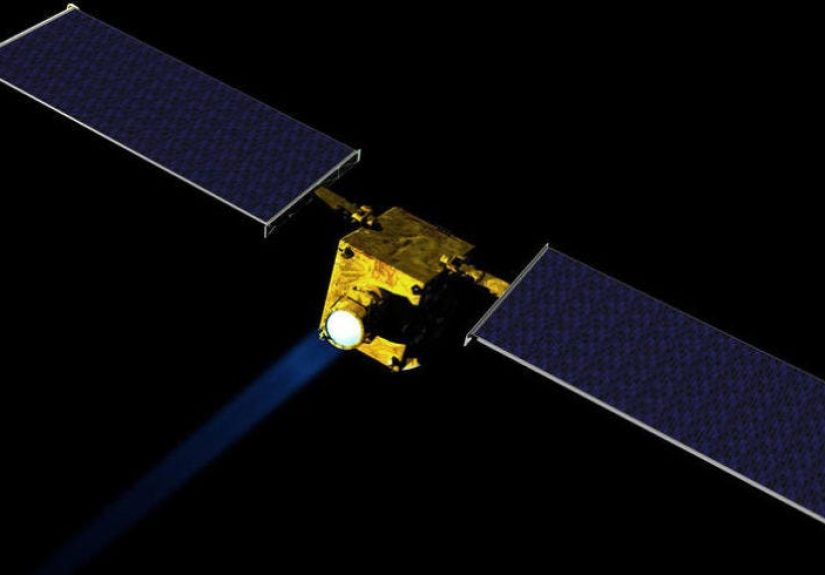
DART launched in late 2021 aboard a SpaceX Falcon 9 rocket and spent less than a year cruising toward the Didymos system. At impact, the boxy spacecraft weighed roughly 570 kilograms, or about 1,260 pounds. That is not exactly heavyweight champion territory when your target is a rocky object about 170 meters wide. But DART had one enormous advantage: speed. It struck Dimorphos at roughly 14,000 miles per hour.
This was not a demolition mission. DART was designed as a kinetic impactor, which means it relied on motion, not explosives. The spacecraft’s job was to transfer momentum to the asteroid and slightly alter its orbit. In the world of planetary defense, that tiny nudge matters. Nobody was trying to vaporize Dimorphos into cosmic confetti. The goal was to test whether a direct hit could shift an asteroid’s path enough to matter over time.
The Spacecraft Had to Think for Itself
One of the most impressive parts of the mission was navigation. Hitting a relatively small object in deep space is not like tossing a dart at a pub wall. It is more like throwing a needle across a dark stadium while riding a roller coaster. DART used its DRACO camera and an autonomous guidance system called SMART Nav to identify the right target and steer into it without real-time joystick control from Earth.
That autonomy was essential because space is rude about time delays. By the time a human operator on Earth saw the final images and tried to correct course, the mission would already be over. DART had to make the final decisions itself, distinguishing Dimorphos from Didymos and guiding the spacecraft into the smaller body. In other words, the mission depended on a camera, software, physics, and a collective refusal to blink.
A Front-Row Seat to the Crash
DART also deployed a tiny companion spacecraft called LICIACube before impact. Its job was to watch the collision and photograph the aftermath, including the plume of ejecta blasted from the asteroid. Those images gave scientists a much better view of what happened after the hit and helped transform the mission from a stunt into a robust scientific experiment.
Meanwhile, telescopes on Earth and major observatories in space, including Hubble and Webb, tracked the system too. This was not just NASA throwing a metal box at a rock and hoping for the best. It was a coordinated global observing campaign built to squeeze every useful bit of data out of one historic collision.
What Happened When DART Hit Dimorphos?
Here is the headline result: DART worked. Before impact, Dimorphos orbited Didymos in about 11 hours and 55 minutes. After impact, that orbital period was shortened by roughly 33 minutes. Mission planners had said that changing the orbit by just 73 seconds would count as success. Instead, DART blew past that benchmark like it had somewhere to be. Technically, it did. Straight into a rock.
That result was historic for a simple reason: humanity changed the motion of a natural celestial object for the first time. Not in a simulation. Not in a concept study. In reality.
But the plot thickened after the celebration. Scientists discovered that the impact did more than merely transfer the spacecraft’s own momentum. It blasted large amounts of debris off Dimorphos, and that escaping material acted like a recoil jet, giving the asteroid extra push. In planetary defense language, this is called momentum enhancement. In regular language, it means the asteroid got an additional shove from its own flying rubble.
That detail matters a lot. Later analysis showed that ejecta substantially amplified the effect of the collision, which helps explain why DART was so effective. Researchers also found that Dimorphos likely has weak, loosely bound surface material, something closer to a rubble pile than a tidy bowling ball. That made the asteroid more responsive to impact than a denser, stronger object might have been.
The aftermath was wonderfully messy. Hubble observations revealed dozens of boulders knocked loose by the crash, some drifting away at little more than a brisk tortoise pace. Scientists also found that Dimorphos’ shape changed after the collision, and newer research showed the impact even altered the binary system’s motion around the Sun by a tiny amount. The shift was minuscule, but the lesson was enormous: in space, tiny changes can become big outcomes when you give them enough time.
Why This Matters for Saving the Planet
DART did not “save Earth” because Earth was never in danger from Didymos or Dimorphos. What it did do was prove that one of the leading asteroid-deflection strategies is physically plausible in the real world. That is a major step forward.
If scientists someday discover a hazardous near-Earth object with enough warning time, a DART-style mission could be part of the response. The principle is straightforward. You do not need to shatter the object into movie-trailer fragments. You just need to alter its speed slightly so that, years later, it arrives at the dangerous intersection of space and time either early or late. Earth passes through that spot, the asteroid misses, and civilization gets to keep its weekend plans.
This is why early detection is everything. Kinetic impact is far more useful when you find the threatening object years in advance. A small push today can turn into a huge miss later. Wait until the asteroid is practically waving at your satellites, and your options get uglier fast.
The Real Hero Is Detection
NASA’s planetary defense strategy begins with finding objects before they find us. At the moment, there is no known significant asteroid threat for the next hundred years or more. That is the good news. The less relaxing news is that many smaller near-Earth objects remain undiscovered, and some of them are still large enough to cause regional damage.
That is why NASA continues to fund sky surveys, radar observations, orbit calculations, and impact-monitoring systems such as Sentry and Scout. Ground-based observatories do a huge amount of this work already, but space-based detection adds a crucial advantage. Some dark asteroids are difficult to spot in visible light, especially if their orbits keep them in tricky observing positions.
Enter NEO Surveyor, NASA’s upcoming asteroid-hunting space telescope. Unlike DART, which tested how to deflect an asteroid, NEO Surveyor is about finding and characterizing hazardous objects in the first place. It is designed to detect hard-to-find asteroids and comets by sensing their heat in infrared wavelengths. That matters because an asteroid does not get safer just because it is hard to see. Space is full of introverts, and some of them are dangerous.
Together, DART and NEO Surveyor represent the two halves of a serious planetary defense program: first spot the problem, then know what to do about it.
What DART Did Not Prove
As exciting as the mission was, DART was not a magical one-size-fits-all answer. It tested one deflection method on one specific type of asteroid system. Different asteroids may respond differently depending on size, structure, composition, spin, and internal strength. A dense metallic object could behave differently from a loosely packed rubble pile. A solitary asteroid might present different challenges from a moonlet in a binary system.
DART also was not a last-minute disaster-response drill. The mission was planned carefully and executed under ideal conditions. In a real emergency, decision-makers would face larger uncertainties, tighter deadlines, and much tougher political and international coordination. NASA’s regular tabletop exercises with other agencies exist for that reason. They help experts think through the ugly questions before those questions come with a countdown clock.
So the sober takeaway is this: DART was a breakthrough, not the final chapter. It moved the field from theory into demonstrated capability, while also revealing how much more there is to learn.
Planetary Defense Is More Practical Than Apocalyptic
The phrase “save the planet” makes for a killer headline, but the underlying work is remarkably unglamorous in the best possible way. It involves data pipelines, orbital mechanics, thermal modeling, observing time, coordination meetings, simulation exercises, and years of steady engineering. Planetary defense is what happens when humanity decides to be responsible on a cosmic scale.
That may sound less cinematic than Bruce Willis jogging toward a nuclear device in space, but frankly, it is more reassuring. The DART mission showed that intelligent preparation beats dramatic improvisation. The real triumph was not just that NASA hit an asteroid. It was that decades of scientific groundwork, patient planning, and international collaboration made that hit meaningful.
That is what should make people sit up a little straighter. The sky is not falling. But for once, humanity has evidence that if a threatening asteroid ever appears on the guest list, we may not have to just stand there holding snacks and screaming.
What Watching DART Felt Like: The Human Experience Behind the Mission
There is a special kind of tension in watching a deep-space mission reach its final moments. It is not loud tension. It is not the kind with screeching violins and someone shouting, “We’re out of time!” It is quieter than that, almost stranger. As DART closed in on Dimorphos, the final DRACO images became sharper and more dramatic by the second. What had been a point of light turned into a lumpy, very real world. The audience on Earth was watching a machine perform an act of astonishing precision millions of miles away, and the whole thing felt both impossibly distant and weirdly intimate.
For engineers and scientists, the experience had to be equal parts pride, terror, and caffeine. Years of design decisions, simulations, reviews, tests, and “what if this fails?” conversations were compressed into a few final minutes. Every pixel mattered. Every guidance update mattered. The spacecraft had to recognize the correct target, adjust autonomously, and keep going with no chance for a human to grab the wheel. It was the kind of moment that reminds everyone in mission control why spaceflight has a habit of making very smart people stare at screens like they are trying to will reality into cooperating.
For the public, DART had a different emotional flavor. It was one of those rare science stories that did not need much translation. You could explain it to a kid in a single sentence: “NASA is trying to hit an asteroid so we know how to move one if we ever need to.” That clarity gave the mission unusual power. It was technical, yes, but it was also instantly understandable. You did not need an advanced degree to appreciate the stakes. This was science with a purpose everybody could feel.
The experience also carried something that many space stories quietly hold: relief. Not relief because Earth had narrowly escaped doom, but relief because the test showed competence. In a world that often feels like it is improvising in the dark, DART was a reminder that human beings can still do the long, difficult, coordinated work of solving future problems before they become present disasters. That is emotionally significant. It turns abstract faith in science into something visible.
There was wonder in it too. The final images from DART were not polished concept art. They were raw, immediate, and almost eerie. A small asteroid filled the frame, growing larger until the feed stopped. That abrupt ending gave the moment unusual force. The spacecraft had done exactly what it was built to do, and then it was gone. Mission accomplished in the most literal way possible.
Even the aftermath had a human quality to it. Scientists kept watching the dust tail, the drifting debris, the altered orbit, the newly misshapen moonlet. The story did not end with impact; it opened into a long period of learning. That is perhaps the most honest expression of how science feels from the inside. Triumph is real, but it is quickly followed by questions. What exactly happened on impact? How much did ejecta contribute? Would another asteroid respond the same way? DART gave humanity a milestone, but it also gave researchers a giant to-do list, which in science is practically a love language.
In that sense, the experience of DART was not just about smashing an asteroid. It was about seeing preparation, uncertainty, fear, ambition, and curiosity all collide in one unforgettable test. And for anyone who watched it unfold, the takeaway was both thrilling and oddly comforting: the universe is still dangerous, but at least now we know we can swing back.
Final Thoughts
NASA’s asteroid impact test was one of those rare moments when science fiction lost its bragging rights to science fact. DART proved that a spacecraft can intentionally strike an asteroid and measurably change its motion. It also revealed that real asteroids are complicated, messy, and scientifically delightful troublemakers. That is exactly why this mission mattered.
Planetary defense is no longer just a stack of white papers and anxious hypotheticals. It now includes a successful full-scale demonstration, growing observational infrastructure, and a clearer understanding of what future missions might need to do. There is still a lot to learn, and there always will be. But after DART, humanity is no longer entering that conversation empty-handed.
That is the real story behind the headline. NASA did not just smash an asteroid for fun, though admittedly that part was pretty great. It ran a dry run for protecting Earth, and the test suggests that with enough warning, enough preparation, and enough smart people doing careful work, we may actually be capable of nudging catastrophe out of our lane.