Table of Contents >> Show >> Hide
- Who Is Sylvain Sarrailh (Tohad), and Why Does His Work Feel So Cinematic?
- The Big Hook: Nostalgia Meets “What If This Was Rated R?”
- What “Tarantino-Like” Means in Illustration (Without Turning This Into Film School)
- How Sarrailh Turns Cute Into Menacing (Without Losing the Joke)
- Specific Examples Fans Love (Because the Internet Has a Type)
- Is This Fan Art, Parody, or Something Else?
- Why This Trend Keeps Winning the Algorithm
- How to Look at These Pieces Like a Design Nerd (Even If You’re Not One)
- A Quick Reality Check: Dark Aesthetic Doesn’t Have to Mean Graphic
- What Sarrailh’s Work Says About Us (Yes, You Too)
- Extra : The Experience of Seeing Childhood Icons “Go Dark” (And Why It’s Weirdly Fun)
There’s a special kind of emotional whiplash that happens when you see a character you once trusted with your entire after-school snack budget
suddenly staring back at you like they just walked out of a gritty, dialogue-heavy revenge flick.
You blink. You laugh. You clutch your inner child like it’s a fragile snow globe. And thenbecause you’re humanyou zoom in.
That push-pull is exactly where French concept artist Sylvain Sarrailh (also known as Tohad) likes to play.
In a series that ricochets around the internet under titles like “beloved childhood characters turned into Tarantino-like monsters,” Sarrailh takes
familiar iconsstorybook sweethearts, Saturday-morning troublemakers, comfort-blanket cartoonsand drops them into a darker, cinematic alternate universe.
It’s parody with polish. Nostalgia with a sharp edge. A “what if?” that’s equal parts hilarious and unsettling.
Who Is Sylvain Sarrailh (Tohad), and Why Does His Work Feel So Cinematic?
Sarrailh is a professional concept artist and art director whose career lives at the intersection of illustration and entertainment design.
In interviews and portfolio notes, he’s described moving from early training and work that included architecture and comics into concept art for games
and film-style projectsfields where mood, readability, and visual storytelling are the whole job.
If you’ve ever wondered why his “monster makeover” pieces don’t look like quick doodles but instead like posters for a movie you didn’t know you needed,
that’s the reason: concept artists are trained to make a single image do a lot of narrative heavy lifting. Who’s the hero? Who’s the threat?
What happened five minutes before this frame? What happens five minutes after?
Sarrailh has even shared a deceptively simple principle that shows up in everything he makes:
start with readability. In other words, the image should communicate quicklybefore you admire brushwork, before you decode references,
before your brain starts writing fan fiction in the margins.
The Big Hook: Nostalgia Meets “What If This Was Rated R?”
Childhood characters are designed to be instantly recognizable. Big silhouettes. Clear colors. A facial expression you can read from across the room
(and from the kitchen, where your parents are pretending not to watch with you).
When an artist flips that visual languagekeeping the recognition but changing the intentyou get a jolt:
the character is the same, but the world isn’t. That jolt is the engine of this trend.
It’s also why these images spread so fast online: they’re immediately legible, but emotionally complicated.
And yes, the emotional part matters. Nostalgia is often described as a bittersweet feelingwarm, comforting, and a little achy at the same time.
Dark reimaginings tap that bittersweetness and crank up the contrast. They’re not just saying, “Remember this?”
They’re saying, “Remember this… but now imagine it survived adulthood.”
What “Tarantino-Like” Means in Illustration (Without Turning This Into Film School)
When people say “Tarantino-like,” they’re usually pointing to a handful of recognizable vibes:
stylized intensity, bold cinematic staging, pop-culture remix energy, and often a tone that swings
from funny to tense in the same breath. In Sarrailh’s case, it’s less about copying any one filmmaker’s exact look and more about borrowing that
heightened “movie moment” feeling.
Think of it as genre seasoning. The characters aren’t literally becoming film characters. They’re being reframed with the visual cues of
crime-thrillers, revenge stories, or grindhouse postershigh contrast, confident poses, ominous props, and a sense that the scene is mid-chaos
even if the image is perfectly composed.
How Sarrailh Turns Cute Into Menacing (Without Losing the Joke)
1) He keeps the silhouette, then raises the “threat level”
The fastest way to keep a character recognizable is to preserve the outline: ears, hair shape, iconic costume pieces, or a trademark body proportion.
Sarrailh often holds onto those key shapes, then amplifies sharper angles, heavier shadows, and more assertive posture. The result reads like:
“Same character. Different life choices.”
2) Props rewrite the story in one second
Props are narrative shortcuts. Swap a picnic basket for something that suggests danger, swap a toy for a tool, swap wide-eyed wonder for a weary stare,
and suddenly the whole backstory changes.
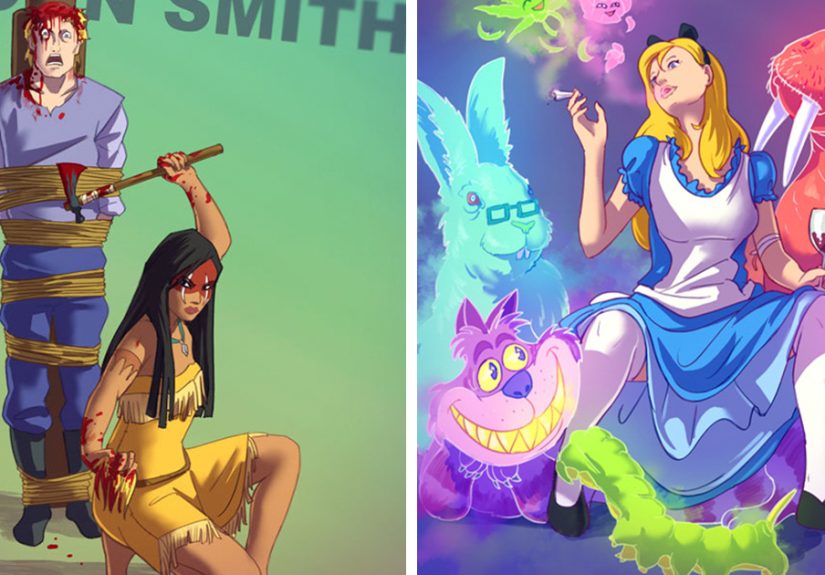
One of the most effective examples is his Alice in Wonderland-inspired piece, staged like a neon-soaked poster.
Alice is posed with a cool, unbothered confidence, surrounded by surreal companions and hazy atmosphere. It’s playful, satirical, and undeniably “adult”
in toneless tea party, more late-night lounge. The humor lands because the core cast is still recognizable, but the vibe has been completely rerouted.
3) Color stays funlighting turns serious
A lot of “dark” fan art goes monochrome. Sarrailh often does the opposite: he keeps vibrant, almost candy-like color, then uses dramatic lighting and
contrast to make it feel dangerous. That clash is part of the appeal. Your eyes say “bright and familiar,” while your brain says “something is off.”
4) Expressions shift from “friendly” to “knowing”
Cute characters usually wear emotions on their sleeve. In these reimaginings, expressions get more ambiguous:
a half-smirk, a tired gaze, a look that suggests the character has seen things. Not graphic thingsjust… plot.
The kind of look that implies backstory, consequences, and a soundtrack that kicks in at the worst possible moment.
5) Backgrounds act like world-building, not decoration
In concept art, backgrounds aren’t wallpaper; they’re evidence. A sign, a skyline, a grimy hallway, a too-clean spotlightthese details tell you what
kind of world the character inhabits now. Sarrailh’s environments often feel like places you could explore in a game:
stylized, readable, and loaded with story hints.
Specific Examples Fans Love (Because the Internet Has a Type)
The series gets shared under a broad umbrellacartoons, fairy tales, and pop-culture iconsso different posts highlight different favorites.
But the recurring pattern is consistent:
- Classic storybook characters reimagined with a gritty, poster-like presence (the Alice piece is a standout for its bold staging).
- Kid-TV energy upgraded into action-hero confidencecharacters who look like they swapped juice boxes for a mission briefing.
- “Too wholesome to fail” ensembles flipped into something eerily powerful, like they’re about to deliver a one-liner and walk away in slow motion.
Importantly, the appeal isn’t just “look, it’s darker.” It’s that the redesigns feel plausible inside their new genre.
That’s a professional skill: the characters don’t look randomly corruptedthey look art-directed.
Is This Fan Art, Parody, or Something Else?
Most viewers encounter these images the way they encounter memes: detached from the original posting context, re-shared with captions like
“my childhood has been robbed” or “this is unreasonably cool.”
From a creative standpoint, these works sit in the broad neighborhood of transformative fan artart that borrows recognizable elements
but changes tone, message, and context. That’s why it feels like commentary on how we relate to childhood media as adults:
the characters become symbols for nostalgia, cultural remixing, and the way pop culture evolves in our heads.
From a legal standpoint, it’s more complicated and depends on context, jurisdiction, and usage.
In the U.S., discussions often revolve around concepts like fair use and whether a work is “transformative.”
The key idea (in plain English) is that commentary, parody, and meaningful transformation are treated differently than straightforward copying.
This isn’t legal advicejust the reason these images are often discussed as “parody,” “satire,” or “transformative reinterpretation.”
Why This Trend Keeps Winning the Algorithm
It’s instantly understandable
You don’t need a caption. You recognize the character immediately. That instant recognition is social-media gold.
It invites debate without requiring homework
People can argue about tone (“too dark!”), craft (“actually stunning”), or meaning (“this is what adulthood does to us”),
all without watching a two-hour explainer video.
It scratches the reboot itchwithout the reboot budget
We live in an era of remakes, reboots, and “live-action versions of your childhood.” Dark reimaginings function like micro-reboots:
one image, one premise, infinite headcanon.
How to Look at These Pieces Like a Design Nerd (Even If You’re Not One)
- Start with the silhouette. Identify the one shape that makes the character unmistakable.
- Spot the story prop. What object tells you the “new genre” in one second?
- Read the lighting. Is it playful, ominous, theatrical, or documentary-like?
- Check the expression. Innocent? Confident? Haunted? (Or the dangerous fourth option: smug.)
- Notice what’s missing. Often the “cute” context is removedno bright playground, no cozy homeand that absence does half the work.
A Quick Reality Check: Dark Aesthetic Doesn’t Have to Mean Graphic
The phrase “Tarantino-like monsters” can sound more intense than the actual viewing experience.
Many pieces lean into stylization and attitudemore “poster for an edgy alternate universe” than anything explicitly graphic.
The “monster” part is often metaphorical: it’s about subverting innocence, not wallowing in shock.
That distinction matters because it’s what keeps the work in the realm of pop-culture remix and satire rather than pure horror.
The best of these images are clever first and dark second.
What Sarrailh’s Work Says About Us (Yes, You Too)
If you’re drawn to these reimaginings, it’s probably not because you want your childhood ruined.
It’s because you want it expanded. You want to see familiar stories through a new lens:
tougher, funnier, stranger, more grown-upwithout losing the emotional shortcut those characters still provide.
That’s why this style resonates across different fandoms. It’s not really about any single character.
It’s about the shared language of childhood mediaand the shared experience of looking back at it with adult eyes.
Extra : The Experience of Seeing Childhood Icons “Go Dark” (And Why It’s Weirdly Fun)
The first time you stumble onto a piece like this, it’s rarely a calm museum moment. It’s usually a scroll-and-stop situation.
You’re half-paying attention, your thumb is on autopilot, and then your brain hits the brakes because it recognizes the outline immediately.
That recognition is almost physicallike hearing the first two notes of a theme song you haven’t heard in years.
And for a split second, you expect comfort.
Then the details load in. The confident pose. The dramatic lighting. The “I’ve been through a lot” facial expression.
Maybe there’s a prop that reframes the whole character into an action-hero archetype. Maybe the environment looks like it belongs in a gritty video game level.
Your nostalgia doesn’t disappear; it just gets… remixed. And your reaction becomes a strange combo of
“Wait, that’s wrong” and “Okay, but that’s kind of cool.”
What makes the experience stick is the mental ping-pong it creates. You remember the original character as a symbol of safetysimple stories, clear morals,
happy endings that arrived on schedule. The reimagined version suggests something messier: a world with consequences, higher stakes, and fewer reset buttons.
That contrast can feel like a joke about adulthood (because it is), but it can also feel like a tiny act of storytelling generosity:
the character didn’t vanish when you grew up; they “grew” with you in a new artistic language.
There’s also a social experience layered on top. These images practically beg to be shared with a friend who will instantly get it.
You send it with a message like, “LOOK WHAT THEY DID,” even though nobody actually did anything to you personally.
Then your friend replies with either horrified laughter or immediate obsessionsometimes both.
And suddenly you’re not just looking at art; you’re having a nostalgia conversation: what cartoons you watched, what characters you loved,
which ones you secretly found annoying, and which stories you realize you misremembered completely.
The funniest part is how fast your brain starts building an entire fake movie around a single illustration.
You invent a plot. You cast a soundtrack. You imagine the trailer voice saying something dramatic that ends in a joke.
That’s when you realize why concept-art-level presentation matters here: the image isn’t just a punchline; it’s a portal.
It invites you to participateto do the “what if?” work in your head without needing a full film, a full comic, or a full reboot.
And if you’re worried this kind of art “ruins” childhood characters, the opposite is often true.
It proves the characters are strong enough to survive reinterpretation. The originals are still there, unchanged.
The darker versions are just a playful mirror held up to how we changehow our tastes evolve, how we learn new genres,
how we turn comfort stories into cultural references and inside jokes.
In that sense, seeing childhood icons go dark isn’t a betrayal. It’s a weird little celebration: these characters mattered enough
to be reimagined, not forgotten.