Table of Contents >> Show >> Hide
- Quick Snapshot: What Porsche’s “Natural Fiber” Actually Is
- Why Porsche Started in Motorsport (Because Racetracks Are Honest)
- The “Made From Plants” Part: Flax, Hemp, and a Big Composite Caveat
- How Porsche Manufactures Natural-Fiber Parts (It’s Not Arts & Crafts Hour)
- Where Porsche Has Used Natural-Fiber Composites So Far
- Performance: Is It Actually Any Good, or Just a Green Sticker?
- Sustainability: Why This Matters Beyond PR
- So… When Do We Get Plant-Fiber Porsche Road Cars?
- What This Means for the Future of Composites
- of Real-World “Experience” Around Porsche’s Plant-Based Composites
Carbon fiber has a reputation: featherlight, crazy stiff, and expensive enough to make your wallet file a restraining order.
It’s also notoriously energy-intensive to produce. So Porsche did what any brand with a motorsport lab and a healthy obsession
with lap times would douse racing as a science experiment and swap some carbon-fiber parts for something that sounds like it
belongs in a linen closet: plant-based natural fiber.
The result is a composite material made primarily from flax (and sometimes hemp), designed to behave a lot like carbon fiber in
the places that matterweight, stiffness, and durabilitywhile cutting the environmental burden tied to traditional carbon fiber
production. And yes, it can look like carbon fiber too, which is important, because race cars have an image to maintain.
Quick Snapshot: What Porsche’s “Natural Fiber” Actually Is
Porsche isn’t weaving a door out of garden twine and calling it innovation. The key idea is familiar to anyone who’s ever seen a
carbon-fiber hood: you take strong fibers, embed them in a resin, and mold them into a lightweight, stiff shape. The difference
is the fiber itself. Instead of carbon strands, Porsche has used agriculturally produced flax fibers (and referenced hemp as part
of the broader “organic fiber mix” concept). In Porsche language, you’ll often see terms like natural fibre reinforced plastic
or natural fibre composite.
This matters because in composites, the reinforcement fibers do a lot of the heavy lifting: they help determine stiffness, strength,
and how the part behaves under load. The resin mostly holds everything together and transfers forces between fibers. So when Porsche
changes the fiber, it’s not just a sustainability flexit’s a structural engineering choice.
Why Porsche Started in Motorsport (Because Racetracks Are Honest)
Porsche didn’t roll this out first on a mass-market road car. It started where failure is loud, public, and measured in tenths:
motorsport. In 2019, Porsche introduced the 718 Cayman GT4 Clubsport as the first “production race car” to feature body panels
made of natural-fibre composite materialspecifically the driver and passenger doors and the rear wing, made from an organic fiber
mix sourced primarily from agricultural by-products such as flax or hemp fibers. Porsche stated these parts offered similar properties
to carbon fiber in terms of weight and stiffness.
In other words, Porsche picked parts that are performance-relevant but not the core survival cell. That’s the sweet spot for a
new material: meaningful impact without gambling driver safety on a first draft.
The “Made From Plants” Part: Flax, Hemp, and a Big Composite Caveat
Let’s be precise: the fiber reinforcement can be plant-based, but the part is still a composite system. Many high-performance
composites use epoxy resins that are not plant-based (though bio-based resins exist and are improving). So “carbon fiber made from
plants” is a catchy headline, not a chemistry textbook.
Still, swapping the reinforcement fiber is a big deal because carbon-fiber supply chains and production energy are major pain points.
Porsche’s approach focuses on replacing carbon fiber where plant fibers can do the jobespecially in non-structural or semi-structural
components.
How Porsche Manufactures Natural-Fiber Parts (It’s Not Arts & Crafts Hour)
1) Resin Transfer Molding (RTM) + a Balsa Core for Doors
Porsche has described a sandwich-style construction for certain components, including doors, using light balsa wood as the core.
The technique correlates to the resin transfer moulding (RTM) process used in carbon-fiber productionbasically, fibers (and the core)
are placed in a mold, resin is injected, and the whole thing cures into a stiff, lightweight part.
2) Autoclave Processes for Aerodynamic Pieces
Porsche has also described using an autoclave process for a rear wingimpregnating layers with epoxy resin and then baking the part
under heat and pressure. That should sound familiar if you’ve ever read about “prepreg” carbon fiber.
3) Vacuum Infusion + Stiffening Tech for Larger Body Kits
When Porsche expanded from doors and a wing to a broader body kit on the 718 Cayman GT4 Clubsport MR, it described newly added components
made via a vacuum infusion process and incorporating Bcomp’s powerRibs™ technology to meet stiffness requirements. The idea is to tune
thickness and fiber orientation so the part is strong where it needs to beand not heavy where it doesn’t.
Where Porsche Has Used Natural-Fiber Composites So Far
2019: 718 Cayman GT4 Clubsport (Doors + Rear Wing)
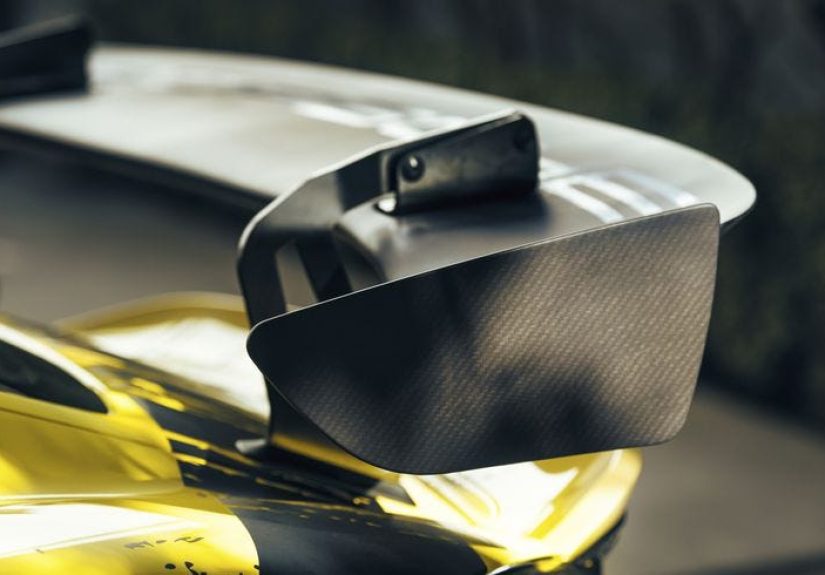
The GT4 Clubsport is where Porsche planted its flag: doors and rear wing made from an organic fiber mix (flax/hemp by-products), aiming
for carbon-like weight and stiffness. Coverage at the time described flax as the primary fiber and noted that at a glance the weave can
resemble carbon fiberalthough production pieces are typically painted or wrapped for racing liveries anyway.
2020: 718 Cayman GT4 Clubsport MR (A Full Natural-Fiber Body Kit Test)
In 2020, Porsche went further: the 718 Cayman GT4 Clubsport MR tackled the Nürburgring 24-hour race featuring a complete body kit made of
natural-fibre composite materials. Porsche described expanding natural-fiber components to include front and rear aprons, spoiler, lids,
mudguards, diffuser, and aerodynamic finsreplacing metal and injection-molded plastic components from the production sports car.
2021: Mission R Concept (Natural-Fiber Reinforced Plastic in an EV Race Future)
Porsche’s Mission R concept pushed sustainability into the spotlight. Porsche described many add-on parts made of natural fibre reinforced
plastic (NFRP) based on agriculturally produced flax fibers, visible on exterior aero pieces like the front splitter, side skirts, and diffuser.
Porsche also stated that producing the renewable flax fiber creates significantly less CO2 than carbon fiber, and that the material delivers
the stiffness needed for semi-structural components with only a small weight penalty (Porsche cited less than 10% additional weight for required stiffness).
2025: Evolving the Tech on a Porsche GT3 Cup (Natural Fibers, New Aesthetics)
The development didn’t stop at “hey, look, it’s beige and eco-friendly.” In 2025, Bcomp described new exterior components on a Four Motors Porsche GT3 Cup car,
including a hood, rear wing end plates, and front bumper dive planes, produced with flax-fiber reinforcement fabrics. The company claimed that when produced in an
autoclave in combination with powerRibs™, natural-fiber parts can reach equivalent stiffness and weight to carbon-fiber components, while improving vibration damping
and crash behavior.
Performance: Is It Actually Any Good, or Just a Green Sticker?
Porsche’s own messaging has been consistent: natural-fibre composites are best suited to areas that are not, or only partially, part of the vehicle structure.
That’s not a knockit’s honest engineering. Carbon fiber remains a top-tier choice for high-load structural applications. But in the “semi-structural and aero”
neighborhood, plant-based fibers can be surprisingly competitive.
Stiffness and Weight: “Similar Properties” Where Porsche Uses It
Porsche has stated that for non-structural components, its recyclable natural-fibre composite materials share properties similar to carbon-fibre composites in terms
of weight and stiffness and meet the same safety and quality standards. That’s a carefully worded claimand it matches the strategy: deploy natural fibers where they
can meet targets without needing to be a carbon-fiber clone in every scenario.
Vibration Damping: A Quiet Superpower
Here’s where natural fibers shine: damping. Porsche has described significantly improved vibration damping in natural-fiber components compared to conventional composites,
and it has pointed to improvements in how the material behaves in the real world of curbs, bumps, and long-distance endurance racing. Some reporting and partner claims
have described dramatically better damping characteristics than carbon fiberhelpful for reducing harshness and potentially improving durability of adjacent components.
Crash Behavior: Less “Carbon Shrapnel,” More Manageable Breakage
Carbon fiber can splinter in sharp, nasty ways when it fails. Porsche has described natural-fiber composites as splintering into larger, less sharp pieces, which can reduce
cleanup and hazards after impacts. Partner claims similarly emphasize ductile crash behavior and reduced sharp shattering.
Sustainability: Why This Matters Beyond PR
Energy and CO2: Attacking Carbon Fiber’s Biggest Weakness
Carbon fiber’s environmental issue is not that it existsit’s how it’s made. Production is energy-intensive, and scaling it sustainably is hard. Porsche and partners have
framed flax-based composites as requiring substantially less energy and producing far less CO2 than carbon fiber. Porsche’s Mission R communication, for example,
highlighted a major CO2 reduction tied specifically to producing the renewable flax fiber compared to carbon fiber.
End-of-Life and Circularity: Still a Work in Progress, But Promising
Traditional carbon-fiber recycling is improving, but it’s complicated and often downcycles the material. Natural fibers can offer different end-of-life pathways. Some partner
messaging highlights that parts may be used for thermal energy recovery rather than landfill disposalthough, as with any composite, the resin system and local waste infrastructure
matter a lot. “Sustainable” doesn’t mean “magically compostable.” It means “better trade-offs,” and Porsche is trying to quantify those trade-offs in the harshest testing environment
it knows: racing.
So… When Do We Get Plant-Fiber Porsche Road Cars?
The short answer: you may see it first in specific, targeted applicationsespecially panels, aero parts, and interior structures where stiffness-to-weight is important but the part
isn’t the primary crash structure.
The longer answer is why motorsport matters: it’s a validation pipeline. Porsche has used racing as a test bed for materials, processes, and technologies for decades, and the natural-fiber
program fits that pattern. If the parts survive endurance racing, they’re more likely to earn a place on high-performance road cars where customers expect both speed and a conscience.
There are real engineering hurdles: natural fibers vary more than industrial carbon fiber, moisture management is critical, and surface finish/long-term aging must be tightly controlled. But the
direction is clearPorsche is treating plant-based composites as a serious performance material, not just a sustainability accessory.
What This Means for the Future of Composites
Porsche’s plant-based composite story is bigger than one brand. It signals a shift in how performance engineering thinks about materials: not “carbon fiber everywhere,” but “the right composite for
the right job,” balancing stiffness, safety, cost, manufacturability, and footprint.
If carbon fiber is the high-performance baseline, natural-fiber composites are becoming the smart alternative for specific partsespecially as reinforcement architectures (like ribbing technologies),
manufacturing methods, and supply chains improve. The next “wow” moment may not be a new engine. It may be a new door.
of Real-World “Experience” Around Porsche’s Plant-Based Composites
If you want to understand why Porsche is interested in plant-based composites, skip the lab for a moment and imagine the paddock. Race weekends are full of quick fixes, fast inspections, and even faster
opinions. A material doesn’t earn respect because it’s green; it earns respect because it survives contact with realitycurbs, debris, heat cycles, and the occasional “creative” driver moment.
In that environment, natural-fiber composites make a strong first impression because they don’t ask teams to rewrite the whole playbook. The parts are still composites: they’re laid up, molded, cured,
and finished with many of the same steps teams already know from carbon-fiber workflows. That familiarity matters. When a door, wing, or aero piece arrives, technicians care less about the origin story
and more about the basics: Does it fit? Does it hold alignment? Does it stay stiff at speed? Can we repair it on a deadline that ends in minutes, not days?
The next “experience” is tactile. Unpainted natural-fiber weaves have a distinctive lookmore organic, less “techno-checkerboard.” But here’s the funny part: the more road-relevant the tech becomes,
the less you’ll see that natural weave. Paint, wraps, and coatings are the grown-up clothes of exterior bodywork. If Porsche can paint natural-fiber parts like any other panel, the material stops being a
novelty and starts being a normal optionexactly the point.
Then there’s the driving feel, and while drivers don’t usually describe body panels in poetry, they do care about vibration and durability. Tracks like Nürburgring or Sebring punish cars with bumps that
can rattle components loose, fatigue mounts, and turn small vibrations into big headaches over endurance distances. Better damping isn’t just comfort; it’s reduced stress on the whole system. If a material
helps calm vibrations, it may also help adjacent parts live longerfasteners, brackets, mounts, and even sensors.
Crash behavior becomes the most practical “experience” of all. When composites fail, the cleanup and safety implications are real. A material that breaks into larger, less sharp pieces can reduce hazards
and shorten the time between incident and return to racing. Nobody celebrates a crash, but everyone appreciates a faster, safer recovery.
Finally, there’s the cultural experience: natural-fiber composites change the story teams tell. Motorsport isn’t just engineering; it’s messaging. A car that proves sustainability can coexist with speed
becomes a rolling argumentespecially when it’s wearing a Porsche crest. And that’s why these plant-based composites matter: they’re not asking performance to slow down. They’re asking performance to evolve.