Table of Contents >> Show >> Hide
- What Refettorio Felix Actually Is (and Why the Name Sounds Italian)
- The People Behind the Plates: Food for Soul, The Felix Project, and St Cuthbert’s
- Ilse Crawford’s Big Idea: Beauty Isn’t a BonusIt’s a Human Right
- A Tour of the Space: How Design Softens a Hard Day
- From Surplus to Three Courses: How the Kitchen Keeps It Real (and Delicious)
- Why Design Matters Here (No, It’s Not “Just Decor”)
- Lessons Worth Stealing (Legally) From Refettorio Felix
- How to Support the Mission (Even If You’re Nowhere Near Earl’s Court)
- Conclusion: A Soup Kitchen That Refuses to Look Like One
- Experiences: What It Feels Like to Step Inside Refettorio Felix
Picture this: you walk into a former church hall in West London and the vibe is less “institutional cafeteria” and more “somebody’s stylish, plant-filled living roomexcept with a professional kitchen that can crank out lunch for a crowd.” That’s Refettorio Felix: a community kitchen and drop-in center where rescued surplus food becomes restaurant-quality meals, and where design isn’t a luxuryit’s part of the service.
The story is equal parts hospitality, social impact, and interior design: chef Massimo Bottura’s Food for Soul brings the refettorio model (a modern-day refectory) to London, The Felix Project supplies rescued ingredients, and British designer Ilse Crawford (Studioilse) turns a once-bare hall into a warm, welcoming space built around dignity at the table. Yes, there are lanterns. Yes, there are plants. And yes, it matters.
What Refettorio Felix Actually Is (and Why the Name Sounds Italian)
“Refettorio” is rooted in the idea of a refectory: a communal dining hall. Refettorio Felix takes that concept and updates it for modern Londonspecifically Earl’s Courtwhere people facing homelessness, loneliness, mental health challenges, substance abuse, and financial hardship can walk in and be welcomed without judgment.
Refettorio Felix operates out of St Cuthbert’s community hub at 51 Philbeach Gardens, Earl’s Court, London. It’s not only a place to eat; it’s also a drop-in center offering a broader network of supportbecause a warm lunch can be life-giving, but it’s even more powerful when paired with practical help and human connection.
The headline idea is simple: fight food waste and social isolation at the same time. The execution is the hard part: turning unpredictable surplus ingredients into nutritious meals, day after day, while making guests feel like they’re dining somewhere that respects them. That’s where the partnershipsand the designstart pulling their weight.
The People Behind the Plates: Food for Soul, The Felix Project, and St Cuthbert’s
Food for Soul: Hospitality as a “Cultural Act”
Food for Soul, founded by chef Massimo Bottura and Lara Gilmore, grew out of a big question: what if surplus food wasn’t treated like trash, and neither were the people who needed it most? The organization’s refettorios aim to transform rescued ingredients into meals that look and taste like someone triedbecause someone did.
That “someone tried” part is not a small detail. Food for Soul projects often involve chefs, designers, artists, and volunteers collaborating to create spaces that feel restorative, not transactional. The meal is the anchor, but the bigger goal is community: conversation, visibility, and the feeling that you belong somewhere for at least the length of lunch.
The Felix Project: The Ingredient Pipeline That Makes the Mission Possible
Refettorio Felix doesn’t run on wishful thinking and a single heroic pot of soup. It runs on logistics. The Felix Project is a London-based food redistribution charity that rescues surplus food that can’t be sold but is still good to eat, then delivers it to frontline charities and community programs. That rescued supply becomes the daily “mystery box” for Refettorio Felix’s kitchenonly the stakes are higher than a cooking show, and nobody gets eliminated (except food waste).
The benefit of this model is huge: it keeps edible food out of landfills while helping serve vulnerable people. The challenge is equally real: surplus changes constantly. Menu planning becomes creative problem-solving, and the kitchen has to be both flexible and disciplined to keep meals balanced and safe.
St Cuthbert’s: A Community Anchor, Not Just a Venue
Refettorio Felix is housed within St Cuthbert’s community setting, which has long served as a refuge and service hub. That matters because the project isn’t parachuting into a neighborhood with a shiny concept and a photo op; it’s building on an existing base of trust and community relationships. Design can improve flow, comfort, and atmospherebut the heart of the place is the people who show up, day after day, to keep it going.
Ilse Crawford’s Big Idea: Beauty Isn’t a BonusIt’s a Human Right
Ilse Crawford has built a career around a deceptively simple principle: design should start with people, not pictures. Instead of asking “What would look cool on Instagram?” the better question is “How do people need to feel here?”
At Refettorio Felix, the design brief wasn’t “make it trendy.” It was closer to “make it dignified.” That changes everything. Dignity isn’t a style; it’s an experience. It’s being greeted like a guest instead of processed like a problem. It’s sitting in a chair that doesn’t wobble while eating from tableware that says “you matter.” It’s a room that doesn’t punish you with fluorescent lighting when your life already has enough harshness.
Crawford and Studioilse approached the project with listening first: learning how staff and volunteers used the space, what guests needed, and what small changes could improve daily operations. The results are practical (better function) and emotional (a warm “come in, you’re safe” energy).
A Tour of the Space: How Design Softens a Hard Day
Lighting: Bringing the Ceiling Down Without Literally Lowering It
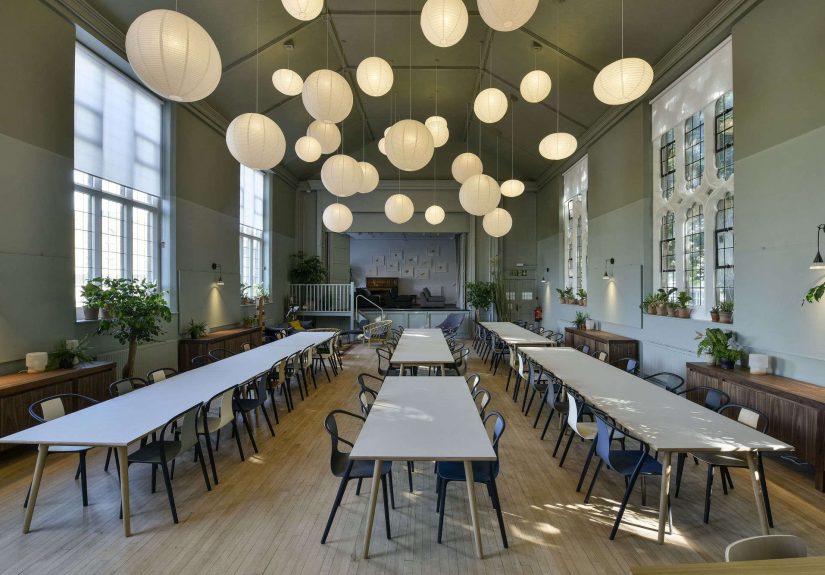
A church hall can be beautifuland also wildly uncozy if it feels like you’re dining inside an aircraft hangar. One of the smartest moves here is lighting: clusters of white paper lanterns and soft, warm illumination that visually “brings the ceiling down,” creating intimacy in a double-height space. It’s the design equivalent of speaking in a calmer voice and watching everyone’s shoulders drop.
Color, Plants, and Materials: The Anti-Institution Starter Pack
The palette leans warm and natural, with wood, a bright-but-gentle neutrality, and plenty of greeneryplants tucked along windowsills and surfaces, often in terracotta pots. The effect isn’t “decor”; it’s reassurance. A plant in a room says, “Someone expects you to be here tomorrow.” That’s a quiet kind of hope.
The dining hall has been described with pale greens and a homelike feelingless “charity hall” and more “community dining room.” And because this is an operational kitchen, the back-of-house has its own design logic: durable surfaces, stainless steel, and tiled areas that can handle real work (and real mess).
Furniture and Donated Details: Comfort You Can Actually Sit On
A big part of the story is that Studioilse worked pro bono and rallied suppliers to donate or discount key elements. This isn’t just generosity; it’s strategy. High-quality furniture in a social project sends a message that the people using the space deserve the same comfort and beauty as anyone else.
The dining area features donated Vitra Belleville chairs (by Ronan & Erwan Bouroullec), and the room includes thoughtfully chosen pieces like Artemide wall sconces, warm textiles (including kilim rugs), and comfortable lounge seating that nudges the mood away from “line up and eat” and toward “stay a minute, breathe, talk.”
More Than a Dining Hall: Corners for Reading, Counseling, and Community
Refettorio Felix isn’t designed as a single-purpose “eat and exit” facility. The wider space includes areas that support the human side of recovery and stabilitylike lounge zones for reading and decompression, private counseling rooms, and flexible areas that can host talks, performances, or movie nights. In other words: the architecture acknowledges that hunger is rarely just about food.
There’s also a practical sustainability layer: the hall can be hired out for events, generating revenue that helps fund the organization’s work. It’s a smart move that turns the space into a community asset in more than one way.
From Surplus to Three Courses: How the Kitchen Keeps It Real (and Delicious)
If you’ve ever tried to cook dinner with “whatever’s left in the fridge,” you already understand the core challengejust scale that up to feeding a room full of people with nutritional needs, dietary restrictions, and a limited margin for error.
Surplus ingredients arrive based on what’s available: produce that’s perfectly good but cosmetically “wrong,” items near their sell-by window, bulk goods that didn’t move, and more. The kitchen team builds meals around that reality. The point isn’t to pretend food waste doesn’t exist; it’s to prove that “leftover” can still mean “loved.”
During the project’s early public momentlaunched around London Food Month in June 2017Refettorio Felix drew attention and support from the food world, including visiting chefs who cooked and helped amplify the mission. That visibility matters, not for celebrity sparkle, but because it helps unlock donations, volunteer energy, and long-term sustainability.
The end goal is consistent: serve meals that are nutritious, well-prepared, and respectful. Not “good enough for charity.” Just good. Period.
Why Design Matters Here (No, It’s Not “Just Decor”)
In social services, it’s easy to treat environment as a “nice to have,” something you invest in only after every other need is covered. But Refettorio Felix flips that logic: the space itself is part of the care.
Here’s the practical argument. When a place feels safe and welcoming, people are more likely to show up consistently. Consistency is how trust forms. Trust is what makes it possible to connect guests to other support: counseling, resources, community ties, and steps toward stability. A harsh space can discourage people from coming back. A warm space can quietly reduce friction on one of the hardest tasks in life: asking for help.
And here’s the human argument. Shame is isolating. Hospitality is connective. A thoughtfully set table, a comfortable chair, softer light, and a room that says “we expected you” can reduce shamesometimes enough to allow conversation, eye contact, and the small social moments that rebuild someone’s sense of self.
Refettorio Felix is also a reminder to the design world: “high impact” doesn’t always mean “high budget.” Strategic donations, pro bono expertise, and smart material choices can produce a space that feels special without becoming precious.
Lessons Worth Stealing (Legally) From Refettorio Felix
1) Treat Guests Like Guests
Language matters. Layout matters. Service style matters. When people are welcomed with warmth and routine hospitality, the meal becomes more than calories; it becomes a social bridge.
2) Design for Real Use, Not a Perfect Photo
Crawford’s approach starts with function: how volunteers move, where people wait, how food is served, where private conversations can happen, how the room shifts between lunch and other programming. Beauty is layered on top of utility, not substituted for it.
3) Build a Supply Chain, Not a One-Time Event
Surplus food rescue requires consistent relationships and reliable logistics. Partnering with a redistribution organization means the kitchen can plan around flow rather than hustle around emergencies.
4) Make the Space Financially Resilient
Allowing venue hire and community events can help diversify funding. It’s not glamorous, but it’s the kind of operational detail that keeps a mission alive after the opening headlines fade.
How to Support the Mission (Even If You’re Nowhere Near Earl’s Court)
Not everyone can volunteer on-site, and that’s fine. Projects like Refettorio Felix survive through a mix of community involvement: donations, corporate support, supplier partnerships, and people spreading the model. If you’re in London, volunteering can be one of the most direct ways to helpespecially because hospitality requires hands, not just hashtags.
If you work in food, hospitality, logistics, design, or events, your skills may be unusually valuable. Refettorio Felix is proof that “professional” talentapplied generouslycan create long-term social infrastructure, not just a short burst of charity.
Conclusion: A Soup Kitchen That Refuses to Look Like One
Refettorio Felix sits at the intersection of three problems that usually get handled separately: food waste, hunger, and social isolation. Its big insight is that they’re connectedand that solutions can be connected too.
The kitchen turns rescued surplus food into nourishing meals. The dining hall turns “service” into hospitality. And Ilse Crawford’s design turns a basic human needbeing fedinto something that also feeds dignity. It’s not about making poverty look pretty. It’s about making care look real.
In a world where many social spaces are built to be efficient, Refettorio Felix is built to be humane. And honestly? That might be the most modern design trend of all.
Experiences: What It Feels Like to Step Inside Refettorio Felix
Even if you’ve never set foot in Refettorio Felix, the concept of “walking into a room that changes your posture” is familiar. Some spaces make you brace yourself: harsh light, hard chairs, signs everywhere telling you what not to do. Refettorio Felix is designed to do the opposite. The first feeling is usually relieflike the room is exhaling and you’re allowed to exhale with it.
The light helps. Soft lighting doesn’t interrogate you. It doesn’t highlight every tired edge of a difficult week. It simply makes the room feel gentler. Then you notice the plants, and they do something quietly psychological: they signal continuity. A plant is living maintenance. A plant means someone cared enough to keep caring. For guests who are used to being treated as temporary problems, that kind of visual stability is its own kind of welcome.
If you volunteer in a place like this, you quickly learn that “service” is a choreography. There’s the practical rhythmsetting tables, moving chairs, organizing stations, navigating a kitchen that’s busy in the way only real kitchens are. But there’s also the emotional rhythm: greeting people, noticing who needs a moment, who wants a conversation, who prefers quiet. The room gives you cues. The seating encourages small groups instead of isolation. The lounge areas make it normal to sit for a bit rather than grab food and disappear. The space doesn’t force connection, but it makes connection easier.
The food itself has a particular magic because it’s born from constraint. Surplus ingredients mean the menu isn’t a fixed script; it’s improvisation with purpose. That unpredictability can sound stressfuluntil you see what it unlocks. You might start a shift thinking, “We’ve got a mountain of carrots and a suspicious number of crates labeled ‘assorted greens’,” and end the day watching those same ingredients turn into a meal that looks intentional. Not fancy for the sake of fancyjust thoughtful. A bowl that’s seasoned properly. A plate that’s arranged like someone cared. That’s the point.
There’s also a strange, beautiful reversal that happens at the table. In many “aid” settings, the person receiving help can feel reduced to a need. In a refettorio setting, the table does some of the social work. People talk about everyday things: weather, football, a TV show, a memory. When you’re sitting in a chair that belongs in any well-designed dining room, eating from proper tableware, the conversation tends to normalize. You’re not “a case.” You’re a person having lunch.
And if you’re the kind of person who notices design details (no shamewe see you), the experience can be genuinely moving. The donated chairs and warm textiles aren’t just “nice.” They’re symbolic. They say: this space is not an afterthought. You are not an afterthought. That message lands even when it’s never spoken aloud.
The most lasting impression, though, is how the room treats time. In many emergency contexts, time is rushed: get in, get fed, move along. Refettorio Felix feels like it gives time backjust a little. Enough to sit. Enough to breathe. Enough to feel human again. And in a city where loneliness can be as sharp as hunger, that might be the most nourishing course on the menu.