Table of Contents >> Show >> Hide
- What Makes Repère Sauvage Different?
- The Setting: Loire Valley Charm Without the Tourist Traffic Jam
- A Property With Real History, Not Fake Rustic Theater
- Design That Lets the Landscape Do the Loudest Talking
- Food, Family, and the End of the Boring Rural Hotel
- Why Repère Sauvage Fits the Way People Travel Now
- Sustainability Here Looks More Like Stewardship Than Slogan
- Who Should Book Repère Sauvage?
- Final Verdict
- Extended Experiences: What a Stay at Repère Sauvage Actually Feels Like
If the phrase nature retreat in the Loire Valley makes you picture a fussy old château with velvet drapes, a haunted corridor, and one chair nobody is allowed to sit on, Repère Sauvage is here to lovingly interrupt that fantasy. Set in Loir-et-Cher, within the broader Loire Valley orbit, this design-forward countryside retreat takes a different route: less powdered-wig nostalgia, more fresh-air intelligence. It is the kind of place where a historic estate, woodland lodges, seasonal food, and family-friendly programming manage to coexist without turning into a lifestyle mood board that forgot real people exist.
That balance is what makes Repère Sauvage interesting. It borrows the Loire Valley’s best qualities, beauty, heritage, food culture, and easy access from Paris, but skips the museum-rope stiffness. Instead of asking guests to admire the countryside from a polite distance, it pulls them into it. The result is a modern rural escape that feels stylish without being precious, quiet without being sleepy, and luxurious without requiring anyone to whisper.
What Makes Repère Sauvage Different?
Repère Sauvage is not just a hotel with a nice view and a decent breakfast basket. The property is built around a 42-hectare estate, mixing hospitality, landscape, food, and programming into one cohesive experience. Guests can stay in the manor or in the forest lodges, eat at an on-site restaurant, wander between pond, meadows, and woodland, and tap into a schedule that includes creative events, tastings, and activities for both adults and children. In other words, this is countryside hospitality with an actual point of view.
The founders, Caroline Costagliola Condy and Capucine Châtelier, shaped the place around the idea that recharging does not have to mean isolation. That philosophy matters. A lot of modern retreats sell the fantasy of disappearing. Repère Sauvage sells something more human: reconnecting with nature, yes, but also with food, conversation, family, curiosity, and the local territory. It is a subtle but important difference. This place is not trying to turn guests into hermits. It is trying to make rural life feel vivid again.
The Setting: Loire Valley Charm Without the Tourist Traffic Jam
The Loire Valley has long been one of France’s great crowd-pleasers, and for good reason. Travelers come for the Renaissance châteaux, vineyard landscapes, market towns, cycling routes, river scenery, and the general feeling that even the light knows how to pose. In American travel coverage, the region is consistently framed as a place where history and pleasure share the same table: you can tour castles in the morning, drink crisp white wine in the afternoon, and still find time for gardens, caves, or riverside wandering before dinner.
Repère Sauvage taps into that wider regional appeal, but it does not lean on postcard overload. Rather than centering spectacle, it centers atmosphere. The estate sits in the Perche Vendômois area of Loir-et-Cher, which gives the property a quieter, more wooded identity than the grandest château corridors of the Loire. That is part of the magic. You are still in a region associated with wine, heritage, and easy escapes from Paris, but the mood is softer and more grounded. Think less “stand in line behind six tour buses,” more “hear birds before breakfast and remember you have shoulders.”
A Property With Real History, Not Fake Rustic Theater
One reason Repère Sauvage feels layered instead of manufactured is that the site actually has a past. The estate contains a historic gate that remains from Fort Girard, once linked to César de Vendôme, the son of Henri IV and Gabrielle d’Estrées. Later, after the old château was demolished, a hunting lodge rose beside it and became the Manoir de la Forêt. By 1940, the manor had been converted into a training center for young cabinetmakers, and from the 1960s onward it functioned as a hotel and restaurant.
That timeline matters because Repère Sauvage is not pretending to have been born yesterday in a branding workshop. It is a revival project. The founders found the estate in poor shape, then spent years renovating and rethinking it before opening in 2025. So when the property talks about heritage, it is not using history as wallpaper. It is building on a real site with a real sequence of uses, then translating that past into something contemporary. The effect is richer than nostalgia and far less cheesy than fake farmhouse drama.
Design That Lets the Landscape Do the Loudest Talking
The Manor Rooms
The manor side of Repère Sauvage offers 16 rooms, and their design seems to understand a principle many luxury hotels still miss: nature does not need competition. The interiors were renovated with the help of interior architect Gwenaëlle Girard, whose work on the project emphasizes soft curves, warm color, natural materials, and a polished sense of detail. Rather than smothering the historic structure in forced minimalism or overdecorated country-house clichés, the rooms appear to strike a middle line, bright, tactile, and calm, with views toward the pond or park helping the outside world stay part of the experience.
That matters for SEO language and actual human life alike. A boutique hotel in the Loire Valley can easily become a parade of nice adjectives and zero identity. Repère Sauvage avoids that trap because the design serves the place. The manor feels like a house that learned better manners, not a showroom trying too hard to say “quiet luxury” every five minutes.
The Wild Houses
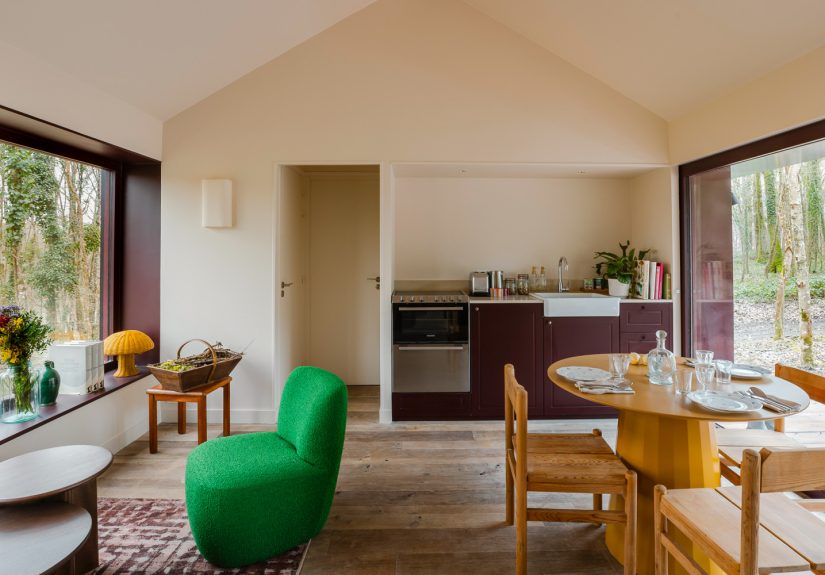
Then there are the lodges, or “Wild Houses,” which are arguably the retreat’s strongest argument. Repère Sauvage has 20 of them, designed for couples or families, and they are meant to create an indoor-outdoor living experience instead of merely placing guests near trees and calling it immersive. Some descriptions note dark or richly toned timber exteriors, and what stands out most is the intention behind them: these are not novelty cabins, and they are not survivalist cosplay either. They are modern woodland accommodations built for comfort, warmth, and visual restraint.
Better still, the circulation across the estate is designed to stay organic and low-impact. Existing paths are used where possible, movement happens by foot or bike rather than by constant car traffic, and the forest setting remains the star. For travelers searching terms like forest lodges France, design retreat Loire Valley, or luxury countryside escape, this is exactly the kind of product that feels current: architecture that participates in the landscape instead of bullying it.
Food, Family, and the End of the Boring Rural Hotel
Repère Sauvage also understands that beautiful scenery alone does not sustain a stay. At the center of the social side is Le Manoir de la Forêt, the on-site restaurant, which positions itself around local, seasonal cooking with a refined but relaxed style. The menu philosophy is tied to regional products and simple, well-executed dishes rather than culinary acrobatics for their own sake. Reports around the opening connect the kitchen to chef Arnaud Domette and emphasize a locavore spirit, meaning guests are not just eating “in the countryside”; they are eating from it.
Then there is the family angle, which deserves real credit. A lot of hotels claim to welcome families, then quietly behave as though children are a minor weather event. Repère Sauvage seems to have planned for them from the start. The kids’ club, Les Petits Sauvages, is built around outdoor discovery and creative activities, with a Montessori-informed, nature-centered approach. Add in the mini-farm, forest play, creative workshops, and a long pool on the property, and the place starts to feel less like a compromise destination and more like a rare trick: somewhere adults actually want to be and children are not merely tolerated.
That makes the retreat more versatile than many design hotels. Couples can come for the lodges and the calm. Parents can come without feeling they have accidentally booked themselves into a judgmental stillness contest. Locals can stop by for dining or events. And remote workers can plausibly spend a few days there without losing the will to answer email. That is not niche hospitality. That is smart hospitality.
Why Repère Sauvage Fits the Way People Travel Now
Modern travelers increasingly want a countryside stay that does more than provide a good mattress in a scenic location. They want design, yes, but they also want flexibility. They want local food, but not necessarily formal dining every night. They want nature, but not a lecture disguised as leisure. They want something photogenic, but preferably something that still works when the phone is face down. Repère Sauvage lands neatly in that sweet spot.
In that sense, the retreat is very of-the-moment. It aligns with broader travel trends around slower stays, design-conscious cabins, multi-generational travel, and rural hotels that function as cultural hubs rather than isolated properties. The Loire Valley already has global cachet because of its castles and wine. Repère Sauvage gives that regional story a fresh chapter by saying, essentially, “What if the countryside could feel elegant, alive, and useful all at once?” Turns out, good question.
Sustainability Here Looks More Like Stewardship Than Slogan
One of the strongest aspects of the project is that its environmental story goes beyond decorative language. Press materials describe a landscape strategy focused on respecting the natural character of the site, restoring neglected grounds responsibly, and managing circulation with minimal disruption. The estate includes forest, meadows, pond, stream, and valleys, and the hospitality footprint is meant to work within that varied ecology rather than erase it.
There is also a more concrete biodiversity component. The forest is described as being managed sustainably, with trees of different ages, while planting in the meadows is intended to support biodiversity. The project has additionally worked on restoring wetland continuity by addressing how one pond had interrupted the natural flow of a small watercourse known as the Gratteloup. That work is not just useful ecologically; it also becomes educational. In other words, sustainability here is not just low-impact aesthetic wallpaper. It is site management, habitat thinking, and long-term maintenance, which is a lot less sexy in a brochure and much more meaningful in real life.
Who Should Book Repère Sauvage?
This retreat makes the most sense for travelers who like the Loire Valley but do not want a stay defined only by château-hopping. It is ideal for design-minded couples, families who value outdoor space and thoughtful programming, Paris-based weekenders looking for a countryside reset, and food lovers who enjoy regional products without needing silver cloches and opera-level formality. It also works for groups of friends and small work gatherings because the estate offers multiple ways to stay, gather, and spread out.
It may be less perfect for travelers who want to spend every waking hour in the biggest-name Loire Valley castle towns, since Repère Sauvage’s strongest selling point is the estate itself. But for anyone craving a modern nature retreat in the Loire Valley rather than a hotel that merely uses the region’s fame as a backdrop, that is exactly the point.
Final Verdict
Repère Sauvage succeeds because it understands that luxury in the countryside no longer has to mean stiff service, floral upholstery, and the emotional temperature of a museum. It can mean space, design, regional food, intelligent family programming, ecological care, and a setting that does not need to shout to feel special. The retreat uses the Loire Valley’s reputation as a foundation, then builds something more contemporary on top of it: a place where heritage is real, nature is active, and style is allowed to breathe.
In a travel market crowded with “hidden gems” that have somehow already been photographed from every angle, Repère Sauvage feels refreshingly specific. It is not trying to be everything. It is trying to be a modern rural landmark, and it comes impressively close.
Extended Experiences: What a Stay at Repère Sauvage Actually Feels Like
Imagine arriving in the late afternoon, after the shift from city speed to countryside slowness has finally reached your shoulders. The estate does not hit you with grand theatrics. It unfolds. First the trees, then the pond, then the sense that the place has been arranged to let silence do some of the decorating. Check-in does not feel like entering a museum piece; it feels like entering a well-composed world. If you stay in the manor, you get the pleasure of structure and softness, old walls, polished rooms, views over the grounds. If you stay in one of the forest lodges, the rhythm changes immediately. Shoes get kicked off faster. Windows matter more. The woods start acting like a second room.
Morning here would likely be one of the retreat’s strongest selling points. Not because there is some heroic sunrise ritual you must perform, but because the setting does half the work for you. Coffee tastes smarter in a place with trees. Breakfast feels less like a task and more like a beginning. If you are traveling as a couple, the appeal is obvious: a walk through the estate, a lazy lunch, a long dinner, and the rare luxury of not needing a complicated plan. If you are traveling with children, the day opens differently but just as well. Outdoor activities, creative sessions, open space, and the kids’ club mean the property is built for motion, not forced stillness.
By afternoon, Repère Sauvage starts to reveal why it works as more than a pretty hotel. One guest can read by the pond. Another can join a tasting or event. Children can be busy outdoors instead of ricocheting off furniture. Someone else can answer a few emails without feeling trapped in a business hotel purgatory. The pool adds another layer of ease, especially in warm weather, and the estate’s social life, dinners, aperitifs, cultural programming, and local energy, keeps the experience from becoming overly inward. You are in nature, but not in exile.
Evenings may be the most memorable part. The light drops, the restaurant becomes the center of gravity, and the retreat’s whole philosophy snaps into focus. This is not a place designed only for sleeping near trees. It is designed for living near them: eating well, talking longer, walking back to your room or lodge under a dark sky, and noticing that the best countryside stays are not about doing nothing. They are about doing the right amount of something. Repère Sauvage seems built around that exact insight, and that is why it lingers in the mind longer than a typical weekend escape.