Table of Contents >> Show >> Hide
- Why FLRAA Became the Aviation Equivalent of a Moonshot
- Meet the Contenders
- Design Philosophy: Compound Coaxial vs. Tiltrotor
- Performance: Speed, Range, and the “Hot-and-High” Reality Check
- Landing Zones: Footprint, Approach Angles, and “Can I Fit This Thing In Here?”
- Maintainability and Risk: The “Newness Tax” Always Comes Due
- Digital Upgrades and MOSA: The Software Argument That Quietly Matters a Lot
- So… Who Won, and What Happens Next?
- Which Concept Was “Better”? The Most Honest Answer
- Experiences Related to “SB-1 Defiant Vs. V-280 Valor”
If you’ve ever watched two very smart engineering teams argue about the future, you’ve basically watched
SB-1 Defiant vs. V-280 Valor. One is a “compound helicopter” that brought a pusher propeller to a rotor fight.
The other is a tiltrotor that looks at helicopters and says, “Cute. Now watch me turn into an airplane.”
Both aircraft were built to help the U.S. Army leap beyond the UH-60 Black Hawk era under the
Future Long-Range Assault Aircraft (FLRAA) effort inside the broader Future Vertical Lift (FVL) modernization push.
The mission is simple to describe and brutally hard to execute: move troops and supplies farther and faster,
operate in “hot-and-high” conditions, and keep evolving through software upgrades instead of decade-long rebuilds.
So who did it betterand why? Let’s break down the matchup without turning this into a flight manual (nobody asked for that kind of stress).
Why FLRAA Became the Aviation Equivalent of a Moonshot
The Army’s public messaging around FLRAA has been consistent: transformational speed and range.
Depending on the document and mission profile, you’ll see threshold and objective targets around the high-200-knot cruise neighborhood,
plus ambitious unrefueled distance goals that make traditional helicopters feel like they’re commuting with a half-charged phone.
The point isn’t just “go fast for the vibes.” Speed and reach change the entire chessboard:
fewer refuel points, fewer staging bases, shorter exposure windows, and more options for commanders.
In plain English: you can start doing missions from places the enemy assumed were “too far to matter.”
Meet the Contenders
SB-1 Defiant: A Helicopter That Refused to Accept Helicopter Limits
The Sikorsky–Boeing SB-1 Defiant is best understood as “helicopter-plus.”
It uses coaxial rotors (two main rotors stacked and spinning in opposite directions) and adds a
rear pusher propulsor to shove the aircraft forward at higher speed.
Why coaxial? Because it can reduce the need for a tail rotor and help address the aerodynamic limits that keep conventional helicopters from safely
sprinting much faster without running into nasty airflow problems on the retreating rotor blade.
The pusher propulsor then contributes forward thrust so the rotors can focus more on lift instead of doing everything everywhere all at once.
The demonstrator program proved real milestonesincluding publicly stated top speeds in the mid-200-knot range during testingand showcased
aggressive maneuvering ideas (fast decel, tight approaches, and “confined area” concepts that helicopter crews care about deeply).
Sikorsky and Boeing framed the FLRAA-ready concept as Defiant X, building on what the SB-1 demonstrator learned.
V-280 Valor: The Tiltrotor That Grew Up and Got Practical
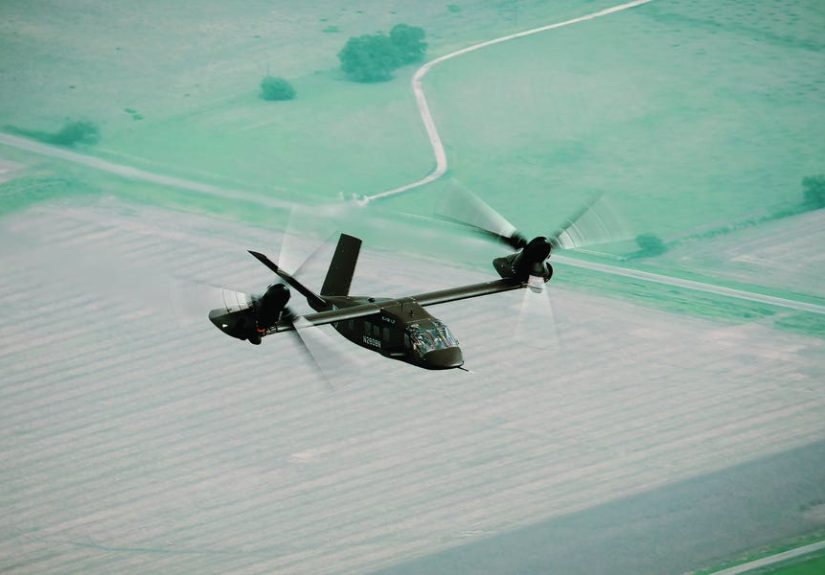
The Bell V-280 Valor is a tiltrotor, meaning it takes off and lands vertically like a helicopter,
then rotates its proprotors to fly like a fixed-wing aircraft. The key advantage is that once it’s in airplane mode,
it can cruise fast and efficientlybecause wings are really good at wings-ing.
Unlike the V-22 Osprey’s full tilting nacelles, the V-280’s design keeps the engines more fixed while the proprotors tilt,
aiming for a simpler mechanical approach (and potentially easier maintenance logic).
Over its demonstrator life, the V-280 logged extensive flight testing hours and reached performance markers that aligned closely with FLRAA’s
“twice as far, twice as fast” spirit.
The Army ultimately selected the V-280 as the FLRAA winner, and the platform is now associated with the
MV-75 designation in public program coverage.
Design Philosophy: Compound Coaxial vs. Tiltrotor
This competition wasn’t just two aircraftit was two worldviews.
The SB-1/Defiant X Bet
- Keep the helicopter DNA: hover, low-speed handling, tight landing zones.
- Break the speed ceiling with coaxial rotors + a pusher prop.
- Win the “maneuvering in ugly terrain” argument: trees, ridgelines, dust, confined approaches.
The V-280/MV-75 Bet
- Accept the airplane mode advantage: speed + range come from wings and efficient cruise.
- Use mature tiltrotor know-how while designing for the Army’s mission set (not a copy-paste of the Osprey).
- Lean into digital engineering and modular upgrades so the aircraft can evolve faster than threats do.
Think of it like this: Defiant tries to make a helicopter do what helicopters usually can’t.
Valor tries to make a “helicopter-airplane hybrid” behave more predictably and sustainably over a long service life.
Both are ambitious. One approach simply matched the Army’s stated priorities more cleanly in the final down-select.
Performance: Speed, Range, and the “Hot-and-High” Reality Check
Performance comparisons get messy because test aircraft, proposed production versions, mission profiles, and payload assumptions all matter.
Still, the public record gives us enough to talk about real differences without making stuff up.
| Category | SB-1 Defiant / Defiant X (concept) | V-280 Valor / MV-75 (concept) |
|---|---|---|
| Core idea | Coaxial rotors + pusher propulsor (compound helicopter) | Tiltrotor with wing-borne cruise (airplane mode) |
| Speed story | Demonstrated mid-200-knot testing milestones; designed for high-speed helicopter handling | Publicly associated with ~280-knot-class cruise targets and high-speed tiltrotor envelope |
| Range story | Improves reach vs. conventional helicopters; range depends heavily on fuel configuration and mission profile | Tiltrotor cruise efficiency supports longer reach; aligns with “twice as far” program messaging |
| Hot-and-high | Coaxial lift efficiency helps hovering performance; compound design aims to keep control margins | Designed to meet high/hot operational requirements while preserving long-range utility |
| Operational feel | More “helicopter-like” in how it uses space and approaches landing zones | More “airplane-like” in cruise, with conversion considerations near landing and takeoff |
A practical takeaway: if your concept of operations depends on extended cruise at high speed to cover long distances,
the tiltrotor architecture is naturally advantaged. If your concept depends on aggressive low-speed maneuvering and keeping the
“helicopter feel” in tight spaces, the compound coaxial pitch looks attractive.
Landing Zones: Footprint, Approach Angles, and “Can I Fit This Thing In Here?”
Here’s where internet debates get loud: landing zones. The Army doesn’t fight on clean concrete pads with a helpful “WELCOME, PLEASE LAND HERE” sign.
Real landing zones are dusty, uneven, cluttered, and occasionally shaped like a bad idea.
SB-1 Defiant’s helicopter-like posture and coaxial configuration were often discussed in terms of agility and confined operations
including demonstrations focused on rapid deceleration and approaches to unimproved zones.
It’s the kind of thing that makes assault and medevac crews nod like, “Yes, that’s the pain point.”
V-280 Valor brings a wing and tiltrotor geometry, which can increase the space you need around the aircraft.
That can be a real constraint. But it also brings the payoff: the wing takes the load in cruise, which supports the speed and range targets
that drove the program in the first place.
In other words: Defiant plays the “tight landing zone” card harder. Valor plays the “get there at all” card harder.
The Army’s selection signals which card mattered most.
Maintainability and Risk: The “Newness Tax” Always Comes Due
Defense aviation has a universal rule: if your aircraft is revolutionary, your maintenance plan needs to be evolutionaryor everyone suffers.
New architectures come with a “newness tax” in training, supply chain, and troubleshooting.
SB-1 Defiant: Complex Rotorcraft Problems, Solved… with More Rotorcraft
Coaxial rotors and a pusher propulsor can deliver incredible performance, but they also introduce unique mechanical and vibrational challenges.
SB-1’s testing history included pauses to address component issues, which is normal in experimental programsbut it’s still schedule friction.
Scaling a high-performance demonstrator into a mass-produced fleet aircraft is a different sport than flying test points.
V-280 Valor: Tiltrotor Maturity, but Not a Free Pass
Tiltrotors have decades of operational history, and the V-280 program leaned heavily into proving a broad flight envelope over extensive test hours.
Still, tiltrotors carry their own concerns (conversion mechanics, emergency procedures, footprint constraints).
The key difference is that tiltrotor challenges have been lived, studied, and iterated on for a long timeso the “unknown unknowns” may be fewer.
Put simply: both aircraft are complicated. One architecture has a longer public track record of being operated at scale.
Digital Upgrades and MOSA: The Software Argument That Quietly Matters a Lot
It’s tempting to treat this as a pure flight-performance contest. But modern military aircraft are also software platforms:
mission systems, networking, electronic survivability integrations, and the ability to accept upgrades without becoming a hangar queen.
FLRAA emphasized modular open systems thinkingoften described as making upgrades faster, less vendor-locked,
and less like performing surgery with oven mitts. Public reporting around the protest process highlighted the importance of meeting these kinds of
architecture requirements. In short: the Army didn’t only pick an airframe. It picked an approach to long-term modernization.
So… Who Won, and What Happens Next?
The Army selected Bell’s V-280 Valor for FLRAA in December 2022, launching the next phase of development toward fielding.
Public program coverage since then has emphasized acceleration, digital prototyping, and earlier-than-originally-planned delivery goals.
(Translation: the Army wants this capability yesterday, but will settle for “as soon as physics and budgets allow.”)
Meanwhile, SB-1 Defiant remains a significant technology demonstrator story: coaxial compound configurations, high-speed rotorcraft handling,
and lessons that can feed future programs. Losing the FLRAA down-select does not equal “wasted”it often means “harvested” into the next design cycle.
Which Concept Was “Better”? The Most Honest Answer
If “better” means “more helicopter-like while being dramatically faster,” the Defiant concept has a strong argument.
If “better” means “best match for FLRAA’s speed-and-range-first strategic purpose,” the Valor/MV-75 tiltrotor fits the brief cleanly.
The Army’s selection effectively tells us the weighting:
operational reach and high-speed cruise won the day, with maintainability and upgrade architecture playing
a supporting role that’s easy to underestimate.
And for the rest of us? This matchup is a giftbecause it shows how aerospace progress happens:
not by picking a single “perfect” idea, but by forcing great ideas to compete until the tradeoffs are crystal clear.
Experiences Related to “SB-1 Defiant Vs. V-280 Valor”
If you’ve ever followed a major aircraft competition from the outsidereading updates, watching demo clips, and listening to pilots describe what
the machine “feels like”you know it turns into a weirdly personal experience. Not because you’re going to fly one tomorrow, but because you start
seeing the aircraft as a set of promises. And every promise has a price tag.
With the SB-1 Defiant, the experience is often about motion. The language around it tends to be physical and immediate:
rapid deceleration, aggressive turns, shifting from “go fast” to “drop into a tight spot” like it’s changing lanes. Even as a spectator,
you can imagine the kind of pilot grin that shows up when an aircraft responds crisply. It’s the rotorcraft equivalent of a sports car
that somehow still has room for your friends and their gear. When people talk about Defiant, they talk about handling and maneuverbecause that’s
where helicopter crews live. In the real world, a mission doesn’t end at “arrive near the objective.” It ends at “put the aircraft safely in a place
that wasn’t designed for aircraft,” then “leave again,” often under pressure. Defiant’s vibeyes, vibeleans into that reality.
With the V-280 Valor, the experience is about transition. Tiltrotors feel like an argument against gravity’s bureaucracy.
You lift off vertically, then (in concept and in demos) you rotate into airplane mode and suddenly the whole mood changes.
It’s not “helicopter working hard to go forward.” It’s “airplane cruising like it has places to be.” Watching that kind of transformation
changes how you think about distance. A map that looks intimidating to a helicopter starts looking more like a planning detail to a tiltrotor.
And if you’ve ever sat through a briefing where everything depends on timehow long until reinforcements, how long until extraction, how long until
weather turns badyou can feel why speed and range become strategic, not just tactical.
There’s also a very human experience baked into the debate: different people care about different pains. Maintainers might watch a program and
quietly wonder, “How many special tools will this need?” Operators might wonder, “What happens when the plan changes at the last second?”
Commanders might wonder, “Can this aircraft expand the set of missions we can even consider?” When you compare SB-1 and V-280, you start practicing
that mindsettradeoffs, priorities, second-order effects. It’s like learning to think in systems.
And then there’s the bigger, slightly funny realization: everyone wants a machine that does everything. We want the aircraft to fly like an airplane,
land like a helicopter, fit like a compact car, carry like a pickup truck, and maintain like a bicycle. Reality, of course, does not care what we want.
What these two aircraft teachjust by existingis that progress is choosing which “everything” matters most. SB-1 leans into the “helicopter reality”
of messy landing zones and dynamic maneuver. V-280 leans into the “operational reach” reality of long distances and fast timelines.
Following this competition feels like watching two very different problem-solvers approach the same nightmare scenario and say,
“Okay, here’s the part I refuse to compromise on.” That’s why it’s fascinatingeven if you never learn to pronounce “proprotor” without pausing.