Table of Contents >> Show >> Hide
- Why Sandstone Feels So Calming (and Why Your Countertop Loves It)
- What Stores Call “Sandstone” (Spoiler: Sometimes It’s Not)
- The Sandstone Accessory Lineup: What to Buy First
- Styling Rules for a Spa-Like Bathroom (No Degree Required)
- Care & Cleaning: Keep the Zen, Lose the Grime
- To Seal or Not to Seal? A Practical Answer
- Buying Checklist: How to Choose Sandstone Accessories That Age Well
- Common Mistakes (and Easy Fixes)
- Experience Notes: What “Serenity Now” Looks Like in Real Life (About )
- Final Rinse: The Calm Countertop Plan
Your bathroom is basically your home’s backstage area: the place where you pep-talk yourself in the mirror,
practice your “I’m totally fine” face, andif we’re being honestscroll in peace. So if any room deserves a
little spa energy, it’s this one.
Enter sandstone bath accessories: soap dishes, vanity trays, tumblers, and canisters with a
soft, earthy vibe that makes even a drugstore toothbrush feel like it has its life together. Done right,
sandstone brings that calm, coastal, boutique-hotel moodwithout requiring you to actually move into a boutique hotel.
Why Sandstone Feels So Calming (and Why Your Countertop Loves It)
Sandstone is a sedimentary rock made from sand-sized grains that were compacted and cemented over time. That origin story
shows up in the best way: muted color, subtle variation, and a natural texture that reads “serene” instead of “shiny and trying too hard.”
In bathrooms, that matters. A lot of common materialschrome, glass, high-gloss ceramicbounce light everywhere. Sandstone, by contrast,
tends to look more matte and grounded. It visually “quietens” the space, which is interior-design speak for
“your brain stops yelling for a second.”
The vibe benefits
- Soft, warm neutrals: Sand, oat, dune, latte foamwhatever you call it, it plays nicely with almost any palette.
- Texture without clutter: One stone piece can add depth without adding more “stuff.”
- Pairs with everything: White tile, black hardware, brass accents, wood vanities, linen towelssandstone is the Switzerland of bathroom materials.
What Stores Call “Sandstone” (Spoiler: Sometimes It’s Not)
Before you picture artisans chiseling your toothbrush holder out of a cliff at sunrise, here’s the real-world breakdown.
On U.S. retail sites, “sandstone” can mean a few different things:
1) Solid sandstone (the real deal)
These pieces are carved or cut from natural stone. They’re satisfyingly heavy, beautifully imperfect, and often have
subtle veining or grain. They can also be more porous and may benefit from sealing depending on finish and use.
2) Sandstone composite / resin-stone blend
Many “stone look” bathroom sets are made from resin mixed with stone powder or fillers. You still get that matte, sandy appearance,
but typically with easier maintenance and less worry about water soaking in.
3) Sandstone-colored ceramic or dolomite
Sometimes “sandstone” is more about the color than the geology. You’ll see pieces that are glazed to look like stone,
but behave like ceramicusually less absorbent and straightforward to clean.
None of these are “bad.” The key is knowing what you’re buying so your care routine matches the material (and so your “spa upgrade”
doesn’t turn into your new side hobby: stain management).
The Sandstone Accessory Lineup: What to Buy First
If you want a calmer bathroom without a full remodel, accessories are the fastest win. Start with pieces that reduce visual clutter
and corral the daily chaos.
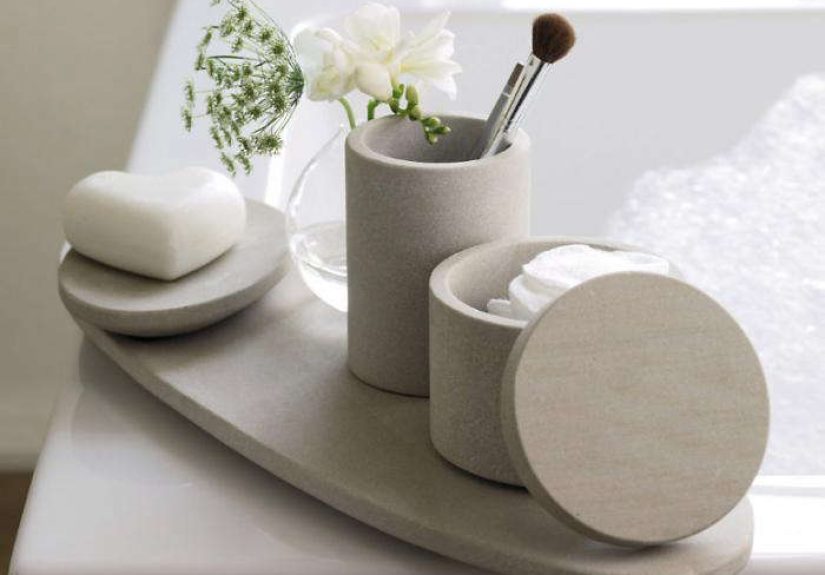
Vanity tray (the unsung hero)
A stone vanity tray instantly makes your countertop look intentional. Place your soap dispenser, moisturizer, and a small candle
on itboom: curated. Bonus: it catches drips, rings, and random product goo so your counter stays cleaner.
Soap dish with drainage
Look for a soap dish that has ridges, grooves, or a sloped design so water can escape. This keeps bars from turning into that sad,
slippery blob that looks like it gave up on life. If your dish is solid stone without drainage, pair it with a small soap saver insert.
Soap or lotion dispenser
A dispenser in a sandstone finish makes even basic hand soap feel fancy. Prioritize a pump that feels sturdy and doesn’t sputter.
If the pump is metal, check whether it’s designed to resist rust in humid rooms.
Toothbrush holder / tumbler
A stone-look tumbler can hold toothbrushes, toothpaste, or even makeup brushes. If you’re using it for toothbrushes, pick one with separated compartments
(because bristles touching bristles is not a friendship we need to encourage).
Canisters for cotton swabs and rounds
This is where sandstone shines: it visually tones down “bathroom supplies” and makes them feel like spa essentials.
Keep it to one or two canisters max unless you want your counter to look like a tiny apothecary shop.
Styling Rules for a Spa-Like Bathroom (No Degree Required)
Sandstone accessories look best when the rest of the counter isn’t trying to audition for a reality show called Hoarders: Bathroom Edition.
Here’s a simple, realistic approach:
Rule 1: Use the “visible five”
Limit what stays out to five things: soap dispenser, toothbrush holder, one canister, one tray, one “nice” item (like a candle or small plant).
Everything else goes in a drawer, cabinet, or a lidded container.
Rule 2: Build a calm palette
- Sand + white: airy and clean (great with white tile and fluffy towels)
- Sand + black: modern and sharp (perfect with matte black fixtures)
- Sand + brass: warm and elevated (instant boutique-hotel energy)
- Sand + wood: organic spa (especially with oak or walnut tones)
Rule 3: Repeat one material
If your accessories are sandstone, echo that natural look somewhere elsewood stool, woven basket, linen towels, or a stone-like tile detail.
Repetition makes the room feel cohesive instead of random.
Care & Cleaning: Keep the Zen, Lose the Grime
Bathrooms are humid, splashy environments. Stone and stone-look pieces can absolutely thrive hereif you treat them the way they want to be treated:
like a calm friend who does not enjoy harsh chemicals.
Everyday maintenance (takes under a minute)
- Wipe water drips from trays and dishes after use.
- Don’t let soap sit in a puddlestanding water is the enemy of “serenity.”
- Use a soft cloth or non-scratch sponge to prevent dulling or micro-scratches.
Weekly cleaning (simple and stone-safe)
Use warm water with a small amount of mild dish soap, or a cleaner labeled safe for natural stone.
Avoid abrasive powders or scrubby pads that can scuff finishes.
What to avoid
- Vinegar or lemon-based cleaners: acids can damage many natural stones and can break down sealers over time.
- Bleach, ammonia, and harsh bathroom sprays: they can discolor surfaces, weaken sealants, or dull finishes.
- “All-purpose” mystery cocktails: if you can’t confirm it’s stone-safe, don’t let it freestyle on your stone.
If you’re battling mildew nearby (grout, caulk lines, shower corners), treat those areas with the right product for that surface
and keep your stone accessories out of the splash zone while you clean. Ventilation and drying are your long-term MVPs.
To Seal or Not to Seal? A Practical Answer
Here’s the honest truth: some sandstone pieces are sealed at the factory, some aren’t, and some “sandstone” items aren’t sandstone at all.
So instead of guessing, use a simple common-sense test:
The water-drop test
Put a few drops of water on the surface and wait a couple minutes. If the water beads up, you likely have some protection.
If it darkens or absorbs quickly, the material is more absorbent and may benefit from a stone-safe penetrating sealerif the manufacturer allows it.
A penetrating (impregnating) sealer is often preferred because it helps resist moisture and staining while keeping a natural matte look.
But always follow the product’s directions and test in an inconspicuous area first. If your accessory is resin-stone composite or glazed ceramic,
sealing usually isn’t necessary (and may not even work as intended).
Buying Checklist: How to Choose Sandstone Accessories That Age Well
- Drainage design: ridges or grooves for soap dishes, raised edges for trays.
- Stability: heavier pieces are less tippy; rubber feet help prevent sliding and scratches.
- Finish feel: a smooth matte is easy to wipe; very rough textures can trap grime in humid rooms.
- Pump quality: a good dispenser pump should feel smooth and consistent, not crunchy or wobbly.
- Right-sizing: measure your counter spacecalm design dies fast when the tray blocks the faucet.
Common Mistakes (and Easy Fixes)
Mistake: Buying the whole matching set and using every piece
Fix: Use 3–5 pieces maximum. Store duplicates. Serenity is not achieved by owning both a soap dish and three backup soap dishes.
Mistake: Letting products leak directly onto stone
Fix: Place bottles on a tray, wipe drips quickly, and keep anything oily (like some hair serums) from sitting on porous surfaces.
Mistake: “Natural” cleaning hacks on natural stone
Fix: Stick to pH-neutral, stone-safe cleaners. The goal is spa vibes, not chemistry experiments.
Experience Notes: What “Serenity Now” Looks Like in Real Life (About )
Imagine your morning routine with a countertop that doesn’t look like a convenience store checkout aisle. The first thing you notice isn’t “wow,
I own stone,” it’s that everything has a home. Your soap dispenser sits on a sandstone tray, and when it drips (because pumps always drip
it’s basically their hobby), the mess is contained. You wipe one surface instead of playing whack-a-mole across the entire counter.
The second thing you notice is tactile: sandstone (or a good stone-look composite) tends to feel grounded and slightly warm compared to glass or glossy ceramic.
That matters in a bathroom, where so many surfaces are smooth, bright, and echo-y. A matte, sandy texture visually absorbs the chaos. It doesn’t reflect
every water spot back at you like a high-gloss finish that keeps score.
In day-to-day use, the tray becomes the quiet organizer. You can stage your “morning five”soap, moisturizer, SPF, a small fragrance, and a hand towel ringed
nearbywithout turning the vanity into a storage unit. If you share a bathroom, this is where sandstone accessories really earn their keep: the tray becomes
a boundary line. On one side is “my stuff,” on the other side is “your stuff,” and peace treaties are signed without a single passive-aggressive note.
Then there’s the soap dish reality. With a draining design, bar soap stays firmer and cleaner-looking longer. Without drainage, it will eventually become
a gooey puddle that makes you question your life choices. The “Serenity Now” move is simple: choose a ridged dish, rinse it weekly, and don’t let water
camp out under the soap like it pays rent.
Cleaning feels different, too. Instead of blasting everything with a one-size-fits-all bathroom spray (which can be too harsh for natural stone),
you adopt a calmer routine: warm water, a little dish soap, a soft cloth, and a quick dry. It’s less dramatic, but also less likely to dull finishes
or wear down protective sealers. Think of it as skincare for your countertopgentle, consistent, and not full of surprises.
The best part is the “after” moment: when you reset the counter at night. You set the tray items back in place, fold the hand towel, and the bathroom
looks like it’s ready for a photoshooteven if the rest of your house looks like you’re currently losing a friendly argument with laundry.
That’s what sandstone accessories deliver when you use them intentionally: not perfection, but a quiet, repeatable calm that makes everyday routines
feel a little more spa and a little less scramble.
Final Rinse: The Calm Countertop Plan
If you want the “Serenity Now” effect, don’t start with buying more. Start with editing. Pick one sandstone (or sandstone-look) tray,
add two to three supporting pieces, and commit to simple, stone-safe cleaning. The result is a bathroom that feels intentional, soothing, and honestly
a little smugin the best way.