Table of Contents >> Show >> Hide
- Meet Hirashima: Japanese Craft, Built for Real Life
- What “Live/Work Furniture” Actually Means (and Why It’s Not a Gimmick)
- The Hirashima Pieces That Make Small Spaces Work Harder
- How to Build a Hirashima-Style Live/Work Layout in a Small Home
- Materials Matter in Small Spaces (Because You’re Always Close Enough to Touch Everything)
- Ordering Hirashima from the U.S.: What to Know Before You Fall in Love
- The Hirashima Checklist: How to Choose Live/Work Furniture That Won’t Annoy You Later
- Conclusion: A Small Space Doesn’t Need More StuffIt Needs Smarter Stuff
- Experience Section: Living With Hirashima-Style Live/Work Furniture (A 7-Day Reality Check)
If your “home office” is currently a laptop balanced on a throw pillow, a mug that’s 60% coffee and 40% panic, and a chair that was designed for “occasional sitting” (read: 11 minutes max)… welcome. You are the target audience for live/work furniture.
Small homes aren’t the problem. The problem is when one room has to be your office, dining room, lounge, guest room, yoga studio, and occasional “I will absolutely fold this laundry today” staging area. That’s where Hirashimaan understated Japanese furniture maker with a knack for multifunctional piecesstarts to look less like “pretty wood furniture” and more like a daily-life cheat code.
Meet Hirashima: Japanese Craft, Built for Real Life
Hirashima is a Japanese furniture company based in Fukuoka Prefecture, known for solid-wood pieces that lean minimalist, warm, and quietly clever. Their designs don’t scream for attention; they just keep solving tiny annoyances you didn’t realize were draining your energylike having nowhere to stash a laptop, no surface that works for both dinner and deadlines, or a bed that turns into a desk only when you’re desperate.
The brand’s design voice is consistent: clean lines, tactile wood grain, and functionality integrated so naturally it feels like the furniture is politely helping you rather than bossing you around. Think “calm, modern, and capable”like that one friend who always has a phone charger and never makes it weird.
What “Live/Work Furniture” Actually Means (and Why It’s Not a Gimmick)
Live/work furniture isn’t just “a desk that folds up” or “a sofa that becomes a bed.” Those can be useful, surebut they can also feel like you’re living inside a transformer toy. The best multifunctional furniture does something subtler:
- It creates zones without walls. A surface, shelf, or ledge can separate “work mode” from “collapse mode.”
- It stores what you use daily. Not “seasonal storage.” Real, everyday storage: chargers, notebooks, remotes, pens, the existential dread of unanswered emails.
- It reduces transitions. If it takes two minutes to set up your work area, you’ll avoid it. If it takes 10 seconds, you’ll use it.
- It keeps the room visually calm. Small spaces feel smaller when every object is shouting.
Hirashima’s strength is that they design for rhythm: a smooth shift from breakfast to work, work to dinner, dinner to “one episode” (three episodes), without constantly rearranging your whole life.
The Hirashima Pieces That Make Small Spaces Work Harder
Hirashima’s live/work idea is easiest to see in a handful of designs that combine two functions without looking like compromise furniture. Here are some standout conceptsuseful whether you’re buying Hirashima or just stealing the strategy.
1) The Dining Table That’s Also a Storage System
A small apartment’s dining table often becomes the everything table: meals, spreadsheets, school projects, gift wrapping, and that one plant you swear you’re keeping alive. Hirashima leans into that reality with tables that integrate storage under the surfacean extra shelf layer that can hold placemats, books, laptops, or baskets.
One example is a bean-shaped dining table concept with a lower storage layer. The shape matters more than it seems: rounded edges make it easier to navigate tight walkways, and an “organic” outline can soften the grid-like feel of small rooms packed with rectangles (screen, desk, cabinets, window).
Small-space win: you keep the tabletop clear faster when the table itself has a “drop zone” for daily clutter.
2) The Sofa That Turns Into a Dining Table (Without Drama)
In many homes, the dining table is the first thing to shrink or disappear. But eating every meal on the couch is a slippery slope. First it’s “cozy.” Next it’s a permanent dent in your cushion and a relationship with crumbs that gets way too serious.
Hirashima’s sofa-plus-table concept flips the typical layout. Instead of a coffee table in front of the sofa, part of the sofa structure becomes a dining-height surface. That means:
- You can eat like a human (plate level, not lap level).
- You can work at a surface that’s not a low coffee table (your neck will send a thank-you note).
- You can host one or two friends without dragging furniture around like you’re moving out.
Small-space win: this creates a “work edge” and a “relax edge” in the same footprintespecially helpful in studios.
3) The Bed That Secretly Contains a Desk
Many people end up working from bed because it’s the only place that feels available. Hirashima’s answer isn’t to scold you with productivity advice. It’s to acknowledge reality and give your bed a built-in work option:
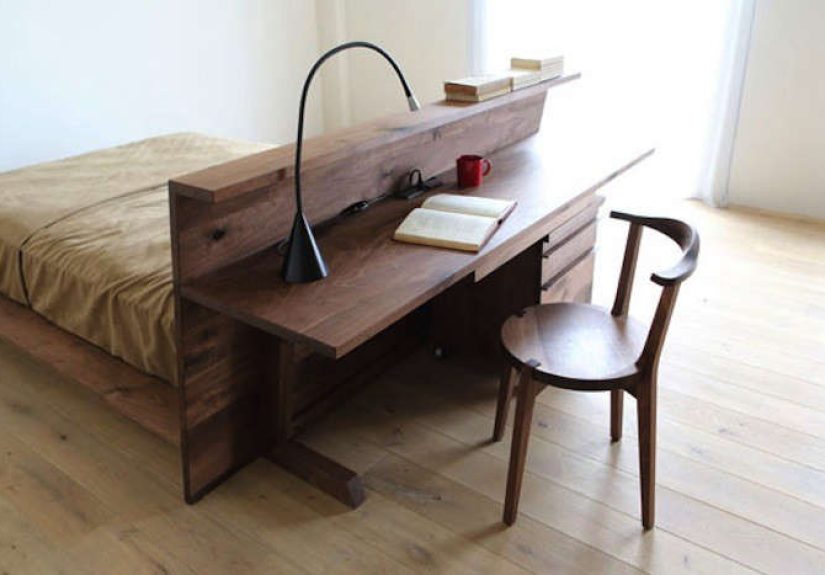
- A long bedside ledge that can act as a lap desk or landing zone for a laptop and notebook.
- A narrow desk attached to the bed frameintentionally slim, so it doesn’t swallow the room.
- Integrated drawers that keep office items out of sight when you’re done.
- Optional modular add-ons like a bookcase attachment instead of a desk, depending on how you live.
Small-space win: you stop “setting up” and start “using.” Your workspace is already there.
4) The “Counter Sofa” Idea: A Back-Ledge for Work, Storage, and Flow
Hirashima’s CARAMELLA line includes variations like a “counter sofa” concept, where the back of the sofa becomes a slim counter surface. This is one of the most underrated live/work moves because it uses space most sofas wastethe air behind them.
In a narrow living room, a counter-backed sofa can create:
- A place for a task lamp, charger, and laptop (a mini work bar).
- A light storage zone without adding a bulky console.
- A visual divider between “living” and “work” areas in open layouts.
Small-space win: it gives you a “desk-adjacent” surface without sacrificing floor area.
How to Build a Hirashima-Style Live/Work Layout in a Small Home
You don’t need a full suite of matching pieces. The real magic is choosing one anchor that solves your biggest daily friction point. Here are three realistic small-space scenarios and how Hirashima-style furniture strategies help.
Scenario A: The Studio Apartment (300–500 sq ft) Where Everything Shares One Room
The problem: Your bed, sofa, and desk are fighting for territory. You either work at the dining table (if you have one) or default to the couch/bed situation.
The Hirashima approach: Choose one piece that creates a built-in work surface without “adding a desk.”
- Best strategy: a bed with an integrated slim desk, or a sofa with a counter/desk surface behind it.
- Bonus strategy: a dining table with under-surface storage so it can handle both meals and work without clutter taking over.
Micro habit that changes everything: keep a small tray or bin for your “work kit” (charger, notebook, pen). When you finish, it goes into the built-in shelf/drawer. Instant reset.
Scenario B: The One-Bedroom Apartment Where the Living Room Becomes the Office
The problem: You want your living room to feel like a living room, not a coworking space that happens to contain a TV.
The Hirashima approach: integrate work surfaces into living furniture so your office can disappear visually.
- Best strategy: a counter-backed sofa, or a compact “work ledge” behind seating.
- Pair with: closed storage (drawers, cabinets, baskets) so paperwork doesn’t become décor.
Design trick: keep your work lighting distinct. A small task lamp signals “work mode” without changing the whole room. Turn it off, and the room returns to normal.
Scenario C: The Hybrid Guest Room / Office (a.k.a. The Room with an Identity Crisis)
The problem: You need a functional workspace but also a bed for guests (or for you when your neighbor starts practicing the drums at 11 p.m.).
The Hirashima approach: avoid giant, single-purpose furniture. Use pieces that provide a desk function built into the sleeping zone.
- Best strategy: a bed with an integrated desk and storage drawers; keep the footprint tight and intentional.
- Alternative: a daybed plus a slim desk/ledge system, so the room stays flexible.
Materials Matter in Small Spaces (Because You’re Always Close Enough to Touch Everything)
In big homes, you can get away with “fine from a distance.” In small homes, you live in handshake range of your furniture at all times. That’s why material quality feels amplified.
Hirashima is known for leaning into solid woodoften walnut and oakwhere the grain and texture do half the decorating work for you. Solid wood also ages in a way that doesn’t feel sad. Scratches become “patina,” not “my life is falling apart.”
If you’re aiming for the Hirashima vibe, prioritize:
- Natural materials that add warmth without visual clutter.
- Simple silhouettes that won’t overwhelm a small room.
- Pieces that hide storage so your essentials don’t become permanent countertop residents.
Ordering Hirashima from the U.S.: What to Know Before You Fall in Love
Here’s the practical part. Hirashima is Japan-based, and availability in the U.S. can be less straightforward than buying from a domestic brand with two-day shipping and 47 nearly identical “modern desks” in stock.
Consider these points:
- Lead times and shipping: International ordering can involve longer timelines and higher shipping costs (especially for solid wood).
- Customization choices: Many designs come in different woods, sizes, and configurationsgreat for tailoring to your space, but it requires measuring carefully.
- Aftercare: Solid wood loves basic maintenance: coasters, gentle cleaners, and occasional conditioning depending on the finish.
- Try before you buy (if possible): If you can see pieces in a showroom or through a distributor, do itcomfort and proportions are personal.
If ordering Hirashima isn’t practical, you can still use the blueprint: choose one multifunctional “anchor” piece that replaces two separate items, then build around it with slim, minimal supporting pieces.
The Hirashima Checklist: How to Choose Live/Work Furniture That Won’t Annoy You Later
Small-space furniture can look genius online and feel irritating in real life. Before you commit, run through this checklist:
- Does it save steps? You should be able to switch modes fast (work → dinner → relax).
- Does it hide the mess? Open shelves are great until they’re filled with cables and mystery objects.
- Is it comfortable for the real activity? “Dining-height” and “coffee-table-height” are not interchangeable (your spine knows).
- Can one piece replace two? If you still need a separate desk, table, and storage unit, you haven’t solved the problem.
- Does it fit your space with clearance? Measure the footprint and the “movement zone” around it.
- Will you still like it when you’re tired? The best furniture is easy to use when you’re not at your best.
Conclusion: A Small Space Doesn’t Need More StuffIt Needs Smarter Stuff
Hirashima’s live/work furniture hits a sweet spot: it’s minimalist without being cold, multifunctional without being gimmicky, and practical without looking like it belongs in a dorm room survival kit. The broader lesson is bigger than one brand:
In a small home, your furniture should do more than fill space. It should reduce friction, support routines, and make your everyday transitions smootherso your apartment feels like a home, not a Tetris game you can’t pause.
Experience Section: Living With Hirashima-Style Live/Work Furniture (A 7-Day Reality Check)
Day 1: I decide to “finally get serious” about my small-space setup. This is how every great plan begins: optimism, a tape measure, and the belief that my belongings will suddenly start behaving. I clear my dining table, which takes 14 minutes and reveals three pens, two chargers, one mystery screw, and a receipt from a place I don’t remember visiting. The Hirashima-style idea that hits first is the under-table shelf concept. The moment I give my everyday clutter a “second layer” to live on, the tabletop becomes usable again. It’s like finding a secret pocket in your jacket, except the pocket is big enough for your entire life.
Day 2: I try the “sofa plus dining/work surface” conceptbasically creating a zone where the back of seating becomes a slim counter. I set a lamp, a notebook, and my laptop there. Two things happen immediately: (1) I stop working from bed, and (2) I realize how much of my stress was caused by not having a default place to put things. When your work items have a home, your brain stops scanning the room like a confused raccoon.
Day 3: The bed-with-a-desk idea is next. Not the “giant desk jammed into the bedroom” approach, but the slim integrated surface approach. It’s narrow, so it forces me to work with essentials onlylaptop, water, notes. No spreading out like I’m mapping a heist. The surprising benefit? I finish faster. Turns out I don’t need 14 open tabs and a snack lineup that resembles airport duty-free.
Day 4: I test the “rhythm” concept: can I switch from work mode to dinner mode without an emotional breakdown? With built-in storage (drawers or a shelf), the reset takes under a minute. Laptop goes away. Notebook disappears. Table is suddenly a table again. I eat like a person instead of a gremlin guarding a keyboard.
Day 5: A friend drops by. Normally, I’d do the frantic “hide everything in the closet” maneuver. But the live/work setup makes the room look calmer by default. I still hide some things, because I’m not a magician, but I don’t have to relocate my entire identity. The counter-backed seating zone also makes it easy to offer a surface for drinks without dragging out extra furniture.
Day 6: The best part reveals itself: mental separation. In a small home, your environment is always talking to you. If your workspace is permanently visible, your brain stays half “on.” A Hirashima-style integrated solution lets you close the loopphysically and mentally. When the work items tuck away, the room stops whispering, “Hey… remember that email?”
Day 7: Final verdict. The biggest win isn’t that the furniture does two jobs. It’s that it reduces daily negotiation. I don’t have to ask myself, “Where am I working today?” or “Where do I put this?” The space answers for me. And in a small apartment, that’s luxury: not marble countertops or a chandelierjust a home that runs smoother, so you can, too.