Table of Contents >> Show >> Hide
- What Does “A Campaign to Get Into Heaven” Even Mean?
- South Park’s Secret Weapon: Heaven-and-Hell Symbolism
- The 2025 Setup: Season 27 Returns and Immediately Chooses Chaos
- Why the Joke Hit Harder After the “Heaven” Messaging
- The Backlash, the Buzz, and the Business Side of Outrage
- What Viewers Took Away: Satire, Not Subtlety
- of Experiences Related to This “Heaven vs. Hell” Moment
- Conclusion
If you’ve ever watched South Park, you know the show doesn’t knockit kicks the door in, trips over the welcome mat on purpose, then blames society for leaving it there.
So when a real-world political message starts sounding like a spiritual marketing campaign“help me get into heaven”the writers’ room in Colorado doesn’t reach for nuance.
They reach for the underworld. Literally.
In 2025, South Park returned to traditional episodes with Season 27 and wasted zero time turning the culture-war thermostat to “boiling.”
The show’s Trump satire leaned hard on a classic South Park tool: pairing public righteousness with the most visually obvious moral contrast imaginable.
And that’s how you get a headline-making joke that basically translates to: “You want heaven? Cool. Here’s hell.”
What Does “A Campaign to Get Into Heaven” Even Mean?
The phrase sounds like a late-night infomercial: “Act now and we’ll throw in eternal salvationshipping and handling not included.”
But the “get into heaven” line took on real-life traction in 2025 because it was used as a political talking point and then echoed in fundraising messaging.
In public remarks, Trump framed his desire to “get to heaven” as something that might be helped by saving lives through diplomacythen later treated it as a running joke about his own odds.
That theme didn’t stay in the realm of quips.
Reports described fundraising emails to supporters using “get to heaven” language as a hookpart motivational sermon, part donation pitch, part “please don’t ask follow-up questions.”
Whether you read it as humor, branding, or genuine spiritual anxiety, it created a perfect setup for satire: modern politics borrowing religious language like it’s a costume from the thrift store.
Why it’s comedy gold
“Getting into heaven” is an instantly understandable image.
It’s also a moral claimimplicit or explicitthat someone deserves approval from a higher authority.
Satire loves moral claims because they give you a target, a contrast, and a big neon sign that says: “Investigate the gap between what’s said and what’s done.”
South Park’s Secret Weapon: Heaven-and-Hell Symbolism
South Park has used religious imagery since the beginningnot as a theology class, but as a storytelling shortcut.
Heaven and hell are cultural shorthand. You don’t need footnotes to understand what the writers are implying when a character talks like a saint but behaves like a wrecking ball.
The show has long treated Satan (and other religious figures) as characters who can be used for social commentary.
Sometimes it’s absurd; sometimes it’s oddly human; sometimes it’s both in the same sentence.
The point isn’t doctrine. The point is contrastespecially when public life gets drenched in virtue-signaling, outrage, and grand declarations.
How satire uses “religious language” without being a religious show
In American pop culture, religious references are everywherepolitical speeches, ads, fundraising appeals, even product slogans.
When those references show up in politics, they can become a kind of moral armor: “I’m on the side of good, therefore criticism is unfair.”
A show like South Park responds by yanking the armor off and replacing it with a clown suit, because subtlety isn’t really its brand.
The 2025 Setup: Season 27 Returns and Immediately Chooses Chaos
Season 27 arrived with the kind of timing that makes PR teams sweat through their blazers.
New episodes hit amid corporate deal headlines, streaming-rights drama, and a media ecosystem that treats every controversy like a snackable content pack.
South Park didn’t politely reintroduce itself. It cannonballed into the discourse.
Episode 1: “Sermon on the ‘Mount” (July 2025)
The season premiere, “Sermon on the ‘Mount,” made it obvious the show planned to swing at big targetspolitics, media power, corporate pressure, and the uneasy relationship between entertainment and institutions.
It also ignited headlines and official pushback, because the episode’s portrayal of Trump used shock tactics and intentionally provocative imagery.
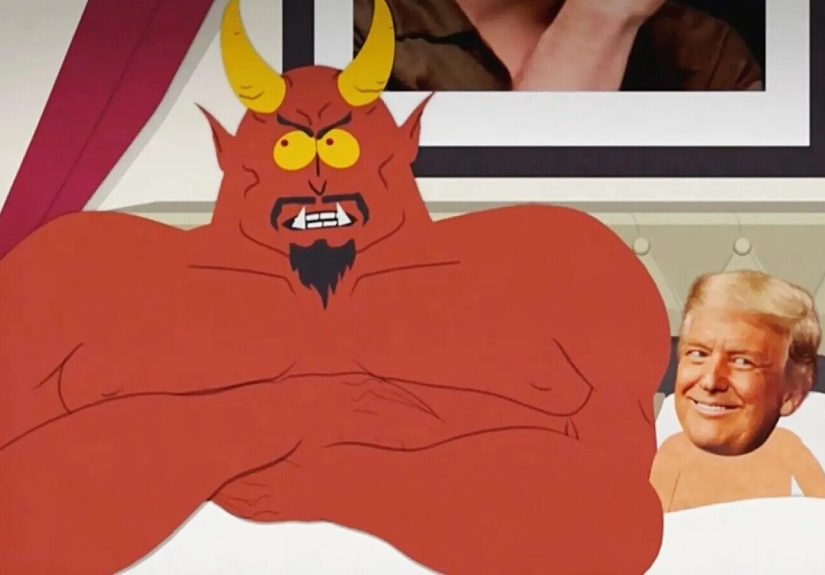
For the purposes of this story, what matters is the symbolic choice: the show places its Trump caricature next to Satan and lets the contrast do the talking.
Even if you never watched a single minute, you can decode the joke:
if someone is publicly posturing as morally righteousespecially with heaven languageSouth Park will underline the opposite in fluorescent marker.
Episode 4: “Wok Is Dead” (September 2025)
By early September, the season leaned into a second wave of commentary with “Wok Is Dead.”
On the surface, it’s a classic South Park mash-up: kids chasing a trend while adults create chaos in the background.
The episode ties together tariffs, media narratives, and a toy crazethen drags Trump-and-Satan satire right through the middle like a marching band with no indoor voice.
The episode’s pop-culture hook (a collectible toy trend) works because it’s familiar: scarcity, hype, status, drama, and grown-ups acting like kids about it.
Layer in a political subplot and cable-news reactions, and you get the signature South Park formula:
make everyone ridiculous, then ask the audience why that feels accurate.
So… did “South Park” literally call Trump “Satan”?
Not in the sense of a formal label-maker reading “TRUMP = SATAN” into the camera.
The show does something more South Park than a direct statement: it uses the association.
Pair the Trump caricature with Satan and let the audience connect the dots.
It’s satire by proximitylike a political cartoon where the donkey and the elephant are standing next to a dumpster fire and the caption just says, “Thoughts?”
Why the Joke Hit Harder After the “Heaven” Messaging
Timing is everything in comedy, and “heaven” language gave the show a clean runway.
When a political figure leans into spiritual framingespecially as part of persuasion or fundraisingsatire has a new question to ask:
Is this faith, branding, or a shield?
The “Trump trying to get into heaven” angle isn’t funny because heaven is funny.
It’s funny because it’s a grand, moral, universal claimdelivered through the same pipelines as campaign merch and fundraising blasts.
That contrast is the spark: the eternal packaged like a limited-time offer.
South Park’s underlying argument (beneath the chaos)
- Public virtue can be used as a marketing asset.
- Outrage keeps the attention engine running (for supporters and critics).
- Media ecosystems can turn anythingfaith includedinto a recurring segment.
- Corporate incentives shape what gets promoted, criticized, or quietly tolerated.
Whether you agree with the show or not, you can see the mechanism: take a real-world moral message, exaggerate it, and force viewers to examine what they’ve been trained to accept.
It’s less “religion is bad” and more “watch how religion gets used.”
The Backlash, the Buzz, and the Business Side of Outrage
The response to the Season 27 premiere wasn’t just social-media chatter.
It triggered official statements, big headlines, and a familiar modern cycle:
controversy → clips → reactions → think pieces → more viewers.
That cycle is part of the point.
South Park frequently critiques the systems that distribute attentioneven as it benefits from them.
In 2025, that tension was extra visible because corporate negotiations and distribution deals were part of the wider news surrounding the show.
Streaming, rights, and why everyone suddenly cared again
A major reason the debate got louder is that the show’s business story was also big news:
streaming rights, new-episode commitments, and deals that signaled just how valuable the franchise remains.
That creates an odd situation where an intentionally offensive show becomes a serious corporate assetlike investing in a fireworks factory and then being shocked it gets loud.
The “attention” accusation is basically free promotion
Critics often say a controversial episode is “just for attention.”
That may be true, but it’s also a weird complaint in a media economy where attention is the currency.
When you publicly scold a show for being attention-seeking, you’re essentially handing it a megaphone and saying, “Here, yell louder.”
What Viewers Took Away: Satire, Not Subtlety
The smartest thing South Park does is also the simplest: it makes its moral contrasts easy to understand.
You don’t need to be a policy expert or a cable-news devotee.
You just need to recognize the basic contradiction: heaven talk on one side, hell imagery on the other.
The show’s critics will argue it’s crude and cynical.
The show’s fans will argue it’s equal-opportunity and fearless.
Both can be true at the same timebecause South Park has never tried to be a gentle guide.
It’s a mirror held at a weird angle so your face looks slightly haunted.
If you’re writing about it, here’s the clean framing
If you want to explain the phenomenon without getting lost in the shock factor, frame it like this:
- Real-world trigger: “heaven” language becomes a noticeable political talking point and fundraising theme.
- Satirical response: South Park pairs the Trump caricature with Satan to invert the moral claim.
- Public reaction: backlash and praise amplify the episode’s reach.
- Meta layer: the show also mocks the systems (media and corporate) that profit from the whole cycle.
of Experiences Related to This “Heaven vs. Hell” Moment
When a headline like “Trump wants to get into heaven” starts circulating, a lot of people experience the same whiplash: you read it, you blink twice, and you wonder if reality accidentally opened three extra browser tabs.
That’s part of why South Park keeps survivinglife keeps handing it premises that already feel like satire.
For many viewers, the experience of watching these episodes isn’t just “haha, funny cartoon.”
It’s more like, “Wait… are we all living inside a sketch?”
One common experience is the group-chat effect.
Someone posts a clip reference or a recap, and suddenly your friends who haven’t watched the show in years are asking, “Is South Park back-back?”
The conversation usually splits into three lanes:
the fans who love the audacity, the critics who hate the crudeness, and the exhausted middle group who mostly want to eat dinner without hearing the phrase “culture war” again.
In that setting, the “heaven” angle becomes a shorthand for a bigger feelinghow politics, religion, and fundraising can blur together until the message sounds like a marketing funnel with a halo filter.
Another experience is the “I can’t explain this to my mom” phenomenon.
People try to summarize the premise“So there’s a toy craze, tariffs, cable news, and… symbolic underworld stuff”and realize it sounds like they’re describing a dream they had after falling asleep on the couch during a 24-hour news marathon.
That’s also where South Park thrives: it takes the overwhelming mess of modern headlines and turns it into a single, loud metaphor.
Viewers often walk away not remembering every plot beat, but remembering the contrast it forced them to see.
For some, the experience is less about comedy and more about media literacy.
They notice how quickly outrage turns into free distribution: a statement gets criticized, then clipped, then debated, then shareduntil the “backlash” becomes the marketing plan.
Watching the show while simultaneously watching people react to the show can feel like a two-screen documentary about attention.
The episode isn’t just telling a joke; it’s demonstrating how jokes become news, how news becomes identity, and how identity becomes merch.
And then there’s the simplest experience: laughing, then pausing.
Many viewers describe that moment where a punchline lands and you immediately think, “Okay, but why does this feel so plausible?”
That’s the show’s dark little magic trick.
Even when you disagree with its worldview, the episodes can make you notice the performance layer in public lifethe moral slogans, the spiritual language, the branding, the careful posing for cameras.
Whether you find it hilarious or infuriating, the “heaven vs. hell” framing is memorable because it turns a complicated debate into a single picture you can’t unsee.