Table of Contents >> Show >> Hide
- Why Space Feels Like a Horror Movie With Better Lighting
- The Body vs. the Vacuum: The Universe Wins on a Technicality
- Fact 1: In a vacuum, you can pass out in about 10–15 seconds
- Fact 2: Low pressure can trigger “ebullism” (yes, fluids can start to boil)
- Fact 3: Holding your breath in space is a terrible idea
- Fact 4: Space isn’t “cold” the way people imaginebut temperature control is brutal
- Fact 5: Microgravity can drain bone density fast
- Fact 6: Muscles shrink even when you work out like it’s your job (because it is)
- Fact 7: Your fluids shift upward, and your face can puff up
- Fact 8: Vision can change in space (sometimes for a long time)
- Fact 9: Space can mess with your immune system
- Fact 10: Sleep is harder when “day” happens 16 times every 24 hours
- Orbit Is Basically a High-Speed Demolition Derby
- Fact 11: The ISS travels around 17,500 mph
- Fact 12: Around 27,000 pieces of large orbital debris are actively tracked
- Fact 13: Even tiny debris can punch above its weight
- Fact 14: The “Kessler Syndrome” scenario is a real concern
- Fact 15: A slow pressure leak can be a major emergency
- Fact 16: Re-entry is a narrow “Goldilocks” problem
- Fact 17: Space radiation can flip bits in electronics
- Fact 18: Solar activity can increase atmospheric drag and mess with orbits
- Fact 19: Space weather can disrupt GPS, radio, and satellite operations
- Fact 20: Solar radiation storms can raise exposure risk for astronauts and polar flights
- The Solar System Doesn’t Want Your Spacecraft to Succeed
- Fact 21: Earth’s radiation belts are real zones of elevated risk
- Fact 22: The Sun can fire off particle storms that arrive fast
- Fact 23: Chelyabinsk proved small space rocks can still cause big problems
- Fact 24: Some asteroids are hard to spot because they approach from the Sun’s direction
- Fact 25: Long-period comets can give short notice
- Fact 26: Interstellar visitors can show up with little warning
- Fact 27: Mars can have planet-encircling dust events
- Fact 28: Jupiter’s radiation environment is intense enough to threaten spacecraft
- Deep Space: Where Physics Makes Its Own Rules
- Fact 29: Interstellar space sits near the temperature of the cosmic microwave background
- Fact 30: Rogue planets may drift through the galaxy without a star
- Fact 31: Black holes don’t “suck” like vacuum cleanersbut they do shred things up close
- Fact 32: Neutron stars are city-sized objects with absurd density
- Fact 33: Magnetars are cosmic magnets with “don’t get close” energy
- Fact 34: A nearby gamma-ray burst could damage Earth’s ozone layer
- Experience: When Space Gets Personal (And Suddenly You Understand the Fear)
- Conclusion: Respect the Void (But Keep Looking Up)
- SEO Tags
Space looks calm from down heresparkly, quiet, romantic. It’s basically the universe’s profile picture.
But the closer you look, the more you realize space is less “peaceful stargazing” and more “unfriendly
neighborhood where the laws of physics stopped pretending to be polite.”
Out there, there’s no air, no pressure, no mercy, and a truly absurd amount of stuff moving fast enough to turn
a paint chip into a tiny cannonball. The cosmos isn’t evil. It’s worse: it’s indifferent. Which means it’ll ruin your day
with the same vibe as a Roomba knocking over a glassno emotions, just consequences.
Why Space Feels Like a Horror Movie With Better Lighting
A good horror story works because it has three ingredients: isolation, uncertainty, and a setting that doesn’t care
if you survive. Space is all three, multiplied by “the nearest help is a few light-minutes away” and topped with cosmic
radiation like sprinkles you absolutely did not order.
Below are 34 real, science-based reasons space deserves respectand maybe a warning label the size of a billboard.
The Body vs. the Vacuum: The Universe Wins on a Technicality
Fact 1: In a vacuum, you can pass out in about 10–15 seconds
Without a pressurized suit, your brain stops getting oxygen almost immediately. You don’t have time for an inspiring
monologue. You barely have time for a confused blink.
Fact 2: Low pressure can trigger “ebullism” (yes, fluids can start to boil)
In very low pressure, liquids can boil at lower temperatures. Your body is built for Earth’s pressure, so removing that
protection creates a physics problem you can’t “tough out.”
Fact 3: Holding your breath in space is a terrible idea
Rapid pressure changes can damage lungs. The safest move is counterintuitive: don’t hold air in like you’re about to
swim across a pool. Space is not a pool. It’s a lawsuit.
Fact 4: Space isn’t “cold” the way people imaginebut temperature control is brutal
In a vacuum, you can’t lose heat by convection because there’s no air to carry it away. Managing heat becomes an
engineering battle: radiate it, reflect it, or overheat like a phone left on a dashboard in July.
Fact 5: Microgravity can drain bone density fast
Your skeleton is a “use it or lose it” system. In microgravity, weight-bearing bones don’t work as hard, and astronauts
can lose measurable bone density month by month if countermeasures aren’t maintained.
Fact 6: Muscles shrink even when you work out like it’s your job (because it is)
Space travelers follow intense exercise routines to fight muscle loss, because Earth’s gravity is basically a full-time
personal trainer you didn’t realize you had.
Fact 7: Your fluids shift upward, and your face can puff up
Gravity normally pulls fluids down. Remove gravity’s “down,” and your body redistributes fluidoften toward the head.
It’s one reason astronauts can look a bit puffy in early mission photos.
Fact 8: Vision can change in space (sometimes for a long time)
NASA tracks a condition called Spaceflight Associated Neuro-ocular Syndrome (SANS), linked to fluid shifts and pressure
changes around the eyes and brain. Space can literally change how you see thingspoetically and physically.
Fact 9: Space can mess with your immune system
Microgravity, radiation, stress, and disrupted sleep can alter immune responses. Some studies show dormant viruses can
reactivate during spaceflightbecause even your immune system gets confused by living in a floating tin can.
Fact 10: Sleep is harder when “day” happens 16 times every 24 hours
On the International Space Station, orbit means frequent sunrises and sunsets. Add noise, workload, and the knowledge
that the walls are doing all the “not dying” for you, and sleep becomes a performance sport.
Orbit Is Basically a High-Speed Demolition Derby
Fact 11: The ISS travels around 17,500 mph
That’s fast enough to circle Earth roughly every 90 minutes. It also means that “bumping into something” is less like a fender-bender
and more like a ballistics test.
Fact 12: Around 27,000 pieces of large orbital debris are actively tracked
Those are the big, trackable objects. The smaller fragmentslike bolts, paint flecks, and shardsare more numerous and
still dangerous because speed does most of the damage.
Fact 13: Even tiny debris can punch above its weight
At orbital velocities, a small object carries huge kinetic energy. This is why spacecraft shielding matters, and why
mission planners lose sleep so you don’t have to.
Fact 14: The “Kessler Syndrome” scenario is a real concern
If collisions create more debris, which triggers more collisions, you can get a cascading chain reaction that makes certain
orbits far more hazardous. Think: cosmic pinball, but the bumpers are your communication satellites.
Fact 15: A slow pressure leak can be a major emergency
Spacecraft are basically pressurized habitats in a place that hates pressure. Even a small leak demands fast diagnosis and
careful fixesbecause you can’t exactly crack a window for “fresh air.”
Fact 16: Re-entry is a narrow “Goldilocks” problem
Too steep and heat loads spike. Too shallow and you can skip off the atmosphere like a stone on a lake (except the lake is
the sky and the stone is a multi-million-dollar vehicle full of humans).
Fact 17: Space radiation can flip bits in electronics
High-energy particles can cause “single-event upsets,” changing the state of a memory cell or microcircuit. In space,
computers need extra protection and redundancy because the universe occasionally throws invisible darts.
Fact 18: Solar activity can increase atmospheric drag and mess with orbits
When the upper atmosphere heats and expands during active solar conditions, satellites in low Earth orbit can experience
more drag, which can shorten lifetimes and increase re-boost needs.
Fact 19: Space weather can disrupt GPS, radio, and satellite operations
Solar flares and geomagnetic storms can interfere with signals and increase risk to satellite systems. The “weather”
out there doesn’t rainit rewrites your navigation plan.
Fact 20: Solar radiation storms can raise exposure risk for astronauts and polar flights
During strong solar particle events, high-energy protons can increase radiation exposure at high latitudes and in space.
Earth’s magnetic field helpsbut it’s not an impenetrable force field.
The Solar System Doesn’t Want Your Spacecraft to Succeed
Fact 21: Earth’s radiation belts are real zones of elevated risk
The Van Allen belts contain trapped charged particles. Space missions crossing or operating near these regions need planning,
shielding, and timing because “just fly through it” is not a strategy.
Fact 22: The Sun can fire off particle storms that arrive fast
Solar energetic particles can travel at a significant fraction of light speed. For astronauts beyond low Earth orbit,
“storm shelter” isn’t poetic languageit’s a mission requirement.
Fact 23: Chelyabinsk proved small space rocks can still cause big problems
In 2013, an asteroid about the size of a small building exploded high in the atmosphere over Russia, causing a shock wave
that broke windows and injured many people. It was a reminder that “not dinosaur-sized” doesn’t mean “harmless.”
Fact 24: Some asteroids are hard to spot because they approach from the Sun’s direction
Telescopes can’t easily see objects coming out of the bright daytime sky. That’s one reason missions and surveys are being
designed to improve detection in the “sunward” blind spot.
Fact 25: Long-period comets can give short notice
Some comets originate far out in the solar system and swing in on long, stretched-out orbits. If one is discovered late,
the warning time may be far shorter than what you’d want for anything moving at “cosmic slingshot” speed.
Fact 26: Interstellar visitors can show up with little warning
Objects like ’Oumuamua reminded scientists that things can pass through our solar system from beyond it. Most are likely harmless,
but the surprise factor is very real: space doesn’t RSVP.
Fact 27: Mars can have planet-encircling dust events
Mars dust storms can grow rapidly and blanket huge regions. They can reduce sunlight dramaticallybad news for solar-powered missions,
and a reminder that “weather” is not just an Earth thing.
Fact 28: Jupiter’s radiation environment is intense enough to threaten spacecraft
Jupiter has powerful radiation belts. Missions operating there require hardened electronics and careful trajectories, because
Jupiter doesn’t just have gravityit has attitude.
Deep Space: Where Physics Makes Its Own Rules
Fact 29: Interstellar space sits near the temperature of the cosmic microwave background
The “background” temperature of the universe is just a few degrees above absolute zero. It’s quiet, dark, and cold in a way that
makes your freezer seem emotionally supportive.
Fact 30: Rogue planets may drift through the galaxy without a star
Free-floating planets can be ejected from their systems and wander alone. A world with no sunrise is not automatically “dangerous,”
but it is objectively unsettling.
Fact 31: Black holes don’t “suck” like vacuum cleanersbut they do shred things up close
Far away, a black hole’s gravity behaves like any other object of the same mass. But get close, and tidal forces can stretch and tear
objects apart. The nickname “spaghettification” is funny right up until you remember it describes real physics.
Fact 32: Neutron stars are city-sized objects with absurd density
A neutron star can pack more mass than the Sun into a sphere about the size of a city. NASA notes that a teaspoon of neutron star material
would weigh about a billion tons on Earth. That’s not “heavy.” That’s “your scale starts crying.”
Fact 33: Magnetars are cosmic magnets with “don’t get close” energy
Magnetars have the strongest known magnetic fields. NASA has explained that getting too near could disrupt electronicsand, at closer ranges,
the field is strong enough to affect matter in serious ways. This is a star that could bully your atoms.
Fact 34: A nearby gamma-ray burst could damage Earth’s ozone layer
Gamma-ray bursts are among the most powerful explosions known. NASA-linked research has modeled scenarios where a burst aimed at Earth could cause
major ozone depletion and long-lasting atmospheric impacts. Ten seconds of cosmic “flashlight” can have years of consequences.
Experience: When Space Gets Personal (And Suddenly You Understand the Fear)
Most of us will never float outside a spacecraft (and that’s okayspacewalks look like the world’s most expensive way to realize you forgot to
close the fridge). But you can still have real experiences that make space feel less like a pretty wallpaper and more like a living, breathing
environment with teeth.
One of the first “space is scary” moments often happens in a totally normal place: your backyard, a dark road trip, or a rooftop. You look up,
see the Milky Way (if you’re lucky enough to be away from city lights), and your brain tries to count starsand fails. Not because you’re bad at
math, but because the number is emotionally rude. The sky stops feeling like a ceiling and starts feeling like a drop-off. People describe it as awe,
which is basically fear wearing a tuxedo.
Then you learn what you’re actually seeing. That bright “star” might be a planet. That faint smudge might be a galaxy. And that means you’re looking
at something so far away that the light started traveling before your favorite shows were even pitched, cast, filmed, and canceled. Space turns time
into a physical object. You don’t just learn historyyou see it.
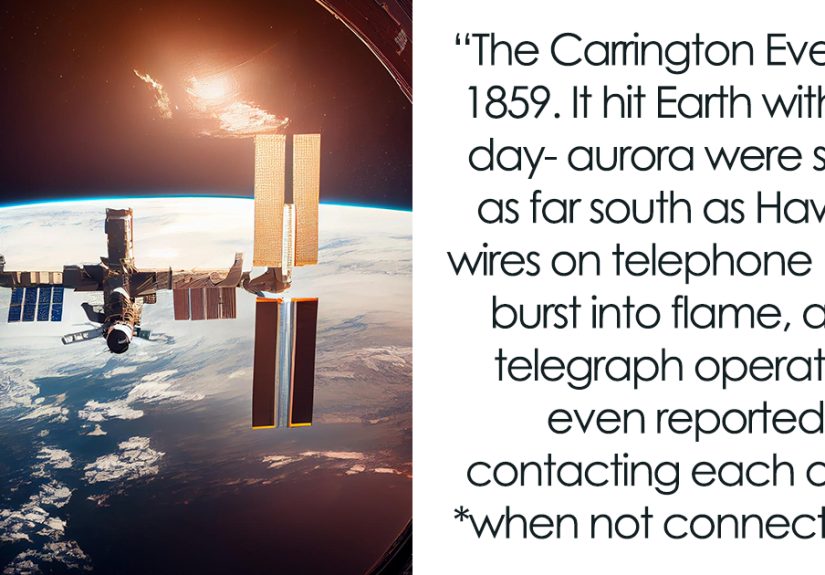
Another common experience is tracking the International Space Station. It glides silently overhead, bright and fast, like a calm reminder that humans
can live off-world… if we bring a lot of engineering and a lot of snacks. The second scary thought arrives right after: the ISS is moving at roughly
17,500 miles per hour, and it’s sharing orbital lanes with debris that doesn’t file flight plans. When you watch it streak across the sky, it feels
peaceful. When you remember how hostile the environment is, it feels like watching someone tightrope-walk over a blender.
If you’ve ever seen auroras (or even watched a live feed), that’s another “space got personal” moment. The lights are gorgeous, but they’re also a
visible sign of the Sun interacting with Earth’s magnetic fieldspace weather painting the sky. It’s like fireworks you didn’t schedule. And once you
realize solar storms can affect satellites, navigation, and radiation exposure at high latitudes, you start to understand why scientists track the Sun
the way meteorologists track hurricanes.
Museums and planetariums can deliver the same punch. A good black hole exhibit is basically a guided tour of the phrase “reality is optional.” You learn
that time runs differently in strong gravity, that light can be bent, and that the universe contains objects so dense the rules you grew up with just
quietly step aside. Even the language changes: “event horizon,” “tidal disruption,” “singularity.” Those are not cozy words. They sound like warnings.
And maybe the most personal space experience is simpler: the moment you feel small, but not in a sad way. In a “my problems are real, but also my planet is
a fragile bubble” way. Space fear isn’t just about danger; it’s about scale. The distances, the energies, the silence, the fact that the universe can do
something dramaticlike a gamma-ray burst or a solar stormwithout noticing we exist. That’s unsettling. But it’s also clarifying. It makes curiosity feel
brave. It makes exploration feel earned. And it makes “take care of Earth” feel less like a slogan and more like basic survival math.
Conclusion: Respect the Void (But Keep Looking Up)
Space is terrifying for the same reason it’s fascinating: it’s real, it’s extreme, and it doesn’t compromise. The vacuum, radiation, debris, distance,
and bizarre physics aren’t just triviathey’re the operating system of the universe.
The good news is that humans have a long history of staring at scary things and learning anyway. We build shields, write better code, track rocks, predict
storms, and keep pushing outwardcarefully. Because space may be scary, but curiosity is stubborn, and engineering is basically optimism with a wrench.