Table of Contents >> Show >> Hide
- What Is Squamous Cell Carcinoma (SCC)?
- Squamous Cell Carcinoma Pictures: What SCC Often Looks Like
- Symptoms of Squamous Cell Carcinoma
- Common Look-Alikes (and Why Self-Diagnosis Is a Trap)
- What Causes SCC? Key Risk Factors
- Actinic Keratosis, Bowen’s Disease, and “In Situ” SCC
- How Doctors Diagnose Squamous Cell Carcinoma
- Treatment Options: What SCC Treatment Usually Looks Like
- What Recovery and Follow-Up Can Feel Like
- Prevention: Sun Protection That’s Actually Practical
- When to See a Dermatologist (Don’t Wait for a Plot Twist)
- Frequently Asked Questions
- Experiences Related to SCC: What People Often Notice (and What They Wish They’d Done Sooner)
- Conclusion
Educational content only. If you’re worried about a spot, a board-certified dermatologist is the MVP for diagnosis and treatment.
What Is Squamous Cell Carcinoma (SCC)?
Squamous cell carcinoma (often called cutaneous SCC when it starts on the skin) is a common type of skin cancer that begins in
squamous cellsthe flat cells near the surface of your skin. Think of them as the “top-floor tenants” of the epidermis.
When UV exposure (sunlight or tanning beds) damages the DNA in these cells over time, some cells start multiplying like they missed the memo about
personal boundaries.
The good news: most SCCs are highly treatable when found early. The trick is that SCC can look like a lot of other “normal” skin problems,
so it often gets ignored as “just a scab” or “that crusty patch I’ve had forever.” (Spoiler: forever is not a skincare goal.)
Squamous Cell Carcinoma Pictures: What SCC Often Looks Like
A picture can be helpful for pattern recognition, but it can’t diagnose you. SCC may look different depending on your skin tone, body location,
and how early it’s caught. In photos, SCC commonly shows up as one of these “usual suspects”:
1) A rough, scaly patch that won’t quit
Many SCCs look like a reddish, scaly patch (or a darker/violaceous patch on deeper skin tones) that feels roughlike sandpaper
with a bad attitude. It may crust, itch, or bleed when bumped.
2) A firm bump (nodule) that’s new or changing
Another common look is a firm, raised bump that might be skin-colored, pink, red, brown, or darker depending on skin tone.
If it’s growing, crusting, or bleeding easily, it deserves attention.
3) An open sore that doesn’t heal (or heals… then returns)
A classic SCC red flag is a non-healing soreespecially one that oozes, crusts, bleeds, or comes back after “almost healing.”
If your skin keeps replaying the same wound episode, don’t just binge-watch it.
4) A wart-like growth (yes, really)
SCC can look wart-like, which is why people sometimes try home remedies for months. If a “wart” is enlarging, tender,
bleeding, or changing shape, it’s time to upgrade from guesswork to a skin exam.
5) Less common (but important) locations
SCC doesn’t only appear on the typical sun-exposed places like the face, ears, scalp, neck, arms, and hands. It can also develop
inside the mouth, on the lips, around the genitals or anus, and even
under or near nails. These areas can present as persistent sores, patches, or unusual discoloration.
Symptoms of Squamous Cell Carcinoma
SCC symptoms are often more about what a spot does over time than how it looks on day one. Watch for:
- A new spot that grows, thickens, or changes texture
- Rough or scaly patches that crust or bleed
- A sore that doesn’t heal after several weeks (or heals and comes back)
- Bleeding with minor friction (towel-dry drama, shirt-collar chaos)
- Itching, tenderness, or pain in a persistent lesion
- A rough patch on the lip that turns into an open sore (actinic cheilitis can be a precursor)
- Inside-the-mouth sore/patch that doesn’t resolve
“But I thought skin cancer always looks scary”
Sometimes it does. Sometimes it looks like a stubborn patch of dry skin that refuses to moisturize into submission.
That’s why dermatology is a specialty and not a vibe.
Common Look-Alikes (and Why Self-Diagnosis Is a Trap)
SCC can resemble conditions that are much less serious. The overlap is the problem. Common look-alikes include:
- Actinic keratosis (AK): precancerous scaly patches from sun damage (some can progress to SCC)
- Eczema/dermatitis: scaly, itchy areas that may flare and calm down
- Psoriasis: thick plaques with scale (often multiple, symmetric areas)
- Warts: rough growths that can be stubborn, especially on hands/feet
- Basal cell carcinoma (BCC): another common skin cancer with different typical patterns
If a lesion is new, changing, bleeding, painful, or not healing, the safest move is evaluationnot another month of “let’s see.”
What Causes SCC? Key Risk Factors
The leading driver for most SCC on the skin is cumulative UV exposurefrom the sun, tanning beds, or sunlamps.
UV damage adds up quietly, like a tab you didn’t know you opened.
Major risk factors
- Sun exposure over time, especially without consistent protection
- Indoor tanning (artificial UV radiation increases risk)
- Older age (more years for UV damage to accumulate)
- Fair skin, light eyes, red or blond hair (not a guaranteejust a higher statistical risk)
- History of sunburns, especially severe or repeated burns
- Actinic keratoses and chronic sun-damaged skin
- Weakened immune system (for example, after organ transplant or long-term immunosuppressive medications)
- Chronic wounds, scars, or previously radiated skin (some areas can behave more aggressively)
Quick reality check: SCC can happen to anyone
Having risk factors doesn’t mean you will get SCC. And lacking risk factors doesn’t mean you won’t.
Your skin doesn’t always follow rules; it follows patternsand those patterns are what clinicians are trained to spot.
Actinic Keratosis, Bowen’s Disease, and “In Situ” SCC
You’ll often hear SCC mentioned in the same breath as actinic keratosis (AK). AKs are rough, sun-damaged patches that are considered
precanceroussome can progress to SCC, so they’re treated seriously, even when they look small.
Bowen’s disease is commonly described as SCC in situ, meaning abnormal cells are confined to the outermost layer
of the skin. “In situ” is essentially the earliest stagestill important, but generally easier to treat than deeper invasive disease.
How Doctors Diagnose Squamous Cell Carcinoma
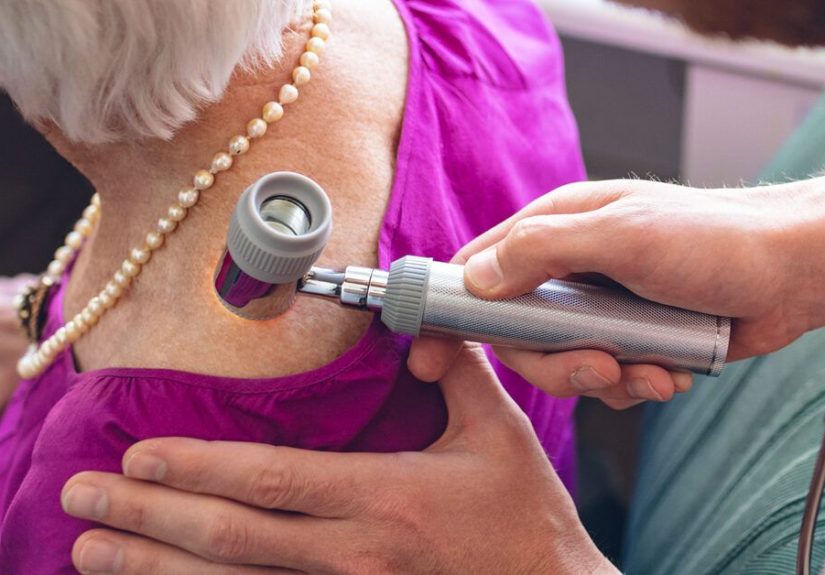
Diagnosis usually starts with a close skin exam. Dermatologists often use dermoscopy (a special magnifying tool) to evaluate patterns.
But the confirmation step is straightforward:
Biopsy: the definitive answer
A skin biopsy removes a small sample (or the entire lesion) for a pathologist to examine under a microscope.
It’s quick, done with local numbing, and far more reliable than internet image matching at 1 a.m.
Staging and “high-risk” features
Many SCCs are low risk and treated easily. Some have characteristics that raise concern for recurrence or spreadsuch as deeper invasion,
certain microscopic findings, or specific locations (like the ear or lip). High-risk features can change the treatment plan,
follow-up schedule, and whether additional evaluation is needed.
Treatment Options: What SCC Treatment Usually Looks Like
Treatment depends on size, depth, location, and risk features. Most people are treated with procedures that remove the cancer locally.
Common options include:
Surgical excision
The lesion is removed with a margin of normal-looking skin. The specimen is checked to make sure the edges (margins) are clear.
Mohs micrographic surgery
Mohs is often used for SCCs in cosmetically or functionally important areas (like the face) or higher-risk tumors.
Tissue is removed in thin layers and examined immediately until margins are clearaiming to remove as little healthy skin as possible.
Curettage and electrodesiccation (ED&C)
This method scrapes and treats the area with electric current, typically used for selected low-risk lesions in appropriate locations.
Cryosurgery, photodynamic therapy, and topical medications (selected cases)
Some very superficial or early lesions may be treated with freezing (cryosurgery), photodynamic therapy,
or topical medications such as 5-fluorouracil (5-FU) or imiquimoddepending on the clinical scenario and clinician judgment.
Radiation therapy
Radiation may be considered when surgery isn’t ideal or as an additional treatment in certain higher-risk cases.
For advanced SCC
A smaller set of cases can become locally advanced or spread to lymph nodes or other areas. In those situations,
care may involve a multidisciplinary team and treatments such as surgery, radiation, and systemic therapies (including immunotherapy),
tailored to the individual case.
What Recovery and Follow-Up Can Feel Like
Recovery varies by treatment type and location. A small excision on the arm may heal quickly, while a facial Mohs procedure can involve layered repair
and a more noticeable healing timeline. Either way, follow-up matters because:
- People who’ve had one SCC are at higher risk of developing another skin cancer later.
- Dermatology follow-ups help catch new lesions early, when treatment is simplest.
- Your clinician may recommend periodic skin exams and self-checks at home.
If you’re the type who loves checklists, congratulations: skin checks are the healthiest version of that personality trait.
Prevention: Sun Protection That’s Actually Practical
Prevention isn’t about never seeing daylight again (we’re not starting a “team vampire” movement). It’s about reducing cumulative UV exposure.
Strategies that public health and cancer organizations consistently recommend include:
Use broad-spectrum sunscreen (and use it correctly)
- Choose broad-spectrum sunscreen with at least SPF 15 (many experts advise SPF 30+ for daily use).
- Apply generously and reapply as directedespecially after swimming or sweating.
- Don’t forget ears, scalp (if hair is thin), neck, tops of hands, and lips (use an SPF lip product).
Cover and time it right
- Wear a wide-brimmed hat, UV-protective sunglasses, and sun-protective clothing when possible.
- Seek shade during peak sun hours (often around late morning to afternoon).
Skip indoor tanning
Indoor tanning isn’t “controlled sun.” It’s high-dose UV exposure you paid for, which is a terrible return on investment.
Do simple self-checks
Get familiar with your skin. If you notice a spot that’s new, changing, itching, or bleedingor a sore that won’t healschedule an exam.
Skin self-exams are especially useful if you’ve had significant sun exposure or prior skin cancers.
When to See a Dermatologist (Don’t Wait for a Plot Twist)
Make an appointment if you notice:
- A sore that doesn’t heal after several weeks
- A spot that bleeds, crusts, scabs, or comes back
- A new bump or patch that’s growing or changing
- A persistent rough patch on the lip or a sore in the mouth
- Any lesion that worries you for any reason (your intuition counts)
If it turns out to be benign, you’ll get peace of mind. If it’s SCC, you’ll be glad you caught it early. Either way, you win.
Frequently Asked Questions
Is squamous cell carcinoma dangerous?
SCC can be serious if ignoredespecially if it grows deeper, recurs, or spreads. But most cases are very treatable when caught early,
which is why early evaluation matters.
Does SCC hurt?
Sometimes SCC is painless. Other times it can itch, feel tender, burn, or hurtespecially if it’s ulcerated or inflamed.
Pain isn’t required for concern.
Can SCC show up somewhere that isn’t sun-exposed?
Yes. While many SCCs occur on sun-exposed skin, SCC can also occur on the lips, inside the mouth, in the genital/anogenital region,
and around nails. Any persistent sore or changing lesion in these areas deserves medical evaluation.
Experiences Related to SCC: What People Often Notice (and What They Wish They’d Done Sooner)
Because SCC can masquerade as “normal life stuff,” a lot of experiences share a theme: the spot didn’t seem urgent… until it did.
People often describe noticing a flaky patch on the forearm or temple that looked like dry skin. They tried moisturizer. They tried a stronger
moisturizer. They tried the “ignore it and hope it respects my boundaries” approach. Weeks turned into months. The patch never quite went away.
It would calm down, then returnsometimes redder, sometimes thicker, sometimes with a little crust that snagged on a towel like it had personal beef
with laundry.
Another common story: the “mystery scab.” It shows up on the ear, scalp, or lower lipplaces that get a lot of sun and not nearly enough sunscreen.
It bleeds after shaving, or it cracks in cold weather, or it just sits there acting like a tiny villain. People often say the same thing:
“I thought it was just because I bumped it.” When it heals and then reappears, that’s when the worry starts. By the time they book an appointment,
many feel annoyed with themselvesnot because they did something wrong, but because they didn’t realize that a non-healing sore is one of the
most important skin signals to take seriously.
For some, the path to diagnosis begins with an appointment for something elsean annual skin check, a rash, a “weird wart.” They’re surprised when
the dermatologist says, “Let’s biopsy that.” The biopsy itself is often described as easier than expected: quick numbing, a small sample, a bandage,
and a short period of waiting. The emotional part is usually the bigger hurdle. People describe feeling a mix of fear (“Is it bad?”) and relief
(“At least we’ll know”). When results confirm SCC, many say the next relief comes from hearing, “We can treat this.”
Treatment experiences vary, but the practical takeaways repeat. After excision or Mohs, people often say they wish they’d planned for a few simple
things: time off for the procedure, a ride home if they’re anxious, and basic wound-care supplies. Some are surprised by how “small” the area looks
at firstthen how the repair can be more involved depending on location (especially on the face). Most describe the healing as manageable with clear
instructions and follow-up. And almost everyone has a post-treatment realization: they become much better at sunscreen and self-checks.
It’s not about perfectionit’s about consistency. Many people also start protecting the “forgotten zones” (ears, hands, scalp, lips) and ditch the
tanning-bed myth forever.
If there’s a universal lesson from these shared experiences, it’s this: don’t wait for pain or drama. SCC is often quiet. Catching it
early usually makes treatment simpler, scars smaller, and outcomes better. And if you’re reading this while side-eyeing a stubborn spot on your skin,
consider that your future self might really appreciate a quick appointment today.