Table of Contents >> Show >> Hide
- The Artist Behind the 8-Bit Ambush
- How He Makes It Look Digital (Without Being Digital)
- Why Pixel Art Works So Well in the Real World
- Is It Vandalism, Public Art, or a Little of Both?
- “New Pics,” New Installs, and the Social-Media Scavenger Hunt
- How to Enjoy This Kind of Street Art Without Being “That Person”
- Conclusion: The City as a Playground (With Boundaries)
- Experiences: What It Feels Like to “Find” Pixel Art in the Wild (Bonus)
If you’ve ever looked at a boring concrete post and thought, “This could really use a tiny Mario,” you’re not alone.
Street art has a long history of turning everyday city stuffsigns, pipes, barriers, brick wallsinto moments of surprise.
But one Swedish artist has a particularly funny way of doing it: he “pixelates” real life with pop-culture characters that look like they jumped straight out of an old-school video game.
The result is a kind of playful urban glitch: the city stays the city, but now it comes with bonus nostalgia and a grin.
The internet often frames this kind of work as “vandalism,” mostly because it appears in public without the usual gallery labels and velvet ropes.
But the vibe is less “angry tag” and more “tiny gift you weren’t expecting on your walk to buy toothpaste.”
And once you notice one piece, you start scanning every pole and curb like you’re a kid hunting collectibles in an 8-bit side quest.
The Artist Behind the 8-Bit Ambush
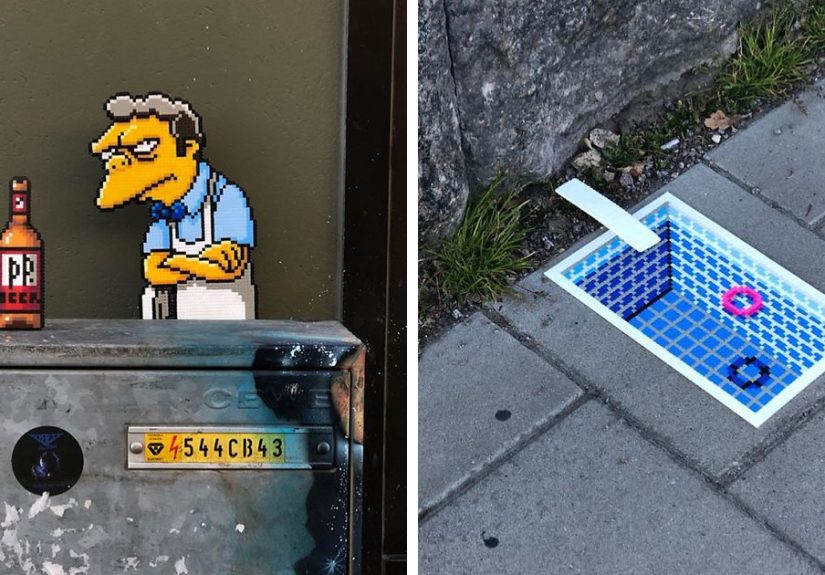
The Swedish artist known as Pappas Pärlor (Johan Karlgren) has built a recognizable style: crisp, colorful pixel characters placed so they interact with the real world instead of simply sitting on it.[1]
His installations often feel like visual jokes that only work because of where they’re placedlike a character “using” a fence, a sign, or a curb as part of the scene.
That site-specific trick is what makes people stop mid-scroll in real life: you’re not just seeing pixel art, you’re seeing pixel art that noticed the environment.
A lot of his imagery pulls from the shared museum of pop culture: classic video games, cartoons, movies, and retro icons.
Even if you don’t recognize every reference, you recognize the language: the chunky pixels, the bold outlines, the “I swear I played this on a Saturday morning” energy.
In a world of hyper-real everything, Pappas Pärlor leans into the charm of low-resolution.
How He Makes It Look Digital (Without Being Digital)
Meet the not-so-secret ingredient: fuse beads
The twist is that this pixel art isn’t printed or painted to look pixelatedit’s built from tiny plastic fuse beads (often known by the brand Perler).[1]
These beads are arranged on a pegboard and fused together with heat, turning a loose pile of dots into a single, sturdy “sprite.”
Perler’s own materials explain that their beads are made from low-density polyethylene (LDPE), described as food-grade plastic.[2]
That matters because the final piece needs to survive handling, weather, and the general chaos of city life.
Why beads are perfect for street “pixels”
Beads create “pixels” that are literal units: each bead is a dot of color, so the artwork naturally inherits that blocky, retro aesthetic.
The texture also helps. A painted pixel mural can look flat from certain angles, but bead-based sprites catch light in a way that makes them pop against concrete and metal.
It’s like the city suddenly has a tiny, shiny sticker from another universeexcept it’s handmade and intentionally placed.
Why Pixel Art Works So Well in the Real World
Pixel art is basically nostalgia with a barcode. The style instantly suggests “game,” “cartoon,” “retro,” “childhood,” even if you can’t name the specific character.
And nostalgia is powerful in public space because it interrupts autopilot.
You can ignore a gray wall. You can’t ignore a gray wall that now includes a character doing something ridiculous with a drainpipe.
This is also why his work plays so well on social media: the humor reads fast, and the format is universally legible.
One installation can be understood in two secondsyet it still rewards the person who notices the details and the placement.
Some images show characters “leaning” into hedges, racing along a beach edge, or skating along an underpassscenes that feel like little punchlines built from location and memory.[3]
Is It Vandalism, Public Art, or a Little of Both?
Let’s not pretend cities don’t have rules. The moment you add anything to property you don’t ownwhether it’s paint, paste, or a tiny bead spriteyou’re stepping into legal and ethical gray zones.
American arts coverage has long documented how graffiti and street art have been dismissed as vandalism while also migrating into galleries and museums over time.[4]
The National Endowment for the Arts has also explored the history and language around street art and graffiti culture, including the complicated relationship between public expression and illegality.[5]
What makes Pappas Pärlor’s approach different is the tone.
His pieces usually don’t read as aggressive or territorial. They read as mischievous and oddly generouslike the city is in on the joke.
That doesn’t automatically make it “allowed,” but it helps explain why so many people react with delight instead of annoyance.
There’s also an important difference between work that damages surfaces and work that’s closer to temporary installation.
Even then, “temporary” can be complicated: adhesives, removal, weathering, and property rights all matter.
In the U.S., debates about what counts as protected art versus removable nuisance have been shaped by real legal conflicts and public controversies.[6]
The bigger point is that street art exists on a spectrum: from sanctioned murals to unsanctioned interventionsand public opinion doesn’t always match the law.
“New Pics,” New Installs, and the Social-Media Scavenger Hunt
Pappas Pärlor’s work travels online almost as much as it exists on the street.
His installations get photographed, reposted, and shared as bite-sized moments of public joyoften with the same reaction: “How did I not see this sooner?”
A large following on visual platforms helps turn these pieces into a kind of ongoing series: new drops, new placements, new jokes, new “levels.”[7]
This isn’t unique to him, either. Pixel-based street art has a built-in scavenger-hunt quality.
In the U.S., coverage of other pixel-inspired street projects has highlighted how fans hunt for pieces and document them like collectibles, blurring the line between street art and game design.[8]
Pappas Pärlor taps that same energy, but with a very Swedish sense of humor: dry, playful, and just a little bit “I did this because it made me laugh.”
How to Enjoy This Kind of Street Art Without Being “That Person”
If these pieces make you want to go looking, do it the fun (and respectful) way:
- Walk slower in “boring” places. Barriers, signposts, and utility boxes are prime territory for tiny surprises.
- Look for interaction, not just decoration. The best pieces often use the environment as part of the joke.
- Photograph, don’t touch. These works can be fragile, and touching public installationsart or notusually ends badly.
- Support artists legally. Many street artists also sell studio pieces, prints, or gallery workssupporting that side encourages more art without encouraging damage.[9]
And if this inspires you to make your own pixel art, the safest move is simple: create bead sprites, magnets, frames, or removable installations made for spaces where you have permission.
The creativity is the pointnot the trespassing.
Conclusion: The City as a Playground (With Boundaries)
Pappas Pärlor’s pixel art is a reminder that public space doesn’t have to feel purely functional.
A single small artwork can turn a forgettable corner into a story, a laugh, or a memory.
Whether you call it “vandalism” or “urban decoration,” the reason it spreads is obvious: it makes people feel something in the middle of their normal dayusually surprise, nostalgia, and the urge to point and say, “Look!”
The best part is that it doesn’t ask for much time.
You don’t need an art degree, a museum ticket, or a perfectly curated itinerary.
You just need to notice the world a little more closelybecause somewhere out there, a tiny pixel character is probably doing something hilarious with a handrail.
Experiences: What It Feels Like to “Find” Pixel Art in the Wild (Bonus)
There’s a specific kind of joy that only happens when you stumble into art by accident.
Not the planned kindwhere you drove downtown, paid for parking, and promised yourself you’d “really take it in.”
I mean the accidental kind: you’re walking to class, heading to work, dragging yourself to the grocery store, and your brain is doing that modern thing where it’s half thinking about the next task and half replaying a random song lyric.
Then you spot it: a little 8-bit character clinging to a sign, hiding near a pipe, or turning a boring concrete edge into a scene.
Your brain does a hard reset. Autopilot off. Curiosity on.
The first reaction is usually disbelieflike you’re not sure if it’s really there.
Pixel art feels “digital,” so seeing it physically attached to the world creates a tiny glitch in your expectations.
You look again. You step closer. You tilt your head (because apparently we all become art critics for five seconds).
And then you smile, because the scene is almost always a joke: the character is positioned as if it belongs there, as if the city was designed with this punchline in mind.
That’s what makes artists like Pappas Pärlor so effective: the placement feels intentional in a way that makes the environment itself seem funnier.
If you’re with friends, the moment becomes social immediately.
Somebody points. Somebody says, “No way.”
Somebody takes a photo. Somebody sends it to a group chat with the caption “THE CITY HAS DLC NOW.”
If you’re alone, the moment becomes oddly personala tiny private win in the middle of a normal day.
You might not talk to anyone about it, but it changes your mood anyway.
And then it changes how you walk for the next few blocks: you start scanning poles and fences like you’ve unlocked a hidden-object mini game.
That “hunt” feeling is a big part of the experience.
Even when you’re not deliberately searching, your eyes begin to look for patterns: bright colors on gray surfaces, blocky outlines, little clusters of unexpected detail.
You notice more of the city, period.
You notice textures, corners, and weird little architectural moments you normally ignore.
In a funny way, pixel street art doesn’t just add something to the environmentit trains you to pay attention to what was already there.
The experience also carries a soft lesson about boundaries.
Most people who love this kind of art don’t actually want their city destroyed; they want their city alive.
That’s why the best way to channel the inspiration is to create legally: make bead sprites at home, do removable displays, collaborate with community spaces, or contribute to sanctioned public art projects.
The magic is the creativity and surprisenot the risk.
You can keep the playful spirit while respecting other people’s property, which is basically the grown-up version of keeping the fun without wrecking the game.
And if you never find a piece in person?
You can still borrow the mindset.
The next time you’re walking through a dull, gray stretch of sidewalk, imagine what would make it better: a tiny character peeking out, a nostalgic reference, a little visual pun that makes strangers smile.
That’s the real gift of pixel street art.
It doesn’t just decorate the cityit reminds you that the city is full of blank spaces where imagination can show up, politely, cleverly, and with just enough humor to make you feel like you discovered something special.