Table of Contents >> Show >> Hide
- What Is SymbiFlow?
- Why the SymbiFlow Toolchain Matters
- How the SymbiFlow Open Source FPGA Toolchain Works
- Supported Devices and Practical Scope
- Strengths of the SymbiFlow Toolchain
- Limitations You Should Know Before Falling in Love
- SymbiFlow vs. Traditional Vendor FPGA Flows
- Who Should Use SymbiFlow?
- Final Thoughts
- Experiences With the SymbiFlow Open Source FPGA Toolchain
- SEO Tags
FPGAs are amazing little shape-shifters. One day they are a video pipeline, the next day they are a soft CPU, and by Friday they are making your logic analyzer look lazy. The catch, historically, has been the toolchain. Too often, FPGA development has felt like joining a private club where the software is large, the licensing is picky, and the workflow seems determined to test your patience before it tests your design.
That is exactly why the SymbiFlow open source FPGA toolchain became such a big deal. It represented a practical push toward an open, scriptable, reproducible FPGA development flow built on community tooling rather than a single vendor’s black box. Today, many developers encounter that work under the broader F4PGA umbrella, but the SymbiFlow name still matters because it marks the moment open FPGA tooling stopped being a quirky side quest and started feeling like real engineering infrastructure.
This article explains what SymbiFlow is, how the toolchain works, why it matters to FPGA developers, where it shines, and where it still asks you to bring a little patience and a strong cup of coffee.
What Is SymbiFlow?
SymbiFlow is an open source FPGA toolchain designed to take hardware designs from HDL source code to an implementable FPGA configuration using open components. In plain English, it aims to do the job of a traditional FPGA flow without forcing you into a fully proprietary environment.
That mission sounds simple until you remember what an FPGA flow actually includes. You need synthesis, technology mapping, packing, placement, routing, timing awareness, device databases, bitstream knowledge, and enough project plumbing to keep all those pieces from arguing in the hallway. SymbiFlow pulled those pieces together into a usable stack and helped prove that open FPGA development could be more than an academic experiment.
In current ecosystem language, SymbiFlow is best understood as the historical name and foundation of a broader open FPGA effort that evolved into F4PGA. That naming shift matters for anyone researching the toolchain today, because documentation, examples, and ongoing project work often live under F4PGA or related subprojects rather than under the original SymbiFlow banner.
Why the SymbiFlow Toolchain Matters
The importance of SymbiFlow is not just that it is open source. Plenty of projects are open source and still hard to use outside of a graduate thesis and three very determined forum threads. SymbiFlow matters because it addresses a very real pain point in FPGA development: toolchain lock-in.
With a traditional vendor flow, you often get excellent device support and polished GUIs, but you also inherit heavyweight installs, opaque internals, limited automation flexibility, and a workflow that may not fit cleanly into modern CI, containerized builds, or research pipelines. SymbiFlow gave developers, researchers, and open hardware teams a way to work with FPGA designs using tools that are easier to script, inspect, version, and extend.
That makes the toolchain especially attractive for:
- research groups studying FPGA architecture and CAD flows,
- open hardware developers who value transparency,
- teams building automated regression and CI systems,
- educators teaching digital design without requiring giant vendor installations,
- engineers who simply enjoy understanding what the tools are doing instead of nodding politely while a proprietary wizard spins.
How the SymbiFlow Open Source FPGA Toolchain Works
At a high level, SymbiFlow follows the familiar stages of an FPGA design flow, but it does so by combining multiple specialized open source projects.
1. HDL Input and Synthesis
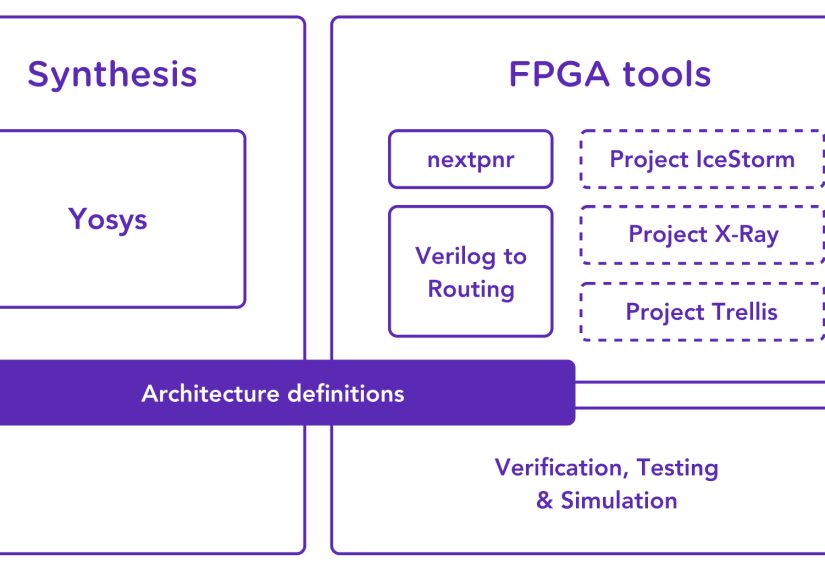
The flow usually begins with Verilog, and in many setups the first major engine is Yosys. Yosys handles synthesis by transforming RTL into a gate- and architecture-aware netlist. This is one of the most important parts of the open FPGA story because synthesis is where a lot of flexibility begins. Yosys is scriptable, modular, and well suited to automated design flows.
For developers, this means you can inspect intermediate representations, integrate formal checks, and create repeatable builds without relying on point-and-click routines. For educators, it means the path from source code to mapped logic is easier to explain. For the curious, it means fewer mysteries and fewer “because the tool said so” moments.
2. Architecture Definitions and Device Data
Open FPGA tooling only works when the software knows the fabric it is targeting. That is where architecture definitions and device databases enter the picture. SymbiFlow and the broader F4PGA ecosystem depend on companion projects that document how specific FPGA families are organized internally.
For example, Project X-Ray is central to open tooling for Xilinx 7-series devices. It documents the bitstream format and device structure needed to build open implementation flows. In similar spirit, other projects such as Project Trellis and Project U-Ray expand the open-device knowledge base to other FPGA families and newer generations.
This is one of the most impressive parts of the open FPGA movement. The community is not just writing tools. It is documenting real hardware behavior at a level detailed enough to support implementation.
3. Packing, Placement, and Routing
Once the design is synthesized, the toolchain needs to map it onto the actual FPGA fabric. Depending on the target flow, this stage may use VPR from the Verilog-to-Routing ecosystem or other back-end paths such as nextpnr-based flows for supported architectures.
This stage is where your elegant design meets physical reality. Logic elements have locations. Routing resources have limits. Timing paths stop being theoretical and start behaving like they pay rent. A good open toolchain needs strong place-and-route support, and SymbiFlow’s significance is tied closely to the fact that it connects open synthesis with genuinely useful implementation back ends.
4. FASM and Bitstream-Oriented Workflows
One of the concepts often associated with SymbiFlow is FASM, or FPGA assembly. FASM acts like a textual representation of FPGA configuration features, which makes it easier to inspect, transform, and reason about low-level device programming data. That matters because it gives advanced users a cleaner bridge between implementation results and final device configuration.
If you like seeing how the sausage is made, FASM is the open FPGA equivalent of getting a kitchen pass. It is not always required for day-to-day work, but it is extremely useful for debugging, research, tooling, and understanding how high-level logic becomes configured silicon.
Supported Devices and Practical Scope
One of the most common questions about the SymbiFlow open source FPGA toolchain is simple: “What can I actually target?” That is the right question, because FPGA tooling is only as good as its device support.
Historically and practically, the most important SymbiFlow-related targets have included Xilinx 7-series devices and QuickLogic EOS S3, with the broader F4PGA effort also describing support around architectures such as Lattice iCE40. Community projects like openXC7 show that the Series-7 side of the ecosystem continues to evolve, especially through nextpnr-xilinx development.
That said, the right mindset is to treat open FPGA support as architecture-specific, not universal. You should always verify the exact family, board, and workflow before committing to a project. Open source FPGA tooling has made huge progress, but it is not yet a magical “all chips, all boards, all features, all the time” solution.
Strengths of the SymbiFlow Toolchain
Transparency
This is the obvious one, but it deserves first place. Open source tools let you inspect the flow, understand failures, and automate builds without crossing your fingers every time a vendor update lands.
Automation-Friendly Workflows
SymbiFlow-style flows are excellent for scripting, CI pipelines, and reproducible builds. That matters in modern engineering teams where repeatability is not a luxury. It is survival.
Research and Education Value
Because the tools and device knowledge are visible, they are ideal for academic research, architecture exploration, and teaching digital design concepts. Students can learn more than just which menu to click.
Ecosystem Flexibility
The open FPGA ecosystem plays well with adjacent open hardware tools, including formal verification, soft-core CPU projects, Python-driven build systems, and containerized development environments.
Limitations You Should Know Before Falling in Love
Every toolchain has tradeoffs, and SymbiFlow is no exception.
Device Coverage Is Selective
The biggest limitation is still support breadth. Vendor tools generally support more devices, more primitives, and more board-specific features. Open flows are improving, but they are still selective.
Documentation Can Feel Fragmented
Because the ecosystem spans multiple repositories and projects, developers sometimes have to jump between documentation for Yosys, F4PGA, Project X-Ray, examples repositories, and board-specific instructions. The information exists, but it can feel like assembling IKEA furniture with instructions spread across three tabs and a conference slide deck.
Debugging Requires Curiosity
This is a strength and a weakness. Open tools let you see deeply into the flow, but they also assume you are willing to do a little detective work. If you want everything hidden behind one giant “Build Bitstream” button, proprietary vendor tools may feel more comfortable.
SymbiFlow vs. Traditional Vendor FPGA Flows
Vendor flows still win on polished support, commercial validation, and broad device enablement. If your project absolutely depends on full-featured support for a new device family, advanced IP integration, or guaranteed production signoff through a vendor-approved path, the proprietary option often remains the safer choice.
But SymbiFlow wins in areas that matter more every year: openness, inspectability, reproducibility, and ecosystem integration. For research, education, prototyping, CI-driven development, open hardware projects, and engineers who prefer tools they can actually understand, SymbiFlow offers something vendor software rarely does: a sense that the toolchain belongs to the user, not the other way around.
Who Should Use SymbiFlow?
You should seriously consider the SymbiFlow open source FPGA toolchain if you:
- want an open and scriptable FPGA flow,
- work on supported 7-series or QuickLogic-related targets,
- care about CI, reproducibility, and automation,
- teach or study FPGA design,
- enjoy understanding the tooling stack instead of treating it as a mysterious weather system.
You may want to stay with vendor tools if you need the broadest device support, the smoothest turnkey experience, or advanced features that the open flow does not yet cover for your exact target.
Final Thoughts
SymbiFlow helped change the conversation around FPGA development. It showed that an open source FPGA toolchain could be more than a proof of concept. It could be practical, extensible, research-friendly, and genuinely useful. Even as project branding and ecosystem structure evolved toward F4PGA and related initiatives, the core idea remains the same: FPGA development should be more open, more scriptable, and more accessible than it used to be.
That does not mean the journey is finished. Open FPGA tooling still has rough edges, selective device coverage, and a few “bring your own patience” moments. But the direction is unmistakable. SymbiFlow opened the door, and once engineers get a taste of transparent, automatable FPGA tooling, it is very hard to go back to a workflow that feels like negotiating with a locked filing cabinet.
In other words, SymbiFlow is not just a toolchain. It is a statement that FPGA development can be open, modern, and a little less mysterious. And frankly, that is the kind of engineering plot twist worth rooting for.
Experiences With the SymbiFlow Open Source FPGA Toolchain
Working with SymbiFlow feels different from working with a classic vendor FPGA suite, and that difference shows up almost immediately. The first thing many developers notice is that the flow feels more like software engineering than traditional hardware tooling. You are reading logs, running commands, inspecting artifacts, and building repeatable steps instead of wandering through a maze of project settings hoping the GUI remembers what you meant last Tuesday.
That can be incredibly refreshing. On a supported board, the experience often starts with a simple design such as a blinky LED, UART pass-through, or small counter. In a vendor flow, that kind of test is usually quick, but much of what happens under the hood remains hidden. With SymbiFlow, you can see the progression more clearly: synthesis, mapping, placement, routing, and intermediate outputs that make the design journey easier to understand. For someone learning FPGA implementation, that visibility is pure gold.
Another real-world advantage is reproducibility. Teams that like containers, CI pipelines, and automated regression testing tend to appreciate the toolchain because it fits naturally into scripted workflows. When a design breaks, you can diff scripts, netlists, constraints, and logs with the same discipline used in software projects. That may not sound glamorous, but in engineering, glamorous is overrated. Repeatable is beautiful.
Of course, not every experience is effortless. Developers often report that the hardest part is not the synthesis itself, but piecing together the right documentation across evolving repositories and target-specific examples. The flow can occasionally feel like an open source scavenger hunt: one clue in the examples repo, one clue in board docs, one clue in architecture definitions, and one clue in an issue thread from a very helpful stranger who solved the exact same problem two years ago. It is charming in a community way, though sometimes you would trade some charm for a single perfect getting-started page.
Still, the overall experience tends to leave a strong impression. When a design finally routes and produces a working result through a fully open flow, it feels less like pressing a button and more like understanding a system. That is the real appeal of SymbiFlow. It gives developers a toolchain they can learn from, trust, automate, and improve. For many engineers, that is not just convenient. It is the whole point.