Table of Contents >> Show >> Hide
- Meet “Angel”: The Fallen Figure That Looks Uncomfortably Alive
- Who Are Sun Yuan and Peng Yu? The Duo Behind the Discomfort
- Why an Elderly Angel? Subverting the “Pretty Winged Person” Trope
- The Craft Behind the Creeps: How Hyper-Realistic Sculpture Tricks Your Brain
- The Internet Panic Button: How “Angel” Went Viral
- How to Look at It Without Looking Away
- Fallen Angels Through History: From Drama to Doubt
- Why It Matters: Faith, Power, and the Body in One Unblinking Object
- Experiences Around “Angel”: A Viewer’s Walkthrough of the Emotional Roller Coaster (500+ Words)
- Conclusion: A Miracle That Refuses to Perform
Imagine walking into a gallery and spotting what looks like a real body on the floorskin, pores, wrinkles, faint
fuzz, the whole unsettling human package. Then your brain catches up and whispers: “Wait… wings?” That’s the basic
emotional itinerary of Angel (2008), the hyper-realistic “fallen angel” sculpture by Chinese artist duo
Sun Yuan and Peng Yu. It’s the kind of artwork that makes people do three things in quick succession:
(1) stare, (2) look away, (3) stare again like their curiosity just won an arm-wrestling match with their common sense.
Online, Angel has been described as “terrifying,” “too real,” andduring its most viral momentsmistaken for
actual supernatural evidence, as if the internet suddenly became a late-night tabloid checkout aisle. But in person
(or even through photos), the sculpture is more than a jump scare. It’s a carefully engineered emotional trap:
a lifelike figure that turns a familiar religious symbol into something fragile, exhausted, and disturbingly mortal.
Meet “Angel”: The Fallen Figure That Looks Uncomfortably Alive
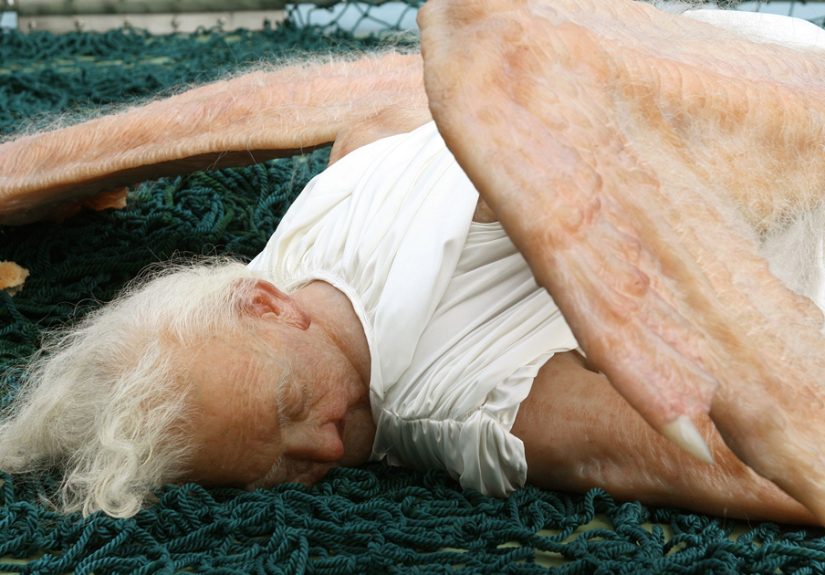
Angel depicts an elderly, life-size winged figure in a pale gown, sprawled on the ground as if asleep,
injured, or deadSun Yuan and Peng Yu never force a single “correct” answer, and the ambiguity is the point.
The wings are especially unnerving: not the feathery, greeting-card kind, but stripped, flesh-toned, and heavy,
like anatomy rather than ornament. The figure’s realism is so intense that viewers often react the way they might
to a medical simulation: respectful distance, nervous glances, and a sudden awareness of their own skin.
The artists achieved this effect using materials associated with hyperreal sculpturethink fiber-reinforced
polymer/fiberglass for structure and silica gel or similar skin-like surfaces for that “this might breathe” illusion.
It’s a technical flex, yes, but it’s not just craft for craft’s sake. The physical credibility is what allows the
concept to land with full weight. If the body looked cartoonish, the metaphor would float away. Instead, it thuds.
Why the “fallen angel” idea hits so hard
Angels in Western visual culture are often rendered as pristine messengerssymbols of power, protection, and
clean, divine certainty. Angel flips that script. Here, the sacred looks defeated. The heavenly looks
stuck in gravity. And instead of sparkling transcendence, you get something closer to the human condition:
aging, vulnerability, and the quiet horror of a body that can fail.
Who Are Sun Yuan and Peng Yu? The Duo Behind the Discomfort
Sun Yuan and Peng Yu have built a reputation for art that pokes at our soft spotsfear, anxiety, power, and
the uneasy edges of what society labels “normal.” They’ve collaborated since around the turn of the millennium
and are known for provocative installations that can be politically charged, psychologically intense, or both.
Their work has been shown internationally and in the United States, including museum contexts that frame them as
artists interested in confrontationart that doesn’t simply decorate a space but changes the emotional temperature
of the room.
In plain English: they’re not here to make your living room feel “more open and airy.” They’re here to make you
notice what you avoid noticing.
A practice built on pressure points
Across different projects, the duo has explored modern anxietiesfrom violence and spectacle to the systems that
shape our bodies and behavior. Even when the materials are “conventional,” their setups tend to engineer a role
reversal: the viewer thinks they’re observing, then realizes they’re implicated. That strategy matters for
Angel, too. You come expecting a symbol. You leave thinking about a body.
Why an Elderly Angel? Subverting the “Pretty Winged Person” Trope
Choosing an elderly figure is a conceptual swerve with real bite. We’re used to angels as eternally youthful,
strong, photogenic beingsbasically celestial influencers with excellent lighting. By giving the angel age and
physical frailty, Sun and Peng force a collision between myth and biology.
The result is unsettling because it breaks two comforting assumptions at once:
- Assumption #1: The divine is invulnerable.
- Assumption #2: Aging belongs to humans, not icons.
When those assumptions collapse, the sculpture starts asking sharp questions. What happens when the figures we
expect to save us are as breakable as we are? What happens when “faith” looks less like triumph and more like
aftermath? And why does that feel like a personal insult to our nervous systems?
The Craft Behind the Creeps: How Hyper-Realistic Sculpture Tricks Your Brain
Hyper-realistic sculpture is basically a magic show where the rabbit is your own perception. The artist’s job is
to deliver enough believable cuesskin texture, weight, posture, subtle color shiftsthat your brain auto-fills the
rest: warmth, breath, life. Then your logic catches up and says, “Nope, still art.” That moment of contradiction is
where the uncanny valley lives: too human to ignore, too not-human to relax around.
Materials that mimic life
Skin-like surfaces (often silicone or silica-gel-based) can hold minute details: wrinkles that crease naturally,
mottled tones that resemble real circulation, even faint hair-like texture. Structural materials (like fiberglass
or FRP) keep the form stable while allowing the outer “skin” to do the psychological heavy lifting. The technique
shares DNA with special effects and medical simulationexcept here the goal isn’t to fool you permanently. It’s to
fool you just long enough to make you feel something complicated.
Hyperrealism has a history of being both hilarious and haunting
Hyperreal figure sculpture has long used realism to trigger social commentary and emotional whiplash. Some artists
lean into everyday life; others distort scale or context so the familiar becomes strange. What makes Angel
stand out is the contrast between subject and treatment: a mythic being rendered with the unromantic truth of
flesh. It’s not “pretty realism.” It’s realism with consequences.
The Internet Panic Button: How “Angel” Went Viral
Angel didn’t just become popular onlineit became a small case study in how quickly people will believe
something extraordinary if a photo looks “real enough.” During one of its viral waves, posts and headlines
circulated claiming a “real fallen angel” had been found in various places (the details changed depending on the
imagination level of the person reposting). The irony is almost poetic: a sculpture about belief, doubt, and
vulnerability became a magnet for modern mythmaking.
Eventually, fact-checking sites and reputable art coverage clarified what was actually happening: the “angel” was
a man-made artwork by Sun Yuan and Peng Yu, created years earlier and exhibited in art contexts. The whole episode
revealed something important about hyper-realistic art: realism doesn’t just make you feelit can also short-circuit
your media literacy if you’re scrolling too fast.
Why the hoax energy matters to the art
The viral confusion isn’t separate from the sculpture’s meaningit’s an accidental extension of it. Angel
shows how badly people want signs, miracles, and certainty. The internet’s reaction proved how easily a convincing
body can be turned into “evidence,” especially when it plugs into familiar religious imagery. In that sense, the
artwork didn’t just depict a fallen angel. It demonstrated how narratives fall on top of images the moment we see
them.
How to Look at It Without Looking Away
If you ever encounter Angel (in a gallery, a photo essay, or the seventh repost in your group chat),
try this approach: treat it less like a horror prop and more like a slow question.
Step 1: Notice the posture before the symbolism
The body language is quietcollapsed, resting, surrendered. Before your brain screams “ANGEL,” your eyes register
“human.” That order matters. The sculpture earns its metaphors through anatomy.
Step 2: Read the wings as burden, not beauty
These wings don’t perform. They don’t lift. They look heavy, damaged, and exposed. Rather than a badge of power,
they feel like proof that power is gone.
Step 3: Sit with the emotional contradiction
You might feel empathy and revulsion at the same time. That’s normal. Hyper-realistic sculpture often operates
like a mirror that reflects feelings you didn’t know were on your face.
Fallen Angels Through History: From Drama to Doubt
“Fallen angel” is a loaded phrase. In religious tradition and literature, it can signal rebellion, punishment,
or transformation. In pop culture, it can mean everything from tragic romance to full-on villain origin story.
Sun Yuan and Peng Yu steer away from the action-movie version and land somewhere quieter: a fallen angel as a
vulnerable body, a collapsed ideal, a symbol that can’t perform its job anymore.
That’s why the sculpture feels contemporary. It taps into modern doubts about institutions, saviors, and systems
that promise protection but often fail. It’s not preaching a single message. It’s staging a scene where certainty
has left the building and the only thing still present is the physical fact of being aliveor not.
Why It Matters: Faith, Power, and the Body in One Unblinking Object
At a time when images travel faster than context, Angel reminds us that realism is persuasivesometimes
dangerously so. But beyond the media lesson, the sculpture also resonates because it refuses comforting distance.
If an angel can look like this, then maybe the line between sacred and ordinary isn’t as clean as we pretend.
In the duo’s broader universe, this fits. Their work often manufactures situations where you feel stuck between
attraction and alarmsafe enough to observe, unsettled enough to question why you’re observing. In that sense,
Angel is a masterclass in emotional engineering: it makes you approach a myth as if it were a person,
then makes you confront how easily your mind builds meaning on top of flesh.
Experiences Around “Angel”: A Viewer’s Walkthrough of the Emotional Roller Coaster (500+ Words)
Let’s talk about the “experience” of Angelnot as a personal travel diary (because you shouldn’t trust
anyone who claims they casually “bumped into a fallen angel” on a Tuesday), but as a realistic walkthrough of what
many viewers describe when they meet hyper-realistic sculpture in the wild.
First comes the misread. You enter a space and see a figure on the floor. Your body reacts before your mind does:
your steps slow down, your voice lowers, and a part of you starts doing the polite-human thing where you don’t want
to stare at someone who might be sleeping. This is a weird moment, because it proves how quickly we follow social
ruleseven when the “person” isn’t a person.
Then comes the detail trap. From a distance, the figure reads as “real enough.” Up close, the realism becomes
aggressively specific: the surface texture, the subtle color variation, the way the posture suggests weight and
gravity. You notice the hair and the tiny cues that your brain usually uses as proof of life. Your logic tries to
intervene“It’s an artwork, calm down”but your nervous system is already involved. You’re not just looking. You’re
evaluating: Is this safe? Is this allowed? Am I supposed to help? (Art museums really do contain the full range of
human instincts, don’t they?)
The wings arrive like a plot twist. Even if you saw them in photos beforehand, the physical presence changes the
meaning. They aren’t decorative. They look like evidence. The angel doesn’t appear heroic; it appears spent.
And that’s where the emotional tone shifts from “wow, impressive craft” to “wait… this is sad.” That sadness is
sneaky. It’s not announced with dramatic lighting or a soundtrack. It’s just there, in the way the body lies
without ceremony.
After sadness comes interpretation, because humans can’t leave anything alone. You start building stories. Maybe
the angel fell. Maybe it was cast out. Maybe it’s resting. Maybe it’s dead. You might think about aging. You might
think about faith. You might think about how we expect help from forces we can’t seeand how those expectations
sometimes collapse under real life. And then, because we live in the modern world, you might also think: “This is
exactly the kind of image that would break the internet if someone posted it with the caption ‘FOUND IN A FIELD.’”
Finally, you leave with a weirdly physical aftertaste. Not just “I learned something,” but “my body reacted to
something.” Hyper-realistic sculpture can do that. It drags big ideas out of the abstract and pins them to a form
you can’t ignore. The experience is part empathy, part discomfort, part fascinationlike your brain took a detour
through a haunted house and came out holding a philosophy book. And if you catch yourself looking back one more time
before you exit, congratulations: you’ve just participated in the artwork’s real medium, which is attention.
Conclusion: A Miracle That Refuses to Perform
Angel by Sun Yuan and Peng Yu is terrifying in the way a mirror can be terrifying: not because it jumps
out at you, but because it reflects something you’d rather keep abstract. It’s a fallen angel that doesn’t offer
drama or redemptiononly the stubborn fact of a body on the floor and the questions that bloom around it.
The sculpture’s hyper-realism is the hook, but its real power is the emotional contradiction it creates: sacred and
ordinary, myth and flesh, belief and doubt, fascination and discomfort. Whether you encounter it in a museum
context or through the long, chaotic hallway of the internet, it asks the same thing: What do you do when the
symbols you trust look as fragile as you?