Table of Contents >> Show >> Hide
- Why Trust BHG’s Pressure-Side Pool Cleaner Picks?
- What Is a Pressure-Side Pool Cleaner?
- The 5 Best Pressure-Side Pool Cleaners, Tested by BHG
- 1. Polaris Vac-Sweep 280 – Best Overall Pressure-Side Pool Cleaner
- 2. Intex 28006E ZX100 – Best Budget Cleaner for Above-Ground Pools
- 3. Polaris Vac-Sweep 360 – Best for Large Debris in In-Ground Pools
- 4. Pentair Racer – Best for Small and Fine Debris
- 5. Polaris Vac-Sweep 65 – Best for Above-Ground Vinyl and Fiberglass Pools
- How to Choose the Right Pressure-Side Cleaner for Your Pool
- Installing and Using a Pressure-Side Pool Cleaner Safely
- Are Pressure-Side Cleaners Still Worth It vs. Robotic Models?
- Hands-On Experiences: Living with a Pressure-Side Pool Cleaner
- The Bottom Line
A backyard pool is pure magicuntil you’re the one chasing leaves, sand, and mystery gunk with a net every weekend.
That’s where pressure-side pool cleaners come in. They quietly cruise around your pool using your existing pump,
vacuuming debris into their own bags so your main filter doesn’t have to work overtime.
Better Homes & Gardens (BHG) put several top models through hands-on testing, ranking them on setup, ease of use,
design, effectiveness, and value. Their editors also leaned on pool pros for advice about water circulation, booster
pumps, and which pool types pair best with pressure-side cleaners. In this guide, we’ll break down BHG’s five
standout picks, explain how pressure-side systems work, and help you decide which cleaner is right for your pool.
Why Trust BHG’s Pressure-Side Pool Cleaner Picks?
BHG’s recommendations aren’t based on reading product pages in an air-conditioned office. Editors actually installed
and used these cleaners over weeks and months in real residential pools. They timed setup, tracked how much debris
each cleaner picked up, checked corners and stairs, and noted issues like hose tangling, noise, and maintenance.
For additional context, they consulted pool experts who specialize in residential maintenance and water chemistry.
These pros emphasized how pressure-side cleaners:
- Use the pool’s return-line water pressure to move around the pool and power their venturi jets.
- Collect debris in on-board bags or canisters so the main filter and skimmer basket don’t clog as quickly.
- Help circulate the water, which supports chemical distribution and clearer water overall.
The result is a short list of pressure-side pool cleaners that balance performance, durability, and value, rather than
just showing off fancy specs.
What Is a Pressure-Side Pool Cleaner?
A pressure-side pool cleaner hooks into your pool’s return line (or a dedicated cleaner line) and uses the force of the
water coming back into the pool to propel itself. Many models also rely on a separate booster pump for extra power.
As water rushes through the cleaner, venturi jets create suction that pulls debris up into a filter bag or debris canister.
Compared with other automatic cleaner types:
-
Suction-side cleaners hook to the skimmer or a suction port and rely on the suction from your pump.
They’re great for fine debris but can put more strain on your filtration system. -
Robotic cleaners have their own motor and power supply, often with advanced navigation and fine
filtration, but they tend to cost more up front. -
Pressure-side cleaners sit between the two: they excel at large debris, keep junk out of your main filter,
and can be more affordable than high-end robots (especially if you already have a booster pump).
Typical pressure-side systems run in the midrange price band: expect to pay a few hundred dollars for the cleaner itself,
plus several hundred more if you need to add a booster pump and plumbing. For many in-ground pool owners who deal with
heavy leaf loads, that trade-off is still worth it.
The 5 Best Pressure-Side Pool Cleaners, Tested by BHG
1. Polaris Vac-Sweep 280 – Best Overall Pressure-Side Pool Cleaner
Best for: Most in-ground pools that need reliable, all-around cleaning.
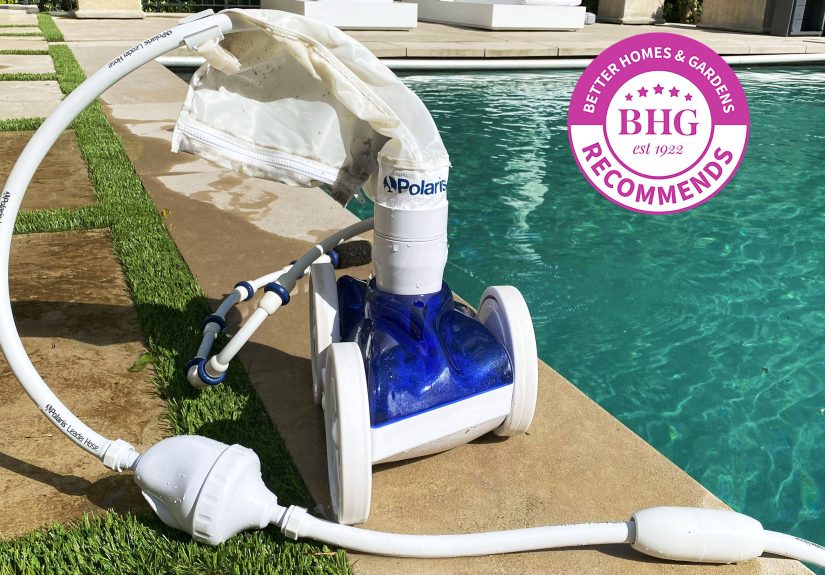
In BHG’s testing, the Polaris Vac-Sweep 280 came out on top, earning perfect scores across every category:
setup, ease of use, design, effectiveness, and value. This classic pressure-side cleaner is compactabout 6.2 pounds
with a footprint around 20 x 23 x 10 inchesyet powerful enough to handle stubborn pollen, pine straw, and everyday debris.
Setup took around 20 minutes from unboxing to the first cleaning cycle. Once running, the 31-foot hose allowed the cleaner
to cover pools of various shapes and finishes, including fiberglass and tile. Dual venturi jets and a 2.25-inch vacuum inlet
help it pull in both small and large debris, which is collected in an external filter bag that’s easy to detach, empty,
and reattach.
There are a couple of trade-offs: the 280 is a vacuum and sweeper, not a scrubber, so it won’t polish away stains or
ultra-fine dust on its own. It also requires a dedicated booster pump (sold separately), which adds cost and installation
complexity if your pool isn’t already set up for one.
Still, for many in-ground pool owners who want a proven workhorse that runs quietly and keeps the floor, walls, and stairs
clean, the Polaris 280 is hard to beat.
2. Intex 28006E ZX100 – Best Budget Cleaner for Above-Ground Pools
Best for: Above-ground pool owners who want pressure-side power on a sensible budget.
If you’re rocking an above-ground pool, you don’t necessarily need a heavy, high-pressure cleaner built for concrete.
The Intex 28006E ZX100 is designed specifically for above-ground setups and was BHG’s budget pick.
Weighing around 13 pounds, it’s light enough to drop into the water and pull back out using the built-in top handle.
Installation is straightforward: connect the hose to the return line, drag the unit to the far side of the pool to reduce
hose kinks, and let it go to work. During BHG’s testing, the ZX100 scooped up a surprising amount of algae and settled debris
from the floor, helping to revive a tired-looking pool.
There are some limitations worth noting:
- It’s for above-ground pools onlyno in-ground use.
- The hose can twist or kink over longer runs, especially in larger pools.
- There’s no “I’m done now” alert; it keeps cleaning until you shut off the pump.
On the upside, it’s also impressively quiet. Testers were able to sit next to the pool and chat while it cleaned,
which is not always the case with noisier, older-style cleaners.
3. Polaris Vac-Sweep 360 – Best for Large Debris in In-Ground Pools
Best for: Leaf-heavy yards and pools near trees or landscaping.
If your pool is constantly full of leaves, seed pods, and acorns, you need serious debris-handling capacity.
The Polaris Vac-Sweep 360 is configured exactly for that. It uses a back “tail” hose to sweep debris toward the cleaner’s
inlet, where a 2.25-inch opening and single-chamber debris bag capture larger junk without clogging.
The 31-foot hose gives the 360 enough reach to cover corners and benches, while its 14-pound weight strikes a balance between
stability and ease of handling. BHG testers found setup intuitive and quickaround 15 minuteswithout needing to constantly
reference the manual.
The 360’s main weakness is ultra-fine debris. Because it relies on a debris bag rather than a fine-mesh filter canister,
it may leave behind very fine sand or silt. You might want to pair it with occasional brushing or a separate fine filtration
solution if your primary problem is dust rather than leaves.
For most in-ground pools overwhelmed by larger debris, though, the Vac-Sweep 360 is a strong, user-friendly option that
doesn’t necessarily require a separate booster pump, depending on your plumbing configuration.
4. Pentair Racer – Best for Small and Fine Debris
Best for: In-ground pools plagued by dust, sand, and tiny particles.
Where the Polaris 360 favors big stuff, Pentair’s Racer turns its attention to the tiniest offenders. Designed to run up to
about 30% faster than many competing pressure-side cleaners, it combines speed with a front rotating brush that scrubs
surfaces as it goes.
That rotating brush helps dislodge fine particles, while the Racer’s extra-large vacuum tube captures both large debris and
the smaller grit that makes pool water look cloudy. Four wide tires improve stability as it moves in forward and reverse,
and built-in LED lights make nighttime cleaning easier to monitor from the deck.
The biggest downside is cost. The Racer is one of the most expensive cleaners in this category and, like many in-ground
pressure-side options, typically requires a booster pump. Assembly is fairly straightforward, but you’ll want to pay
attention to the included diagrams if you’re new to pressure-side systems.
If you want pressure-side cleaning but also care about fine debrismaybe your pool is in a dusty climate or regularly gets
fine sandthe Racer is worth a close look.
5. Polaris Vac-Sweep 65 – Best for Above-Ground Vinyl and Fiberglass Pools
Best for: Round above-ground pools up to about 24 feet wide and 5 feet deep.
Many pressure-side cleaners are designed exclusively for in-ground pools, but the Polaris Vac-Sweep 65 is built for
above-ground setups, especially vinyl or fiberglass constructions that can’t handle aggressive scrubbing.
The 65 connects to a 1.5-inch threaded return line and uses a 24-foot floating hose to cover pools up to 24 feet across.
A surface module helps recirculate clean water while jets at the hose’s end loosen debris, which is then captured in a
detachable floor bag. Polaris estimates that, under normal conditions, the cleaner can finish its job in around three hours.
The design is simplewhich is a pro and a con. On one hand, it’s easier to install, maintain, and repair, and at just under
14 pounds, it’s not difficult to handle. On the other hand, that simplicity means it isn’t as effective at picking up the
smallest debris. If you frequently deal with silt, you may need to supplement with manual vacuuming or additional filtration.
How to Choose the Right Pressure-Side Cleaner for Your Pool
Before you click “add to cart,” take a few minutes to match the cleaner to your specific pool situation. BHG’s experts and
pool pros recommend paying attention to a few key specs:
Weight
Heavier cleaners tend to hug surfaces better and are less likely to float, but they’re also harder to pull out of the pool.
Lighter modelslike the roughly 6-pound Polaris 280are easier to handle and store, especially if you remove the cleaner
after each use. Just make sure the cleaner is heavy enough to stay submerged and climb walls properly.
Hose or Cable Length
This determines how much of your pool the cleaner can reach. You want enough length to comfortably hit the farthest corners
without so much extra that the hose becomes a tangled spaghetti monster. If your pool is particularly large or irregularly
shaped, double-check the manufacturer’s recommended maximum pool size.
Pool Type and Surface
In-ground and above-ground pools differ in both depth and surface durability. Many in-ground cleaners are too powerful or
too aggressive for thin vinyl walls, which can wrinkle or tear. If you have an above-ground pool, look for cleaners (like
the Intex ZX100 or Polaris 65) specifically labeled for that use and avoid heavy scrub brushes intended for concrete.
Filter or Debris Bag Style
Pressure-side cleaners typically use:
- Single-chamber debris bags – Great for large leaves, acorns, and bugs; not ideal for superfine debris.
- Multi-stage filtration or finer mesh – Better for dusty or sandy pools, sometimes paired with a scrubbing brush.
Consider what actually ends up in your pool. If you’re surrounded by trees, prioritize capacity and a wide inlet. If sand
sneaks in from a nearby patio, prioritize finer filtration and surface scrubbing.
Installing and Using a Pressure-Side Pool Cleaner Safely
Most pressure-side cleaners follow the same basic installation steps:
- Confirm your pool’s water level and that your main filtration system is working properly.
- Connect the cleaner hose to a dedicated pressure line or to a return outlet, per the manual.
- Adjust the flow using any included pressure regulator or valve so the cleaner moves steadily without flipping or racing.
- Submerge the cleaner and hose fully, allowing all air to escape before you start the pump.
- Turn the system on and watch the cleaner for a few minutes, tweaking hose length, weights, or pressure as needed.
One often-overlooked tip is storage: pool pros recommend removing the cleaner from the water between uses. Chlorine
and other chemicals can degrade plastics and seals over time, shortening the life of the unit. Rinse the cleaner off with
fresh water, empty the bag or canister, and store it out of direct sun when possible.
Are Pressure-Side Cleaners Still Worth It vs. Robotic Models?
With robotic pool cleaners getting smarter (and more common), it’s fair to ask whether pressure-side cleaners still make
sense. The answer depends on your priorities:
-
If you already have a booster pump and lots of large debris, a pressure-side cleaner like the Polaris 280 or 360 can
be more cost-effective and easier to repair. - If your biggest issue is fine dust and you want scheduled cleanings and app control, a robotic cleaner may be a better fit.
-
If you’re somewhere in the middle, a higher-end pressure-side model with a scrubbing brush (like the Pentair Racer) can
bridge the gap.
Some independent testers have pointed out that older pressure-side designs can feel dated compared with scrappy little
robots that map your pool and sip electricity. But pressure-side units still shine in simple, reliable leaf-gobbling
powerespecially for in-ground pools where a booster pump is already part of the equipment pad.
Hands-On Experiences: Living with a Pressure-Side Pool Cleaner
Specs and lab tests are helpful, but how do these cleaners perform when they’re part of your daily routine? BHG’s
long-term testing and user reviews paint a pretty realistic picture.
Take the Polaris Vac-Sweep 280. BHG testers ran it on a consistent schedule for six months and noted that it never got
stuck or bogged down in the pool. Even during heavy pollen season, it kept the water looking clear, and the only regular
“maintenance” was emptying the filter bag and giving the unit a quick rinse. Over time, the 280 essentially faded into the
background of the homeowners’ pool carealways working, rarely noticed.
Real-world owners echo that vibe. Many report that once they dial in hose length and pressure, the 280 (and its sibling,
the 360) becomes a dependable, low-drama worker that just circles the pool doing its thing. They like that replacement
partsbags, wheels, tail scrubbersare easy to find, and that most repairs can be handled without a professional call.
The Intex ZX100 earns praise from above-ground pool owners for similar reasons. It isn’t flashy, and it doesn’t pretend to
be a high-tech robot, but it’s straightforward: hook it to the return line, let it zip around for a few hours, and scoop
out the basket when you’re done. Owners appreciate how light it is to lift and how quietly it runs, especially in smaller
yards where loud mechanical noise would ruin the vibe.
On the higher end, Pentair’s Racer inspires mixed but generally positive feedback. People love its ability to scrub and
remove fine debris, especially in dusty climates where other cleaners struggle. The LEDs are more than a gimmickthey
make it easy to see what the cleaner is doing during an evening swim. That said, the higher price and booster-pump
requirement can be dealbreakers for budget-conscious owners or for those who’d rather spend that money on a more advanced
robotic unit.
Polaris’s Vac-Sweep 65 for above-ground pools tends to get described as “simple but effective.” Owners with vinyl pools
appreciate that it doesn’t aggressively grind on the surfaces, and they find setup approachable even without a lot of
pool-equipment experience. The most common complaints? It’s not a champion at fine debris, and in very windy or tree-heavy
environments, you may still need to manually spot-clean corners or steps between automated runs.
It’s also worth mentioning that pressure-side cleaners sometimes take a bit of tinkering at the beginning. Adjusting hose
length, adding or moving hose weights, and dialing in flow through the pressure regulator can make the difference between
a cleaner that cruises gracefully and one that sulks in a corner. Many experienced pool owners recommend planning a
dedicated “tuning” session the first weekend you install the cleaneronce it’s dialed in, you usually won’t have to touch
those settings again unless you change pumps or plumbing.
Ultimately, the recurring theme from both lab tests and homeowners is this: a good pressure-side cleaner doesn’t need to be
the smartest gadget in your backyard. It just needs to be the one that quietly keeps your pool clear so you can swim more
and skim less. Whether you go with BHG’s best-overall Polaris 280, a budget-friendly Intex ZX100, or another pick tailored
to your pool’s needs, the right pressure-side cleaner can easily become the unsung hero of your summer.
The Bottom Line
If you want a reliable, low-fuss way to keep your pool clear of leaves, bugs, and everyday debris, a pressure-side pool
cleaner is still a smart investment. BHG’s hands-on tests highlight the Polaris Vac-Sweep 280 as the best overall pick
for most in-ground pools, with strong alternatives for budget shoppers, above-ground pool owners, and those battling
either extra-large or ultra-fine debris.
Match the cleaner to your pool type, surface, and debris pattern, take a little time to dial in the hose and pressure,
and you’ll spend the season floating in clear water instead of chasing leaves with a net.