Table of Contents >> Show >> Hide
- What BHG’s “Best Kitchen Sink” Picks Have in Common
- The Six BHG-Recommended Kitchen Sinks (And Who They’re For)
- 1) Best Single Basin, Undermount: Kraus Standart Pro (30")
- 2) Best Double Basin, Undermount: Kraus Premier (Low Divider)
- 3) Best Workstation Sink: Rejuvenation Cannon (Accessories Included)
- 4) Best Apron Front (Farmhouse Style): Bocchi Classico Fireclay
- 5) Best Single Basin, Drop-In: Kohler Verse Stainless Steel
- 6) Best Double Basin, Drop-In (or Undermount): Kraus Quarza Granite Composite
- How to Choose the Best Kitchen Sink for Your Home
- Start With Installation: Undermount vs Drop-In vs Farmhouse
- Pick a Material That Matches Your Patience Level
- Depth and Size: Big Enough to Work, Not So Big It Breaks the Layout
- Single Bowl vs Double Bowl: Choose Your Workflow
- Noise Control Is Not a Fancy FeatureIt’s Sanity
- Workstation Features: The “Small Kitchen, Big Brain” Upgrade
- Faucet Holes: Decide How Many “Extras” You Really Want
- Maintenance Tips That Keep a Great Sink Looking Great
- The Quick “Which Sink Should I Buy?” Cheat Sheet
- Real-World Experiences: What People Notice After Living With These Sinks
- Final Thoughts
A kitchen sink is basically your home’s most overworked employee. It clocks in early (coffee mug rinse),
stays late (mystery pot “soak” that lasts three business days), and never files a complaintunless you
count that one corner where gunk goes to retire.
Better Homes & Gardens (BHG) narrowed the chaos down to six editor-recommended sinks across the styles
people actually buy: undermount, drop-in, workstation, farmhouse, single-bowl, double-bowl, and even a
granite composite option for the “I want drama, but make it durable” crowd. This guide unpacks those
picks in plain English, adds context from other trusted home and kitchen authorities, and helps you
choose a sink that fits your cabinets, your cookware, and your daily habits (including the “I cook
like I’m hosting a cooking show” habit).
What BHG’s “Best Kitchen Sink” Picks Have in Common
Even though the six picks cover different layouts and budgets, they share a few non-negotiables:
practical depth for pots and pans, materials that handle real-life abuse, and designs that don’t
punish you for cooking (or procrastinating on dishes).
- Usable size (not just “looks big” size): enough bowl depth and width for sheet pans, stockpots, and colanders.
- Materials that match your lifestyle: stainless steel for low-fuss living, fireclay for classic style, and composite for color + durability.
- Noise control: pads, undercoatings, or sound-absorption features so your sink doesn’t sound like a drum solo at midnight.
- Installation reality: drop-in for easier swaps, undermount for wipe-clean counters, workstation for built-in efficiency, farmhouse for statement style.
The Six BHG-Recommended Kitchen Sinks (And Who They’re For)
Below are the BHG editor picks, translated into “what it means for your kitchen” languageplus the
trade-offs you should know before you click “add to cart.”
1) Best Single Basin, Undermount: Kraus Standart Pro (30")
If your goal is maximum “one big bowl that fits everything,” this is the classic play. BHG highlights
the space-saving advantage of a single-basin undermount: fewer dividers, more room for bulky cookware,
and a cleaner counter edge because crumbs can be swept straight in.
Why it works: The 18" x 30" x 10" bowl gives you depth for tall pots and the kind of wide
basin that doesn’t force you to wash a pan diagonally like you’re solving a puzzle. It’s stainless
steel, built for day-in/day-out use.
Best for: People who cook with large pots, roast pans, and sheet traysand anyone who wants
a sleek counter line with undermount cleanup convenience.
Watch-outs: Undermount installation is less forgiving than drop-in. Your countertop material
needs to handle moisture at the cutout, and you’ll want proper sealing to prevent future headaches.
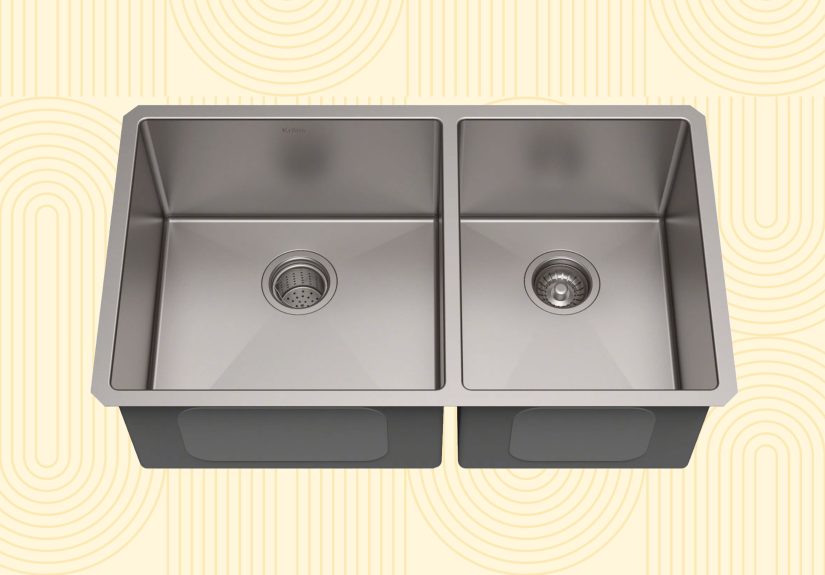
2) Best Double Basin, Undermount: Kraus Premier (Low Divider)
Double bowls are the “I like lanes” option: wash on one side, rinse or dry on the other, or keep a
soaking zone for utensils that mysteriously multiply. BHG’s take is especially practical because the
sink uses a low dividerso you still have the ability to bridge large pans across both basins.
Why it works: BHG points to durability and sound control: angled/sloped design for drainage,
plus rubber pads and sound barrier tech so the sink stays conversationally quiet even when water’s
running. (Yes, a sink can be “quiet enough to hold a conversation.” It’s a weirdly modern luxury.)
Best for: Multitaskers, households that hand-wash often, and anyone who wants two work zones
without losing the ability to handle big cookware.
Watch-outs: Double bowls reduce the “single giant tub” feeling. If you routinely wash
oversized roasting pans, a single bowl may feel easier.
3) Best Workstation Sink: Rejuvenation Cannon (Accessories Included)
Workstation sinks are basically the Swiss Army knife of sink design: built-in ledges let you slide
accessories across the basin so food prep and cleanup happen over the sinknot across your
countertops.
Why it works: BHG notes it includes a professional-grade colander, a stainless roll-up mat,
and a base grid with rubber feet. The tiered levels let you swap cutting boards, colanders, and racks
in and out, turning one footprint into multiple stations.
Best for: People who cook frequently, want less counter clutter, or love the idea of rinsing,
draining, and chopping in one organized zone.
Watch-outs: Workstation sinks can become “accessory-dependent.” If you know you’ll never use
the add-ons, you may be paying for features you won’t touch.
4) Best Apron Front (Farmhouse Style): Bocchi Classico Fireclay
Farmhouse (apron-front) sinks are equal parts function and vibe. They’re typically deeper, wider, and
designed with an exposed front panel that becomes a focal point. BHG’s pick leans classic: fireclay,
matte finish, clean lines.
Why it works: Fireclay is non-porous and generally stain-resistant, and BHG notes it’s sized
to handle pots and pans. It also includes a stainless grid to encourage drainage and help protect the
sink surface during everyday use.
Best for: Traditional kitchens, farmhouse-inspired designs, and anyone who wants a big,
dramatic basin that doesn’t feel like an afterthought.
Watch-outs: Fireclay is tough, but it’s not invincible. BHG cautions that ceramic materials
can crack if a heavy object is dropped and repairs aren’t really an optionso this is “durable,” not
“indestructible.”
5) Best Single Basin, Drop-In: Kohler Verse Stainless Steel
Drop-in (top-mount) sinks are the “keep it simple” choice. The rim sits on the countertop cutout, which
often makes replacements easierespecially if you’re swapping an existing sink without changing the
countertop.
Why it works: BHG calls out the low rim for easy crumb-sweeping and a comfortable 9-inch
bowl depth for larger pots and pans. It also includes sound-absorption tech, so it’s not a clanging
echo chamber.
Best for: Renovations where you want a straightforward install, DIY-friendly swaps, and a
sink that performs without demanding a full countertop redo.
Watch-outs: Top-mount rims can catch grime at the edge over time. They’re still easy to keep
clean, but undermount tends to win the “wipe crumbs directly in” contest.
6) Best Double Basin, Drop-In (or Undermount): Kraus Quarza Granite Composite
Want color without the fragility drama? Composite sinks (granite/quartz composite) are engineered from
stone dust and resins, molded into shape. BHG’s pick is a quartz composite model designed to look
granite-like, with a non-porous surface and flexible installation.
Why it works: BHG highlights that it can install as drop-in or undermount and that both bowls
are similarly sizedhandy for two-cook kitchens. It also has pre-scored knockout holes so you can
customize accessories and attachments.
Best for: Households that want a darker or more design-forward sink, plus a material that
resists everyday wear and looks great with stone counters.
Watch-outs: Composite is extremely hard. BHG notes that hardness can be a drawback because
dropped glassware can break more easily than in a more forgiving material like stainless steel.
How to Choose the Best Kitchen Sink for Your Home
“Best” depends on how you cook, clean, and move around your kitchen. Here’s the buying guide partwhere
you avoid buying a sink that looks gorgeous in photos but fights you in real life.
Start With Installation: Undermount vs Drop-In vs Farmhouse
-
Undermount: Sleek look, easy to wipe crumbs into the sink, but installation requires solid
support and proper sealing. It’s typically best with moisture-resistant countertop materials. -
Drop-in (top-mount): Easier to replace and often friendlier for DIY swaps. The rim sits on
the countertop, which can be slightly more work to keep spotless at the edges. -
Farmhouse (apron-front): Statement style and deep basins, but can require cabinet/counter
modifications and extra support because many are heavy.
Pick a Material That Matches Your Patience Level
Stainless steel is popular for a reason: it’s resilient, easy to clean, and forgiving on
dishes. Gauge matterslower numbers mean thicker steel. Many guides point out that 18-gauge is common,
while 16-gauge is thicker and tends to feel more substantial (and often quieter).
Fireclay / ceramic brings classic charm and strong stain resistance, but can crack from
heavy impacts. If your household includes enthusiastic pan-droppers (we don’t judge), stainless may be
the safer bet.
Granite/quartz composite delivers color options and a stone-like look, plus durability.
But it’s hardgreat for the sink, less great for your favorite wine glass if it slips.
Enameled cast iron is the “heritage heavyweight” optiongorgeous and long-lasting, but very
heavy, which can impact installation and cabinet support decisions.
Depth and Size: Big Enough to Work, Not So Big It Breaks the Layout
In many kitchens, a 30- to 33-inch sink length is common, and bowl depths often live in the
roughly 7- to 10-inch range. Deeper bowls help reduce splashing and hide dish piles better (which may
or may not be a healthy lifestyle choice, but it’s definitely a lifestyle choice).
Also: measure your base cabinet width before falling in love. A sink can’t magically fit into a cabinet
that’s too small, no matter how strongly you believe in positive thinking.
Single Bowl vs Double Bowl: Choose Your Workflow
- Single bowl: Best for big cookware and a flexible “everything fits” basin.
- Double bowl: Best for multitaskingwashing/rinsing, or washing/drying. Low dividers can offer the best of both worlds.
Noise Control Is Not a Fancy FeatureIt’s Sanity
Sound-dampening pads, undercoatings, and engineered sound-absorption (often mentioned by manufacturers
and reviewers) can make a stainless sink feel dramatically more premium. If you’ve ever flinched when a
spoon hits the bottom of a thin sink, you already understand why this matters.
Workstation Features: The “Small Kitchen, Big Brain” Upgrade
A workstation sink can add prep space without adding an island. If your counters are crowded, built-in
ledges plus accessories (cutting boards, colanders, racks) can be legitimately life-improving. If your
counters are roomy and you prefer simple cleanup, you might not need the extra moving parts.
Faucet Holes: Decide How Many “Extras” You Really Want
BHG notes that one-hole setups are easiest but limit add-ons, while two-hole or three-hole options can
support sprayers, soap dispensers, or filtered water taps. The right choice depends on whether you’re
actually going to use the extrasor just like the idea of them.
Maintenance Tips That Keep a Great Sink Looking Great
-
Stainless steel: Rinse debris, avoid leaving salty or acidic residue sitting too long,
and use gentle abrasives (like baking soda) for deeper cleaning when needed. Drying after use helps
reduce water spots. -
Composite: Stick to mild soap and water; avoid harsh chemicals that can damage the
surface. If your water is hard, wipe and dry more often to prevent mineral haze. -
Fireclay: Treat it like a beautiful ceramic workhorse: wipe it regularly, use non-abrasive
tools, and don’t test gravity with your cast-iron skillet.
The Quick “Which Sink Should I Buy?” Cheat Sheet
- You cook big: Choose a deep single-bowl undermount like BHG’s Kraus Standart Pro pick.
- You multitask dishes daily: Choose BHG’s low-divider double-bowl undermount option.
- You want maximum function per square inch: Go workstation (hello, Rejuvenation Cannon).
- You want a statement sink: Go farmhouse fireclay (Bocchi) and plan installation carefully.
- You want easy replacement now: Go drop-in stainless (Kohler Verse) for a simpler swap.
- You want color + durability: Go composite (Kraus Quarza) and accept that glassware is taking a risk.
Real-World Experiences: What People Notice After Living With These Sinks
Reviews are great, but the “day 37 reality check” is where the best kitchen sink proves itself. Here
are the most common real-kitchen moments homeowners and remodelers talk about when they switch sink
stylesespecially when moving into one of the categories BHG highlights.
1) The noise factor becomes personal… fast. Thin stainless sinks can turn dishwashing into
a percussion performance. People often report that sound-dampening pads and undercoatings feel like a
hidden luxury: you can run water early in the morning without waking the whole house, and you don’t
brace yourself every time a fork hits the basin. If you’re sensitive to noise (or you live with
someone who is), sound control isn’t an accessoryit’s quality of life.
2) Depth changes your entire rhythm at the sink. A deeper bowl reduces splashing and keeps
dirty dishes below the counter line, which makes the kitchen look calmer. The trade-off is reach: very
deep basins can feel harder on the back if you’re leaning in to scrub. Many people end up loving
roughly 9–10 inches because it balances capacity and comfort, especially with larger pots and pans.
3) Single-bowl vs double-bowl is less about “better” and more about “how you move.”
Single bowls win for big cookware, and owners love not having a divider blocking a roasting pan. Double
bowls win for workflowone side becomes “wash/soak,” the other becomes “rinse/drain.” The low-divider
style BHG mentions is a real compromise: you keep the organization without giving up the ability to
span a large tray across both sides.
4) Workstation sinks feel amazing when you actually use the accessories. People who prep a
lot of food often rave about sliding a cutting board over the sink, rinsing produce in a fitted
colander, and letting water fall directly into the basin instead of across the counter. The roll-up
mat becomes a flexible drying rack, and the bottom grid prevents the “why is my sink scratched already”
moment. On the flip side, owners who prefer a minimalist setup sometimes admit the accessories end up
stored away, which means the sink is performing like a normal sinkjust with extra parts that need a
home.
5) Composite sinks earn compliments…and occasionally break a glass. The design appeal is
realdark composite sinks can make a kitchen look instantly more modern and intentional. People also
like that the surface hides water spots better than shiny stainless. But composite is hard; if someone
drops a glass, the sink usually wins. Owners who love composite tend to add a bottom grid, use a
rubber mat when needed, or simply become more careful with fragile items.
6) Farmhouse fireclay feels like a “centerpiece,” but it demands respect. Homeowners often
choose fireclay because it looks timeless and feels substantial. The wide, deep basin is satisfying to
useespecially for big pots and baking sheets. The most repeated advice is practical: protect the
surface with a grid, avoid slamming heavy cookware, and plan the installation well (these sinks can be
heavy and may require cabinet adjustments). When done right, it’s one of the most loved upgrades in a
remodel because it looks intentional, not incidental.
The takeaway: the “best kitchen sink” is the one that matches your daily behavior. If you want simple,
stainless is hard to beat. If you want beauty and presence, farmhouse fireclay delivers. If you want a
kitchen that functions like a prep station, workstation accessories can genuinely change how you cook.
Final Thoughts
BHG’s picks cover the most common real-world needs: maximum single-bowl space, organized double-bowl
workflow, workstation versatility, farmhouse statement style, easy drop-in installation, and a durable
composite option with design impact. Choose based on how you actually cook and cleannot how you hope
you’ll behave after buying a new sink (we all have dreams).