Table of Contents >> Show >> Hide
- Why Your Pool Really Does Need a Timer
- Types of Pool Timers (and Which One You Probably Need)
- What Bob Vila’s Team Looks For When Testing Pool Timers
- The Best Pool Timers – Tested by Bob Vila
- Best Overall: Honeywell Home TI040/U Aube 7-Day Programmable Timer
- Best Bang for the Buck: Woods 50015WD Outdoor 7-Day Heavy-Duty Digital Timer
- Best Programmable: Suraielec Smart Wi-Fi Box Pool Timer
- Best for Small Pools: BN-Link 24-Hour Mechanical Outdoor Multisocket Timer
- Best Smart Timer: Tessan Waterproof Wi-Fi Smart Timer Outlet
- Best Heavy-Duty: GE Outdoor Heavy-Duty 24-Hour Mechanical Box Timer
- Best Mechanical Classic: Intermatic T104R 24-Hour Mechanical Time Switch
- How to Choose the Right Pool Timer for Your Pool
- Installation and Safety Tips
- Real-World Experiences with the Best Pool Timers (Extra Insights)
- Conclusion
If you’ve ever dashed outside in pajamas at 11 p.m. because you forgot to shut off the pool pump, this article is for you.
A good pool timer turns that chaos into calm: it quietly runs your pump, filter, lights, and even water features on a schedule,
so your pool stays clean and your energy bill doesn’t look like a horror movie.
After hands-on testing and deep dives into expert reviews, Bob Vila’s team highlighted a handful of pool timers that stood out
for reliability, ease of use, and long-term value. At the top of the list is the Honeywell Home TI040/U Aube 7-Day Programmable Timer,
but several other modelsdigital plug-in timers, Wi-Fi box timers, and smart outletsearned high marks for different types of pools
and budgets.
Below, you’ll find a practical, homeowner-friendly guide to the best pool timers tested by Bob Vila, plus insider advice from
other trusted pool resources on how to choose the right one, avoid common mistakes, and make the most of your new timer.
Why Your Pool Really Does Need a Timer
Pool timers are more than convenient on/off switchesthey’re mini energy managers for your backyard. By running your pump and
filtration system only when needed, a timer can help:
- Cut energy costs: Running a pump 24/7 burns unnecessary electricity. Timers let you schedule run time during optimal hours and in efficient blocks, so you pay for clean waternot wasted watts.
- Extend equipment life: Pumps and heaters last longer when they’re not constantly cycling or running nonstop.
- Improve water quality: A consistent schedule avoids long gaps when water just sits and gets cloudy or algae-prone.
- Automate your routine: Go on vacation or simply forget about it for a few daysyour timer keeps the system on track.
In short, a good pool timer helps your water stay clear, your equipment stay healthy, and your brain stay focused on fun thingslike
actually swimming.
Types of Pool Timers (and Which One You Probably Need)
Not all pool timers look or behave the same. Knowing the basic types makes it much easier to match one to your pool setup.
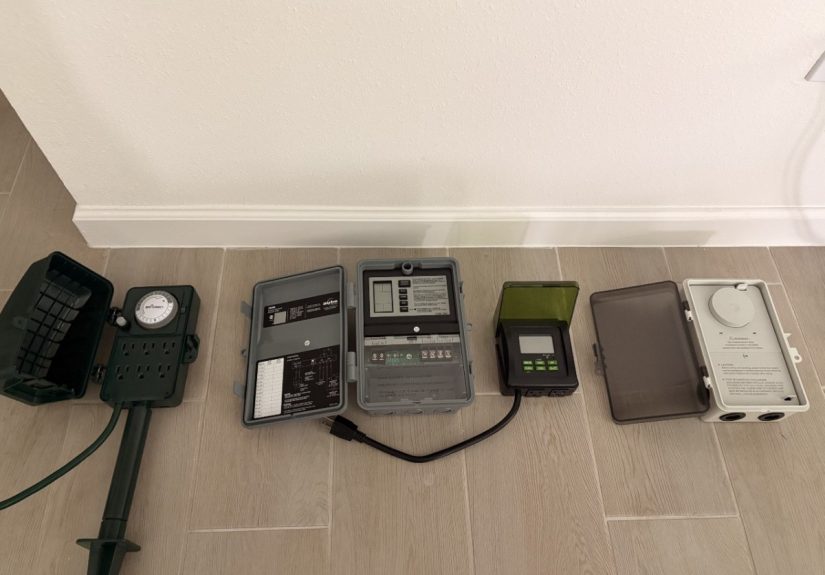
1. Mechanical Box Timers
These are the old-school workhorses: a metal (or heavy plastic) enclosure with a rotating dial and little on/off trippers.
Models like the Honeywell TI040/U and Intermatic T104R fall into this category. They’re designed to handle higher loads
(often 40 amps) and can control pumps, heaters, and other heavy-duty gear.
Pros:
- Very durable and weather-resistant
- Excellent for inground pools and powerful pumps
- “Set it and forget it” reliability
Cons:
- Requires wiringoften a job for a pro
- Limited programming flexibility compared to digital timers
2. Digital Plug-In Timers
Digital plug-in timers, like the Woods 50015WD, plug into a standard outlet with your pump plugged into the timer.
They usually feature an LCD screen and buttons to set daily or weekly programs with fine time control down to the minute.
These shine with:
- Easy, no-wiring setup
- Multiple on/off events per day
- Great for above-ground pools, fountains, and smaller pumps
3. Smart Wi-Fi Box Timers
Smart box timers, such as the Suraielec Smart Wi-Fi Box Pool Timer or BN-LINK’s heavy-duty Wi-Fi timer, combine the power
of a wired box with app and voice control. They’re typically rated up to 40A and support multiple voltages (120V–277V),
making them suitable for larger systems and heaters.
The upside: remote scheduling, countdowns, sharing access with family members, and integration with smart-home platforms
like Alexa or Google Assistant.
4. Smart Outdoor Outlets
Devices like the Tessan Waterproof Wi-Fi Smart Timer Outlet function like regular smart plugs but are designed for outdoor
use with weather protection. While they don’t handle the same massive loads as a full box timer, they work well for smaller pumps,
lights, or accessories, and each outlet can often be programmed separately.
5. Multi-Outlet Stake Timers
Stake timers such as the BN-Link 24-Hour Mechanical Outdoor Multisocket Timer offer several outlets with a single
mechanical dial schedule. They’re ideal if your “pool setup” is really a small above-ground pool plus some string lights
and a fountain that all need to turn on and off together.
What Bob Vila’s Team Looks For When Testing Pool Timers
The Bob Vila testing approach doesn’t just ask, “Does it turn on and off?” It drills down into how well a timer works in
real backyards with real people using it every day.
Key Criteria
- Compatibility and capacity: Does the timer support common pool voltages (120V, 240V, or 208–277V) and enough amperage for pumps, heaters, and lights?
- Ease of installation: Can a handy homeowner realistically install it, or is this strictly an electrician’s job?
- Programming flexibility: How many on/off cycles per day? Can you set weekday/weekend schedules? Is there a temporary bypass?
- Durability and weather resistance: Is the housing metal or plastic, waterproof, and lockable? How does it hold up outdoors?
- User-friendly controls: Simple dials and tabs, or intuitive apps and screens that don’t require a PhD to operate?
- Value for money: Does the performance justify the price compared to competing models?
Timers that scored well hit a sweet spot of reliability, ease of use, and enough flexibility that you don’t need to
reprogram the thing every time the weather changes.
The Best Pool Timers – Tested by Bob Vila
Best Overall: Honeywell Home TI040/U Aube 7-Day Programmable Timer
The Honeywell Home TI040/U earns the “best overall” crown because it behaves like a tank with a brain. It’s a mechanical timer
in a rugged, lockable metal enclosure, built to manage 120V or 240V pool systems. Bob Vila’s testers appreciated how solid
the casing feels and how consistently it ran pumps without hiccups.
With 7-day programming and up to two on/off cycles per day, it covers typical pool routines: a long filtration cycle in the
afternoon and maybe a shorter run early morning. A temporary bypass mode lets you override the schedulesay, after a heavy stormwithout
wiping out your normal settings.
The main trade-off: no built-in smart or Wi-Fi functionality. But if your priority is rock-solid, low-fuss performance, this
is exactly what you want.
Best Bang for the Buck: Woods 50015WD Outdoor 7-Day Heavy-Duty Digital Timer
The Woods 50015WD shows that you don’t have to spend a fortune to upgrade from “manual switch life.” This plug-in digital timer
connects to a standard outlet, and its simple button layout makes scheduling surprisingly painlesseven if your thumbs usually
fear electronics.
It supports up to 20 on/off cycles with custom weekday/weekend programming. That means you can run the pump longer on weekends
and cut it back during the week. It’s a stellar choice for above-ground pools, fountains, and other 125V outdoor gear.
Downsides? The plastic housing isn’t as tough as metal, and the backup battery eventually needs replacing. But for the price,
it punches way above its weight.
Best Programmable: Suraielec Smart Wi-Fi Box Pool Timer
For pool owners who want heavy-duty power plus app control, Suraielec’s Smart Wi-Fi Box Pool Timer shines. It’s rated for high
loads (up to 40 amps and 120–277VAC), which makes it suitable for larger pumps and even heaters.
The timer connects to a smartphone app (via the Tuya/Smart Life platform), so you can set complex schedules, countdowns, and
random modes without ever opening the box. Voice control via Alexa or Google Assistant is the cherry on top. The lockable housing
keeps kids and curious guests from pushing buttons they shouldn’t.
The weak spot is Wi-Fi reliability. Like any smart device in the yard, performance depends heavily on the strength of your
home network near the pool equipment. If your router struggles to reach the back fence, you may want a mesh system or range extender.
Best for Small Pools: BN-Link 24-Hour Mechanical Outdoor Multisocket Timer
If your “pool system” is a smaller above-ground pool plus some decorative lights and maybe a waterfall, the BN-Link multisocket
timer offers simple, all-in-one control. It has multiple grounded outlets under a weather-resistant housing and runs on a 24-hour
mechanical dial.
You just insert small tabs around the dial for on/off periods, then plug in your gear. It’s excellent for people who want to
avoid wiring or complex programming and still keep their mini backyard oasis on a consistent schedule.
Best Smart Timer: Tessan Waterproof Wi-Fi Smart Timer Outlet
The Tessan smart outdoor outlet brings smart-home convenience to poolside without a panel upgrade. With IP44 water resistance,
individually programmable outlets, and app control, it’s perfect for smaller pumps, pool lights, or adjacent landscape lighting.
The app allows sunrise/sunset schedules, remote toggling, and voice integration. It’s not built for massive 2-speed inground pumps,
but as a flexible accessory timer, it’s hard to beat.
Best Heavy-Duty: GE Outdoor Heavy-Duty 24-Hour Mechanical Box Timer
For big inground pools and high-powered systems, the GE Outdoor Heavy-Duty 24-Hour Mechanical Box Timer is a powerhouse. It offers
a rugged NEMA-3 metal housing, lockable cover, and the ability to handle up to 40 amps at 120–277VAC. Bob Vila’s testers liked how
confidently it handled demanding loads like pumps and heaters without drama.
It operates on a 24-hour dial with 30-minute interval settings, making it straightforward but not extremely customizable.
Installation requires tools and some electrical know-how, so many homeowners will want an electrician for this one.
Best Mechanical Classic: Intermatic T104R 24-Hour Mechanical Time Switch
Intermatic has been a go-to name in pool controls for decades, and the T104R is a classic example of why. It’s a 24-hour mechanical
timer in a durable outdoor case, designed for 208–277V loads and commonly used on inground pool pumps.
Instead of fancy digital menus, you get a clear, intuitive dial with on/off trippers. For many pool owners and pros, that simplicity
is a feature, not a bug. It’s reliable, serviceable, and widely available if you ever need parts or replacement.
How to Choose the Right Pool Timer for Your Pool
Match the Timer to Your Pool Type and Equipment
- Above-ground pools: Often do well with digital plug-in timers like the Woods 50015WD or small mechanical or smart stake timers.
- Inground pools: Typically need a wired mechanical or smart box timer rated for higher voltage and amperage.
- High-horsepower pumps and heaters: Look for 40A capacity and multi-voltage support (120/240/277V).
Consider Your Climate and Use Patterns
In hot or stormy climates, weatherproof construction and sturdy enclosures are non-negotiable. In areas with frequent freezes,
a timer with integrated or add-on freeze protection can automatically run the pump when temperatures drop, helping prevent
damage to plumbing and equipment.
Think About Your Tech Comfort Level
- Tech-comfortable homeowners: Will love Wi-Fi box timers and smart outlets with app and voice control.
- Low-tech or set-and-forget types: Are better off with a mechanical timer or a simple digital plug-in with a basic interface.
Common Mistakes to Avoid
- Buying a timer that can’t handle your pump’s voltage or amperage
- Mounting a timer where it’s fully exposed to sprinklers or direct downpours (even “weatherproof” units like a little shelter)
- Running the pump too little in an effort to save energycloudy water will cost you more in chemicals later
- Skipping professional installation when you’re not comfortable with electrical work
Installation and Safety Tips
Pool timers live in a wet, outdoor environment and often carry high electrical loads. Safety should come first:
- Turn off power at the breaker before any wiring work.
- Use GFCI protection as required by local codes.
- Securely mount box timers to a solid surface away from standing water.
- For box-style timers, hire a licensed electrician if you’re unsure about wiring diagrams or local electrical codes.
- Test the timer with a short schedule first to confirm the pump turns on and off as expected.
Mechanical and smart box timers will often outlive the pump they control if installed correctly and protected from the worst of the elements.
Real-World Experiences with the Best Pool Timers (Extra Insights)
Numbers and specs are great, but how do these timers feel to own? Let’s look at some lived-in experiences that mirror what many
pool owners report in reviews and forum discussions.
Picture a new homeowner with a modest above-ground pool. Their pump plugs into an outlet on the back of the house, and they’ve been
manually switching it on every day after work. At first, it’s fine. A few weeks later they miss a couple of days, the water turns hazy,
and suddenly they’re deep into shock treatments and algae battles. A budget-friendly digital timer like the Woods 50015WD completely
changes their routine: they plug it in, program weekday and weekend schedules, and the pump quietly runs on time every day. Within a
week or two, the water quality stabilizes, and they stop obsessing over whether they remembered to flip a switch.
Another scenario: a long-time pool owner with an older inground setup. The pump and heater are both wired to an ancient timer that’s
starting to stick and occasionally fails to turn on. They upgrade to a Honeywell TI040/U or an Intermatic T104R, both of which are
designed to handle heavy loads and run day in, day out. At first, the mechanical dial and trippers feel a bit old-fashioned compared
to smart gadgets. But after a season of rock-solid performanceincluding power outages where the timer retains its schedulethey’re
sold on mechanical simplicity and reliability.
Then there’s the tech-savvy homeowner. Their pool area is already wired with smart landscape lighting and a Wi-Fi sprinkler controller.
For them, a Suraielec smart box timer or a BN-LINK Wi-Fi pool pump timer fits right in. App notifications confirm when the pump runs,
and it’s easy to tweak schedules during a heat wave or before a big pool party. Some owners report minor Wi-Fi hiccupsespecially
when the equipment pad sits at the edge of the house’s signal rangebut a simple mesh Wi-Fi system or outdoor access point usually
clears that up. Once the signal issue is solved, the ability to check and adjust the pool from a phone becomes one of those
“how did I live without this?” upgrades.
Heavy-duty timers also come into their own in extreme weather or high-use situations. During peak summer, when pumps run longer and
heaters, lights, and water features are all in play, timers like the GE heavy-duty box or robust 40A Wi-Fi models keep everything
on a predictable schedule. Owners appreciate that, with proper installation, these units don’t overheat or trip unexpectedly, even
when running high-horsepower pumps and multiple circuits. In areas subject to freezing temperatures, pairing a heavy-duty timer with
freeze-protection accessories or automation systems that automatically run the pump in cold snaps gives extra peace of mind.
Across all these scenarios, one theme repeats: the “best pool timer” is the one that fits your actual pool life. If you want to
install it once and practically forget it, a solid mechanical or simple digital model is your friend. If you love fine-tuning from
your phone and already live in a smart-home ecosystem, a Wi-Fi box or smart outlet will feel natural. Bob Vila’s top picks give you
reliable options in each of those lanesso you can stop micromanaging your pump and start enjoying the water.
Conclusion
A pool timer might not be the flashiest upgrade in your backyard, but it’s one of the hardest-working. The best pool timers tested
by Bob Vilalike the Honeywell TI040/U, Woods 50015WD, Suraielec smart box timer, BN-Link multisocket, Tessan smart outlet, GE
heavy-duty box timer, and Intermatic T104Rcover everything from small above-ground setups to full-scale inground systems.
Choose a timer that matches your equipment, your climate, and your personal tolerance for tech. Install it safely, give it a solid
schedule, and you’ll save energy, protect your equipment, and enjoy cleaner water with far less effort.