Table of Contents >> Show >> Hide
- Why Hand-Painted Signs Still Stop People in Their Tracks
- Meet Travis Simon: Brooklyn’s Proudly Analog Typographer
- Reverse Glass Gilding: The Magic Trick Happening on the Inside of a Window
- “Ancient” Doesn’t Mean Outdated: Where These Techniques Come From
- The Comeback Story: Why Sign Painting Is Booming Again
- The Letterheads: The Community Keeping the Craft Alive
- So… Is It Expensive? (Yes.) Is It Worth It? (Also Yes.)
- How to Support Sign Painting (Even If You Don’t Own a Storefront)
- Experiences That Make You Believe in the Craft (500+ Words)
- Conclusion: Brooklyn’s Old Skills, Future-Proof Beauty
Walk through Brooklyn long enough and you’ll spot it: a storefront name that doesn’t look “printed.”
The letters sit a little prouder. The curves feel a little more human. And when the sun hits just right,
the whole thing flashes like it’s winking at you from 1910.
That wink is often real goldapplied by hand, one impossibly thin sheet at a time. And one of the artists helping
bring this old-world craft roaring back into a modern, screen-filled city is Travis Simon, a Brooklyn-based
sign painter and gilder who runs Brush & Leaf Inc. from a modest workshop that’s refreshingly, stubbornly analog.
Why Hand-Painted Signs Still Stop People in Their Tracks
We’re living in the era of frictionless design: download the font, drag the vector, hit “export,” and boombranding.
It’s efficient. It’s scalable. It’s also why so much of what we see starts to blur together. When everything can be
made instantly, “perfect” becomes the default… and “perfect” becomes background noise.
A hand-painted sign does the opposite. It creates friction in the best way. Your brain pauses because the work
doesn’t feel mass-produced. You can sense the decision-making in the strokes: where the line thickens, where it
relaxes, where a serif turns with confidence instead of snapping to a grid. That tiny pause is marketing goldsometimes
literally.
And small business owners know it. Bars, restaurants, boutiques, studios, and hotels don’t just want a label on a window.
They want a beacon. Something that tells passersby, “We care about craft. We care about details. We’re not a template.”
In crowded neighborhoods where every block competes for attention, a hand-lettered mark can feel like a handshake.
Meet Travis Simon: Brooklyn’s Proudly Analog Typographer
A Workshop That Smells Like Work (Not Wi-Fi)
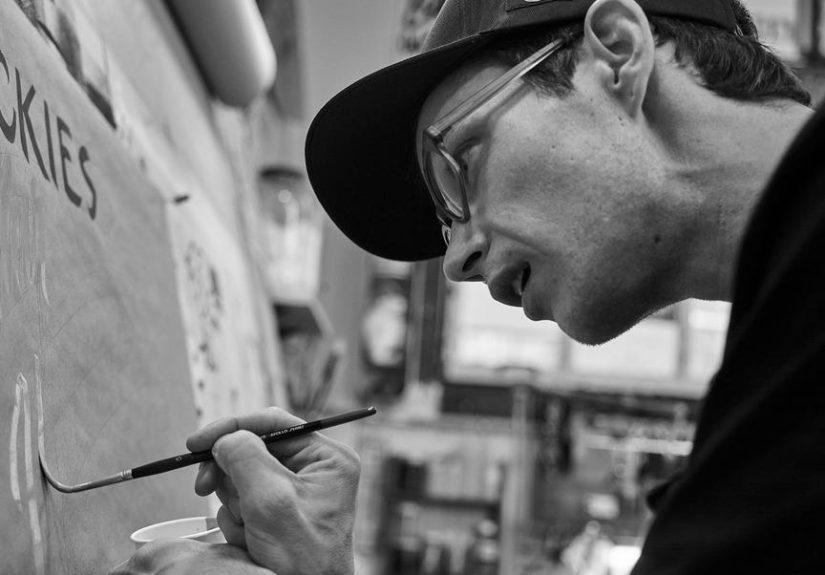
Simon’s studio isn’t designed for “content.” It’s designed for making. It’s described as having no computer and no printer,
with shelves lined in small cans of lettering enamel and walls covered in letterforms, logos, and painted glass panels.
It’s the kind of place that reminds you craftsmanship has a soundtrackbrush bristles, scraping tools, the soft tap of a mahl stick,
and the occasional sigh of someone who just realized they need to redraw a curve by a hair’s width.
That analog mindset isn’t a gimmick. It’s part of the product. Simon’s philosophy is simple: computers can do the job,
but handwork carries a human signal that people actually feel. In a city packed with visual noise, that signal is powerful.
From Graphic Design to Gold Leaf
Simon didn’t pop out of the subway fully formed with a squirrel-hair brush and a book of gold leaf tucked under his arm.
He built his way here. He studied graphic design (graduating in 2006) and worked in a design agency creating packaging,
but he wasn’t thrilled with corporate creative life. He moved through hands-on jobssilkscreening, running a print shop,
and even crafting high-end furniture in a mill-working environment where obsession with precision was a feature, not a bug.
Along the way, he drilled the fundamentals the old-fashioned way: hours and hours of practice. Script lettering alone demands
“up for thin, down for thick” brush control that doesn’t care about your feelings. It cares about muscle memory.
When he got good enough, he began taking on small sign gigs, even bartering chalkboard menu boards for meals and beers in Williamsburg.
Not glamorous, but very New York: build the skill, build the reputation, let the city become your portfolio.
Reverse Glass Gilding: The Magic Trick Happening on the Inside of a Window
If you’ve ever admired gold lettering on a storefront window and wondered why it looks so cleanlike it’s floating inside the glass
you’re probably looking at reverse glass work. Simon is noted for doing a large portion of his projects as reverse painting on glass using
enamel and gold leaf.
The idea is counterintuitive: you paint the sign backwards, in layers, on the inside surface of the glass.
What viewers see from the street is the result of decisions made in reverse order. Highlights and fine details go down first.
Background colors come later. If you do it right, the glass protects the work from weather and wear while giving the letters a crisp,
jewel-like finish.
Why Gold Leaf Looks “Alive”
Gold leaf isn’t “gold paint.” It’s actual gold beaten into ultra-thin sheets that catch light differently as you move.
That shimmer is why gold signage has a long tradition in cities: it’s readable, luxurious, and strangely energetic.
It doesn’t just sit thereit performs.
Gilding is also demanding. The work is slow, the materials are expensive, and the technique punishes impatience.
A “simple” storefront sign can take days, especially if the goal is immaculate edges and a mirror-bright finish.
Simon’s process has been described as painstaking, involving transferring designs and preparing the surface so delicate gold leaf can bond cleanly.
“Ancient” Doesn’t Mean Outdated: Where These Techniques Come From
The romance of sign painting isn’t just nostalgia. There’s real history in the materials and methods. Gold leaf decoration dates back centuries,
including medieval illuminated manuscripts made with precious pigments and metals. The leap from manuscript to storefront makes more sense than you’d think:
both are about readability, beauty, and status. One sells scripture. The other sells sandwiches. Both want you to look.
In American cities, hand-painted lettering became part of the streetscapeon windows, walls, trucks, awnings, and billboards.
Before vinyl and digital printing took over, sign painters were essential workers in the attention economy. They were the original “branding department,”
except they carried ladders instead of laptops.
Ghost Signs and Wall Dogs: The Outdoor Gallery We Forget to Notice
Long after businesses close, old painted ads can linger on brick wallsfaded lettering that looks like a memory. These are often called “ghost signs.”
They’re a reminder that sign painting was once everywhere, and that the urban landscape has layers.
Historically, some large-scale painters were nicknamed “wall dogs,” a term tied to the physical, high-elevation nature of mural and billboard work.
The craft could be tough and risky, and older paints could contain materials we now recognize as hazardous. Today’s best sign painters keep the beauty
of the tradition while modernizing the safety and materials where possible.
The Comeback Story: Why Sign Painting Is Booming Again
The revival of hand-lettered signage isn’t happening in a vacuum. It’s part of a broader cultural swing back toward tactile craft:
handmade ceramics, film photography, slow fashion, woodworking, bread that takes two days because it “builds flavor,” and so on.
When the world gets more digital, people crave proof that a human was here.
Social media has also played a funny role. Platforms that flatten everything into a screen have become a billboard for the unflattenable.
Videos of brush lettering, gilding, and window painting go viral because they’re satisfying to watch. The process is the hookand the final sign is the payoff.
Not Just Brooklyn: A National Movement of Modern Sign Painters
While Simon is a standout Brooklyn example, he’s part of a growing national ecosystem:
artists reviving hand-painted storefront work in cities like San Francisco and Dallas, and traditional sign shops and collectives that keep old methods alive
while designing for modern brands.
- City-by-city character: Some painters think about how signage reads for pedestrians vs. drivers, adjusting scale, palette, and layout to the rhythm of each city.
- Gold leaf specialization: Many artists build entire practices around gildingbecause it’s rare, difficult, and instantly recognizable.
- Small business storytelling: Hand-painted signs become part of a neighborhood’s identityan “IYKYK” visual language for locals.
The Letterheads: The Community Keeping the Craft Alive
Skills survive when people share them. In the sign painting world, one of the best-known communities is the Letterheads:
sign artists who meet up to swap techniques, work on projects together, and keep the old knowledge circulating.
The group traces back to the mid-1970s and has expanded widely since then.
These gatherings matter because sign painting isn’t just “talent.” It’s technique: spacing, layout, brush control, paint behavior,
surface prep, gilding timing, and a thousand tiny habits that are hard to learn in isolation.
Meet-ups turn the craft into a living tradition instead of a museum piece.
And the future looks surprisingly young. Recent Letterheads events have drawn sign pros in their 20s to 40speople choosing to learn
work that’s slower, harder, and way less “automated” than most design careers. That choice is the point.
So… Is It Expensive? (Yes.) Is It Worth It? (Also Yes.)
Hand-painted signage costs more than vinyl because you’re not just buying a resultyou’re buying time, judgment, and skill.
Gold leaf pushes the price higher because the materials are costly and the process is easy to mess up if you rush.
But for the kinds of businesses that rely on ambiance and reputation, signage isn’t a throwaway expense.
It’s a first impression you use every day.
The value is also practical. Reverse glass work can be protected by the window itself. Quality enamels and proper prep can last for years.
And aesthetically, a hand-painted sign can outlive multiple rebrands because it doesn’t feel trendy in a fragile way. It feels rooted.
How to Support Sign Painting (Even If You Don’t Own a Storefront)
- Notice it: Seriously. The simplest support is attention. Point it out to a friend. Learn the names behind the work.
- Choose businesses that invest in craft: The shops that pay for hand-lettered signage are often the ones putting care into everything else, too.
- Respect old work: If your neighborhood has ghost signs, treat them like cultural artifacts, not “dirty walls.” Preservation starts with appreciation.
- Commission responsibly: If you do hire a painter, give them room to do what you’re paying forplanning, spacing, and execution. “Make it pop” is not a design brief.
Experiences That Make You Believe in the Craft (500+ Words)
If you’ve never watched a sign painter work up close, it’s hard to explain how quickly it changes your relationship with everyday streets.
You start noticing things you used to scroll past in real life: the way letters sit on a line, the way curves balance weight, the way gold catches light
without screaming for it. It’s like your city suddenly upgraded from standard definition to something with texture.
One of the most striking experiences is seeing a window design go from “nothing” to “there’s a business here” in a single afternoon.
At first it looks like a few chalk marksloose guidelines that barely resemble a finished word. Then the painter starts laying down color,
and you realize the letters were always hiding in the plan. It’s not random. It’s choreography. A clean downstroke lands, then a hairline returns upward,
and suddenly the word has posture.
Gold leaf adds another level of “wait, what?” because the material behaves unlike paint. When it appears, it doesn’t feel applied so much as revealed.
From the sidewalk, you might only catch flashes at firstlittle sparks as cars pass and daylight shifts. But as the surface fills in,
the letters begin to look almost dimensional, even though they’re flat. People walking by slow down without meaning to. Someone eventually asks the inevitable question:
“Is that real gold?” (The painter hears this approximately one million times a year and still answers like a normal person, which is the true mark of professionalism.)
Another experience that sticks with you is the quiet discipline of corrections. Digital design taught us the fantasy of “undo.”
Sign painting teaches the reality of “recommit.” If spacing feels off, the fix isn’t a keyboard shortcutit’s a careful decision:
adjust a stroke, tighten a curve, rework a serif so it feels intentional. Watching that process is oddly reassuring. You see that excellence isn’t magic;
it’s attention. The work becomes a public lesson in patience.
Then there’s the community side. When sign painters gatherat meet-ups, workshops, or old-school Letterheads eventsit looks like a reunion of people who speak the same
wonderfully specific language. They talk about brushes and paint flow the way chefs talk about knives and heat. Someone pulls out a glass panel like it’s a sacred text,
and suddenly a small crowd forms to admire the edge quality of a gilded curve. It’s nerdy. It’s wholesome. It’s also how crafts survive: through shared obsession,
generous critique, and the joy of getting better together.
Finally, the most lasting experience is what happens after the painter leaves. You keep walking past that windowon sunny mornings, rainy nights, and in the weird gray
light that only New York seems to manufactureand the sign keeps doing its job. It welcomes people. It anchors the block. It becomes part of the neighborhood’s memory.
Years later, you might not remember exactly what you ordered there, but you’ll remember the way the gold letters looked at dusk, like the city was briefly lit from within.
Conclusion: Brooklyn’s Old Skills, Future-Proof Beauty
Travis Simon’s workand the broader return of sign paintingproves something comforting: not every valuable skill gets replaced by a faster tool.
Some skills come back precisely because they’re slower. Because they require presence. Because they leave behind evidence of care.
In a world where so much design is optimized for speed and sameness, a hand-painted sign is a small act of resistanceand a highly effective one.
It says: a human made this. A human chose these curves. A human gave this business a face.
And if you ask Brooklyn, that’s still worth stopping for.