Table of Contents >> Show >> Hide
- No, It Wasn’t Actually Called Rush Hour It Was Collision Course
- Why Jay Leno and Pat Morita Were Such an Unlikely Pairing
- What Collision Course Got Right
- What Collision Course Got Wrong
- Why Rush Hour Became a Hit and Collision Course Became a Trivia Question
- Why This Forgotten Buddy-Cop Movie Still Matters
- The Experience of Watching Collision Course Today
- Conclusion
If you love movie trivia that sounds made up, here is a gem that feels like it escaped from a dusty VHS box in the back corner of a video store: years before Rush Hour turned Jackie Chan and Chris Tucker into one of the most memorable buddy-cop duos of the 1990s, another East-meets-West action comedy had already taken a swing at the same idea. That movie was Collision Course, a late-1980s oddball starring Jay Leno and Pat Morita.
No, it was not literally titled Rush Hour. And no, it did not launch a blockbuster franchise, dominate the box office, or make anyone forget the words “Jackie Chan” and “Chris Tucker.” But if you are talking about the original movie that feels like a prototype for Rush Hour, Collision Course is the one people keep circling back to. It had the mismatched cops, the cross-cultural friction, the wisecracks, the car-centric plot, and the “how did this even get greenlit?” energy that makes film history so much fun.
That is exactly why the story still fascinates movie fans. On paper, it sounds impossible: Pat Morita, already beloved for his Oscar-nominated turn as Mr. Miyagi, paired with Jay Leno, who was still better known as a stand-up comic and future late-night institution than as a movie lead. Put them in a buddy-cop setup involving Detroit, Japanese industry, and a stolen turbocharger, and you have a film that feels both wildly specific to the 1980s and strangely ahead of its time.
So let’s pop the hood on this forgotten action comedy, look at why people call it the “original Rush Hour,” and figure out why one version became a cultural phenomenon while the other became a gloriously weird piece of Hollywood trivia.
No, It Wasn’t Actually Called Rush Hour It Was Collision Course
The first thing to clear up is the headline itself. When people say the original Rush Hour starred Jay Leno and Pat Morita, they are speaking in spirit, not in title. The movie in question is Collision Course, an action-comedy made in the late 1980s and eventually released to U.S. audiences on home video after a troubled production and delayed rollout.
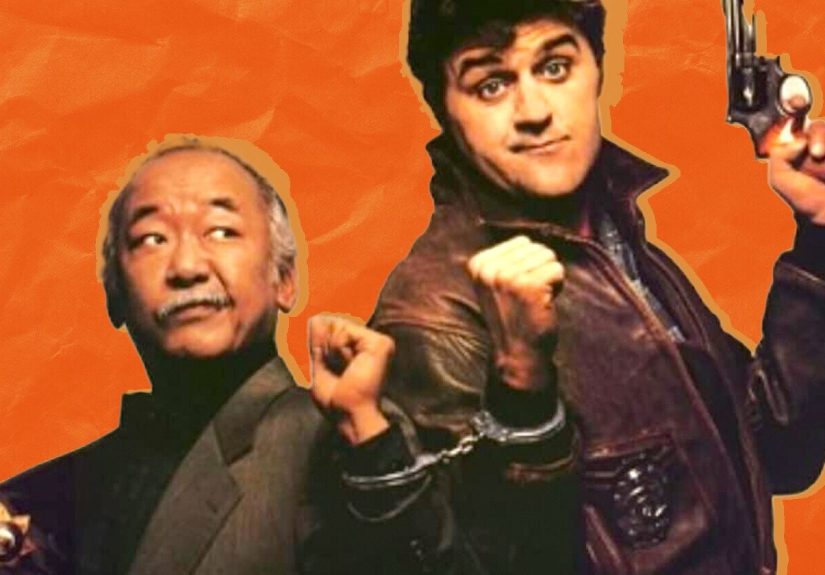
The plot sounds like a buddy-cop fever dream cooked up in a room full of coffee, shoulder pads, and Detroit auto magazines. Morita plays Inspector Fujitsuka Natsuo, a Japanese investigator who comes to the United States. Leno plays Detroit cop Tony Costas. Together, they are thrown into a case involving a stolen prototype turbocharger, corporate greed, criminals with very large weapons, and enough culture-clash banter to power a small city.
If that setup is making your brain whisper, “Wait, this really does sound like Rush Hour with different hair,” you are not alone. The comparison is obvious. Both stories are built on the same reliable action-comedy skeleton: one tightly wound Asian lawman, one loud American counterpart, lots of bickering, plenty of misunderstandings, and a growing partnership that turns mutual annoyance into grudging respect.
The difference is that Rush Hour arrived in 1998 with sharper pacing, bigger stars, and Jackie Chan’s world-class physical comedy. Collision Course, by contrast, feels like the rough draft found in the glove compartment.
Why Jay Leno and Pat Morita Were Such an Unlikely Pairing
Jay Leno Was Not Supposed to Be an Action-Comedy Hero
Today, Jay Leno is practically welded into pop culture memory as a late-night host, monologue machine, and collector of enough cars to make a dealership blush. But in the late 1980s, he was still climbing. He had built his reputation through stand-up, television appearances, and guest-hosting work that showcased his easygoing style and relentless work ethic.
What he did not have was a classic movie-star aura. He was funny, familiar, and quick on his feet, but he was not exactly the guy most people would cast as a Detroit detective trading bullets and insults with international criminals. That is part of what makes Collision Course so intriguing now. It captures Leno in a strange little pocket of time when Hollywood looked at a popular comic and thought, “Sure, let’s hand him a gun and a badge.” Bold choice. Chaotic choice. Very 1980s choice.
Leno’s performance is one reason the movie has developed a kind of cult curiosity. He brings talk-show timing and stand-up rhythm to a role that probably needed either harder-edged charisma or a more polished comic persona. The result is awkward in places, but never boring. Watching him act in a full-on buddy-cop movie feels like stumbling across an alternate timeline where late-night television took a very strange detour.
Pat Morita Brought Credibility, Warmth, and a Better Screen Presence
Pat Morita, on the other hand, had the kind of screen presence that could stabilize nearly any project. By the time Collision Course entered the picture, Morita was already a major figure in American entertainment. He had sitcom roots, sharp comic timing, and serious dramatic weight, especially after The Karate Kid made him an Oscar nominee and a permanent pop-culture icon.
That history matters because Morita was far more than “the other guy” in this pairing. He gave the film a center of gravity. While Collision Course leans into broad comedy and familiar stereotypes, Morita’s performance gives the movie some genuine personality. He can play dignified, deadpan, frustrated, and quietly amused all at once, which is exactly the kind of balance a mismatched buddy movie needs.
In many ways, Morita is the secret explanation for why Collision Course is still remembered at all. Swap him out, and this might just be another forgotten action-comedy fossil. With him, it becomes a weird little “what if?” in Hollywood history.
What Collision Course Got Right
For all its rough edges, Collision Course did land on a formula that Hollywood would later refine with much better results. The movie understood that audiences enjoy watching opposites collide before they click. It knew that cultural contrast could drive both conflict and comedy. It also understood that a buddy-cop story works best when the investigation is just sturdy enough to keep the characters moving from one argument, chase, or explosion to the next.
It also tapped into something very specific about the era. The Detroit-versus-Japan tension in the story was not random. It reflected economic anxieties and trade-war chatter that were very real in the 1980s, especially in conversations about the auto industry. That gives the film a time-capsule quality. It is not subtle, but it is revealing. The movie shows how Hollywood was packaging real-world economic fears into glossy mainstream entertainment.
There is also a certain shameless charm in the film’s commitment to its own nonsense. A stolen turbocharger as the center of an action-comedy plot? Beautifully weird. It is the kind of detail that makes the movie instantly memorable, even if not always for the reasons the filmmakers intended.
What Collision Course Got Wrong
Now for the less flattering truth: Collision Course mostly survives as a curiosity because it does not fully work. The tone wobbles. The humor can feel forced. The action is more serviceable than exciting. And the “culture clash” material often leans into the blunt, heavy-handed habits that many 1980s studio comedies treated as normal.
This is where the comparison to Rush Hour becomes especially useful. Both movies rely on contrast, but Rush Hour makes that contrast feel playful, fast, and built around star chemistry. Collision Course too often feels like it is straining to prove that the setup is funny rather than simply letting the comedy happen.
There is also the simple problem of magnetism. Jackie Chan and Chris Tucker were a high-voltage pairing. Chan gave Rush Hour breathtaking physical skill, while Tucker added verbal fireworks and a comic engine that never stopped revving. Leno and Morita are memorable because the casting is so odd, but they do not generate that same kind of combustible, crowd-pleasing rhythm.
In short, Collision Course had the ingredients but not the recipe.
Why Rush Hour Became a Hit and Collision Course Became a Trivia Question
When Rush Hour arrived in 1998, it took a familiar buddy-cop framework and polished it until it gleamed. Jackie Chan had already proven himself an international action legend, and Chris Tucker brought a comic style that was loud, elastic, and impossible to ignore. The movie had momentum, confidence, and a major-studio rollout that helped turn it into a box-office success.
That success was not small. Rush Hour became a genuine hit, launched sequels, and secured its place in late-1990s movie culture. It was the version of the formula that clicked with mainstream American audiences at the perfect moment. The action was cleaner, the banter was faster, and the stars were used exactly the way the audience wanted them used.
Collision Course never had that kind of runway. Its production troubles, delayed release, and unusual casting worked against it before viewers even got to the plot. Instead of arriving as an event, it drifted into the world as a curiosity. That difference matters. Movies do not live on concept alone. Timing, marketing, star image, and execution do a lot of the heavy lifting.
Still, the earlier movie deserves credit for showing that the basic template had potential. If Rush Hour was the polished sports car, Collision Course was the prototype in the garage with a few bolts rolling around on the floor.
Why This Forgotten Buddy-Cop Movie Still Matters
There are at least three reasons people still talk about Collision Course. First, it is a fascinating footnote in the careers of both leads. For Jay Leno, it represents a rare attempt to turn comedic fame into movie stardom. For Pat Morita, it shows a performer whose range extended well beyond the role that made him immortal.
Second, it is an unusually clear snapshot of late-1980s Hollywood thinking. The film combines auto-industry anxiety, buddy-cop formulas, fish-out-of-water comedy, and action set pieces in a package that could only have come from that moment. You can practically hear the era humming behind it.
Third, it gives movie fans one of those delightful, almost unbelievable comparisons that make film history fun to explore. Once you know that a Jay Leno–Pat Morita movie exists and that it resembles a pre-Rush Hour draft, you cannot unknow it. That fact sticks in your head like a pop-culture splinter.
The Experience of Watching Collision Course Today
Watching Collision Course now is a very specific kind of entertainment experience, and honestly, that is part of the appeal. You do not watch it expecting a lost masterpiece. You watch it because you want to feel the strange electricity of a movie that should not exist but somehow does. It is the cinematic equivalent of opening an old garage, finding a vintage machine under a tarp, and realizing that it still starts if you kick it hard enough.
The first experience is disbelief. Jay Leno as the lead in a buddy-cop action comedy still lands like a joke someone forgot to finish. Then Pat Morita shows up, and the whole thing becomes even more surreal because he is not sleepwalking through the material. He is trying. He is giving the movie shape, rhythm, and flashes of charm. That contrast between Leno’s oddball casting and Morita’s steady professionalism becomes one of the film’s most interesting qualities.
The second experience is nostalgia, even for viewers who never saw the movie when it first appeared. Collision Course is packed with the textures of its time. The pacing, the dialogue, the jackets, the cars, the whole industrial mood of Detroit, the broad villains, the unapologetically literal approach to cultural contrastit all screams late-1980s studio filmmaking. If you enjoy movies as time capsules, this one delivers in bulk. It preserves not just a genre formula, but a mindset.
The third experience is comparison. It is almost impossible to watch the film without mentally measuring it against Rush Hour. You notice the bones of the later blockbuster everywhere: the upright Asian investigator, the fast-talking American counterpart, the irritation, the reluctant teamwork, the case that exists mostly to keep the two leads bouncing off each other. But where Rush Hour glides, Collision Course lurches. Where Rush Hour snaps, Collision Course sort of shrugs and says, “We are doing our best here.”
And yet, that is why the movie can be fun. Not because it is better than Rush Hour, but because it lets you see the evolution of a formula in real time. It is like hearing an early demo of a song that later became a huge hit for another artist. The melody is there. The hook is there. But the confidence, precision, and polish have not fully arrived.
There is also something oddly affectionate about revisiting a movie that so clearly missed its shot at becoming a mainstream classic. Hollywood history is full of winners, but the near-misses can be more revealing. They show you what the industry was testing, what it misjudged, and what later filmmakers improved. Collision Course tells a story not just about one movie, but about how Hollywood learns by making awkward versions before it stumbles into the right one.
For fans of Pat Morita, the experience can also feel bittersweet. The film is a reminder that he had comic agility and screen presence that went far beyond his most famous role. He could anchor silliness without losing his dignity, which is harder than it looks. Even in a movie this uneven, you can see why he remained such a compelling performer.
So yes, watching Collision Course today is part comedy, part curiosity, part film-school field trip, and part late-night “how have I never heard of this?” joy. It may not be essential viewing for everyone, but for movie lovers who enjoy forgotten action comedies, strange casting experiments, and the prehistory of blockbuster formulas, it is a wonderfully peculiar ride.
Conclusion
The phrase “the original Rush Hour starred Jay Leno and Pat Morita” is not technically precise, but it captures a real and entertaining truth. Long before Jackie Chan and Chris Tucker turned the mismatched-cops formula into a major hit, Collision Course had already tried a similar setup with a wildly unexpected duo.
That earlier movie never became a classic, and it certainly never became a franchise. But it remains a fascinating piece of entertainment history because it shows the buddy-cop formula in a less refined, more experimental form. It also preserves an unforgettable pairing: Jay Leno taking a rare shot at movie stardom and Pat Morita doing what Pat Morita always did bestbringing intelligence, warmth, and timing to material that needed all three.
In the end, Collision Course matters not because it beat Rush Hour, but because it accidentally predicted the lane that Rush Hour would later own. And if nothing else, it gives us one of the best pop-culture sentences ever spoken out loud: “Did you know the pre-Rush Hour buddy-cop movie starred Jay Leno and Pat Morita?” That sentence alone is worth the ticket price. Or at least the streaming rental and a raised eyebrow.