Table of Contents >> Show >> Hide
- What Actually Happened in Dayton
- Why the Bombers Rolled Instead of Flew
- The Aircraft That Turned the Road Into a Runway Without Flying
- Why This Highway Convoy Still Matters
- How the Convoy Fits Into the Museum’s Bigger Story
- Experience Section: What It Must Have Felt Like When the Bombers Came Down the Road
- Conclusion
Every now and then, history stops being polite and decides to make an entrance. In Dayton, Ohio, during 1970–71, that entrance looked like a line of enormous military aircraft being hauled down public roads like they were headed to the world’s strangest county fair. Not flown. Hauled. Rolled. Moseyed, if you will.
The occasion was the move of historic aircraft from the old Air Force Museum site at Patterson Field to the museum’s new home at historic Wright Field. And yes, that meant some of America’s most famous warbirds and bombers ended up sharing pavement with streetlights, utility poles, and probably at least one confused driver wondering whether he’d accidentally turned into an alternate timeline.
Today, the National Museum of the U.S. Air Force is famous for its massive galleries and jaw-dropping collection. But before the polished exhibits and giant hangars, there was a gritty, practical, deeply American operation: get priceless aircraft from Point A to Point B without losing a wingtip, a tail, or anyone’s mailbox. The result was one of the most charmingly surreal moments in aviation historyan honest-to-goodness bomber convoy on the highway.
What Actually Happened in Dayton
The short version: the museum had outgrown its earlier home, and a new purpose-built facility was being developed at Wright Field. The move was tied to a major expansion effort supported by the Air Force Museum Foundation, which helped fund the new building that opened in 1971. That new structure was designed specifically to display aircraft indoors, a huge step up from earlier spaces that were far less ideal for showcasing large planes.
As part of that transition, aircraft were relocated from Patterson Field to Wright Field. Official museum materials and archival footage descriptions confirm the move happened in 1970–71, and that aircraft were moved from Patterson Field to historic Wright Field. In other words, this wasn’t a myth, a fan story, or an “I swear my grandpa saw it” situation. It really happened.
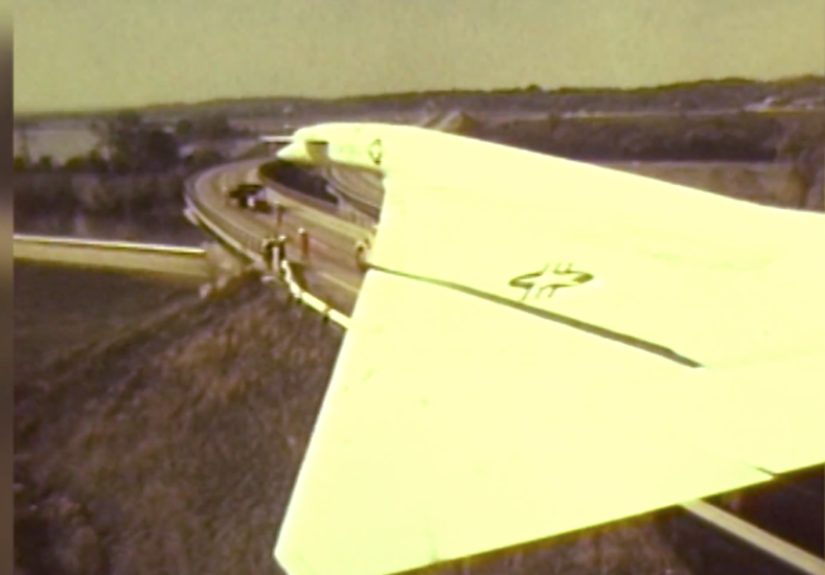
One of the best-known images from the move shows the North American XB-70 Valkyrie being transported down State Route 444. It looks unreal even when you know it’s real: a gigantic white futuristic bomber prototype creeping past everyday roadside scenery. It’s the kind of image that makes you double-check whether your coffee was too strong.
Why the Bombers Rolled Instead of Flew
A reasonable question here is: Why not just fly them over?
Because museum aircraft are not the same as active-duty aircraft, and moving them safely is often more like moving industrial artifacts than “taking the car out for a spin.” Some aircraft were no longer flightworthy. Others were historically significant and better preserved through controlled ground transport. Some were simply too risky or too costly to return to flying status, even temporarily.
Then there’s the small issue of size. Many of these aircraft are enormous. The XB-70, in particular, is not exactly a compact crossover SUV. Detailed engineering accounts of the move note that road crews had to widen sections of roadway, reinforce at least one bridge, and coordinate the temporary removal or lifting of utility lines and traffic infrastructure. This was not just a convoyit was a carefully choreographed public works project with wings attached.
The Highway Logistics Were Wild
Reconstructed accounts of the route planning describe crews lifting power lines, removing street signs and signal lights, and making sure the roadway could physically accommodate the aircraft dimensions. In at least one stretch, the route had to be widened because the aircraft (especially the XB-70) simply demanded more room than a normal road was built to give.
Think about that for a second: the highway didn’t “fit the cargo,” so the cargo won, and the highway adapted.
That level of planning also helps explain why the images are so striking. These aircraft weren’t just being towed around on a closed airfield. They were threading through the built environment of a real city, inch by inch, with crews watching every clearance point like hawks.
The Aircraft That Turned the Road Into a Runway Without Flying
Popular retellings of the move often highlight a lineup that included famous WWII and Cold War aircraft, plus a few machines that technically weren’t bombers but absolutely stole the show anyway. Here’s why the convoy felt so epic: it wasn’t just one airplane. It was a rolling timeline of American airpower.
WWII Heavy Hitters: B-17, B-24, B-25-ish Attitude, and B-29 Star Power
The Boeing B-17 Flying Fortress remains one of the most iconic U.S. bombers ever built. Museum and aviation sources consistently emphasize its role in daylight bombing campaigns over Europe and its reputation for taking heavy damage and still bringing crews home. That toughness is a big reason the B-17 became legend-status in public memory.
The Consolidated B-24 Liberator brought a different strength: range. It served in every major theater of World War II, and its long reach made it especially useful for missions like the famous Ploesti raid and long over-water operations. If the B-17 gets the movie-poster treatment, the B-24 deserves the “quiet workhorse that carried a lot of the weight” badge.
Then there’s the B-29 Superfortress, represented at the museum by Bockscar. Whatever your angle on aviation historytechnology, strategy, ethics, or geopoliticsthe B-29’s place in history is unavoidable. It was a leap forward in capability and a defining aircraft of the late war period.
Popular coverage of the convoy also points to the Martin B-26 Marauder in the move footage, another WWII-era aircraft with a strong operational legacy. The convoy, in that sense, wasn’t just moving airplanes. It was moving the physical memory of an entire era.
Cold War Giants: B-36, B-52, and the Supersonic B-58
If the WWII bombers brought gravity, the Cold War aircraft brought pure scale and swagger.
The Convair B-36 Peacemaker was designed for intercontinental strategic bombing and became a major deterrent aircraft in the early Cold War. The museum’s B-36 is especially significant because it made the last B-36 flight ever when it flew from Davis-Monthan Air Force Base to the museum in 1959. That alone makes it a centerpiece-level machine.
The Boeing B-52 Stratofortress, meanwhile, is the opposite of a relic in one important way: it refuses to retire from relevance. It entered service in the 1950s and has remained central to U.S. bomber capability for decades. Official museum and Boeing sources both underline its longevity, adaptability, and huge payload capacity. It’s basically the aviation version of a cast-iron skillet: old, reliable, and still very much in use.
The Convair B-58 Hustler added a different flavor to the convoy story. The B-58 was the U.S. Air Force’s first operational supersonic bomber and set multiple speed and altitude records. The museum’s B-58 is a record-setting aircraft in its own right and was flown to the museum in December 1969right around the era of the big move. So even when it wasn’t physically on the road at the same moment as every other aircraft, it belonged to the same dramatic chapter of museum growth and aircraft preservation.
The Scene-Stealer: The XB-70 Valkyrie on State Route 444
Let’s be honest: the XB-70 is the celebrity shot.
Official museum captions explicitly identify the XB-70 Valkyrie moving from the old museum at Patterson Field down State Route 444 to the new home at Wright Field during 1970–71. That one image captures the whole mood of the event: futuristic bomber prototype, ordinary roadside infrastructure, and a move that somehow feels both improvised and impossibly professional.
The XB-70 itself has a fascinating backstory. It was conceived in the 1950s as a high-altitude, Mach 3 nuclear strike bomber, but changing technologyespecially missiles and ICBMsshifted its role before the full bomber program could mature. The U.S. Air Force used completed XB-70 aircraft as test platforms instead, and NASA historical material also highlights how the program evolved from strategic bomber ambitions into a major research story in aviation history.
In other words, when the XB-70 rolled down that road, it wasn’t just “another museum piece.” It was a one-of-a-kind symbol of a very specific moment in American aerospace ambition.
And Yes, There Were a Few Non-Bombers in the Party
Archival descriptions and modern coverage also reference aircraft like the North American F-82 Twin Mustang appearing in footage from the move. The F-82 isn’t a bomber, but it absolutely belongs in the conversation because it shows how broad the museum’s mission was (and is): preserve the full story of U.S. airpower, not just one category of aircraft.
The museum’s F-82B “Betty Jo” is notable on its own merits, including a record-setting Hawaii-to-New York flight in 1947. So if it sneaked into the convoy’s visual memory, that’s less a technicality and more a bonus.
Why This Highway Convoy Still Matters
It’s easy to treat the convoy as a fun oddball anecdotebecause it is fun, and it is oddbut it also represents something bigger.
First, it was a preservation milestone. Moving aircraft into a purpose-built facility meant better long-term protection, better interpretation, and better public access. That matters because metal airplanes don’t preserve themselves. Humidity, corrosion, cramped layouts, and poor infrastructure can quietly erase history one bolt at a time.
Second, the convoy tells a classic American story: public-private support, local pride, and practical engineering all pulling in the same direction. The Air Force Museum Foundation played a major role in funding the museum’s growth, and the 1971 dedication by President Richard Nixon shows how nationally significant the institution had become by the time the new building opened.
Third, the convoy made aviation history visible to ordinary people in a way museums usually can’t. Normally, you visit history after it’s already parked, lit, and labeled. In Dayton, people got to see history in transitawkward, oversized, and gloriously real.
You can almost hear the collective neighborhood reaction:
“Is that a bomber?”
“On the road?”
“Well… I guess so.”
How the Convoy Fits Into the Museum’s Bigger Story
The museum’s history stretches back to the 1920s, but the move to the Wright Field site and the opening of the 1971 building marked a turning point. It created the foundationliterally and figurativelyfor the museum visitors know today.
Later expansions added more galleries and dramatically increased display capacity, including major Cold War and missile/space exhibits. Air & Space Forces Magazine has noted how the museum grew into one of the country’s top attractions and one of the largest military aviation museums anywhere. That scale didn’t happen by accident. It happened because someone, years earlier, decided the aircraft were worth preserving and then figured out how to move them safely.
Even the dedication language from 1971 feels fitting in hindsight. Nixon’s remarks framed the museum as a gift for “this generation and generations to come.” Whatever one’s politics, that idea lands. The convoy wasn’t just about transportation. It was a handoff across time.
Experience Section: What It Must Have Felt Like When the Bombers Came Down the Road
If you want to understand why this story sticks, don’t start with technical specs. Start at the curb.
Imagine standing in Dayton in the early 1970s, maybe because a neighbor told you something weird was happening, maybe because local word-of-mouth was faster than any official notice. You get there expecting “a plane move,” which sounds modest enough. Then the aircraft appears, and your brain does that little stutter-step it does when scale stops making sense.
These weren’t sleek little museum pieces on tidy trailers. These were full-size military aircraft navigating public roads one careful foot at a time. The convoy pace would have felt almost ceremonial. Nobody was in a hurry, because nobody could be in a hurry. Every telephone wire, every signpost, every turn radius mattered.
The soundscape would have been memorable too. Not jet noisethis wasn’t a flyoverbut diesel engines, hydraulic whines, shouted hand signals, maybe radios crackling, and the occasional stop while crews checked clearances. It was less “air show” and more “precision moving day for giants.”
For kids, it must have felt impossible in the best way. Adults spend a lot of time saying things like “you can’t put that there” or “that won’t fit.” Then along comes a convoy proving that, with enough planning, yes, actually, a bomber can go there, and yes, it can fit.
For museum staff and volunteers, the emotional side was probably just as strong as the logistical side. They weren’t moving anonymous hardware. They were escorting artifacts tied to wartime service, Cold War deterrence, and major turning points in aviation technology. A B-17 or B-24 isn’t just aluminum and rivets. It carries stories of crews, factories, missions, losses, and survival. A B-29 carries even heavier historical weight. The XB-70 carries the memory of a future that almost was.
There’s also a very human kind of stress in a move like this. Even if the route is planned perfectly, you still hold your breath at every narrow section. Someone is watching a wingtip. Someone else is checking wheel placement. Another person is staring at overhead lines with the focus of a surgeon. Every few minutes, there’s probably a tiny wave of relief: Okay, cleared that one. Next obstacle.
And then there’s the community effect. Events like this create shared memory. Decades later, people may not remember the exact date, but they remember the feeling: seeing a military aircraft where no military aircraft should be, right there on a road they drive every week. It turns local geography into story geography. State Route 444 stops being just a road and becomes the road where the XB-70 rolled by.
That’s probably the biggest reason this convoy still resonates. It wasn’t hidden inside a hangar, and it wasn’t abstract history in a textbook. It was history out in the open, moving slowly enough for people to really see it. The aircraft were between homesbetween one museum era and the nextand for a brief stretch of time, the public got to witness that transition in real life.
A lot of museum history happens quietly: acquisitions, restoration work, conservation planning, cataloging. Important work, but mostly invisible. This was the opposite. This was visible, physical, awkward, and unforgettable. A convoy of vintage U.S.A.F. bombers didn’t just relocate a collection. It gave Dayton a story that still sounds too good to be trueexcept the photos prove it.
Conclusion
The time a convoy of vintage U.S.A.F. bombers moseyed down the highway wasn’t just a quirky transportation story. It was a landmark moment in museum preservation, a feat of route planning and engineering, and a public-facing reminder that history sometimes has to move before it can be properly displayed.
From WWII legends like the B-17, B-24, and B-29 to Cold War icons like the B-36, B-52, B-58, and the unforgettable XB-70 Valkyrie, the convoy represented a rolling archive of American aviation history. Dayton didn’t just host a move. It hosted a moment when the past and future traveled the same road.
And honestly, if there were ever a perfect use of the phrase “moseyed down the highway,” this was it.