Table of Contents >> Show >> Hide
- What’s Actually Being “Restricted”?
- The “Secret” Part: What Reporting Said the U.S. Did
- Why Washington Wanted Those Guardrails
- How Restrictions Played Out in Practice
- The Policy Shift: From “No Strikes in Russia” to “Limited, Defensive Strikes”
- So Was There a “Kill Switch” or Geofence?
- Why This Story Matters (Even Years Later)
- Conclusion
- Experiences Related to the HIMARS Restrictions (A Human, Real-World View)
If you’ve followed U.S. military aid to Ukraine for more than five minutes, you’ve probably noticed a pattern:
Washington likes to help, but it also likes guardrails. Lots of guardrails. Preferably with reflective tape, a
rulebook, and a lawyer standing nearby saying, “Yes, but…”
That tensionsupport Ukraine, avoid direct escalation with Russiahas shaped nearly every big weapons decision
since 2022. And it’s why a surprisingly wonky, behind-the-scenes story grabbed attention: reporting that the
United States quietly altered the HIMARS rocket systems it sent to Ukraine so they couldn’t fire certain longer-range
munitions (and, by extension, couldn’t be used to hit targets deep inside Russia).
“Secretly restricted” sounds like a spy thriller. In reality, it’s more like a belt-and-suspenders approach to
policy: if you’re worried about how a partner might use a capability, you can (1) ask for assurances, (2) limit
what you ship, and (3) make sure the hardware itself can’t do the thing you’re nervous about. The HIMARS story
touches all three.
What’s Actually Being “Restricted”?
HIMARS vs. the rockets it fires
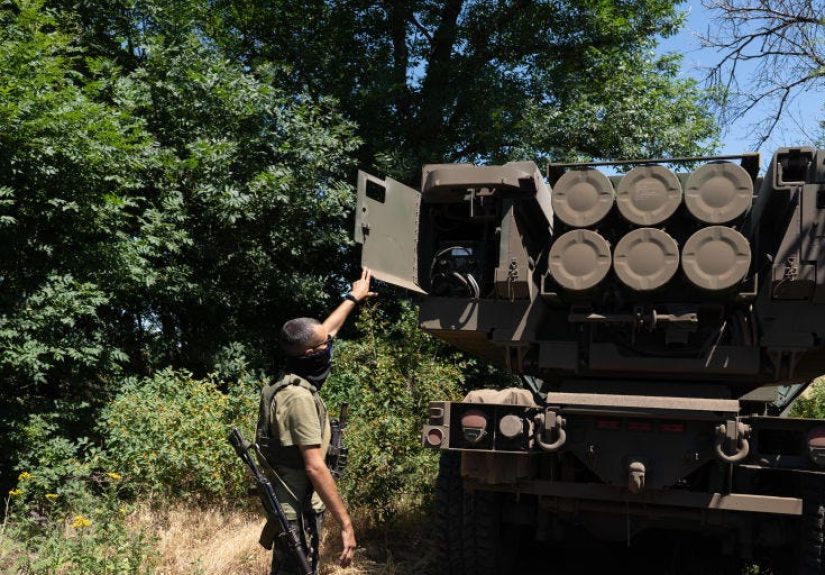
HIMARS (High Mobility Artillery Rocket System) is a truck-mounted launcherthink “pickup truck for precision rockets,”
except the pickup is a military vehicle and the cargo is math. The launcher can fire different kinds of munitions,
depending on what you load into the pod and what your fire-control system is set up to accept.
Here’s the key point: the launcher is versatile. That versatility is exactly why restrictions mattered. If you give
someone a device that can shoot a family of rockets and missiles, the question becomes: which family members are
invited to the party?
The short-range workhorse: GMLRS
Early U.S. deliveries to Ukraine emphasized Guided Multiple Launch Rocket System (GMLRS) rocketsprecision munitions
commonly described as having a range on the order of ~70 kilometers (roughly 40+ miles), depending on the variant.
In war terms, that’s “deep enough to ruin a logistics officer’s week,” but not “deep enough to turn Moscow into a
headline.” GMLRS became a major factor in Ukraine’s ability to hit ammunition depots, command posts, and supply hubs
behind the front lines.
The long-range “big brother”: ATACMS (and why it was controversial)
The hotter debate wasn’t about GMLRS. It was about longer-range munitions like ATACMS (Army Tactical Missile System),
which can reach much farther. For much of 2022 and into 2023, the U.S. resisted sending ATACMS, publicly and privately
weighing escalation risk, stockpiles, and strategy.
So when reports emerged that the U.S. modified Ukraine-bound HIMARS so they couldn’t fire ATACMS (even if Ukraine
somehow got the missiles elsewhere), it fit the broader pattern: don’t just limit what you providelimit what the
system can do.
The “Secret” Part: What Reporting Said the U.S. Did
In December 2022, major reporting described the U.S. as quietly altering HIMARS launchers sent to Ukrainechanges
characterized as hardware and software modificationsto prevent them from firing longer-range missiles. The basic
logic was straightforward: it’s easier to keep a “no deep strikes into Russia” policy intact if the launcher itself
won’t cooperate.
Importantly, many operational details were not publicly documented. That’s normal. Governments rarely publish
“Here’s how we modified a weapons system, and here’s what it can’t do now” as a cheerful PDF for hobbyists.
What the public did get was the strategic outline: the U.S. wanted Ukraine to have battlefield-changing precision
fires, but not a turnkey tool for long-range strikes that could trigger a major political and military escalation.
If you’re wondering, “Is that unusual?”not really. Arms transfers often come with conditions, end-use monitoring,
and export-control constraints. What made the HIMARS story stand out was the idea of changing the launcher itself,
not just limiting the munitions shipped.
Why Washington Wanted Those Guardrails
Escalation management (aka “avoid the fireworks show”)
From the start, U.S. officials framed aid around helping Ukraine defend its territory while trying to avoid a
direct U.S.-Russia confrontation. One way to reduce risk was to prevent U.S.-provided systems from being used to
strike targets on Russian territoryespecially deep inside Russia.
Early on, U.S. messaging emphasized that Ukraine had provided assurances about how it would use the systems. In other
words: “We’re sending these, and you’re telling us you won’t use them to hit Russia.” The restriction story is like
the follow-up sentence Washington didn’t say out loud: “Also, we’re going to make that easier to enforce.”
Alliance politics and “everyone has a different red line”
The U.S. isn’t the only donor. Aid is a coalition effort, and coalitions are a little like group chats: someone is
always worried the conversation will get out of hand, someone else is sending “let’s do it” emojis, and somebody is
trying to pin a message that everyone ignores.
Restrictions served another purpose: they helped keep allied support cohesive by reassuring partners (and domestic
audiences) that U.S. weapons weren’t automatically a blank check for strikes anywhere, anytime.
Stockpiles, pacing, and the “capability ladder”
A quieter reason behind restrictions is resource management. Even if you remove escalation from the equation, the
U.S. still has to balance what it can send with what it needs for its own readiness, training, and global commitments.
That reality encourages gradualism: send systems in phases, observe effects, adjust policy, repeat.
How Restrictions Played Out in Practice
Step one: “Here are the launchershere are the rules”
In 2022, U.S. officials repeatedly emphasized that provided rocket systems were intended for Ukrainian defense and
not for striking targets inside Russia. Alongside public statements, the U.S. relied on Ukrainian assurances and
policy conditions. And, according to later reporting, there were also technical constraints on what the launchers
could fire.
Step two: battlefield impactwithout crossing the border
Within Ukraine’s internationally recognized territory, HIMARS and GMLRS helped change the rhythm of fighting by
threatening ammunition depots and logistics nodes that had previously sat comfortably beyond tube artillery range.
Russia responded by moving supplies farther from the front and adapting with camouflage, dispersal, and electronic
warfare.
In other words: the system workedand it worked inside the “rules.”
Step three: adaptationjamming, countermeasures, and the real world
Precision weapons don’t exist in a vacuum. Over time, reporting highlighted how Russian electronic warfare and jamming
efforts reduced the effectiveness of some GPS-guided munitions. That doesn’t make HIMARS “useless”it means the contest
shifted. Precision is a competition, not a permanent feature.
This matters for the restriction conversation because it shows something people miss: capability isn’t just about range.
It’s also about survivability, guidance, targeting data, and whether your opponent is actively trying to make your
expensive rocket behave like an overconfident dart thrown in a windstorm.
The Policy Shift: From “No Strikes in Russia” to “Limited, Defensive Strikes”
By 2024, the battlefield and political context changed. Russia’s pressure near the border (including around Kharkiv)
intensified calls for Ukraine to be able to hit forces firing from across the border. The U.S. position began to evolve.
May–June 2024: limited permission for cross-border defense
Reporting in late May 2024 described a U.S. policy adjustment allowing Ukraine to use U.S.-supplied weapons against
certain military targets inside Russia that were directly supporting operations near Kharkiv. Shortly afterward,
public clarifications emphasized that the permission wasn’t only about one geographic slice, but about enabling
cross-border “counterfire” in defense of Ukrainian forces.
Think of it as Washington redrawing the line from “no” to “yes, but only for this defensive purpose.” It wasn’t a
free-for-all. It was a narrow carveout shaped by battlefield necessity and escalation caution.
ATACMS: from withheld to delivered (carefully)
The long-range missile debate also evolved. The U.S. confirmed that it had provided certain ATACMS variants in 2023,
and later supplied longer-range versions in 2024. Some deliveries were intentionally quiet, reflecting continued
sensitivity about escalation and operational security.
That arcinitially restricting launchers and withholding missiles, later sending missiles under tighter policy
conditionshighlights the larger theme: U.S. aid is not just about capability, but about controlling the timing,
context, and political risk of that capability.
So Was There a “Kill Switch” or Geofence?
Let’s address the internet’s favorite genre: “Secret button disables everything.” Claims about remote kill switches,
GPS geofencing, or always-on U.S. control pop up regularly in wars involving advanced weapons. Some of these claims
are speculation; some are misunderstandings; some are exaggerated versions of real, boring realities like export
controls, software configurations, supply chains, and intelligence support.
The most credible public reporting around HIMARS restrictions focused on modifications that limited what munitions
the launchers could fireespecially longer-range missilesrather than a dramatic Hollywood-style off switch that
someone in Washington flips when they’re having a bad day.
And even without any cinematic “kill switch,” the U.S. still has powerful leverage through:
- Munitions supply: A launcher is only as active as its ammo pipeline.
- Training and support: Complex systems run best with sustained technical backing.
- Policy conditions: Aid packages can expand, pause, or change based on compliance and strategy.
- Targeting and intelligence support: Modern precision strike ecosystems often rely on datawhen data changes, results change.
In short: you don’t need a magic remote to influence how a system is used. Logistics and policy already do that job
every day, wearing sensible shoes and carrying clipboards.
Why This Story Matters (Even Years Later)
It reveals the “how,” not just the “what,” of military aid
People often debate whether the U.S. should send a system. The HIMARS restriction story is about how it was
sent: configured, bounded, and paired with policy conditions. That’s where strategy livesin the details that turn a
weapons transfer into a political instrument.
It shows the U.S. balancing two goals that often collide
The U.S. wanted Ukraine to succeed on the battlefield, and it also wanted to reduce the risk of a wider war. Those
goals can alignuntil they don’t. Restrictions are one way to keep them aligned for as long as possible.
It’s a preview of future security assistance models
The broader lesson extends beyond Ukraine: advanced weapons increasingly come with software-defined capabilities,
modular munitions, and configurable interfaces. That means future aid debates may include not only “do we send it?”
but “which features do we enable?”
Conclusion
The phrase “The U.S. secretly restricted HIMARS rockets bound for Ukraine” sounds dramatic because it compresses a
complex policy into a single spicy headline. Underneath the spice is a familiar reality: when Washington sends
high-impact weapons into a high-stakes war, it tries to shape not only what Ukraine can do, but what it can’t
doat least at first.
Early in the war, that meant relying on Ukrainian assurances, limiting the munitions provided, and (according to
reporting) configuring launchers to prevent use of longer-range missiles. As the battlefield changed, U.S. policy
shifted toward limited cross-border defensive strikes and eventually the provision of longer-range missiles under
careful conditions.
If there’s a takeaway, it’s this: military aid isn’t just a shipment. It’s a strategywith settings.
Experiences Related to the HIMARS Restrictions (A Human, Real-World View)
Restrictions on a system like HIMARS don’t just live in press statementsthey show up in the everyday experience of
everyone orbiting the war, from soldiers and trainers to policymakers and civilians following the news. One of the
most common “aha” moments for people new to defense policy is realizing that a weapon can be both powerful and
intentionally limited, like a sports car delivered with a speed limiter because the dealership knows your driveway
exits onto a crowded street.
For Ukrainian forces, the experience often begins with training: learning a system’s strengths, its routines, and its
boundaries. There’s a practical comfort in knowing what you can count onreliable precision at a certain range,
repeatable procedures, predictable support. But there can also be a psychological friction when you know a platform is
capable of more in theory than it is in your hands right now. That gapbetween “the launcher family can do X” and
“our specific launchers can do Y”isn’t just technical trivia. It shapes planning, expectations, and the way people
talk about what’s possible.
For U.S. and allied officials, the experience is a constant balancing act that rarely looks heroic up close. It’s
meetings where everyone agrees Ukraine needs help, followed by debates about timing, thresholds, and second-order
effects. It’s writing policies that aim to be clear but must remain flexible as the war changes. And it’s living with
the knowledge that any decision will be criticized from two directions at once: “too cautious” and “too risky.”
Restrictions are often the compromise toolan attempt to deliver meaningful capability while still keeping a hand on
the escalation thermostat.
For defense industry and logistics teams, “restriction” feels less like espionage and more like configuration
management. What version is being shipped? What interfaces are enabled? What documentation and sustainment package
goes with it? In modern systems, software and hardware settings can be as consequential as the metal itself, and the
behind-the-scenes work is painstaking. Nobody hangs a banner that says “Congrats on your carefully bounded capability!”
but that’s exactly what is being built.
For journalists and analysts, the experience is learning to separate three different debates that the public often
blends together: what a system can technically do, what munitions have actually been delivered, and what policy
authorizes their use. Those three lines don’t always match at the same moment. A launcher might be capable of firing a
long-range missile, but the missile isn’t delivered. Or the missile is delivered, but policy limits where it can be
used. Or policy changes, but the technical configuration lags. That’s why “Why can’t they just…?” questions are so
commonand so hard to answer in one sentence.
Finally, for ordinary people watching from afar, restrictions can feel emotionally contradictory: “If Ukraine is
defending itself, why limit it?” That reaction is understandable. The lived experience of following this war includes
repeated cycles of urgency (“they need this now”) and restraint (“we must avoid escalation”), and it can be exhausting.
But that tension is also the story. Restrictions are one way governments try to live inside that contradictionhelping
in a way that changes the battlefield, while trying to keep the conflict from widening. It may not be satisfying, but
it is, for better or worse, how modern great-power crisis management often works.