Table of Contents >> Show >> Hide
- What Maker Faire Rochester Actually Is
- Why Rochester Is Such A Good Home For The Maker Movement
- Yes, There Is Hot Air
- But The Real Draw Is Hands-On Wonder
- Student STEAM Fest Makes The Event Matter Even More
- The Best Part Is The People
- Why Events Like Maker Faire Rochester Matter
- What A Day At Maker Faire Rochester Feels Like
- Conclusion
At first glance, the title sounds like a wink. “There’s more than hot air at Maker Faire Rochester” suggests a little showmanship, a little spectacle, and maybe a little smoke-machine energy. And honestly, that is part of the charm. Maker Faire Rochester has long embraced the gloriously dramatic side of the maker movement: giant bubbles, vortex cannons, flame-belching art, oversized optical illusions, and the sort of inventions that make kids point with both hands at once. But the real story is bigger than the visual fireworks.
Maker Faire Rochester is one of those rare events where robotics and crochet, semiconductors and cosplay, soldering irons and handmade crafts all somehow feel like members of the same family. It is not just a festival. It is a living argument for curiosity. The event brings together engineers, artists, hobbyists, teachers, tinkerers, students, and families in one place and politely dares them to touch things, try things, ask questions, and maybe go home wanting to build something weird in the garage.
That is what makes the Rochester edition special. Yes, there is hot air. Sometimes literally. But there is also heart, humor, local pride, and a deeply hands-on approach to learning that feels refreshingly human in an age where too many experiences are designed to be scrolled past instead of actually experienced.
What Maker Faire Rochester Actually Is
Maker Faire Rochester follows the broader Maker Faire spirit: a giant, family-friendly “show and tell” for people who make things. The official Maker Faire language describes these events as gatherings where engineers, artists, scientists, crafters, and curious amateurs share projects, hobbies, experiments, and inventions. In Rochester, that big-tent philosophy has become a local tradition.
The 2025 edition marked the 12th annual Maker Faire Rochester, held at the Gordon Field House on the Rochester Institute of Technology campus. With more than 90 makers, creators, and innovators on site, the fair offered an impressive spread of interactive exhibits and hands-on activities. That range matters. This is not an event where you walk past tables full of “please do not touch” signs and pretend to enjoy yourself. This is a place where you are expected to poke, build, test, laugh, and occasionally discover that the person explaining a circuit board is as excited as a kid showing off a science project before the judges arrive.
And unlike some tech-heavy events that can feel like networking with better lighting, Maker Faire Rochester leans into accessibility. Families show up. Grandparents show up. Teachers show up. Students show up. People who own laser cutters show up. People who still think a Raspberry Pi is a dessert sometimes show up too, and they are welcome just the same.
Why Rochester Is Such A Good Home For The Maker Movement
Rochester fits this event almost suspiciously well. It is a city with a long relationship to science, optics, imaging, manufacturing, design, and education, so a maker fair here does not feel imported. It feels native. Rochester already has the ingredients: institutions like RIT and the Rochester Museum & Science Center, community organizations such as Rochester Makerspace, and a culture that treats creative problem-solving as both practical and fun.
That ecosystem shows up all over the fair. RIT students and programs have participated with activities designed to spark curiosity in younger learners. Rochester Makerspace represents the community-workshop side of the movement, offering tools, space, and support for hobbyists, artists, entrepreneurs, and lifelong learners. Meanwhile, the Rochester Museum & Science Center has deep ties to the local maker community, including collaboration with longtime Maker Faire Rochester leader Dan Schneiderman. In other words, the fair is not some once-a-year novelty. It is the public-facing celebration of a creative network that is active year-round.
There is also a broader educational mission behind it. Rochester’s Maker Faire has been supported by NYSCATE, the New York State Association for Computers and Technologies in Education, which represents a huge statewide network of educators focused on thoughtful technology use in schools. That backing helps explain why the fair feels like more than entertainment. It is entertainment, sure, but it is also outreach, inspiration, workforce development, and the kind of informal education that sneaks up on you while you are busy staring at a robot.
Yes, There Is Hot Air
Let us address the title directly. The “hot air” line is not just clever marketing. Maker Faire Rochester has a genuine history of featuring exhibits that are loud, kinetic, bubbly, fiery, or all of the above. In 2025, one of the headline crowd-pleasers was Mega Bubble Man, Jim Livi, a bubble artist and performer known for giant bubbles and a 30-foot outdoor bubble record. His “Bubblopolis” style playground is exactly the kind of exhibit that captures the Maker Faire mood: part science demo, part performance, part invitation to stop being cool and just play already.
Then there was the Vortex Cannon, a project that turns air into spectacle by releasing it from a high-pressure chamber to create a visible vortex ring. It is the kind of build that delights children, teens, adults, and anyone who has ever secretly wanted to weaponize a science lesson in the name of fun.
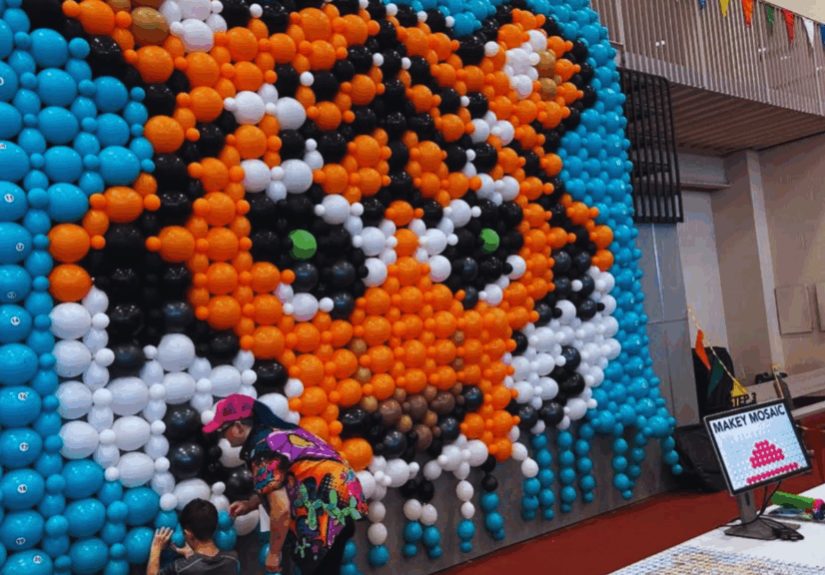
But Rochester’s history with theatrical making goes back further. Past editions have featured Royal Trumpets shooting flames into the air, a fire-breathing dragon art car, kinetic sculptures, robot petting zoos, light-up instruments, rideable couches, K’Nex roller coasters, and enormous collaborative balloon art. This is important because it reveals something essential about the fair: wonder is not treated as an optional extra. It is built into the design.
That is part of Maker Faire’s genius. It understands that spectacle is not the opposite of learning. Sometimes spectacle is the front door to learning. A kid comes for the fireballs and stays for the engineering. An adult wanders in to see giant bubbles and leaves talking about fluid dynamics. Nobody complains.
But The Real Draw Is Hands-On Wonder
For all the flash, the deeper appeal of Maker Faire Rochester is how tactile it is. Visitors can learn to solder, experiment with optics, explore microelectronics, meet makers working in traditional folk arts, watch cosplay come alive, and interact with both cutting-edge tools and older technologies like typewriters and telephones. That last part is especially charming. The fair does not worship novelty for novelty’s sake. It appreciates making as a continuum, from old-school craftsmanship to futuristic fabrication.
That mix keeps the event from becoming predictable. One table may focus on advanced manufacturing and semiconductors. Another may invite you to crochet. Another may involve painting with soil. Another may showcase upcycled art created from discarded media. Another may feature homemade games, handmade crafts, or computing demos that are equal parts educational and gloriously silly.
Take the Interactive Computing Zoo, for instance. It is described as a kind of “petting zoo” for computers, where children are encouraged to touch rather than simply observe. That one detail says everything about the Maker Faire philosophy. Knowledge is not precious glass behind a museum case. It is something you handle, break apart, question, and rebuild.
There is also a strong artistic streak running through the fair. Pop artist Nicole Majewski’s upcycled work, for example, reflects the way Maker Faire treats creative reuse as a legitimate and exciting form of innovation. A discarded object is not trash yet. It might be a sculpture, a tool, a costume element, or the first chapter of some future project you cannot explain to your family without using your hands.
Student STEAM Fest Makes The Event Matter Even More
If the public fair is the main event, the Student STEAM Fest is the proof that Maker Faire Rochester is thinking beyond a single Saturday. The student program gives school groups in grades 3 through 8 an early, dedicated experience built around hands-on learning. Instead of treating education as a side dish, Rochester makes it central.
The listed activity strands tell the story: robotics and drones, manufacturing and engineering, sustainability, the arts, hands-on science, culinary exploration, coding, and general DIY skills that range from jewelry making to home repair. That is a beautifully broad definition of STEAM. It suggests that building a robot and learning practical household skills are not opposites. They are both forms of competence. They both teach agency. They both say, “You can understand how this works, and you can make something too.”
This matters because career inspiration rarely arrives in a neat PowerPoint. More often, it sneaks in through exposure. A student who thinks they are just having fun with circuits may discover a love of electronics. Another may realize that design, fabrication, or advanced manufacturing feels less abstract when a real person is standing there explaining how they got started.
That connection is especially timely in Rochester. The region’s role in the NY SMART I-Corridor tech hub has given local conversations about semiconductors, optics, and advanced manufacturing real urgency. When Maker Faire Rochester features collaborative exhibits tied to optics and microelectronics, it is not just showing off impressive tech. It is connecting community curiosity to real regional opportunity.
The Best Part Is The People
What keeps Maker Faire Rochester from feeling like a trade show with a glue gun addiction is the people. Makers are not there to posture. They are there to explain. The atmosphere encourages conversation, and that changes everything. A fair like this is powered by enthusiasm, not sales pressure. You can ask how something works without feeling like you are interrupting a pitch deck.
That warmth shows up in the event’s recurring crowd favorites too. Cosplay contests bring a playful, fan-driven energy. Big Face Portraits and optical tricks add instant laughter. Vendor booths add a marketplace feel without overwhelming the interactive spirit. Performances help keep the floor lively. There is enough structure to guide the day, but enough chaos to make discovery feel spontaneous.
And that discovery is not age-specific. Kids can be enchanted by bubbles and buttons. Teenagers can gravitate toward robotics, gaming, or cosplay. Adults can appreciate the craftsmanship, the career pathways, the advanced tech, or the pure nostalgic joy of seeing someone obsess over a handmade mechanism for no reason other than it is cool. Which, to be fair, is a very good reason.
Why Events Like Maker Faire Rochester Matter
In a culture that often splits people into fake categories like “creative” and “technical,” Maker Faire Rochester makes a stronger argument: those categories were always flimsy. A good maker is usually both. They solve problems, improvise, iterate, design, test, fail, fix, and try again. That is engineering. That is art. That is education. That is life with slightly more solder.
Maker Faire Rochester also offers something increasingly rare: a public event where curiosity is the main attraction. You do not need to be an expert. You do not need to buy expensive gear. You do not even need a project. You just need the willingness to be interested. In that sense, the fair is quietly radical. It invites people to be participants instead of consumers.
That may be the biggest reason there is more here than hot air. The bubbles pop. The flame bursts vanish. The fair ends at some point and everybody goes home. But the after-effect lasts. Someone goes home wanting to build. Someone signs up for a class. Someone looks up a makerspace membership. Someone decides that science is not scary, art is not frivolous, and technology is not only for “other people.” That is not empty hype. That is impact.
What A Day At Maker Faire Rochester Feels Like
You walk into Maker Faire Rochester expecting a few cool gadgets and maybe one guy in goggles explaining magnets with suspicious enthusiasm. Within minutes, your expectations are in pieces, which feels appropriate for a maker event. The first thing that hits you is not any one exhibit. It is the atmosphere. The room hums with movement, chatter, laughter, motors, music, and the low-key electricity of people who are genuinely delighted to be there.
One minute you are watching a child try to decide whether a robot is adorable or terrifying. The next, you are standing beside a family staring at a bubble so large it looks like it should have its own zip code. Somewhere nearby, a maker is explaining how a project failed three times before it finally worked, and somehow that makes the finished object even more impressive. You can feel the difference between a polished corporate display and a real maker demo almost instantly. One says, “Observe our innovation.” The other says, “Here, try this. It might break, but that is part of the fun.”
As you move through the fair, the categories start to blur in the best possible way. Art behaves like engineering. Engineering behaves like theater. Craft behaves like science. A cosplay display may involve sewing, sculpting, electronics, painting, storytelling, and a heroic amount of hot glue. A computing exhibit may be deeply educational and completely ridiculous at the same time. A hands-on activity that looks simple from ten feet away becomes a lesson in physics, design, patience, and humility once you actually try it.
There is also something wonderfully democratic about the experience. You do not need a special vocabulary to belong there. Nobody quizzes you before letting you admire a beautifully made object or join an activity. People ask questions freely. Makers answer generously. Kids get encouraged instead of shushed. Adults get permission to be curious without pretending they already understand everything. In some corners, you can hear the unmistakable sound of someone saying, “Wait, that is how that works?” which may be the unofficial anthem of the entire event.
The sensory experience is half the magic. Bright costumes flash past serious-looking hardware. You catch the smell of solder, then popcorn, then something that suggests a machine may be doing exactly what it was built to do. People gather around kinetic sculptures, optical illusions, game demos, textile stations, and science activities with the same energy because the common ingredient is participation. Even when you are only watching, you do not feel passive. You feel pulled in.
And then there is the emotional texture of the day. Maker Faire Rochester is joyful without being slick. It feels local in the best sense: proudly weird, deeply welcoming, and full of people who care enough to explain their process, not just display the result. You leave with photos, sure, but also with ideas. Maybe you want to learn to solder. Maybe you want to repair something instead of replacing it. Maybe you want to find a community workshop, sign your kid up for a STEM program, or finally start the project that has been sitting in your head for months.
That is the real experience of Maker Faire Rochester. It does not just entertain you for a few hours. It nudges you toward possibility. It reminds you that making is not reserved for geniuses, artists, or experts with giant tool collections. Making is for curious people. And after a day at this fair, curiosity feels a lot less like a personality trait and a lot more like a plan.
Conclusion
So yes, there is hot air at Maker Faire Rochester. There are bubbles, vortexes, flames, optical tricks, and enough theatrical energy to keep the day lively. But that is only the bait, and the event has never been just about spectacle. The real substance is in the conversations, the hands-on learning, the community spirit, the student experiences, the art, the technology, and the joyful refusal to keep disciplines neatly separated.
Maker Faire Rochester works because it treats creativity as something public, participatory, and worth celebrating. It shows that invention can be playful, education can be noisy, and a family outing can also be a glimpse into the future. In a world full of passive entertainment, this fair offers something better: an invitation to make, learn, and imagine. Not bad for an event that starts with bubbles.