Table of Contents >> Show >> Hide
- What Is a Sea-Inspired Multilayered Table, Exactly?
- Why It Works: The Illusion Is Basically “Ocean Physics” You Can Touch
- How These Tables Are Made (Without Turning This Into a DIY Chemistry Lab)
- Materials Matter: Wood, Glass, and the “Sustainable Luxury” Conversation
- Styling Tips: How to Make an Ocean Depths Table Look Like “Art” (Not “Theme Restaurant”)
- Living With It: Maintenance, Safety, and Everyday Practicality
- Why People Want One: The Psychology of Staring Into the Deep
- Buying Guide: What to Look For in an Ocean-Inspired Coffee Table
- Experience Section: What It Feels Like to Live With an “Ocean Depths” Table (Real-World Moments)
- Conclusion: A Little Ocean, A Lot of Wonder
Some coffee tables are here to hold your mug. This one is here to make you question your life choiceslike why you ever settled for a flat surface when you could be staring into an abyss.
Imagine leaning in to set down your tea and suddenly feeling like you’re hovering over a continental shelf, watching the water turn from bright turquoise to a deep, inky blue. It’s furniture, sure.
But it’s also a tiny, hypnotic “submarine window” for your living roomminus the pressure of being 11,000 meters underwater and realizing you forgot snacks.
Sea-inspired multilayered tables (often compared to a 3D bathymetric mapaka the topography of the ocean floor) blend design, optical illusion, and a little science to create something that feels alive.
They’re the kind of piece that makes visitors say, “Wait… is that real?” and makes you say, “Please don’t put your keys on the trench.”
What Is a Sea-Inspired Multilayered Table, Exactly?
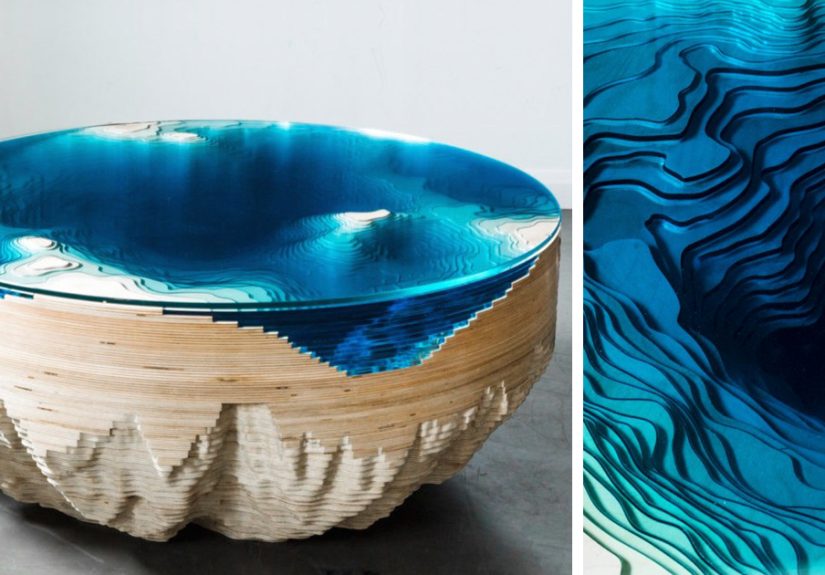
A sea-inspired multilayered table is designed to look like you’re peering into ocean depths. Instead of a single slab of wood or a plain glass top, the “water” effect is built from stacked layersoften wood contours and tinted glass (or a similar transparent medium)arranged so the color deepens as the layers descend.
One of the most recognizable examples is the Abyss-style concept popularized by designer Christopher Duffy (Duffy London), where precision-cut layers of wood and glass create a sculptural cross-section of the sea.
The top looks like a calm ocean surface; the interior reveals a dramatic drop-off with increasingly darker blues that mimic how water visually changes with depth.
The result? A functional coffee table that behaves like an art object. You can place a book on it. You can also lose 12 minutes staring into it like a cat watching a ceiling fan.
Why It Works: The Illusion Is Basically “Ocean Physics” You Can Touch
Depth Is a Color Story (Not Just a Distance Problem)
In real oceans, water appears bluer because it absorbs more of the red end of the light spectrum, leaving blue light to dominate what reaches your eyes. As water gets deeper, less light returns from below, and the colors look darker and more mysterious.
That’s why shallow shorelines can look bright and tropical while deep open water can look almost navylike the ocean put on formalwear.
Multilayered ocean tables borrow that same visual logic: as you stack tinted material (like glass) in thicker “depth,” the color appears richer and darker. The table doesn’t need to move. Light does all the heavy lifting.
Layers Turn a Flat Tabletop Into a 3D Bathymetric Map
Bathymetry is the ocean’s version of a mountain mapexcept the “mountains” are underwater ridges, shelves, valleys, and trenches. Designers take inspiration from these forms because they naturally create drama:
a gentle continental shelf, a sudden slope, a deep basin. In other words, the ocean floor has better curves than most modern furniture.
In the best ocean depth tables, the contours feel believable: the shallows look expansive, the drop-offs feel steep, and the deepest section pulls your eye like a visual whirlpool.
Even if you don’t know what a submarine canyon is, your brain recognizes “deep” when it sees one.
How These Tables Are Made (Without Turning This Into a DIY Chemistry Lab)
High-end sea-inspired multilayered tables typically rely on precision manufacturingthink carefully cut layers, tight alignment, and an optical setup that looks effortless only because it isn’t.
A common approach involves:
- Contour layers that create the ocean-floor topography (often sculpted wood or similar structural materials).
- Transparent “depth” layers (like tinted glass) that visually intensify color as thickness increases.
- Careful assembly so seams don’t ruin the illusionbecause one misalignment can turn “mystical ocean” into “stack of blue stuff.”
In some collections, variations include circular or rectangular formats, different finishes, and even luxury material options like marble editions that reimagine the “seabed” as stone.
The point isn’t just to decorate a roomit’s to stage an experience: depth, light, and perception, served with your cappuccino.
You’ll also see ocean-inspired tables made with cast materials (like resin) in the broader design world. Those can look stunning, but they require careful handling and safety practices and are best left to trained adults or professionals.
For this article, we’ll keep the focus on the design principles and the real-world experience of living with a “window into the sea.”
Materials Matter: Wood, Glass, and the “Sustainable Luxury” Conversation
Wood: Warmth, Structure, and a Seabed That Feels Real
Wood does something important here: it keeps the piece from feeling cold or overly futuristic. The ocean is dramatic, yesbut it’s also natural.
Wood grain gives the “seabed” an organic identity, and layered contours make it feel like geology rather than decoration.
Many premium makers emphasize responsibly sourced wood. If you see “FSC-certified” mentioned, that’s a sign the wood comes from a chain of custody designed to support responsible forest management.
It’s not a magic wandno label solves every supply-chain issuebut it’s a meaningful signal when you’re buying statement furniture meant to last.
Glass: The Real Star of the Depth Effect
Glass isn’t just “clear stuff.” In layered ocean tables, it’s a depth engine. Stack it, tint it, shape it, and suddenly your eyes interpret thickness as distance.
The deeper the layers, the darker the blues appearlike you’re looking through water that keeps going.
A well-designed piece will also consider practical realities: edge finishing, scratch resistance, stability, and how the table behaves under daily use.
Because if a table invites you to stare into the abyss, it should also survive a weekend of snacks.
Styling Tips: How to Make an Ocean Depths Table Look Like “Art” (Not “Theme Restaurant”)
Ocean-inspired furniture can be a design flex or a design trap. The difference is usually restraint.
The table is already doing the mostin a good wayso the room doesn’t need to shout “BEACH!” with a megaphone.
Let the Table Be the Main Character
- Keep nearby colors calm: whites, sand tones, charcoals, warm woods, muted blues, and soft greens.
- Avoid over-matching: if everything is nautical, the table loses its wow factor and becomes a prop.
- Use texture, not gimmicks: linen, wool, boucle, rattan, matte ceramicsthese support the “natural” feel without turning your home into a souvenir shop.
Lighting Is the Secret Upgrade
This kind of table is basically a light show that doesn’t know it’s a light show. Soft, angled lighting (like a floor lamp or warm overhead light) can make the layered blues look deeper and more dimensional.
Strong glare can flatten the effect, so if you can, position it where reflections don’t dominate the surface.
Pro tip: if you want maximum “ocean window” vibes, look at it at night with warm ambient lighting. It can feel like the abyss is glowing from within.
Which is cool. Also slightly unsettling. In the best way.
Living With It: Maintenance, Safety, and Everyday Practicality
Cleaning Without Destroying the Magic
Treat the top like you would quality glass: gentle, non-abrasive cleaning methods, and no gritty cloths that can leave micro-scratches.
Small scratches are the enemy of optical claritybecause the illusion depends on clean light paths.
- Use coasters (yes, even for waterespecially for water, because irony).
- Lift objects instead of dragging them across the surface.
- Keep sharp items away from the top edge and corners.
Glass Safety: Respect the Material
Most modern glass tabletops are designed with safety in mind, often using tempered glass.
Still, glass can break under the wrong conditionsespecially if it’s scratched, impacted, or stressed. The simplest rule is also the best: don’t treat it like a workbench.
If you have kids or energetic pets, consider placement and supervision the same way you would with any glass furniture.
The goal isn’t to fear the table. The goal is to enjoy it without giving your living room a surprise “dramatic shattering” subplot.
Why People Want One: The Psychology of Staring Into the Deep
There’s a reason ocean imagery shows up everywherefrom spa murals to phone wallpapers. Humans find water soothing, and depth especially fascinating.
A multilayered ocean table captures that pull in a physical object: you get calm at the surface and mystery underneath.
It’s also a kind of biophilic designbringing nature-inspired forms and patterns indoors to support comfort and visual interest.
And unlike a fish tank, it doesn’t require feeding schedules or awkward conversations about why the goldfish looks judgmental.
In social settings, it becomes a conversation magnet. People lean in. People ask questions. People forget they came over to talk about something else entirely.
(“So how’s work?” “Amazing. But have you noticed how the trench gets darker right here?”)
Buying Guide: What to Look For in an Ocean-Inspired Coffee Table
If you’re shopping for a sea-inspired multilayered tablewhether it’s a luxury design piece or a contemporary interpretationfocus on the features that protect the illusion and the investment.
Questions That Separate “Wow” From “Why Did I Buy This?”
- What is the “depth” material? Tinted glass, acrylic, or other mediums behave differently in clarity and durability.
- How is it assembled? Precision alignment matters. Seams, bubbles, and uneven layers can weaken the effect.
- How stable is the base? Deep designs can be visually “heavy.” The structure should be physically confident too.
- Is the wood responsibly sourced? Look for credible sustainability signals when available.
- What’s the care guidance? A good maker will explain cleaning, handling, and placement clearly.
A sea depths table is a statement piece. But the best statement is the one you don’t regret after the novelty wears off.
You want something that still feels magical in month twelvewhen you’ve stopped taking photos of it and started actually living with it.
Experience Section: What It Feels Like to Live With an “Ocean Depths” Table (Real-World Moments)
The first experience most people report isn’t “I love the craftsmanship” or “the materials are exquisite.” It’s simpler: they lean in.
A sea-inspired multilayered table triggers the same reflex as standing near a cliff overlook. You look down because your brain wants to understand the drop.
And because it’s indoors, you can do it in socks while holding snacks, whichif we’re being honestmakes it superior to most actual cliffs.
In daylight, the table feels crisp and architectural. The layered contours read like a topographic sculpture, and you notice the transitions:
the shallows, the slope, the sudden plunge. You’ll catch yourself walking around it the way you’d circle a museum piece, shifting angles to see how the color changes.
Visitors do this too. They pretend they’re “just looking,” but then they move their head side to side like they’re calibrating a submarine periscope.
At night, it becomes a mood device. With warm ambient lighting, the “ocean” looks deeper and more cinematic, and the darkest section can feel almost bottomless.
This is usually when someone says, “Okay, that’s actually wild,” and another person immediately tries to take a photo that doesn’t capture the effect at all.
(It’s not their fault. Depth illusions are famously bad at cooperating with smartphone cameras.)
Daily life adds its own chapter. You learn quickly that fingerprints show up on glossy surfaces, and you start keeping a soft cloth nearbynot because you’re obsessive,
but because you want the table to keep doing its thing. Coasters become less of a “rule” and more of a “respect offering.”
If you’ve ever owned a black car, you know the vibe: beautiful, dramatic, and constantly asking, “Could you not?”
The table also changes how people gather. Instead of everyone spreading out, there’s a natural clustering around it.
Someone points at the “deepest” area and jokes about the Mariana Trench. Someone else wonders out loud whether the shapes were inspired by real seafloor maps.
Even people who don’t care about furniture suddenly care about furniture, because the object is doing more than sitting thereit’s telling a story.
If you’re a design-minded person, the experience becomes strangely emotional. Not in a “weep openly into your throw pillow” way, but in a quiet “this makes my space feel special” way.
A sea-inspired table can act like a micro-vacation: a reminder of coastlines, boat rides, aquariums, or that one moment you stood on a pier and watched the water shift colors.
It’s a physical cue for calmsomething you notice while waiting for your laptop to update or while listening to someone explain fantasy football.
Over time, the wow factor doesn’t disappear; it evolves. The table stops being a novelty and becomes a familiar ritual.
You notice the way the “depth” looks different from different seats. You appreciate how it anchors the room without needing extra decoration.
And every once in a whileusually when the lighting is just rightyou catch yourself staring down again, thinking,
“Yep. Still cool. Still an abyss. Still not putting my keys on the trench.”
That’s the real magic of an ocean depths coffee table: it keeps rewarding attention. It’s functional art that doesn’t demand constant admiration,
but quietly offers itwhenever you’re in the mood to take a small mental dive without leaving your living room.