Table of Contents >> Show >> Hide
- Why Do These Bizarre Board Games Exist?
- The Top 10 Most Bizarre And Shocking Board Games
- 10. Los Mampfos – Donkey Digestive Guessing Game
- 9. Snifty Snakes – No Hands, Just Nose
- 8. Ugg-Tect – Communicating With Inflatable Clubs
- 7. Crows Overkill – Romance, Geishas, and Strategic Bird Murder
- 6. Falling – A Real-Time Race to Hit the Ground Last
- 5. Kittens in a Blender – Cute Art, Horrible Title
- 4. Prison Bitch – Cardboard Prison Power Struggle
- 3. Serial Killer: The Board Game – Murder Tour of the United States
- 2. Crack Whore – A Solo Dice Game About Escaping the Streets
- 1. Public Assistance – “Why Bother Working for a Living?”
- Are These Shocking Board Games Worth Playing?
- Player Experiences With Bizarre and Shocking Board Games
When most people think of board games, they picture cozy nights with Monopoly,
Scrabble, or maybe a tense round of Catan. But somewhere far away from
rainbows, family-friendly fun, and wholesome box art, there’s a shadowy corner of the
hobby filled with bizarre, controversial, and downright shocking board games that
somehow still made it onto store shelves.
Over the last few decades, the board game boom has produced thousands of titles a year.
Hidden among them are games about welfare abuse, serial killers, prison brutality,
and… donkeys pooping colored wooden disks. These are the games that make you look at
the box, look back at your life choices, and quietly ask, “Who thought this was a good idea?”
Inspired by the original Listverse rundown of shocking board games and backed up by
board game databases, newspaper archives, and hobby discussions, this list tours ten
real games that push taste, theme, and common sense to their absolute limits.
Some are dark satire, some are gross-out party fodder, and some are just so weird
that they loop back around to fascinating.
Why Do These Bizarre Board Games Exist?
Before we dive into the list, it helps to understand why these games were made in the
first place. In many cases, designers were chasing one of three things:
- Shock value and free publicity – A game called Kittens in a Blender markets itself. Outrage is basically a built-in marketing budget.
- Satire and social commentary – Games like Public Assistance and Ghettopoly (a related infamous title) use caricature and stereotypes to “say something” about politics or culture, though critics argue they mostly punch down.
- Novelty for a crowded market – Thousands of games release each year. If your design involves inflatable clubs, prison hierarchies, or body bags, people will at least remember it.
Whether you see them as clever commentary, edgy humor, or simply bad ideas in cardboard form,
these strange board games prove the hobby can go to some very unexpected places.
The Top 10 Most Bizarre And Shocking Board Games
10. Los Mampfos – Donkey Digestive Guessing Game
Let’s start on the “lightly disgusting” end of bizarre. Los Mampfos is a kids’
game about donkeys, food, and poop. Published in 2006 by French company Gigamic and
designed by Rüdiger and Maya Dorn, the game has players moving chunky wooden donkeys
around a track and “feeding” them colorful wooden disks representing different foods.
The punchline comes during scoring: players lift the donkey’s tail and watch the pieces
tumble out, then collect poop tokens based on what they predicted the donkey “ate” the most.
It’s part memory game, part betting, and part giggle-fest for children who think bodily
functions are the peak of comedy (which, to be fair, they often are).
Despite its toilet humor, Los Mampfos was actually well received and even
nominated for Germany’s prestigious Kinderspiel des Jahres (Children’s Game of the Year),
proving that you can make a surprisingly solid family game out of livestock and poop.
9. Snifty Snakes – No Hands, Just Nose
Released in the 1970s, Snifty Snakes looks like something invented at a party
when someone said, “What if we used our faces instead of our hands?” Players wear plastic
glasses with a long, wobbly snake attached to the bridge of the nose. The board is raised
and filled with holes; your job is to nudge cones into those holes using only your snake
“nose.”
The result is an unintentional slapstick show. Everyone leans over the table, whipping
their heads around while the plastic snakes flop everywhere. Officially it’s a dexterity
game; unofficially it’s a test of who can laugh hardest while trying not to concuss
themselves on the board edge.
Today, Snifty Snakes is mostly a collector’s oddity, but it foreshadowed the wave of
modern party games that force you to wear ridiculous gear and sacrifice dignity for laughs.
8. Ugg-Tect – Communicating With Inflatable Clubs
If you’ve ever wanted to yell nonsense at your friends and then whack them on the head
with a plastic club, Ugg-Tect is here for you. This 2009 game casts players as
Stone Age architects trying to communicate how to build a structure using only primitive
grunts and gestures.
One player, the “architect,” sees a pattern built from colored blocks. They must guide
their team to recreate it by shouting simple syllables and smacking teammates with an
inflatable club to signal “yes” or “no.” It’s loud, chaotic, and intentionally ridiculous.
Underneath the caveman slapstick is a clever cooperative puzzle about communication and
miscommunication. But let’s be honest: people mostly remember the clubs.
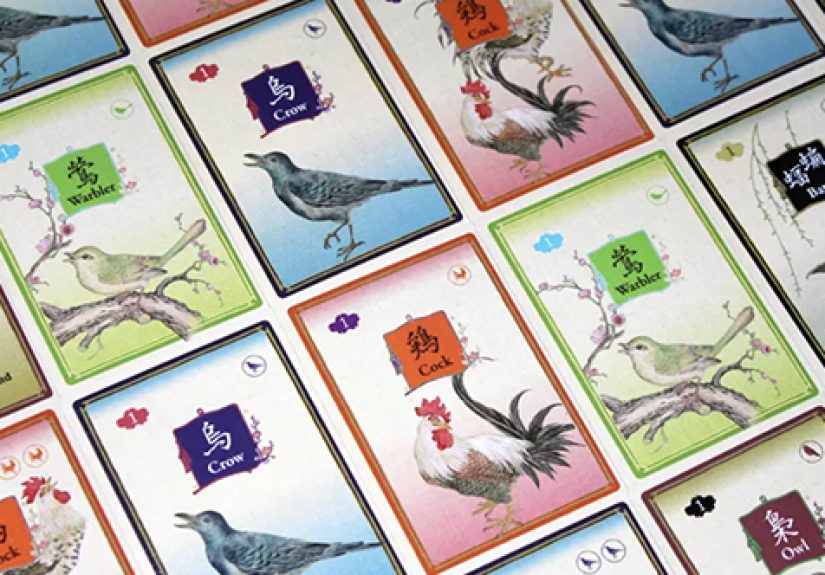
7. Crows Overkill – Romance, Geishas, and Strategic Bird Murder
With the poetic original title roughly translating to
“I would kill all the crows in the world to sleep with you in the morning,”
Crows Overkill is a Japanese card game that blends romance, folklore, and
some pretty dark imagery.
Players are clients in a red-light district, trying to stay hidden with their companions
for as long as possible. Crows act as tattletales: if a crow lands on your window and
“caws,” you’re discovered and eliminated. Your only hope is to play cards that kill or
redirect the birds to other players.
Mechanically, it’s a ruthless elimination game about timing and hand management. Thematically,
it dances on a fine line between romantic melancholy and “did we really need to kill this
many birds for date night?”
6. Falling – A Real-Time Race to Hit the Ground Last
Falling by Cheapass Games is minimalist, fast, and absurdly grim. The premise:
everyone is falling to their death. No one survives. Your only objective is to be the last
one to hit the ground.
One player acts as the dealer, flipping cards in real time to each falling player. Other
cards speed up or slow down people’s descent, redirect cards, or otherwise interfere with
the inevitable impact. There are no turns; everything happens at once, creating frantic
chaos as everyone tries to delay their doom by a few precious seconds.
It’s a strange blend of dark comedy and ultra-light gameplay. The theme is morbid, but
the tone is tongue-in-cheek, poking fun at our tendency to compete even when the outcome
is universally terrible.
5. Kittens in a Blender – Cute Art, Horrible Title
If there were awards for “most offensive title hiding a surprisingly OK game,”
Kittens in a Blender would be a top contender. Published in 2011, this card game
asks players to save their own kittens from a blender while not being overly concerned
about everyone else’s.
The core board is divided into three zones: the countertop (safe), the box (safer),
and the blender (very much not safe). Players move kitten cards around and choose
when to hit “blend,” which scores points for safely rescued cats and subtracts points
for any of your adorable furballs that get turned into metaphorical smoothies.
The artwork leans hard into big eyes and bright colors, which takes some of the edge
off the premise. A portion of proceeds has been donated to animal charities in the
past, giving players a little moral cushioning. Still, this is not the game you pull
out when your animal-loving aunt asks if you “have anything cute.”
4. Prison Bitch – Cardboard Prison Power Struggle
We’re now firmly in the “absolutely not for family game night” category.
Prison Bitch is a self-published card game about life inside a men’s prison,
using crude humor and explicit language to depict gangs, intimidation, and coercion.
Players compete to build reputation by recruiting followers, attacking rivals, and
maintaining status in a brutal hierarchy. The mechanics borrow from take-that card games,
where the joy (or discomfort) comes from sabotaging others and surviving constant attacks.
The game was reportedly banned from at least one major gaming convention, and copies are
hard to find. Even within the hobby, it’s often cited as an example of how edgy satire
can easily tip into something that feels mean-spirited rather than insightful.
3. Serial Killer: The Board Game – Murder Tour of the United States
Rare, controversial, and often described as the “holy grail” of banned board games among
collectors, Serial Killer: The Board Game takes the true-crime fascination to a
deeply uncomfortable place. Players travel across a map of the United States committing
murders, collecting victims, and trying to avoid being caught in states that still have
the death penalty.
The game reportedly came packaged in a body bag-style container and came with tokens
representing victims. Its dark humor and gleeful embrace of violence earned it bans in
multiple places and a permanent spot in the “what were they thinking?” hall of fame.
From a design perspective, Serial Killer mirrors classic roll-and-move travel games.
What sets it apart is how it trivializes real-world horror. It’s one of the clearest
examples of how theme can completely change the emotional impact of otherwise basic
mechanics.
2. Crack Whore – A Solo Dice Game About Escaping the Streets
With a title that is offensive even by shock-game standards,
Crack Whore is a solitaire dice game in which you play a sex worker
trying to earn enough money to escape street life. The path to “winning” involves
surviving abusive pimps, dangerous clients, drugs, disease, and random violence.
Mechanically, the game is about pushing your luck and managing limited resources.
Thematically, it turns a very real, very painful set of social issues into something
that risks feeling like a cruel joke which is exactly why it has generated so much
criticism in hobby circles.
In discussions among board gamers, Crack Whore is often referenced not because
it’s widely played (it’s extremely obscure) but because it represents a kind of
boundary-testing that most modern publishers would never touch.
1. Public Assistance – “Why Bother Working for a Living?”
Topping the list is Public Assistance: Why Bother Working for a Living?, a
1980 board game that turns welfare and social support into the butt of the joke.
Players move around the board collecting government benefits while trying to dodge
the “working person’s burden” of taxes and bills.
The game was marketed as a sarcastic critique of welfare programs, but many people saw
it as a cruel caricature of poor and marginalized communities. It quickly sparked boycotts,
angry op-eds, and political debates. Some retailers pulled it from shelves, and it became
a symbol of the culture wars of its era.
Today, surviving copies are collector’s items. From an historical perspective,
Public Assistance is fascinating as a time capsule of 1980s political attitudes.
As a “fun” game to bring to your next get-together, though, it’s a surefire way to turn
game night into a heated argument about public policy.
Are These Shocking Board Games Worth Playing?
So, should you actually play any of these bizarre board games, or just read about them
and quietly move on with your life?
From a purely historical or collector standpoint, many of these titles are fascinating.
They show how designers experimented with taboo topics, satirical commentary, and
provocative marketing long before the modern wave of “dark” party games. Games like
Los Mampfos, Ugg-Tect, and even Falling can still deliver genuinely fun,
if strange, experiences without leaning too hard into cruelty.
On the other hand, games centered on racial stereotypes, sexual violence, or real-world
tragedy raise valid ethical questions. They walk a thin line between social commentary
and exploitation, and whether they belong at a modern gaming table depends heavily on
the group, the context, and everyone’s comfort level.
If you’re curious about bizarre board games, the safest route is often to try the
less harmful, more absurd entries: the donkey poop, inflatable clubs, and falling
from the sky are plenty weird without dragging real peoples’ suffering into the mix.
Player Experiences With Bizarre and Shocking Board Games
Reading about these games is one thing; actually sitting down to play them is a completely
different experience. People who have tried them often describe a strange emotional arc:
curiosity, awkward laughter, and then a long moment of “Do we really want to keep going?”
With something like Los Mampfos, the experience is mostly pure silliness.
Kids and adults alike end up laughing as the donkey “poops” out the colored disks on the
table. The worst ethical dilemma you’ll face is whether you’re okay with your six-year-old
shouting, “Yes! I got the most poop!” in front of the grandparents. As odd as it sounds,
the game feels more like a cartoon than anything genuinely shocking.
Ugg-Tect and similar party games often become instant stories people retell later.
Someone inevitably commits to the role a little too hard, shouting caveman noises and
swinging the inflatable club with Oscar-level intensity. These games live or die on
the group’s willingness to be goofy. The rules are simple; the fun comes from how far
people are willing to go to “perform” the theme.
The darker games feel radically different at the table. Stories from groups who have
tracked down Falling, Serial Killer, or Public Assistance often mention
a kind of emotional whiplash. At first there’s novelty: “Wow, I can’t believe this
exists.” After a few turns, that shock either evolves into morbid humor or just quiet
discomfort, depending on the people playing.
One common reaction is that the mechanical gameplay is often fairly ordinary. Under
the extreme themes, you still find familiar structures: roll-and-move tracks, card
draws, and basic resource management. The theme does almost all the heavy lifting,
which makes the experience feel more like reading an edgy comic strip than exploring
a deeply designed strategy game.
For some gaming groups, these titles become “once and done” curiosities. They get
played exactly one time as a kind of dare, then go back on the shelf as conversation
pieces. People might remember the shock factor, a few outrageous cards, or the way
someone at the table refused to participate in a specific action, but they rarely
become regular staples of game night.
Others prefer to keep their experimentation in the realm of quirky rather than cruel.
They gravitate toward bizarre games that are weird without targeting vulnerable groups:
games about donkeys, nonsense languages, or abstract absurdity. There’s plenty of room
in modern board gaming to be wild, surreal, and even darkly funny without leaning on
harmful stereotypes or real-world trauma.
If you’re thinking about introducing one of these controversial games to your own group,
the best “pro tip” is simple: talk first. Give people a clear idea of the theme and tone,
and make it clear that it’s completely fine to say, “No thanks, I’ll sit this one out.”
A good board game table should feel safe and welcoming, even when the box art looks like
it escaped from the world’s strangest thrift store.
Ultimately, bizarre and shocking board games are like any other extreme media: they invite
conversation about taste, satire, and where we draw the line between “edgy” and “too far.”
Whether you decide to collect them, try them once, or just read about them from a safe
distance, they’re proof that the humble board game can be a surprisingly powerful mirror
for the culture that creates it.