Table of Contents >> Show >> Hide
- The Brief: One Home, Two Levels, Three Personalities (Parent, Kid, Cat)
- The Architectural Plot Twist: A Spiral Staircase That Acts Like a Sculptural Anchor
- Material Magic: Baltic Birch Plywood, But Make It Paris
- White Floors, Warm Wood: The Color Palette That Feels Bigger Than It Is
- A Sliding Door That Isn’t Just a Door: It’s a Family Mood Regulator
- Cat-Centric Design That Doesn’t Look Like a Pet Store Aisle
- Pegboard Walls: Flexible Storage That Grows Up Gracefully
- The Breakfast Nook: Tiny Moment, Big Lifestyle Upgrade
- 10 Design Moves You Can Steal (Even If You Live Nowhere Near the 15th Arrondissement)
- Common Mistakes to Avoid (So Your “Très Chic” Doesn’t Become “Très Chaos”)
- Why This Apartment Feels So Parisian (Without Drowning in Clichés)
- Experiences: Living “Très Chic” With a Young Family (and Yes, a Cat) of Real-Life Lessons
- Conclusion: Très Chic Is a Strategy, Not a Vibe
Paris apartments have a reputation: gorgeous bones, charming quirks, and storage that seems to have been designed by someone who has never owned a vacuum.
So when a young couple (with a baby on the way) decided their beloved cat, Sacha, deserved a home as thoughtfully designed as any human roommate,
they didn’t just “make it work.” They went full geniuspairing Parisian cool with family-proof practicality in a duplex renovation by SABO project.
The result is the kind of place that looks effortlessly chic (because Paris), but is secretly doing Olympic-level multitasking:
zones that flex, built-ins that swallow clutter, surfaces that survive real life, and cat-sized portals that make the whole apartment feel like a stylish maze
made for a small human and a small tiger with whiskers. If “form meets function” had a French passport, it would live here.
The Brief: One Home, Two Levels, Three Personalities (Parent, Kid, Cat)
The headline move is big: the renovation combined two identical apartmentsone stacked over the otherinto a single duplex.
That matters because it changes the entire strategy. Instead of squeezing every function into a single plane, the designers could separate “day life” from “night life.”
Translation: the upper level becomes a bright, social, open-plan zone (kitchen, dining, living), while bedrooms settle downstairs for calm and privacy.
The apartment’s total footprint lands at a roomy-for-Paris size, but the philosophy still screams small-space discipline:
every inch has a job, every surface has a reason, and every “pretty” choice doubles as a “practical” choice.
It’s not minimalism for Instagramit’s minimalism so you can find the diaper cream at 2 a.m. without turning on every light and summoning the cat.
The Architectural Plot Twist: A Spiral Staircase That Acts Like a Sculptural Anchor
Open plans can sometimes feel like one big “everything room.” This apartment avoids that with a dramatic organizing element:
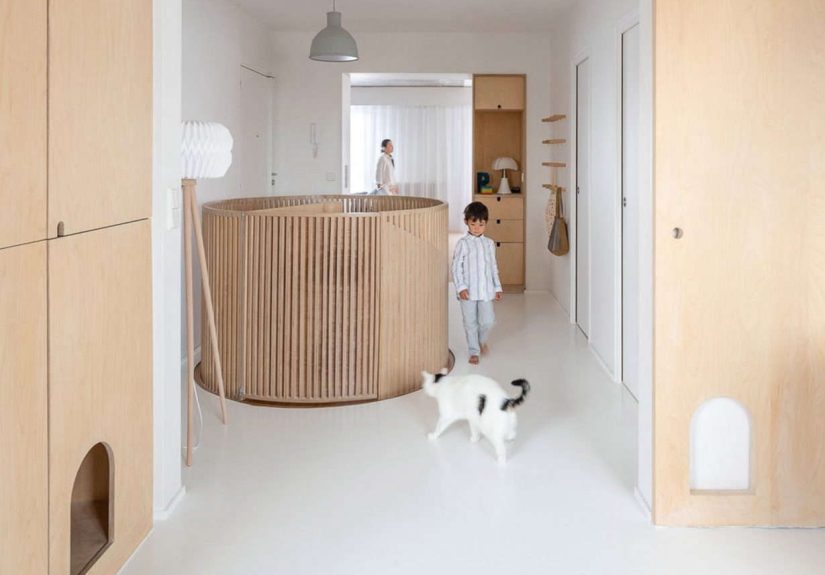
a spiral staircase wrapped in a rounded enclosure. It’s functional, yes, but it also works like a visual punctuation mark.
You can orient yourself instantlyentry, kitchen, livingbecause the stair volume quietly tells your brain where “center” is.
There’s also a surprisingly smart detail: a curved door that keeps Sacha upstairs when needed. That’s not just cuteit’s a real-life hack.
Cats and open staircases are basically a parkour invitation. A door gives the family control during cooking, cleaning, guests, or that classic moment when
you’re trying to get out the door and your cat suddenly becomes a furry escape artist with opinions.
Material Magic: Baltic Birch Plywood, But Make It Paris
Let’s talk about the star: Baltic birch plywood built-ins. If you’re thinking “plywood = temporary,” this apartment is here to correct you, politely,
with Parisian authority. The plywood runs through nearly every room, creating cohesionlike a visual “through-line” that makes the home feel calm and intentional.
The key is restraint and finish. A light satin protective coat keeps the wood looking natural rather than glossy-and-gymnasium.
Cutout handles avoid fussy hardware and keep the cabinetry feeling clean. The vibe is humble material, elevated execution:
the kind of design move that whispers “custom” instead of shouting “expensive.”
This strategy also happens to be family-friendly. Wood has warmth (important when you’re staring at toys that appear out of thin air),
and plywood is forgiving. It’s not precious marble that makes you panic when a sippy cup hits the floor.
It’s a durable, modern material palette that invites living.
White Floors, Warm Wood: The Color Palette That Feels Bigger Than It Is
Upstairs, the floors are a clean white poured-in-place resin, with one deliberate exception:
the living area is delineated by birch plywood flooring. That contrast does three useful things at once:
- It bounces light (white resin is basically a brightness amplifier).
- It zones the space without walls (wood “carpets” the living area visually).
- It keeps the palette simple so furniture and daily life don’t make the room feel chaotic.
Downstairs, traditional oak flooring brings warmth and a softer, quieter moodperfect for bedrooms.
It’s a subtle but effective “day/night” shift: bright and energetic upstairs, grounded and restful below.
A Sliding Door That Isn’t Just a Door: It’s a Family Mood Regulator
One of the smartest moves in the upper level is a large sliding door that can partition the kitchen from the living/dining area.
In a family home, kitchens are loud: clattering pans, blender drama, and smells that linger like they pay rent.
A sliding door gives flexibilityopen when you want flow, closed when you want calm.
Bonus: it’s a stealthy way to manage visual clutter. Even tidy people have messy moments.
A door lets you “reset” the living space instantly when guests arrive or when you’d rather not display your countertop “collection” of baby bottles.
Cat-Centric Design That Doesn’t Look Like a Pet Store Aisle
Here’s where this apartment becomes legendary: feline-sized pass-throughs carved into multiple walls on the first floor.
It’s whimsical, surebut it’s also practical. Cats are territorial and routine-driven.
When they can move smoothly through a home, they’re less likely to treat your sofa like a therapy journal.
There’s also an arched opening that discreetly houses the litter boxan elegant solution to an unglamorous necessity.
It keeps the box accessible to the cat while visually minimizing “litter box energy” for humans.
And yes, that is a real interior design term now. You’re welcome.
If you want to steal this idea without cutting holes in your walls, you can borrow the principle:
give cats vertical territory and a dedicated perch. Window perches are popular for a reasoncats love a vantage point,
and they take up almost no floor space. Pair that with a scratch-friendly surface (like a small wall-mounted post),
and you’ve met your cat’s needs without turning your living room into a jungle gym. (Unless you want to. No judgment.)
Pegboard Walls: Flexible Storage That Grows Up Gracefully
Pegboard appears in the living room, entry, and master bedroom as a flexible storage and display system.
The brilliance is that pegboard doesn’t lock you into one arrangement.
Today it’s baby essentials; tomorrow it’s keys, hats, and the mysterious tape measure you can never find; next year it’s art supplies and homework gear.
Pegboard is also a “clutter translator.” Instead of letting small objects pile up horizontally (the classic “doom counter”),
it lifts them vertically onto the wall. Suddenly the same stuff reads as organizedalmost intentionaleven if your life is not.
The Breakfast Nook: Tiny Moment, Big Lifestyle Upgrade
Opposite the kitchen, a breakfast nook overlooks the neighborhoodproof that you don’t need a big dining room to have a daily ritual.
In family homes, rituals are everything. A small, consistent place for morning coffee and quick meals becomes the calm center of the day.
If your apartment can’t fit a full table, a banquette is a smart swap:
it hugs walls, saves space, and can hide storage underneath for linens, toys, or the entertaining supplies you swear you use “all the time.”
It’s the kind of move that feels grown-up while quietly solving the “where do we put everything?” problem.
10 Design Moves You Can Steal (Even If You Live Nowhere Near the 15th Arrondissement)
- Unify materials across rooms (one wood tone, one metal finish, fewer visual “arguments”).
- Zone with flooring or rugs instead of walls to keep an open plan feeling spacious.
- Add a sliding door to create “privacy on demand” (kitchen, office nook, kid zone).
- Go custom where it counts: entry storage, kitchen pantry wall, bedroom closets.
- Use pegboard for adaptable storage that changes as your family changes.
- Hide the litter box in a ventilated cabinet or discreet nook so it’s accessible but not center stage.
- Give pets vertical space (perches, shelves, a tall cat tree that looks like furniture).
- Choose forgiving finishes (wipeable paint, durable flooring, textiles that don’t fear crumbs).
- Keep sightlines clear from entry to living area so the home feels larger and calmer.
- Design for routines: a drop zone for bags, a breakfast spot, a “reset” cabinet for quick cleanup.
Common Mistakes to Avoid (So Your “Très Chic” Doesn’t Become “Très Chaos”)
1) Treating open plan as permission to skip storage
Open plan looks great in photos. In real life, it’s a spotlight. Without storage, everything becomes visibleand therefore stressful.
Build in more storage than you think you need, especially near the entry and kitchen.
2) Picking “pretty” materials that can’t survive actual living
If you have a young family (or a cat who believes gravity is a suggestion), durability is style.
Choose finishes you can wipe, floors you don’t baby, and fabrics that won’t collapse emotionally at the first spill.
3) Forgetting the pet logistics
Cat-friendly design isn’t just about cute shelves. It’s about placement:
keep food and litter away from high-traffic zones, provide scratching outlets, and create calm hiding spots.
A happy cat is less likely to redecorate your curtains with their claws.
Why This Apartment Feels So Parisian (Without Drowning in Clichés)
The most Parisian thing here isn’t a chandelier or ornate moldingit’s confidence.
The design makes bold choices (resin floors, plywood everywhere, cat portals) but keeps the overall palette disciplined.
That balance is the secret sauce: playful details inside a calm framework.
In many modern Paris renovations, you’ll see the same goal: preserve character, but edit for contemporary life.
Whether that means highlighting original structure, introducing sculptural elements, or rethinking storage,
the best projects respect the past while refusing to live like it’s still 1890.
Experiences: Living “Très Chic” With a Young Family (and Yes, a Cat) of Real-Life Lessons
If you’ve ever tried to make a small apartment feel “calm,” while simultaneously housing a tiny human and a cat with the confidence of a lion,
you already know the truth: the home isn’t just a backdrop. It’s a system. And when the system works, life feels easier in a way that’s hard to explain
until you’ve lived the opposite.
The first thing you notice in a well-designed family apartment is how it handles mornings. You wake up groggy, you’re negotiating breakfast,
and the cat is doing that thing where it stares into your soul as if you’re late for an appointment it scheduled. A dedicated breakfast nookno matter how small
turns chaos into routine. It becomes the “default setting” for your day: coffee here, quick toast there, a tiny pause where everyone (including the cat)
knows where to be.
Then comes the second revelation: doors are emotional tools. A sliding door that closes off the kitchen isn’t just about soundit’s about sanity.
Maybe one parent is cooking while the other is trying to keep a baby calm. Maybe you’re on a work call. Maybe the kitchen looks like a science experiment.
With one smooth slide, the living area becomes peaceful again. It’s not hiding; it’s managing visibility, which is basically interior design’s version of
“choosing your battles.”
Storage systems start to matter in oddly personal ways. Pegboard, for example, feels like a cheat code because it adapts faster than your life changes.
In one season it’s tiny hats, bibs, and a ridiculous amount of little socks. In another, it’s school supplies. In another, it’s keys, sunglasses,
and that tape you swear is “temporary” but has been “temporary” for two years. The best part? Pegboard makes everyday objects look organized without requiring
you to become an organized person overnight. It’s supportive, not judgmentallike the friend who texts “proud of you” when you fold laundry.
Cats, of course, introduce their own design curriculum. They want vertical space. They want a vantage point. They want to patrol the apartment like a tiny security guard
who accepts payment in treats. If you give them a perch near a window and a dedicated scratching area, they often stop “customizing” your furniture.
And when the litter box is thoughtfully tucked away (with ventilation and easy access), the home feels cleaner without pretending pets don’t exist.
The cat still knows it’s the boss; it’s just a boss with good manners.
The biggest lived-in lesson is this: “chic” isn’t the absence of stuff. It’s the presence of a plan. When the plan is clearzones for living, zones for sleeping,
storage where it naturally belongsyour home can be both beautiful and forgiving. Which, for a young family, is the most luxurious combination of all.
Conclusion: Très Chic Is a Strategy, Not a Vibe
This Parisian duplex nails something many homes chase and few achieve: it’s stylish without being fragile.
The plywood built-ins create continuity. The white resin floors brighten and simplify. Pegboard makes storage flexible.
Sliding doors provide instant control over noise, smell, and visual clutter. And the cat-friendly details prove that designing for real life
doesn’t have to look like compromise.
If you’re renovating, redecorating, or just trying to make a small place feel more functional, the takeaway is simple:
choose a calm material palette, invest in smart built-ins, create zones you can adjust, and respect the routines of every creature who lives with youtwo-legged or four.
That’s how you get “Très Chic” that lasts longer than a trend (and longer than the cat’s patience).