Table of Contents >> Show >> Hide
- Who Is Victor Zastolskiy?
- How These Surreal Interiors Are Created
- Why These 54 Surreal Interior Designs Captivated Bored Panda
- The Artistic Influences Behind the Surreal Interiors
- What Makes These Interiors So Hypnotic?
- How Surreal Interior Art Influences Real-World Design
- 54 Surreal Interiors, One Big Takeaway
- Personal Reflections: Experiencing Victor Zastolskiy’s Surreal Interiors
What if your living room suddenly filled with water, your sofa started floating toward the ceiling,
and a herd of deer calmly wandered through your hallway as if they owned the place? For digital artist
and interior designer Victor Zastolskiy, that kind of impossible home is just another day at work.
His series of 54 surreal interior designs, featured on Bored Panda, turns ordinary rooms into dreamlike
sets where gravity, logic, and traditional décor rules quietly step aside.
Part interior design, part video game world, and part optical illusion, Zastolskiy’s work sits comfortably
in the growing wave of 3D artists who use digital tools to create impossible architecture and
cinematic interiors that feel halfway between a magazine spread and a fever dream.
Who Is Victor Zastolskiy?
Victor Zastolskiy started out as a traditional interior designer, working on real spaces for real clients.
Over time, that “day job” evolved into a springboard for creative experimentation. According to interviews
and features about his work, his style was shaped by three major influences: years of interior design practice,
hands-on experience designing computer games, and a formal art education.
Today, he is known as a successful contributor on stock and image platforms like Depositphotos and is frequently
highlighted by design and art media for his hypnotic, puzzle-like interiors that attract both design fans
and digital-art enthusiasts.
Interestingly, Zastolskiy doesn’t primarily describe himself as a photographer, even though many of his images
initially look like high-end interior photography. Instead, he leans heavily on 3D modeling,
image compositing, and meticulous post-production. He only reaches for a camera when he
cannot find the perfect base image for his next idea.
How These Surreal Interiors Are Created
From Real Rooms to Digital Dreamscapes
At the core of Victor’s process is a blend of real-world reference photography and 3D design software. He
often begins with a familiar typology: a city apartment, a cozy kitchen, a classic sitting room, or a minimal
loft. Then he systematically bends reality. Water floods the floor while the ceiling stays crisp and dry.
Furniture hovers at impossible angles. Walls open into dark caves or collapsing brick spheres that seem to
explode into the room.
This “base reality plus one impossible twist” approach is common in contemporary surreal architecture and
dreamscape renderings, where 3D modeling tools allow artists to test how far they can stretch space,
perspective, and physics before the viewer disconnects.
Tools of a Digital Illusionist
While Victor hasn’t publicly pinned his workflow to one single program, artists working in this niche typically
use a mix of 3D software such as Rhinoceros 3D, 3ds Max, or Blender, paired with rendering engines like
Octane, V-Ray, or similar tools. These platforms make it possible to simulate lighting conditions, reflections,
shadows, and textures so convincingly that viewers often mistake the final image for a photograph at first glance.
Once the structure of a room is built, the details do the storytelling. Zastolskiy plays with:
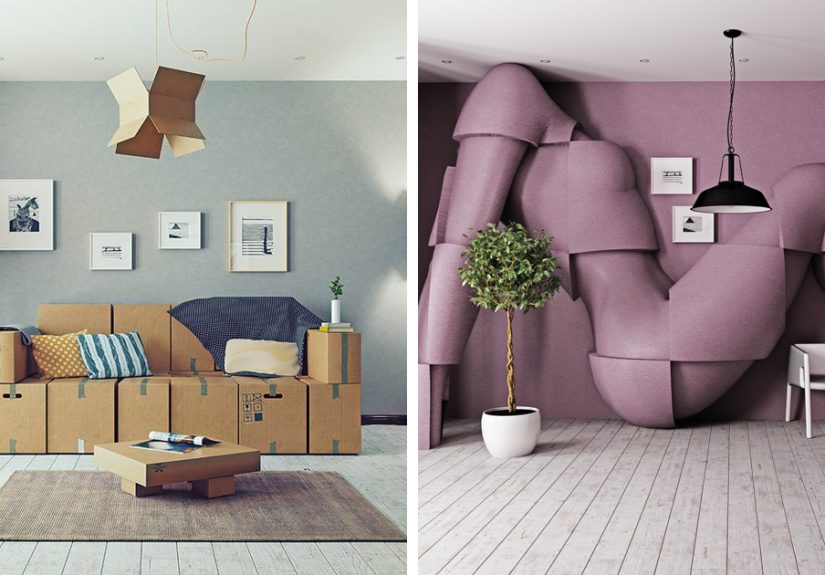
- Unexpected materials – like a wall made of soft, folded fabric shapes that feel almost alive.
- Uncanny props – a life-size deer standing casually in a grand salon or chairs marching up
the wall as if gravity changed its mind. - Bold color blocking – a single beam of bright red pouring from a ceiling lamp, continuing
as a painted “river” across an otherwise white room. - Liquid effects – water pooling inside kitchens and dining rooms, turning mundane chores into
something cinematic and slightly apocalyptic.
All of these details are controlled inside software before being rendered at high resolution, then polished in
post-production for contrast, color balance, and mood.
Why These 54 Surreal Interior Designs Captivated Bored Panda
Bored Panda specializes in visual stories that inspire, amuse, or pleasantly weird out its readers, so Victor’s
work fits the platform perfectly. In the feature “Victor Zastolskiy Created These 54 Surreal Interior Designs”,
the images are presented almost like a visual puzzle bookeach frame is a game of “spot what’s not normal” for
design lovers.
Scroll through the series and you’ll see:
- Living rooms that appear to be underwater, complete with tropical fish gliding past sofas.
- Classic apartments where walls give way to rocky caves and tunnels.
- Lush interiors with animals who look like long-term renters rather than guests.
- Clean, Scandinavian-style rooms hijacked by bright geometric interventions and impossible perspectives.
Each scene looks polished enough to be in a high-end interior magazine, yet the surreal elements push it into
the territory of concept art and 3D illustration. It’s that tension between “this could be real” and
“absolutely not” that keeps people scrolling.
The Artistic Influences Behind the Surreal Interiors
Echoes of M.C. Escher and Impossible Architecture
Many of Zastolskiy’s compositions belong to the broader tradition of impossible architecture, a style
often associated with the Dutch graphic artist M.C. Escher, whose iconic staircases and paradoxical
buildings seem to loop back on themselves forever. Escher’s work combines mathematics, geometry, and surreal
perspective to create illusions that still fascinate designers and 3D artists today.
Contemporary digital libraries are full of “Escher-style” rooms, 3D optical illusions, and surreal architecture
stock imagesevidence that the appetite for mind-bending spaces hasn’t slowed down. Zastolskiy’s interiors
sit comfortably in this lineage, but his focus on everyday domestic spaces (living rooms, kitchens, bedrooms)
makes the surreal feel more personal and immediate.
Dreamscapes and the Digital Design Movement
The rise of “dreamscape” interiorswhere architecture, interior design, and art merge into one digital canvashas
been fueled by powerful 3D software and the visibility of social media. Design platforms and publishers note
how digital creators are using these tools to test wild concepts that might be too expensive or physically
impossible to build in real life.
In this context, Victor’s 54 surreal interiors are part of a larger conversation: What happens when we treat
homes not just as physical spaces to decorate, but as narrative worlds we can write, erase, and rewrite digitally?
What Makes These Interiors So Hypnotic?
Balancing Familiarity and Surprise
One reason these images resonate is that they start with spaces we understand. A sofa, a dining table, a
gallery wallthese are all familiar design elements. When something impossible is addeda pool of water lapping
at the legs of a dining set, or a bright portal of bricks opening up mid-wallthe mind does a double-take.
Psychologically, that combination of comfort and unease is powerful. It invites viewers to linger. You know this
can’t be real, but it feels like it almost could be, especially with how carefully light, texture, and shadow
are rendered.
Storytelling Without a Single Word
Each of Victor’s surreal interiors is essentially a short story in one frame. A flooded kitchen suggests
a disaster that somehow doesn’t bother anyone. A room cracked open to reveal a cavern hints at a hidden world
just beyond the drywall. A giant animal in a formal living room feels like a quiet but stubborn guest who
refuses to leave.
Because there are no visible people in many of the scenes, viewers intuitively step into the narrative themselves.
“What would I do if this were my house?” is a surprisingly effective way to keep users engaged on
platforms like Bored Panda, Pinterest, and design blogs, which thrive on shareable, emotionally charged imagery.
How Surreal Interior Art Influences Real-World Design
While most of us probably won’t install a full indoor ocean or invite a stag to live in our living room,
surreal 3D interiors do have a tangible impact on how designers, homeowners, and brands think about space.
-
Concept testing for architects and designers. Digital dreamscapes allow designers to explore
bold volumes, unusual circulation paths, or theatrical lighting effects long before a project is builtor
even before they pitch an idea to a client. -
Visual content for marketing and editorial. Stock libraries and design media use surreal
interiors as eye-catching visuals for campaigns, magazine covers, and trend stories. That’s part of why
artists like Zastolskiy gain traction so quickly: their work is highly “shareable” and visually legible
even at thumbnail size. -
Inspiration for home décor trends. While the full surreal effect might not be recreated in
a typical apartment, smaller elementsvivid color blocking, unexpected compositions, or sculptural furnitureoften
filter into mainstream interior design.
In other words, even if you never turn your bedroom into an underwater aquarium, you might borrow the idea of
a bold, saturated accent wall or a single whimsical piece of décor that becomes the “plot twist” in your own home.
54 Surreal Interiors, One Big Takeaway
Taken together, “Victor Zastolskiy Created These 54 Surreal Interior Designs” is more than a scrollable
gallery of cool images. It’s a snapshot of where digital art, interior design, and online culture meet. The
series shows how far you can push an ordinary room when you’re not worried about building codes, budgets,
or gravityand how those over-the-top experiments can still ripple back into everyday design choices.
Victor’s work reminds us that our homes don’t just have to be practical; they can also be imaginative spaces
where we tell stories about who we are, what we fear, and what we secretly wish our worlds looked like.
Personal Reflections: Experiencing Victor Zastolskiy’s Surreal Interiors
Looking at Zastolskiy’s interiors feels a bit like waking up from a vivid dream and trying to describe it to
a friend. You remember the room clearlythe wooden floor, the sunlight through the windows, the familiar shape
of the sofa. But then you get to the strange parts: “There was water everywhere, but nothing was ruined,” or
“A huge deer was just standing there, like a roommate who pays rent in antlers.” The rational mind wants to
tidy those details away, but the emotional mind quietly hopes you never have to.
One of the most striking things about these images is how quickly they trigger a physical response. Your body
reacts even though you know you’re safe behind a screen. The submerged kitchen makes your feet feel cold.
The cracked wall opening into darkness tightens your chest just a little. The floating furniture makes your
inner ear brace for motion. That reaction is part of the magic. It proves how deeply we’re wired to respond
to spaceeven digital spaceas if we’re really standing inside it.
From a design perspective, these surreal interiors are a masterclass in composition. Zastolskiy understands
the rules of classic interior photographywhere to place the focal point, how to lead the eye with lines,
how to balance light and shadowand then deliberately breaks them to keep us curious. A long corridor of
chairs, a color block that doesn’t respect furniture boundaries, or a void opening up where a wall should be
are all visual tricks that make the viewer pause instead of scrolling past.
These works also raise interesting questions about the future of interior design. Will clients start to expect
more theatrical, “unreal” renderings of their spaces before they commit to a renovation? As 3D tools become
more accessible and AI-assisted rendering accelerates, the line between practical drawings and digital fantasy
might blur even further. In that world, artists like Zastolskiy become important not just as visual storytellers,
but as pioneers who show us how playful and emotionally rich our built environments could be.
On a more personal level, there’s something strangely comforting about these images. Yes, they’re unsettling,
but they also suggest that spaces don’t have to be perfect to be meaningful. A flooded room can still be
beautiful. A cracked wall can be a portal instead of a problem. A living room shared with a wild animal can
feel oddly serene. It’s a reminder that our own homeswith their quirks, mismatched furniture, and half-finished
projectsare also stories in progress, and that a little surrealism might actually make them more human.
So the next time you rearrange your furniture or repaint a wall, you might find yourself thinking like Victor
Zastolskiy for just a moment: “What if I added one impossible detail?” Even if you keep your floors dry and
your wildlife outdoors, that tiny shift in perspective can make everyday design decisions feel a lot more fun.