Table of Contents >> Show >> Hide
- What Is Grass Fertilizer Burn?
- What Does Fertilizer Burn Look Like?
- Is It Definitely Fertilizer Burn? Common Look-Alikes
- What Causes Lawn Fertilizer Burn?
- How to Fix Fertilizer Burn (If It Already Happened)
- 5 Tips to Prevent Grass Fertilizer Burn
- Bonus: Smarter Fertilizing Habits That Reduce Burn Risk
- Experiences From the Real World: 5 “Fertilizer Burn Stories” and What They Teach
- Conclusion
Fertilizer is supposed to make your lawn look like a soft green carpet. But sometimes it does the opposite:
it turns patches of grass into crispy, tan “toast points” that look like your yard briefly auditioned for a desert documentary.
That damage is commonly called grass fertilizer burn (or lawn fertilizer burn), and it’s one of the most frustrating
DIY lawn-care mistakesbecause it usually happens right after you tried to do something nice.
The good news: fertilizer burn is preventable, and in many cases it’s fixableespecially if you catch it early.
In this guide, you’ll learn what fertilizer burn really is, why it happens, how to tell it apart from other lawn problems,
what to do if it happens, and five practical ways to prevent it from ever showing up again.
What Is Grass Fertilizer Burn?
Grass fertilizer burn is injury to turfgrass caused by applying fertilizer in a way that overwhelms the grass plant.
Most often, the problem isn’t that the fertilizer is “hot” in a dramatic senseit’s that many fertilizers contain
soluble salts. When a heavy dose of those salts sits on grass blades or concentrates in the soil,
it can pull water out of plant tissues (think: a moisture magnet with terrible manners), leaving grass dehydrated and damaged.
That’s why fertilizer burn can look a lot like drought stress: yellowing, browning, and thinning.
In severe caseslike a big spill or a badly miscalibrated spreaderyou can kill patches outright.
Why fertilizer “burns” grass: the simple science
Turfgrass survives by balancing water inside its cells with water in the soil.
When fertilizer salts are too concentrated, the water balance shifts.
Grass can lose water faster than it can replace it, which stresses the plant.
If the concentration is extreme (a spill, a pile of granules, a double-pass you didn’t mean to do),
grass tissue can die.
Some fertilizers also contain nitrogen forms that can be especially stressful in excess.
Whether the burn shows up on blades, roots, or both depends on how the product was applied,
the weather, and how quickly the fertilizer was watered into the soil.
What Does Fertilizer Burn Look Like?
The most common fertilizer burn symptoms show up within a few days after applying fertilizersometimes faster in hot, dry weather.
Here are typical signs of overfertilizing grass:
- Yellow-to-brown patches that look “scorched” or dried out
- Streaks or stripes that match your spreader path (the lawn’s way of leaving a receipt)
- Dark green lines next to brown lines (uneven application: some areas got “too much,” others got “just right”)
- Grass tips turning tan while the base looks less affected (granules stuck to blades)
- Slow growth or thinning in affected spots
Pattern clues: your lawn is a detective
Fertilizer burn often creates distinctive shapes:
- Rectangles or arcs from stopping/starting with a spreader
- Lines from wheel tracks or uneven overlap
- One intense spot where a spill happened (or where the bag tipped like it was fainting)
- Edge burns near driveways or sidewalks if fertilizer was swept or washed into the lawn
Is It Definitely Fertilizer Burn? Common Look-Alikes
Before you blame the fertilizer bag, consider these common imposters:
Drought or heat stress
Heat stress usually appears in broad areas and follows sun exposure and watering patterns.
Fertilizer burn is more likely to show up as streaks, spills, or oddly shaped patches that match where product landed.
Dog urine spots
Dog spots often have a “fried egg” look: a brown center with a dark green ring (extra nitrogen around the edges).
Fertilizer burn can mimic this, but dog spots usually repeat in favorite “go” locations.
Fungal disease
Many lawn diseases cause circular patches, thinning, or discolored rings.
If your lawn has fuzzy growth early in the morning, visible spots on blades, or symptoms that spread beyond where you fertilized,
disease may be involved.
Herbicide injury
Weed killers can discolor or distort grass, sometimes creating “drift” patterns on windy days.
If you applied weed-and-feed or sprayed weeds around the same time, consider that as a factor too.
What Causes Lawn Fertilizer Burn?
Fertilizer burn almost always comes down to one of these causes (or a combo platter):
1) Applying too much fertilizer
This can happen because you eyeballed the lawn size, guessed on the spreader setting, or thought
“a little extra” would make it greener faster. (It can, brieflyright before it turns beige.)
2) Uneven spreader application
Spreader calibration matters. If the spreader is set incorrectly, clogged, or you overlap passes unevenly,
you can create stripes of over-application and under-application.
3) Spills and piles
A small spill can create a big burn. Granules that pile up concentrate salts and nitrogen in one spot.
4) Not watering it in (or watering at the wrong time)
Many granular fertilizers are meant to be watered into the soil so they don’t sit on the blades.
If fertilizer stays on grass during hot, dry conditions, the risk of burn increases.
On the other hand, heavy rain immediately after applying can move nutrients off-target and create concentrated runoff zones.
5) Applying during stressful weather
Fertilizing during extreme heat, drought, or when the lawn is dormant stacks stress on stress.
Grass already struggling with water balance is more likely to scorch when salts enter the picture.
6) Quick-release products used aggressively
Quick-release nitrogen can green up fast, but it also carries a higher risk if applied too heavily or unevenly.
Slow-release nitrogen is generally gentler and more forgiving.
How to Fix Fertilizer Burn (If It Already Happened)
If you think you burned the lawn, don’t panic. Your next steps depend on timing and severity.
Step 1: Remove any visible granules (if possible)
If you can still see fertilizer sitting on blades or in a pile, gently sweep or rake it up.
If it spilled on hard surfaces, scoop it up and keep it out of drains and gutters.
Step 2: Water deeply to dilute and move salts downward
If the fertilizer was applied recently, deep watering can help dissolve granules and reduce salt concentration around roots.
In suspected over-application areas, multiple soakings may help “leach” excess salts downward through the soil profile.
(You want the salts out of the root zonenot merely redistributed in the top inch.)
Practical approach: apply water in cycles (so it soaks in rather than running off), then reassess over the next week.
If your soil is compacted or clay-heavy, slower cycles are especially important.
Step 3: Pause additional fertilizer
Don’t “fix” fertilizer burn with more fertilizer. Give the lawn time to recover.
Focus on watering and normal mowing practices.
Step 4: Be patient with mild burn
If the damage is mostly tip burn (tan tips, but crowns and roots still alive), the lawn may grow out of it over time.
New growth can replace damaged bladesespecially if conditions are otherwise good.
Step 5: Repair severe damage with reseeding or plugging
If patches are truly dead (you can tug and the grass pulls up easily, and there’s no green at the base after a couple of weeks),
plan a repair:
- Rake out dead material
- Loosen the top layer of soil
- Reseed (cool-season lawns) or plug/sod (warm-season lawns)
- Keep the area evenly moist until establishment
5 Tips to Prevent Grass Fertilizer Burn
Prevention is easier than repairand it’s also less emotionally exhausting than staring at fertilizer stripes
while whispering, “But I followed the vibes.”
Here are five real-world ways to prevent fertilizer burn.
Tip #1: Measure your lawn and do the math (no guess-fertilizing)
Most lawn fertilizer labels are based on covering a specific square footage.
If you don’t know your lawn size, you can easily apply too much.
Measure the lawn (even a rough rectangle estimate is better than vibes), then calculate product amount.
Example: You want to apply 1.0 lb of nitrogen per 1,000 sq ft, and your fertilizer is 32-0-4.
The “32” means 32% nitrogen by weight. To get 1.0 lb nitrogen, you need:
1.0 ÷ 0.32 = 3.125 lbs of product per 1,000 sq ft.
That simple math prevents a lot of accidental overfeeding.
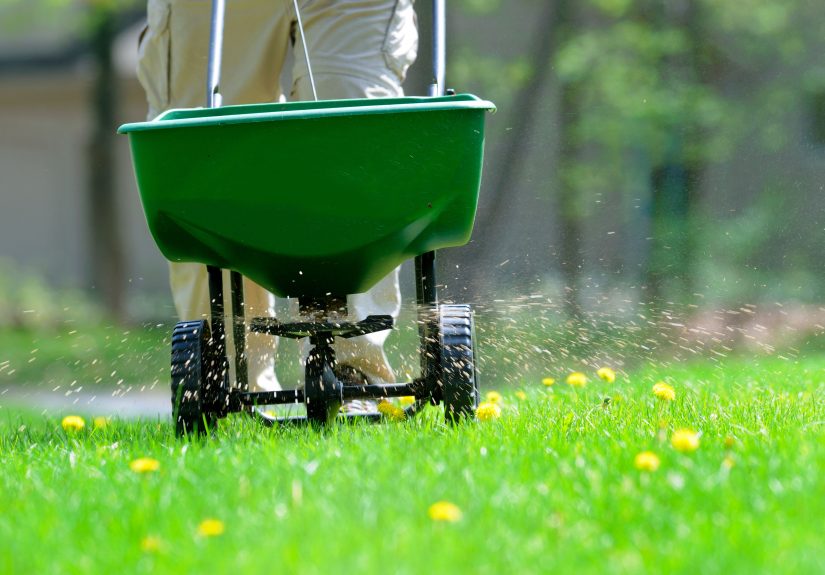
Tip #2: Calibrate your spreader and apply in two directions
Spreader settings on a bag are a starting point, not a promise from the universe.
Calibration helps you apply the intended rate.
A practical technique that also reduces streaking: apply half the product in one direction, then the other half perpendicular.
This “crosshatch” approach evens out small inconsistencies in walking speed and overlap.
- Keep your pace steady (no sprinting to beat the sunset)
- Overlap slightly and consistently
- Don’t stop with the spreader open
- Close the hopper when turning or pausing
Tip #3: Apply to dry grass, and avoid extreme heat or drought
Applying granular fertilizer to wet blades can cause granules to stickcreating tiny concentrated burn points.
Aim for a dry lawn surface and avoid the hottest part of the day.
Also skip fertilizing when the lawn is under drought stress or not actively growing.
A good rule of thumb: if you’re sweating just standing there, your grass is probably stressed too.
Tip #4: Choose slow-release nitrogen when you can
If you want fewer “oops” moments, slow-release nitrogen is your friend.
It feeds the lawn gradually instead of dumping a big dose all at once.
That typically means a lower risk of burn and a steadier, longer-lasting green-up.
This is especially helpful for:
- Busy people who might not water at the perfect time
- Lawns on sandy soil (nutrients can move through quickly)
- Anyone who’s ever said, “I’m just going to wing it” while holding a fertilizer spreader
Tip #5: Water it in properlyand clean up hard surfaces
Watering after application helps move fertilizer off the blades and into the soil where roots can use it.
Follow the label, but in many cases a light-to-moderate watering is recommended rather than leaving granules sitting on foliage.
Also: sweep fertilizer off sidewalks, driveways, and patios. If it washes into the lawn in a concentrated stream,
it can burn edges and contribute to runoff issues. Cleaning up is not just tidyit’s lawn-saving.
Bonus: Smarter Fertilizing Habits That Reduce Burn Risk
Get a soil test (so you’re not feeding imaginary deficiencies)
Soil testing helps you avoid unnecessary fertilizer applications and lets you choose the right product.
It’s the lawn-care version of “measure twice, cut once,” except you’re measuring nutrients instead of wood.
Respect your grass type and season
Cool-season grasses (like Kentucky bluegrass, fescues, ryegrass) are often fertilized most heavily in fall.
Warm-season grasses (like Bermuda, zoysia, St. Augustine) typically prefer fertilizing during active summer growth.
Mismatching season and fertilizer timing increases stress and burn risk.
Don’t chase neon green
A healthy lawn is green, not radioactive. Slow, steady feeding usually wins.
Over-fertilizing can lead to excessive top growth, more mowing, and higher disease susceptibility.
Experiences From the Real World: 5 “Fertilizer Burn Stories” and What They Teach
Lawn advice is nice in theory, but most people learn best through storiesespecially the kind that make you say,
“Oh no, I’ve absolutely done that.”
Here are experience-based scenarios that mirror what homeowners and turf folks commonly see, plus the takeaway that keeps it from happening again.
1) The “One Extra Pass” Panic
Someone finishes fertilizing, looks at the bag, and thinks, “There’s still a lot left… I must not have used enough.”
So they do one more lap around the lawnusually along the edges where turns happen and overlap is already heavy.
Three days later: a crispy outline that perfectly traces the perimeter like a lawn-care crime scene chalk line.
Lesson: Trust your math, not the leftover bag weight.
Fertilizer spreaders don’t always empty perfectly evenly, and walking pace changes the rate.
If you measured the lawn, calculated product amount, and applied that amount, you’re done.
2) The “Wet Grass Shortcut”
A busy homeowner fertilizes right after morning irrigation because the lawn is already wet and “ready.”
Some granules stick to blades (especially in thicker turf). Those stuck granules act like tiny salt-and-nitrogen hotspots.
The result isn’t always huge dead patchessometimes it’s lots of little tan specks that make the lawn look dusty or scorched.
Lesson: Apply granular fertilizer when the foliage is dry, then water it in afterward.
Dry-on, water-in is typically safer than wet-on and hope-for-the-best.
3) The “Spreader Setting Guess” Stripes
Someone borrows a neighbor’s spreader. The dial has numbers, which feels scientific, so they pick a setting that looks reasonable.
The spreader throws product heavier on one side, and the overlap pattern is inconsistent.
A week later, the lawn has alternating dark green and light/brown stripeslike it’s wearing a badly fitting suit.
Lesson: Different spreaders apply differently. Use a calibration mindset:
apply half the rate in two directions, keep a steady pace, and avoid stopping with the spreader open.
If you’re switching equipment, don’t assume settings transfer cleanly.
4) The “Driveway Sweep” Surprise
Fertilizer lands on the driveway. Instead of sweeping it up into the trash or back into the spreader,
someone sweeps it “back into the grass” in a concentrated line.
Later, after watering or a rain, that line gets even more concentrated as it dissolves and moves into the edge soil.
The lawn edge browns exactly where the driveway meets the turf.
Lesson: Hard surfaces are not a staging area.
Sweep fertilizer off pavement and pick it up; don’t broom it into the lawn like you’re hiding evidence.
It can burn the edge and it can also wash toward storm drains.
5) The “Heat Wave Application” Regret
A forecast says it might rain “sometime this week,” so someone fertilizes during a hot stretch to get ahead of it.
The rain doesn’t show. The lawn is already stressed, and the fertilizer adds salt load without immediate moisture support.
The result is blotchy browning that looks like the lawn aged ten years overnight.
Lesson: Timing matters as much as product choice.
Fertilize when grass is actively growing and conditions support recoverygenerally not during heat extremes or drought.
If you can’t water appropriately after application, wait for a better window.
These experiences all point to the same truth: fertilizer burn usually isn’t bad luckit’s a rate, timing, or application issue.
The fix isn’t fancy. Measure, calibrate, apply evenly, pick a sane day, and water correctly.
Do that, and your lawn stays in the “lush” category instead of the “crispy snack” category.
Conclusion
Grass fertilizer burn happens when fertilizer is applied too heavily, too unevenly, or under stressful conditions,
leading to dehydration and tissue damage. The most recognizable signs are brown patches and stripes that match spreader patterns or spills.
If you catch it early, deep watering and cleanup can reduce damage. Long term, prevention is straightforward:
measure your lawn, do the math, calibrate your spreader, avoid extreme weather, choose slow-release when possible,
water it in correctly, and keep fertilizer off hard surfaces.