Table of Contents >> Show >> Hide
- Before You Start: The Non-Negotiables (Rules, Safety, and Respect)
- 1) Net Fishing: Cast Nets, Dip Nets, and Small Seines
- 2) Fish Traps: Minnow Traps, Basket Traps, and Hoop Nets
- 3) Setlines: Trotlines, Limb Lines, Bank Lines, and Jug Lines
- 4) Handlines: The Simplest Rod-Free Method That Still Feels Like “Fishing”
- Handling Your Catch: Keep Fish Healthy (and Keep Your Options Open)
- Extra Reality Check: “Survival Fishing” vs. Responsible Fishing
- Field Notes: 4 Rod-Free Fishing Experiences (About )
- Conclusion
No rod? No problem. Whether you forgot your gear, want to try something different, or you’re just curious how people fished
before graphite rods and fancy reels took over the world, there are plenty of legit ways to catch fish without “rod-and-reel.”
The trick is doing it legally, safely, and ethicallybecause “creative” fishing methods can slide into “wildly illegal”
faster than a catfish disappearing under a dock.
In this guide, you’ll learn four practical, rod-free fishing methods that anglers use across the U.S.: netting, trapping,
setlines, and handlines. You’ll also get real-world examples, safety notes, and common mistakes to avoidso your
“I tried something new” story doesn’t become an “I met a game warden” story.
Before You Start: The Non-Negotiables (Rules, Safety, and Respect)
“Catching fish without a rod” is a big category, and laws vary a lot by state, waterbody, and species. Some places allow
certain nets for baitfish but not for game fish. Some allow trotlines or jug lines only for nongame species. Some waters
ban all passive gear. Your best move is to check your state fish and wildlife regulations (and any special rules for the lake,
river, park, or reservoir you’re on) before you set anything in the water.
-
Always confirm what’s legal where you are. Nets, traps, and passive hook gear can be heavily restricted,
especially in parks and protected waters. -
Use common-sense safety. Wear a life jacket near current or deeper water, fish with a buddy when possible,
and keep sharp hooks, weights, and lines organized so they don’t turn into surprise finger jewelry. -
Respect fish, habitat, and other people. Don’t block boat ramps, don’t leave gear unattended longer than
allowed, and don’t “borrow” someone else’s setline like it’s a community snack table.
One more important note: methods like hand-fishing (“noodling”) can be legal in some places, but they can also be risky,
highly regulated, or flat-out prohibited. If you’re new, skip anything that puts your hands into dark holes or tangles you
can’t see. There are safer ways to be adventurous.
1) Net Fishing: Cast Nets, Dip Nets, and Small Seines
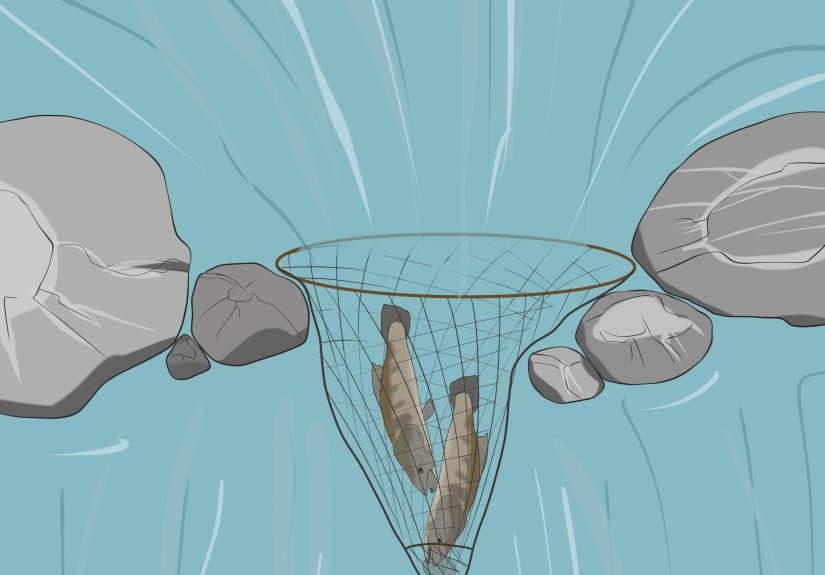
If you want a fast, rodless way to catch fish (especially bait), net fishing is the classic move. The big advantage is speed:
you can catch multiple baitfish in one attempt instead of waiting for one fish to bite. The big caution is legality: many states
restrict net types, sizes, mesh measurements, seasons, and what species you can keep.
What it’s best for
- Baitfish (shad, minnows, small panfish in some places where allowed)
- Shallow, open water where you can see schools moving
- Quick bait gathering before you switch to another method
Common net options (and how they differ)
-
Cast net: A circular net with weighted edges you throw over baitfish. Great for open shorelines, marinas,
canals, and flatswhere permitted. - Dip net: A handheld net used to scoop baitfish along banks, around lights at night, or in very shallow water.
- Minnow seine: A small net pulled between two people in shallow areas (often limited to bait collection).
How to use netting without turning it into chaos
You don’t need a “step-by-step choreography routine” to succeed, but you do need a plan. Start in a wide-open area without
brush, docks, swimmers, or submerged “line-eating” debris. Watch the water first. Baitfish often move in nervous little clouds,
flicker at the surface, or gather around structure and lights.
Use netting strategically: a dip net for tight spots and a cast net for open water. If you’re after bait, keep it simplecatch
only what you’ll actually use that day. Nothing says “rookie mistake” like hauling a bucket of baitfish you can’t legally keep,
can’t transport, or can’t use.
Safety and ethics tips
- Mind the handline/rope. Loose rope and moving water are a bad combokeep it tidy.
- Watch for bycatch. If you net something you can’t keep, release it quickly and gently.
- Don’t net where it’s crowded. Your cast net should not become an accidental blanket for someone’s kayak.
2) Fish Traps: Minnow Traps, Basket Traps, and Hoop Nets
Trapping is the slow-cooker version of rodless fishing: you set it, let it work, then return later. It’s quiet, efficient,
and can be very effective for baitfish or certain nongame specieswhen it’s legal. Traps can also create problems if
they’re left too long, poorly marked, or placed where they snag wildlife.
What it’s best for
- Collecting bait (minnows and small baitfish in many regulated settings)
- Passive fishing when you don’t want to actively work a spot
- Steady results in ponds, coves, backwaters, and slow-flow areas
Trap types you’ll hear about
- Minnow trap: Typically a small trap with funnel entrances; widely used for bait collection where permitted.
- Basket/slat trap: A more rigid trap design that some states regulate by materials, openings, or dimensions.
-
Hoop net/trap net: Larger, often highly regulated gear that may be restricted to specific waters, seasons,
or licensing categories.
Trapping the smart way (without harming fish or breaking rules)
Think “low-impact and easy to check.” Place traps where baitfish naturally travel: along weed edges, near downed timber,
or in quiet pockets off the main current. Avoid areas with heavy boat traffic, swimming zones, and places where your gear
could become a hazard.
Check traps frequentlyboth for fish welfare and because many regulations require it. A trap left too long can stress fish,
attract predators, or tangle with wildlife. And if you’re trapping for bait, remember that some waters restrict baitfish use
entirely to prevent invasive species spread. The safest habit is to treat bait rules like airport security: assume it’s stricter
than you wish it was.
Common mistakes to avoid
- Unmarked gear: Some places require tags, names, or spacing rules between traps.
- Wrong location: Protected waters, parks, and certain reservoirs may ban traps entirely.
- Transporting live bait illegally: This is a big one. Regulations often focus on preventing invasive species.
3) Setlines: Trotlines, Limb Lines, Bank Lines, and Jug Lines
Setlines are one of the most common “no rod” methods for catching bigger fishespecially catfishin waters where they’re allowed.
The idea is simple: instead of actively holding a rod, you place one or more baited hooks on a line and let fish come to you.
The reality is that setlines come with responsibilities: they must be placed safely, marked properly, checked regularly,
and used only where legal for the species you’re targeting.
What it’s best for
- Catfish and other species commonly targeted with passive hook gear (rules vary)
- Covering water when fish are spread out
- Night fishing in places that allow setlines after dark
Setline styles (in plain English)
-
Trotline: A long mainline with multiple branch lines/hooks. Effective, but often requires specific tagging,
marking, or hook-limit compliance. -
Limb line/bank line: A single line attached to a branch, stake, or fixed object, typically with one (or limited)
hooks depending on local rules. - Jug line: A floating device with a line and hook beneath itbasically a “bobber with ambition.”
- Throwline: A setline that can be cast out and anchored, used in some places under specific regulations.
How to use setlines responsibly
The goal is to catch fishnot to create a floating obstacle course. Place gear away from boat lanes, docks, and swimming areas.
Use durable materials that won’t snap and leave hooks behind. Keep hooks to the legal limit and follow marking/tag rules where required.
Then check lines often. Aside from rules, frequent checks reduce deep-hooking and improve survival for fish you release.
Another key point: some states treat setlines as nongame gear, meaning possession of certain game fish while
operating them can be illegaleven if those fish could be caught by rod-and-reel. If you’re not 100% sure, assume you need to
release anything not explicitly allowed.
Best baits and placements (general guidance)
For catfish waters, anglers often favor natural baits placed along channel edges, near current seams, and at the mouths of coves.
In lakes, setlines can be effective along drop-offs or near submerged structure. In rivers, they often perform best just outside the
main push of current where fish can feed without fighting the flow.
4) Handlines: The Simplest Rod-Free Method That Still Feels Like “Fishing”
If netting and trapping feel like “fishing’s quiet cousins,” handlining is fishing’s minimalist best friend. A handline is exactly
what it sounds like: line stored on a spool or winder, worked by hand instead of with a rod. It’s portable, inexpensive, and useful
from shore, docks, bridges, or boats.
What it’s best for
- Piers, docks, and bridges where you can fish vertically
- Small lakes and ponds when fish are near structure
- Travel and backup gear because it packs down small
How handlining works (without overcomplicating it)
You typically use a simple rig: a hook, an appropriate sinker or weight for the depth/current, and bait or a small lure.
You lower or cast the line, feel for taps, then retrieve by hand. The “skill” part is line control: keeping your line organized
so it doesn’t knot itself into a tiny, angry bird’s nest.
Safety notes
-
Protect your hands. If you’re pulling in a lively fish, keep tension controlled and avoid wrapping line
tightly around fingers. - Keep hooks covered when not in use. A hook in a pocket is a terrible way to learn anatomy.
- Stay aware of surroundings. On bridges and docks, be mindful of pedestrians and other anglers.
Handlining is also a great “gateway method” because it doesn’t rely on multiple unattended hooks or special net/trap rules.
You’re actively fishing, you’re present the whole time, and you can release fish quickly if needed.
Handling Your Catch: Keep Fish Healthy (and Keep Your Options Open)
Whether you’re catching bait or landing dinner, good fish handling matters. Fish aren’t built for long air exposure or rough handling,
and many jurisdictions emphasize responsible catch-and-release practices because survival rates improve when anglers minimize stress.
Quick best practices that make a big difference
- Wet your hands before touching fish. This helps protect their slime coat.
- Keep air time short. If you must lift a fish out of the water, make it brief and purposeful.
- Avoid gills and eyes. Those areas are delicate and easily injured.
- Use simple, fish-friendly hooks when possible. Easier removal = less handling time.
And if a fish is deeply hooked and you can’t remove the hook easily without harming it, many fisheries agencies advise
cutting the line close to the hook rather than forcing removal. It’s not as cinematic as a perfect release, but it’s often better
for the fish than a prolonged surgery session on a hot dock.
Extra Reality Check: “Survival Fishing” vs. Responsible Fishing
The internet loves dramatic “survival fishing hacks.” Real life is less dramaticand that’s a good thing. Responsible fishing
is about legal gear, selective harvest, and protecting waterways so fish populations stay healthy. If you’re learning rodless
methods, treat them as legitimate fishing techniques, not shortcuts. That mindset keeps you safer, keeps you compliant, and keeps
fishing accessible for everyone.
Field Notes: 4 Rod-Free Fishing Experiences (About )
Picture this: you show up to the water feeling confident… and then realize your rod is still leaning in the corner at home like a
forgotten umbrella. You have two choices: sulk, or pivot. Rod-free fishing is basically the art of pivotingwith a splash of
“this might actually work” optimism.
Netting moment: On a warm evening, baitfish start flickering near the surface like someone is sprinkling popcorn
into the water. A cast net (in places it’s legal) turns that chaos into instant results. You make one clean throw and pull back a
handful of baitfish that look like they’re personally offended by gravity. The funny part? Your confidence skyrockets immediately.
The net doesn’t care if you’re a beginner. It cares if you picked a spot full of sticks. One bad location and you’re doing the
“untangle dance” while pretending you meant to do that.
Trap moment: Traps are the patient person’s method. You set a minnow trap in a quiet cove, walk away, and spend
the next hour acting like you’re not thinking about it every five minutes. When you return, the reveal feels like opening a
mystery boxexcept instead of a prize, it’s tiny fish giving you the side-eye. The best part is how calm it feels: no casting,
no waiting for a bite, just “check, collect, reset.” The not-so-fun part is realizing traps demand responsibility. If you forget
them, it’s bad for fish and bad for you. Trapping rewards the organized angler, not the “I’ll remember later” optimist.
Setline moment: Setlines can feel like fishing with a to-do list. You plan placement, marking, and timing.
You check lines like you’re doing rounds. When it works, it works big: a steady tug, a heavier pull, and suddenly dinner has
an opinion about going home with you. When it doesn’t, you learn humility fasteither the fish weren’t there, the bait wasn’t
right, or the location was basically the fish equivalent of an empty parking lot. The real “experience lesson” is this:
setlines aren’t lazy fishing; they’re structured fishing. They reward attention and care.
Handline moment: Handlining is the most “classic” feeling rod-free method because you’re still actively reading
the water. On a dock, you lower a baited rig and feel for tiny taps through the line. There’s something satisfying about that direct
connectionno reel, no rod, just you and whatever is curious below. The first time you feel a solid pull and hand-over-hand a fish
up from the water, you’ll grin like you invented fishing. Then you’ll remember you still have to unhook it safely and quickly,
and your grin turns into a focused “okay everybody stay calm” face. It’s simple, it’s effective, and it teaches you line control
fastbecause messy line storage will punish you with knots like it’s a personal vendetta.
The takeaway from all four experiences is the same: rod-free fishing isn’t a gimmick. It’s a set of techniques that work when you
respect the rules, respect the water, and keep safety in the front of your mind. And yesdouble-checking regulations may not feel
adventurous, but it’s a lot more fun than explaining your “innovation” to an officer with a clipboard.
Conclusion
If you want to catch fish without a rod, you’ve got solid options: netting for fast bait collection, traps for passive results,
setlines for bigger targets (where legal), and handlines for a minimalist, active approach. The best method depends on your location,
the species you’re targeting, and local regulations. Start simple, stay safe, and treat every method like real fishingbecause it is.