Table of Contents >> Show >> Hide
- What a Breaker Actually Does
- How to Tell If a Breaker Has Tripped
- Easy Ways to Reset a Breaker Safely
- What to Do If the Breaker Will Not Stay On
- Common Reasons Breakers Trip in Real Homes
- When a GFCI Outlet, Not the Breaker, Is the Real Problem
- When You Should Not Reset a Breaker Yourself
- Smart Tips to Prevent Future Breaker Trips
- A Quick Example: The Breaker Reset That Actually Solves the Problem
- Final Thoughts
- Real-Life Experiences With Resetting a Breaker
- SEO Tags
Few things make a house feel more dramatic than a room going dark for no obvious reason. One second you are making toast, drying your hair, and charging half the neighborhood’s devices. The next second, your kitchen has the energy of a cave. In many cases, the culprit is a tripped circuit breaker. The good news: resetting a breaker is often simple. The better news: your breaker is not being rude. It is doing its job by stopping electrical trouble before that trouble turns into smoke, sparks, or an expensive call that starts with, “Well, that’s not ideal.”
If you want easy ways to reset a breaker, the trick is not brute force or blind optimism. It is knowing what a breaker does, how to spot the tripped one, how to reset it safely, and when to stop pretending you are on a home-improvement show and call a licensed electrician. This guide walks you through the process in plain American English, with practical examples, common mistakes, and a few sanity-saving tips for the next time your microwave and air fryer decide they can’t share.
What a Breaker Actually Does
A circuit breaker is a safety switch inside your electrical panel. When it senses too much current, a short circuit, or a ground fault, it “trips” and shuts off power to that circuit. That sounds inconvenient, but it is much better than letting wires overheat behind your walls. In other words, the breaker is the overprotective friend of your electrical system, and in this case, that is exactly the personality you want.
Most homeowners deal with tripped breakers because of one of these issues:
- Overload: Too many devices are pulling power on one circuit at the same time.
- Short circuit: Hot and neutral wires touch where they should not.
- Ground fault: Electricity takes an unintended path to ground, which can be dangerous.
- Faulty appliance: One problem device keeps tripping the circuit.
- Breaker or wiring problem: If it happens often, the issue may be deeper than “too many things plugged in.”
How to Tell If a Breaker Has Tripped
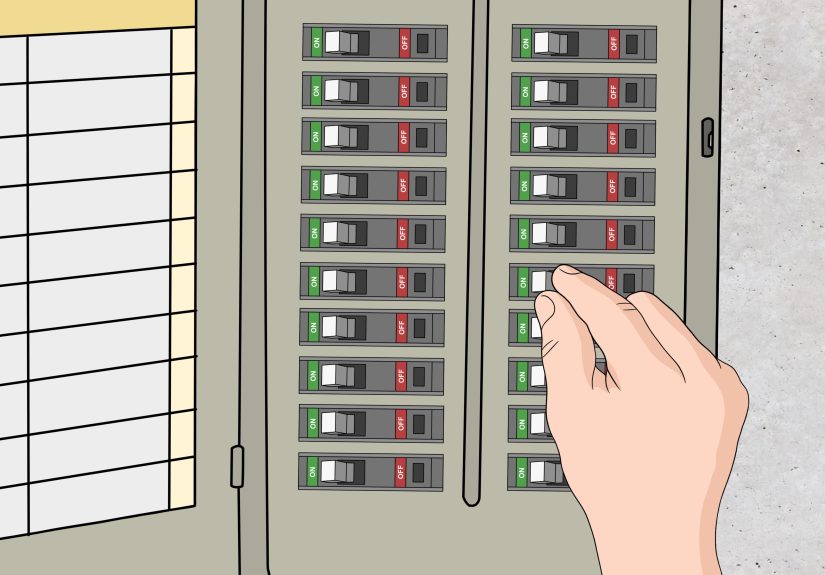
Not every tripped breaker screams for attention. Some sit in a middle position between ON and OFF. Others look almost on, especially double-pole breakers for 240-volt appliances. So if part of your home loses power, open the panel door and scan carefully.
Common signs of a tripped breaker
- One room or one set of outlets suddenly loses power.
- A breaker handle is in the middle or slightly out of line with the others.
- A large appliance will not run, but the rest of the house seems fine.
- A bathroom, garage, kitchen, or outdoor outlet is dead and may be tied to a GFCI outlet nearby.
If the breaker panel looks normal but an outlet still does not work, check for a tripped GFCI outlet. These outlets usually have TEST and RESET buttons and are common in bathrooms, kitchens, garages, basements, laundry rooms, and outdoor areas. Sometimes the “dead” outlet is not broken at all. It is just downstream from a GFCI that quietly decided to take the day off.
Easy Ways to Reset a Breaker Safely
Resetting a breaker is usually straightforward, but safety comes first. You are touching only the breaker handle, not removing the panel cover or working inside the panel. If the area is wet, if you smell burning, or if the panel looks damaged, stop right there and call a licensed electrician.
Step 1: Turn off or unplug devices on the affected circuit
Before you reset anything, shut off lights and unplug appliances on that circuit. This reduces the load and helps you figure out what may have caused the trip. If the breaker tripped because your toaster oven, coffee maker, and blender were all auditioning for a power-drain award, unplugging them gives the circuit a fair chance to recover.
Step 2: Stand safely at the panel
Make sure your hands are dry and the floor is dry. Stand slightly to the side of the panel rather than directly in front of it. That may sound overly cautious, but this is one of those moments when “slightly dramatic” is just another word for “smart.”
Step 3: Find the tripped breaker
Look for the switch that is between positions or not aligned with the others. If your panel labels are clear, this step is easy. If your panel labels look like they were written during an earthquake in 1997, you may need a little patience.
Step 4: Push the breaker firmly to OFF first
This is the step many people miss. A tripped breaker often will not reset unless you push it fully to the OFF position first. Do not just nudge it toward ON. Move it all the way off until it clicks into place.
Step 5: Flip it back to ON
Once the breaker is fully off, switch it firmly back to ON. If it stays on, congratulations: power should be restored. If it immediately trips again, the breaker is not being stubborn. It is warning you that the underlying problem is still there.
Step 6: Bring devices back one at a time
Plug things back in gradually. If the breaker trips again when one specific appliance comes on, you may have found the offender. A space heater, microwave, hair dryer, toaster oven, portable AC, and vacuum can all be repeat offenders on crowded circuits.
What to Do If the Breaker Will Not Stay On
If the breaker trips again right away, do not keep forcing resets. Repeated resetting is like hitting snooze on an alarm while your house is still trying to tell you something important.
Instead, try this simple troubleshooting sequence:
- Turn off everything on that circuit.
- Reset the breaker again.
- If it stays on, reconnect items one at a time.
- If it trips when a certain appliance is used, stop using that appliance and have it checked.
- If it trips with nothing plugged in, the problem may be in the wiring, outlet, switch, or breaker itself.
A breaker that will not reset may point to a short circuit, ground fault, damaged wiring, a failing breaker, or a serious overload problem. That is electrician territory, not guess-and-flip territory.
Common Reasons Breakers Trip in Real Homes
Overloaded kitchen circuits
Kitchens are the Olympics of electrical demand. Microwaves, air fryers, coffee makers, electric kettles, and toasters all love to pull a lot of power. Run several at once on the same branch circuit and the breaker may trip to protect the wiring.
Bathroom hair-tool chaos
Hair dryers, curling irons, and straighteners can draw serious wattage. Add bright vanity lighting and a space heater in winter, and your breaker may decide the spa experience is over.
Space heaters and portable AC units
These are famous for tripping breakers, especially on older circuits or when used with extension cords. They are not evil, just hungry.
Faulty appliances
If the breaker trips whenever a specific appliance starts up, the appliance may have a damaged cord, internal fault, or motor issue. Do not keep testing it like you are trying to prove a point.
Outdoor or wet-area problems
Moisture, damaged cords, outdoor outlets, and bathroom receptacles often involve GFCI protection. If power disappears in these areas, check the nearest GFCI outlet before assuming the main panel is the villain.
When a GFCI Outlet, Not the Breaker, Is the Real Problem
Sometimes the breaker is fine, but a GFCI outlet has tripped. In that case, press the RESET button on the outlet after unplugging any devices. If it will not reset, or if it trips repeatedly, there may be moisture, a wiring problem, or a faulty connected device.
This is especially common when:
- The bathroom outlet died but the lights still work.
- The garage refrigerator lost power.
- An outdoor receptacle stopped working after rain.
- The kitchen counter outlet is dead while nearby outlets still have power.
When You Should Not Reset a Breaker Yourself
There is a big difference between resetting a normal trip and ignoring a warning sign. Stop and call a licensed electrician if you notice any of the following:
- A burning smell near the panel, outlets, or switches
- Scorch marks, rust, buzzing, or crackling sounds
- Warm faceplates or a hot panel door
- Lights flickering or dimming often
- The breaker trips repeatedly with normal use
- The breaker will not stay on even with everything unplugged
- You feel a tingle or mild shock from an appliance or switch
These symptoms can point to damaged wiring, failing devices, loose connections, or a defective breaker. That is not the time for confidence. That is the time for a professional.
Smart Tips to Prevent Future Breaker Trips
Spread out high-demand appliances
Try not to run several heat-producing appliances on the same circuit at once. Your kitchen may be multifunctional, but your breaker has boundaries.
Learn your panel labels
If your panel is poorly labeled, take time to identify what each breaker controls. Future you will be deeply grateful.
Check GFCI and AFCI protection regularly
Safety devices only help when they are working properly. Testing GFCI and AFCI protection periodically is a smart habit, especially in homes with newer code-required protection.
Use dedicated circuits when required
Large appliances often need their own circuits. If a microwave, refrigerator, sump pump, or laundry appliance keeps tripping a breaker, it may need a dedicated line or a professional review of the load.
Retire suspicious appliances
If one old appliance keeps tripping breakers, smells odd, or makes weird sounds, do not keep giving it second chances. Some machines deserve retirement.
A Quick Example: The Breaker Reset That Actually Solves the Problem
Let’s say your living room breaker trips every time you vacuum while the space heater is running. You go to the panel, find the breaker in the middle position, switch it fully off, then back on. Power returns. Great. But the real fix is not the reset alone. The real fix is changing the load: move the space heater to another circuit or do not run it while vacuuming.
That is the key idea homeowners often miss. Resetting a breaker restores power. Solving the cause prevents the next trip.
Final Thoughts
Learning easy ways to reset a breaker is one of those basic home skills that pays off fast. The process is usually simple: unplug devices, find the tripped breaker, push it fully off, then switch it back on. But the smartest homeowners do one extra thing: they pay attention to why the breaker tripped in the first place.
If the cause is a one-time overload, problem solved. If the breaker keeps tripping, the outlet smells hot, or the panel looks sketchy, let a licensed electrician take over. A breaker is a safety device, not an inconvenience machine. When it trips, it is usually doing you a favor.
So yes, you can absolutely reset a breaker. Just do it with dry hands, clear eyes, and enough humility to know when your house is asking for backup.
Real-Life Experiences With Resetting a Breaker
One of the most common homeowner experiences is the “everything was fine until dinner” moment. Someone preheats the air fryer, starts the microwave, plugs in the slow cooker, and suddenly the kitchen goes dark. At first it feels mysterious, but after one or two episodes, most people realize the circuit is not broken at all. It is simply overloaded. Once they learn to unplug a few appliances, reset the breaker correctly, and stagger usage, the problem usually becomes much less dramatic. It is less of an electrical emergency and more of a scheduling conflict between power-hungry gadgets.
Another familiar experience happens in bathrooms during cold weather. A person turns on a space heater, flips on bright vanity lights, and starts a hair dryer. A few seconds later, silence. This kind of trip teaches a practical lesson fast: high-wattage devices add up. Homeowners often say the breaker reset itself is easy, but the real breakthrough is understanding what not to run together. That small shift in habit can prevent repeat trips for months.
There is also the classic garage or outdoor outlet mystery. A freezer, holiday lights, or power tools stop working, and the breaker panel looks completely normal. After a lot of confused staring, the homeowner eventually finds a tripped GFCI outlet in a bathroom, garage, or exterior wall. That moment feels oddly personal, like the house was hiding the answer on purpose. Still, it is a useful reminder that not every power loss starts at the main panel.
Older homes create a different kind of experience. People often discover that one breaker seems to control half a floor, or that panel labels are vague enough to qualify as fiction. In those homes, resetting the breaker may restore power, but repeated trips often push homeowners to get the panel labeled properly, reduce extension-cord use, or bring in an electrician for upgrades. The experience becomes a wake-up call rather than a one-time annoyance.
Then there is the appliance-specific problem. A homeowner resets the breaker, plugs everything back in, and the circuit trips only when one old microwave, treadmill, or window AC unit turns on. That pattern is incredibly useful. It turns a mystery into a clue. Many people say this is when they stop blaming the house and start suspecting the appliance. In plenty of cases, replacing the problem device solves everything.
What most real-world experiences have in common is this: the reset is only half the story. The more valuable lesson is spotting patterns. When does it trip? What was running? Did it happen after rain, during heavy appliance use, or only with one device? Homeowners who ask those questions usually solve the problem faster, avoid unnecessary panic, and know sooner when it is time to call a professional.