Table of Contents >> Show >> Hide
- Why This Phrase Lands So Hard Right Now
- The Make: Story Behind the Title
- What Psychology Says About “No Fate” (Without the Movie Trailer Voice)
- The M.A.K.E. Method: A Practical Way to Apply the “No Fate” Mindset
- How to Use This Mindset in Everyday Life
- Common Mistakes People Make With the “No Fate” Mindset
- 500+ Words of Real-Life Experiences Related to “No Fate: It’s What You Make Of It That Matters”
- Final Takeaway: Don’t Worship the PlanWork the Material
Some phrases sound cool on a T-shirt and then disappear by laundry day. Others stick around because they describe something painfully real. “No fate” is one of those phrases. It’s bold, a little cinematic, and honestly kind of perfect for the modern erawhen half of us are doomscrolling, the other half are building side projects, and most of us are trying to figure out how to stay hopeful without pretending everything is fine.
What makes this idea powerful is not the slogan itself. It’s the action hidden inside it: make. Not predict. Not complain. Not manifest and nap. Make. Build. Repair. Rework. Try again. That’s the point.
This article explores why the phrase “No Fate: It’s What You Make Of It That Matters” hits so hard right now, what it reveals about resilience and agency, and how you can apply that mindset in real lifeat work, in your health habits, in relationships, and in creative projects that go sideways five minutes before the deadline (or five seconds before guests arrive, which is worse).
Why This Phrase Lands So Hard Right Now
The phrase “There’s no fate but what we make for ourselves” is widely recognized from The Terminator universe, but its staying power comes from something deeper than nostalgia. It gives people a language for agency during uncertainty. In plain English: life is messy, but your choices still matter.
That message has become especially relevant in the creator and maker world, where failure isn’t theoreticalit’s physical. A weld cracks. A print warps. A prototype fries. A storm wrecks your installation. And then the real question shows up: What do you make from what’s left?
That’s exactly why the recent Make: story behind this title resonated far beyond maker circles. It wasn’t just about art. It was about rebuilding meaning after disruption.
The Make: Story Behind the Title
From Black Cloud to “No Fate”
In the Make: piece that inspired this topic, writer Jennifer Blakeslee describes Ukrainian artist Oleksiy Sai and producer Vitaliy Deynega’s work, including a massive installation called Black Cloud. The project was presented as a striking warning symbolan immersive cloud-like artwork using light and sound, including real war recordings, to communicate threat and urgency.
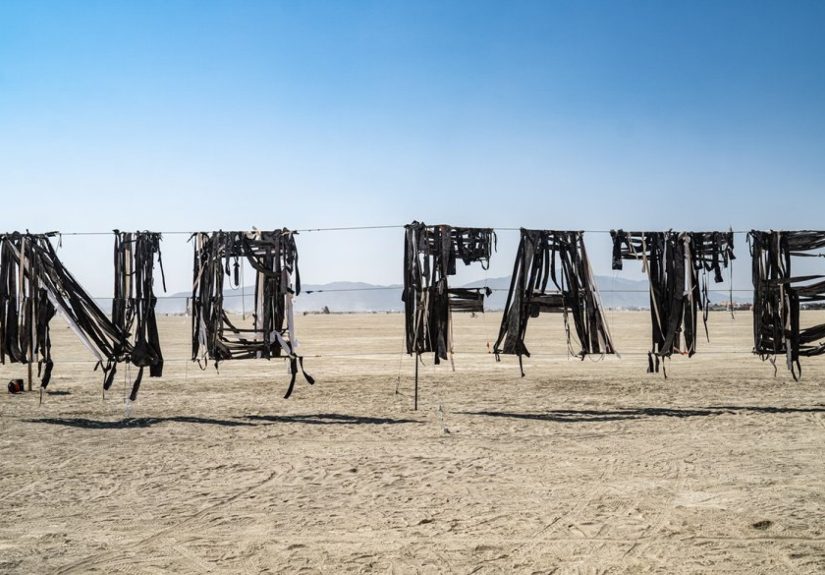
According to Make:, the installation was brought to Burning Man 2025 after prior large-scale work by the team, and then it was badly damaged during severe desert winds during build week. That alone would be a brutal ending for most projects. But the story did not end there.
Instead of treating destruction as the final chapter, Sai reportedly used shredded material from the damaged structure to create a giant sign in the desert inspired by the line, “There’s no fate but what we make for ourselves.” In other words: the wreckage became the message.
That is such a maker move it almost deserves its own holiday.
Why This Matters Beyond Art
What happened here is bigger than a festival anecdote. It demonstrates a principle that shows up in psychology, leadership, and recovery work over and over again:
- You may not control the event.
- You can often influence the response.
- The response can change the meaning of the event.
Nova Ukraine’s coverage of the project emphasized cultural expression as a form of resistance and connection, especially during wartime. That matters because “making” is not always about productivity. Sometimes it’s about preserving identity, dignity, and voice.
What Psychology Says About “No Fate” (Without the Movie Trailer Voice)
1) Agency and Locus of Control
Psychology uses the term locus of control to describe how people understand what influences outcomes in their lives. In simple terms, an internal locus of control leans toward “my actions matter,” while an external locus of control leans toward “outside forces determine what happens.”
Now, life is not a motivational poster. External forces absolutely exist: illness, layoffs, disasters, war, timing, luck, policy, family obligations, the printer jamming when you are already late. The goal is not denial. The goal is to avoid surrendering every ounce of agency.
That’s where the “no fate” mindset becomes useful: it shifts your attention toward the next meaningful action. Not perfect controljust useful control.
2) Resilience Is Built, Not Born Fully Assembled
Resilience is often misunderstood as “never feeling bad” or “bouncing back instantly while looking photogenic.” Real resilience is messier. It is the capacity to adapt, recover, and keep moving through difficult conditions.
U.S. health and psychology guidance consistently frames resilience and coping as a set of learnable behaviors: social connection, self-care, perspective shifts, problem-solving, and flexible coping strategies. In other words, resilience is less like a personality type and more like a toolkit.
That’s good news. Toolkits can be improved.
3) Growth Mindset Helps You Reframe Failure
Stanford’s growth mindset framework is useful here because it encourages people to see setbacks as information, not identity. If something fails, the question becomes “What can I learn or change?” instead of “What is wrong with me?”
That one shift is huge. It turns fate into feedback.
4) Small Actions Beat Grand Speeches
CDC and NIMH guidance on stress and mental health repeatedly emphasizes that small daily actions can make a meaningful difference: breaks from stressful media, movement, journaling, gratitude, better sleep habits, and connection with people you trust. Harvard Health similarly recommends starting small and being consistent when building new habits.
That is the practical version of “make.” It doesn’t have to be dramatic. It just has to be repeated.
The M.A.K.E. Method: A Practical Way to Apply the “No Fate” Mindset
Let’s turn the phrase into a repeatable framework you can actually use when life gets noisy.
M Map What You Can Control
When stress spikes, your brain tends to lump everything into one giant panic burrito. Separate it.
- Not in your control: the past, other people’s choices, breaking news, weather, market chaos
- Influenceable: communication, preparation, boundaries, effort, timing
- Directly controllable: your next action, your routine, your response, your breathing
This step alone can reduce overwhelm because it gives your mind a job besides spiraling.
A Act Small (But Act Now)
Big goals are great for vision boards and keynote speeches. Small actions are what get results.
Examples:
- Instead of “fix my career,” update one section of your résumé.
- Instead of “get healthy,” walk for 10 minutes after lunch.
- Instead of “repair this relationship,” send one honest check-in text.
- Instead of “finish the project,” name the next visible step and do only that.
If you want to reclaim agency fast, do something small enough that your excuses feel embarrassed.
K Keep Adjusting
Cleveland Clinic’s coping guidance highlights flexibility: coping is a process, not a one-time event. Translation: what works on Tuesday may flop on Thursday, and that doesn’t mean you failed. It means you are human.
Adjustments might include:
- switching from late-night work sessions to early-morning focus blocks
- trading doomscrolling for a short walk and a journal entry
- using deep breathing before a hard conversation
- asking for help earlier instead of “being strong” until you combust
Flexibility is not weakness. It is skilled adaptation.
E Expand Support
The “make it” mindset is often confused with “do it alone.” Those are not the same thing. CDC, NIMH, and resilience guidance consistently emphasize connection. Support can include friends, mentors, coworkers, therapists, faith communities, or online communities built around shared goals.
Even makers know this: the build goes faster when someone hands you the right wrench.
How to Use This Mindset in Everyday Life
At Work
When a project changes direction (again), “no fate” means you stop wasting energy arguing with reality and start shaping the next deliverable. Clarify the new goal, cut scope if needed, and deliver the strongest version possible with the time you have.
That’s not giving in. That’s professional resilience.
In Health and Stress Management
If your stress is high, don’t start with a six-part transformation plan and a matching water bottle. Start with basics that major health organizations recommend because they are boring and effective: sleep routines, movement, breaks from constant negative input, breathing, meditation or mindfulness (if helpful), and regular meals.
Mayo Clinic and NCCIH both note that meditation and mindfulness may help with stress for many people, while NCCIH also points out that evidence varies by condition and study quality. That is a helpful reminder to stay practical: use what works for you, and don’t treat any single practice like magic.
In Relationships
You cannot force people to change. You can change how clearly you communicate, what boundaries you set, and what behavior you continue to accept. “No fate” in relationships often looks less like speeches and more like consistent standards.
In Creative Work
Creative people know fate’s evil cousin: perfectionism. The “make” mindset breaks the spell. Ship the draft. Test the prototype. Patch the bug. Paint over the weird part. (Or call it “intentional texture” and keep moving. Artists have been doing this forever.)
The point is progress with integrity, not flawless first attempts.
Common Mistakes People Make With the “No Fate” Mindset
1) Turning It Into Toxic Positivity
You do not need to smile through pain to be resilient. Grief, anger, fear, and disappointment are normal responses. Resilience includes feeling them and still moving forward.
2) Confusing Control With Blame
Saying “my choices matter” does not mean every bad thing is your fault. It means your response still has value.
3) Waiting for Motivation
Motivation is nice. Structure is better. A short routine you can repeat will outperform occasional bursts of inspiration every time.
4) Going Solo Too Long
Self-reliance is useful. Isolation is expensive. Ask for help before the wheels come off, not after.
500+ Words of Real-Life Experiences Related to “No Fate: It’s What You Make Of It That Matters”
The examples below are composite, real-world-style scenarios based on common patterns people experience in work, health, caregiving, and creative life.
Experience 1: The Laid-Off Designer Who Built a Better Week Before a Better Career
A mid-career designer lost her job during a company restructuring and spent the first two weeks doing what many people do: refreshing email, replaying the meeting in her head, and eating snacks that were clearly meant for “guests.” Her turning point was not a giant breakthrough. It was a whiteboard with three columns: “Can’t Control,” “Can Influence,” and “Can Do Today.” She could not control the layoff. She could influence her network and portfolio. She could update one case study that afternoon. That one case study turned into two, then a referral, then freelance work, then a better full-time role. She later said the biggest change was psychological: once she stopped asking, “Why did this happen?” every hour and started asking, “What can I make from this?” her energy came back.
Experience 2: The Caregiver Who Stopped Waiting for a Perfect Routine
A man caring for an aging parent kept trying to build an ideal self-care planworkouts, meal prep, meditation, journaling, eight hours of sleep, and probably world peace before breakfast. It failed daily, which made him feel worse. A therapist encouraged him to build a “minimum viable routine”: a 10-minute walk, one real meal, and five slow breaths before bed. That sounds tiny, but it changed everything. The routine was realistic, so he actually did it. Once he felt less depleted, he could think better, communicate better with family, and handle emergencies with less panic. His lesson: fate was not giving him a lighter load, but he could still make a sturdier way to carry it.
Experience 3: The Small Business Owner Who Reframed a Flop
An online shop owner launched a product line she loved. Sales were… let’s call them “character-building.” Instead of declaring the whole business cursed, she reviewed customer messages and noticed a pattern: people liked the concept but wanted a simpler version at a lower price point. She redesigned the offering, improved the product photos, and tested smaller batches. The second launch performed far better. Her original plan failed, but the failure was not fateit was market feedback wearing an ugly outfit.
Experience 4: The Student Who Replaced ‘I’m Bad at This’ With ‘I’m Not Good at This Yet’
A college student repeatedly bombed statistics quizzes and decided he was “not a math person.” After a study skills workshop, he changed two things: he started doing shorter daily practice sessions instead of cramming, and he met weekly with a tutor. His scores improved gradually, not dramatically. But the real shift was in language. “I’m terrible at this” became “I need another strategy.” That one sentence kept him in the game long enough to improve. It was a simple growth-mindset move, but it made the difference between quitting and adapting.
Experience 5: The Maker Who Salvaged a Failed Build
A hobbyist spent weeks building a backyard project for a family event. The final assembly failed the night before the party after a storm warped part of the structure. He was furious and ready to scrap the whole thing. Instead, he salvaged the usable pieces, simplified the design, and turned it into a smaller feature that still looked great and worked safely. Guests loved it, and most never knew there had been a “version one.” His favorite line afterward: “I didn’t build what I planned. I built what the moment allowed.” That is the “no fate” mindset in one sentence.
Final Takeaway: Don’t Worship the PlanWork the Material
“No Fate: It’s What You Make Of It That Matters” is not a promise that life will be fair. It is a reminder that meaning, progress, and even hope are often built in the response.
Sometimes the material is time. Sometimes it’s discipline. Sometimes it’s grief. Sometimes it’s shredded fabric after a storm.
Whatever the material, the invitation is the same: make something from it.