Table of Contents >> Show >> Hide
- How GG, the “Gray Goat,” Walked Into the Pen and Stayed
- Why a Stray Kitten Would Attach Himself to Baby Goats
- From Stray Kitten to Full-Time Goat Sibling
- The Humans in the Story Did More Than Just Smile and Take Videos
- Why This Cross-Species Friendship Makes Sense
- What People Can Learn if They Find a Stray Kitten in an Unusual Place
- Why the Internet Fell in Love With the “Gray Goat”
- The Real Beauty of the Story
- Related Experiences: Why Stories Like GG’s Feel So Familiar to Animal Lovers
Every now and then, the internet hands us a story so charming it feels suspiciously engineered by a committee of poets, farmers, and very determined baby animals. This is one of those stories. A tiny gray stray kitten wandered into a goat pen, made himself comfortable among a crew of miniature goats, and started behaving less like a cat and more like an undersized, whiskered herd member with a flexible spine and superior napping skills. In a world full of alarming alerts and mysterious subscription charges, that kind of news hits like emotional lemonade.
But the tale of the “Gray Goat” is more than a cute headline. It is a story about grief, companionship, rescue, instinct, and the strange little miracles that happen when animals decide the rules are optional. It also says something quietly powerful about how social creatures heal. The goats needed company. The kitten needed safety. The humans needed joy. Somehow, a tiny gray outsider stumbled into a pen and became exactly the right creature at exactly the right time.
Stories like this work because they are funny and tender at once. A kitten in a goat family already sounds like the setup to a children’s book or a cartoon pitch. Yet what makes it memorable is that it was grounded in real life. There was a real farm routine, real heartbreak, real responsibility, and real animal care behind the adorable photos and videos. The result is a modern farm fable with hay, chaos, and a suspicious amount of emotional intelligence from creatures who cannot file taxes.
How GG, the “Gray Goat,” Walked Into the Pen and Stayed
The heart of the story begins on a South Carolina farm where Jan Goswick and her husband had fallen hard for their Nigerian Dwarf goats. These miniature dairy goats may be small in size, but they have the kind of giant personalities that make people start sentences with, “I know this sounds ridiculous, but my goat has a sense of humor.” Jan’s first goats, Peanut and Marvin, were loved like family, and that bond only grew stronger with daily care, play, and the kind of close observation that comes with farm life.
Then the family suffered a loss when Marvin died unexpectedly. That grief did not stop with the humans. Goats are social animals, and Peanut was left alone. Anyone who has ever watched a herd animal lose a companion knows loneliness is not some dramatic human projection. Social animals change when the group changes. They can become stressed, quieter, less playful, and generally look as if the whole day has lost its spark. Jan did what caring owners do: she moved quickly to make sure Peanut would not stay isolated for long.
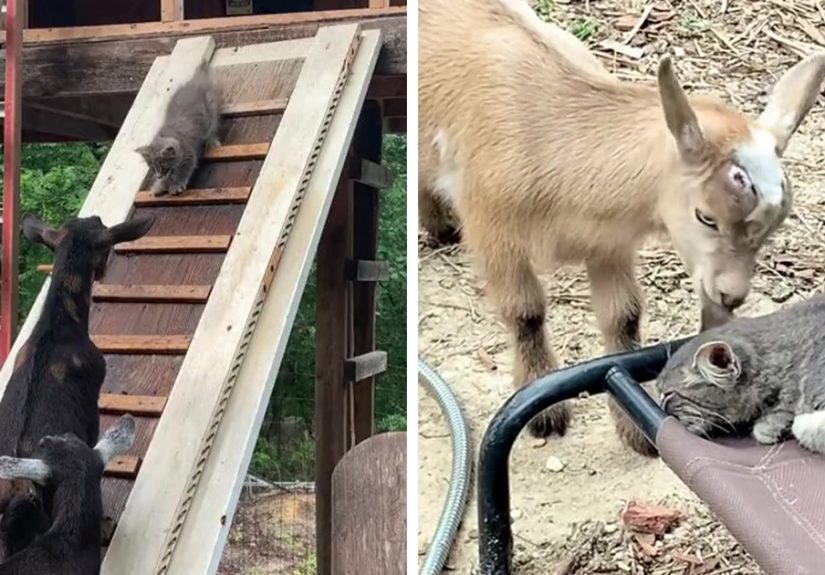
She brought home more young goats for company, but healing did not happen all at once. Then, as if the universe had a flair for storytelling, a tiny gray kitten appeared in the goat pen. At first, he was so still and so unexpected that he reportedly looked almost like a stuffed toy. But he was very much alive, very much mobile, and very much interested in hanging around the goats. He left, came back, and then did what the best surprise houseguests do in heartwarming animal stories: he settled in like he had a lease.
The family checked with neighbors to see whether anyone had lost a kitten. No one claimed him. Eventually, the little gray drifter was named GG, short for “Gray Goat,” which is objectively a top-tier nickname. It is hard to improve on a name that sounds like a joke, a title, and a personal destiny all at once.
Why a Stray Kitten Would Attach Himself to Baby Goats
Here is where the story stops being merely adorable and starts becoming fascinating. Why would a kitten decide that goats were his people? The short answer is proximity, timing, and social flexibility. Young animals are often more open to companionship, routine, and environmental cues than we give them credit for. Kittens have an important early socialization period, and enriched, positive experiences during youth matter. That does not mean every kitten raised near livestock is automatically going to identify as a goat with excellent balance, but it does help explain why cross-species comfort can happen.
GG was tiny, vulnerable, and looking for safety. The goats were young, active, and constantly together. The pen offered warmth, companionship, and a rhythm of life he could join. He did not need a species manual. He only needed a place where he felt secure. The baby goats became his moving, bouncing social circle, and he responded the way many young animals do: by observing, following, imitating, and attaching.
This is one reason people love farm stories. They reveal how often animals organize their relationships around comfort and familiarity rather than human categories. A kitten does not sit down with a clipboard and say, “Excuse me, biologically this arrangement is irregular.” He says, “These weird toddlers are warm, loud, and apparently very committed to group activities. I’m in.”
That social magnetism matters even more with goats. Goats are herd animals with clear social structures. They do best with companionship, and their behavior often reflects the health of the group around them. On a small farm, one animal’s mood can ripple outward. When GG began following the goats, sleeping with them, and generally inserting himself into their world, it was not just cute theater. It helped create a sense of normalcy after loss.
From Stray Kitten to Full-Time Goat Sibling
According to Jan’s account, GG did not just visit the goats. He committed. He followed them everywhere, played with them, teased them, and slept alongside them at night. That is not casual networking. That is cultural immersion. If the goats wandered, GG wandered. If they rested, GG rested. If they bounced around the pen like caffeinated marshmallows, GG joined the scene with the confidence of someone who had missed the memo that cats are supposed to act cooler than this.
What made the story especially moving was the way Peanut responded. Jan noticed that the lonely goat seemed more like himself again once GG arrived and the new bond formed. It is easy to assume that healing must arrive in solemn, cinematic fashion, but often it arrives as a ridiculous little gray kitten who refuses to respect species boundaries. The farm became livelier. The tension eased. The pen did not feel empty anymore.
That emotional turnaround is part of what transformed GG from “stray kitten” into “family member.” He was not just another animal passing through. He had become woven into the daily life of the goats and the humans caring for them. He was comic relief, comfort, and companionship rolled into one furry package with excellent timing.
The nickname “Gray Goat” was not just about his color. It was about belonging. He was the oddball who somehow fit. Every family has one member who seems to operate on a slightly different software version yet still becomes essential to the household ecosystem. GG just happened to be that relative in feline form.
The Humans in the Story Did More Than Just Smile and Take Videos
One reason this story lands so well is that the people involved were not careless romantics letting the animals sort everything out while they stood back and declared it destiny. They were observant. They tried to determine whether the kitten belonged to someone. They monitored the animals closely. And when GG later developed health issues, including an eye problem and signs consistent with respiratory illness, they sought veterinary care and adjusted his living situation.
That matters. A happy rescue story is not only about the emotional highlight reel. It is also about the practical choices that keep the ending from turning grim. Found kittens may need help from a veterinarian, rescue group, or experienced foster network. They may need screening, treatment, parasite control, vaccines, or a plan for safe housing. In GG’s case, the family eventually had to keep him indoors for his health, even though he clearly thought this policy was a personal insult of the highest order.
There is something both funny and deeply responsible in that turn. The kitten loved the goats. The family loved the kitten. But love does not always mean letting an animal do what he prefers every second of the day. Sometimes it means creating a safer life, even when the patient stares dramatically through the back door like a Victorian poet separated from his true pasture-born destiny.
To help GG adjust, the family later adopted another cat, Pickles, and that companionship helped smooth the transition. It was a smart move. Social support does not always have to come from the original group. Sometimes the best solution is a new friend who speaks your language, shares your zoomie schedule, and understands that knocking light objects off surfaces is not a crime but a calling.
Why This Cross-Species Friendship Makes Sense
It is tempting to treat cross-species friendships as magical exceptions, but animal behavior experts would likely say they are unusual without being impossible. Young animals often build attachments through repeated exposure, routine, play, and the absence of threat. If the setting is calm and supervised, animals can form strong positive associations with individuals outside their own species.
That does not mean every pairing is safe or wise. A cute moment on social media is not a substitute for species-specific needs, proper introductions, space, and common sense. Goats can be rough, cats can be stressed, and farm environments can expose animals to weather, injury, and disease. But under the right conditions, social bonds can emerge in ways that surprise us. GG’s story is memorable because he did not merely tolerate the goats. He synchronized with them.
There is also a farm-life logic to the whole thing. Animals on small farms often see one another constantly. They observe feeding routines, sleeping spots, daily movement patterns, and caretaker behavior. Familiarity lowers stress. Repetition builds trust. Before long, what looks improbable to an outside viewer can become totally normal inside the fence.
That is why the best part of the story may not even be the first meeting. It is the quiet, repeated behavior afterward: following, sleeping, returning, choosing the same companions again and again. Affection is lovely, but routine is what proves attachment. GG kept picking the goats. And the goats, in their tiny hoofed way, kept accepting him.
What People Can Learn if They Find a Stray Kitten in an Unusual Place
The first lesson is simple: do not assume a kitten has no owner just because he appears in a barn, field, or goat pen with strong “I live here now” energy. Check with neighbors. Scan for a microchip if you can safely transport the animal. Reach out to a veterinarian, shelter, or rescue. A found kitten can be a lost pet, a stray in need of help, or a young cat born outdoors who needs a careful assessment before anyone makes permanent decisions.
The second lesson is to watch health closely. Kittens can go downhill fast, especially if they are very young or carrying respiratory infections, eye infections, parasites, or dehydration. Sneezing, eye discharge, lethargy, poor appetite, or difficulty breathing are not “maybe he just had a long day” symptoms. They are signs to get professional guidance.
The third lesson is that adorable animal friendships still need boundaries. Safe housing, clean bedding, supervision, and species-appropriate nutrition matter. A kitten should not be treated like a tiny goat nutritionally or medically just because he has joined the herd socially. That is the difference between a wholesome story and a preventable disaster. The most loving thing people can do is enjoy the sweetness without forgetting the science.
And finally, remember that rescue is often less dramatic than movies suggest. It can look like asking around, setting up a carrier, wiping little crusty eyes, washing bedding, keeping an indoor space calm, or introducing a new companion at the right pace. The heroism is usually in the boring details. The viral video comes later.
Why the Internet Fell in Love With the “Gray Goat”
Part of the appeal is visual. A tiny gray kitten tucked among baby goats is almost unfairly photogenic. The size contrast alone is enough to short-circuit adult seriousness. Add the fact that Nigerian Dwarf goats already look like toy versions of regular goats, and the entire cast begins to resemble a storybook assembled by a very sentimental farmer with excellent lighting.
But the deeper reason people connect with GG is emotional. He arrived during a period of grief. He made a lonely goat less lonely. He gave a hurting human family something funny and alive to focus on. He was not just cute. He felt restorative. In that way, the story taps into something universal: the hope that comfort can arrive unexpectedly, and that healing does not always knock politely at the front door.
There is also something deliciously satisfying about identity chaos in animal stories. A goat who thinks it is a dog, a cat who thinks it is a horse, a duck who follows a lawn mower like it pays rent. We love these stories because they make the world feel more playful than rigid. GG’s whole existence in that pen suggested that belonging is sometimes less about matching the group and more about being accepted by it.
The Real Beauty of the Story
Strip away the viral captions and the squeaky soundtrack, and what remains is a story about chosen family. A stray kitten found companionship where he happened to land. A grieving household found joy in a creature they never planned for. A goat who needed his spark back found it in a tiny gray sidekick with cat ears and goat-level enthusiasm.
That is why the “Gray Goat” story lingers. It is silly, yes. It is meme-ready, absolutely. But it is also a reminder that animals are not mechanical little beings ticking through instinct in a vacuum. They are responsive, social, and shaped by the company they keep. Sometimes the right friend does not look anything like you. Sometimes he meows instead of bleats. Sometimes he climbs where he absolutely should not. And sometimes he becomes family anyway.
Related Experiences: Why Stories Like GG’s Feel So Familiar to Animal Lovers
Anyone who has spent real time around rescue animals, barn cats, bottle babies, or foster kittens will tell you the same thing: once survival is no longer the only priority, animals start making social choices that are weirdly touching and occasionally hilarious. A kitten raised near calm dogs may copy their confidence. A farm cat may trail after calves during morning chores. A lonely goat may become obsessed with one particular chicken, wheelbarrow, or human boot for reasons known only to goat psychology and possibly the moon. GG’s story feels exceptional, but the emotional pattern behind it is familiar to people who live closely with animals.
One common experience is seeing a vulnerable animal attach itself to the steadiest, warmest, or most available presence nearby. That is not sentimentality talking. It is often exactly how safety gets built. Foster caregivers see it when frightened kittens pile onto one confident littermate. Farmers see it when orphaned kids settle faster with routine, touch, and companionship. Shelter workers see it when scared animals become visibly braver once they are housed beside calmer ones. Animals may not narrate their feelings, but they absolutely broadcast them through behavior.
Another familiar piece is imitation. People laugh when an animal “acts like” another species, but imitation is a practical social tool. Young animals learn by watching. They follow movement, copy play, and repeat actions that seem to lead to comfort or inclusion. So when a kitten follows baby goats into every corner of a pen, curls up when they curl up, or charges around after them like a furry intern trying to fit in on day one, that behavior feels funny because it is also recognizable. It is social learning with whiskers.
There is also the emotional side for humans. Many people who rescue or care for animals know the strange timing of comfort. Sometimes the animal who shows up during a hard season becomes unforgettable not because he is rare, but because he arrived when you most needed distraction, laughter, or routine. Grief can make a home feel hollow. Animals, with their demands and odd habits, bring motion back into a space. You still have to feed them, clean up after them, and worry about them, but that activity can be healing. GG did not erase loss on the farm. He interrupted it. Sometimes that is how healing starts.
Perhaps that is why stories like this spread so widely. They confirm what animal people already suspect: affection is often more flexible than we think, and family can be assembled in wonderfully unplanned ways. A gray kitten may arrive as a stranger and end up as a goat sibling, a comforter, a clown, and a permanent legend in one small pen. That feels rare, but it also feels true. And that combination is exactly why readers never get tired of stories like the Gray Goat.