Table of Contents >> Show >> Hide
- Apollo Week Is Really About Big Ambition
- From Vision to Vehicle: How Apollo Was Built to Work
- Launch Day: July 16, 1969
- The Moon Landing Was Calm on the Radio and Chaotic Everywhere Else
- Apollo’s Science Was More Than Footprints and Flagpoles
- Why Apollo Still Feels Modern
- Welcome to Apollo Week, Where the Past Still Counts Down
- Experience Section: What Apollo Week Feels Like When You Really Lean Into It
- Conclusion
- SEO Tags
If there were ever a perfect excuse to spend a whole week staring at rockets, replaying countdown audio, and pretending your coffee mug is Mission Control, this would be it. Apollo Week is more than a nostalgic lap around one of the greatest achievements in modern history. It is a reminder that the Apollo program did not simply put people on the Moon. It changed how America thought about engineering, risk, science, ambition, teamwork, and what humans could do when they stopped arguing about the office thermostat long enough to build something extraordinary.
The phrase “We have a liftoff” still lands with force because Apollo was never just about the launch. It was about the years of planning behind the launch, the split-second decisions during the mission, and the legacy that kept echoing long after splashdown. To welcome Apollo Week properly, you have to look at the whole arc: the bold political promise, the brutal lessons, the elegant hardware, the near-impossible Moon landing, and the science that kept paying dividends decades later.
Apollo Week Is Really About Big Ambition
Apollo began as a moonshot in the most literal sense. In 1961, President John F. Kennedy challenged the nation to land a man on the Moon and return him safely to Earth before the decade was out. That goal sounded almost absurd at the time. America had not yet mastered long-duration human spaceflight, much less lunar landings. But Apollo turned that challenge into a national project with a clear deadline, a giant technical appetite, and absolutely no room for shrugging.
That is one reason Apollo Week still feels electric. It celebrates a moment when the United States set a wildly difficult objective and then organized talent, money, institutions, and public attention around making it real. Apollo was not a lucky bounce. It was a disciplined, high-stakes campaign of testing, failure, redesign, and persistence. In today’s language, Apollo was a masterclass in systems engineering. In normal language, it was a miracle built with checklists.
The week also works because Apollo was not only Apollo 11. The moon landing was the headline, but the story had a long runway. Apollo 8 sent humans beyond Earth orbit for the first time and delivered the iconic Earthrise view that changed how people saw our planet. Apollo 1 exposed fatal design and safety flaws after a cabin fire killed Gus Grissom, Ed White, and Roger Chaffee during a ground test. The program that reached the Moon was shaped as much by tragedy and correction as by triumph and applause.
From Vision to Vehicle: How Apollo Was Built to Work
One of the most fascinating parts of the Apollo program is that it was both gigantic and incredibly precise. Apollo’s goals extended beyond planting a flag. NASA framed the program around broader aims: advancing U.S. leadership in space, developing the technology needed for national interests, carrying out scientific exploration of the Moon, and learning how humans could work in the lunar environment. In other words, Apollo was not just a stunt with better branding. It was a research, engineering, and geopolitical program rolled into one.
The hardware reflected that ambition. Apollo lunar missions rode the Saturn V, a launch vehicle so powerful it still feels slightly unreasonable. Above it sat a spacecraft built in three major parts: the command module, where the crew lived and flew; the service module, which provided propulsion and support systems; and the lunar module, the spider-like machine that carried two astronauts down to the Moon and back up to lunar orbit.
This architecture mattered. It allowed NASA to use lunar orbit rendezvous, a strategy that sounded complicated because it was complicated. Instead of landing the whole spacecraft on the Moon like someone parallel parking an apartment building, Apollo sent only the lunar module down. That choice saved mass, reduced risk, and made the mission achievable within the decade. Behind the scenes, the guidance computers, tracking networks, and mission procedures had to work with astonishing reliability. The Apollo Guidance Computer itself became legendary, not because it looked flashy, but because it quietly helped steer one of history’s most demanding journeys.
Launch Day: July 16, 1969
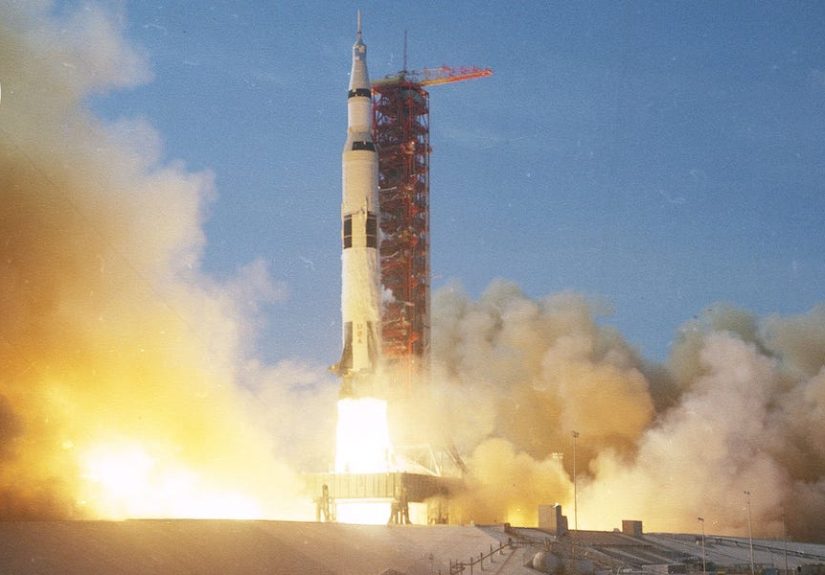
Then came the moment people still replay with goosebumps on demand. On the morning of July 16, 1969, Apollo 11 launched from Florida with Neil Armstrong, Buzz Aldrin, and Michael Collins aboard. At 9:32 a.m. Eastern, the Saturn V lifted off and the most famous commute in human history began.
Popular memory often jumps straight from launch pad to Moon dust, but the trip itself was a sequence of beautifully choreographed moves. After reaching Earth orbit, the spacecraft performed the transposition and docking maneuver: the command and service module separated, turned around, docked with the lunar module, and pulled it free from the spent rocket stage. This was not glamorous. It was just critically important, which is the Apollo way. The crew then began the long coast to the Moon, a journey of roughly three days across a distance that still feels rude when you say it out loud.
By the time Apollo 11 entered lunar orbit, the mission had already proven the system worked. But the most dangerous phase was still ahead. Armstrong and Aldrin climbed into the lunar module Eagle, undocked from Collins in Columbia, and began their descent toward the Sea of Tranquility while Collins remained alone in lunar orbit, tending the only ride home. That detail never stops being dramatic. Collins was not just waiting; he was safeguarding the thread that tied the Moon back to Earth.
The Moon Landing Was Calm on the Radio and Chaotic Everywhere Else
The Apollo 11 landing was one of those rare events that felt both highly scripted and completely improvisational. The flight plan may have been minute-by-minute, but reality had a habit of showing up with extra tension. During descent, the lunar module’s computer threw alarms. The planned landing area looked unfriendly. Fuel was running low. Armstrong took semi-manual control and guided Eagle away from hazardous terrain, buying the mission a safe landing site with nerves, skill, and very little spare margin.
When the module touched down on July 20, 1969, more than 102 hours after launch, Armstrong delivered the words that have been replayed into history: “The Eagle has landed.” Mission Control, which had been collectively holding its breath, practically exhaled through the radio. It was one of the defining moments of the twentieth century because it represented more than successful piloting. It represented a national promise kept under pressure.
Armstrong and Aldrin spent just under a day on the lunar surface, with a little over two hours outside the spacecraft during the moonwalk itself. They gathered samples, photographed the terrain, deployed experiments, and tested how humans could operate in a place where every movement looked like slow-motion optimism. Meanwhile, millions on Earth watched grainy television images and listened to audio that made the Moon suddenly feel not close, exactly, but reachable.
Apollo’s Science Was More Than Footprints and Flagpoles
People sometimes talk about Apollo as if it were only a Cold War spectacle with excellent camera angles. That undersells the mission badly. Apollo 11 carried real scientific objectives, and later Apollo missions expanded them even further. On the first landing mission alone, astronauts collected lunar material, deployed a solar wind composition experiment, set up a passive seismic experiment, and installed a laser ranging retroreflector that remains scientifically useful. That last device still helps scientists measure the changing distance between Earth and the Moon with remarkable precision.
The samples brought back by Apollo missions transformed lunar science. They helped researchers estimate the Moon’s age, study the history of impacts across the inner solar system, understand the nature of lunar regolith, and refine ideas about how the Moon formed. Seismic data opened a window into the Moon’s interior. Later analysis of Apollo rocks even contributed to evidence that trace amounts of water were present in lunar materials. So yes, Apollo gave the world unforgettable images. It also gave scientists decades of actual work to do, which is the less cinematic but more durable kind of legacy.
Apollo even changed how humanity saw Earth. Apollo 8’s Earthrise image and the broader visual culture of lunar exploration made our planet appear finite, fragile, and shared. That may sound poetic, but it had real cultural consequences. Spaceflight did not just expand the map outward. It also turned our gaze back home.
Why Apollo Still Feels Modern
Part of Apollo’s staying power comes from the fact that it feels both old and weirdly current. The computers were primitive by modern consumer standards, yet the mission design was sophisticated enough to handle unimaginable complexity. The communication systems were global. The risk management was relentless. The project required coordination across institutions, contractors, research groups, and government leadership at a scale that still impresses historians.
That is why Apollo Week is not just retro pageantry for people who own too many space books. It is a useful lens for understanding innovation itself. Apollo proves that progress is rarely linear, rarely tidy, and never the product of one hero alone. Armstrong, Aldrin, and Collins became symbols, deservedly so, but the program was also the work of engineers, software specialists, mathematicians, technicians, flight directors, seamstresses, machinists, and planners. If the Moon landing had a hidden superpower, it was organized competence.
It also helps explain why Apollo continues to inspire new lunar ambitions. Every modern plan to return humans to the Moon, build sustainable lunar operations, or push onward toward Mars lives in Apollo’s shadow at least a little. The templates are still there: test incrementally, respect the physics, train obsessively, and never trust a mission profile that sounds “pretty straightforward.” Space has a wicked sense of humor.
Welcome to Apollo Week, Where the Past Still Counts Down
So what does it mean to welcome Apollo Week? It means treating Apollo as more than a sepia-toned highlight reel. It means remembering that the first lunar landing was the visible peak of a much bigger mountain. It means honoring the people lost along the way, the teams who solved impossible problems, and the scientific legacy that still shapes research today.
It also means letting yourself enjoy the drama of it. The launch. The separation maneuvers. The descent alarms. Collins circling above. Mission Control sweating through its shirts. The first bootprints. The samples. The splashdown. Apollo is one of those stories that stays thrilling even when you know the ending, because the ending was never guaranteed.
And maybe that is the real reason Apollo Week matters. It reminds us that history’s most powerful achievements often begin with a sentence that sounds just a little too bold, followed by years of hard work from people stubborn enough to make it true. In Apollo’s case, the sentence ended with the Moon. The work changed the world.
Experience Section: What Apollo Week Feels Like When You Really Lean Into It
There is a special kind of thrill that comes from experiencing Apollo Week not as a trivia theme, but as an immersive journey through the mission itself. Start with the countdown audio and launch footage, and you immediately understand why the phrase “We have a liftoff” still has electricity in it. The Saturn V does not merely leave the pad; it seems to convince gravity to take a coffee break. Even through archival film, you can feel the vibration, the fire, the impossible scale. It is not hard to imagine what families, engineers, reporters, and schoolkids felt as that rocket climbed into the Florida sky.
Then the experience becomes quieter and somehow more intense. Reading the Apollo 11 flight plan or listening to mission communications turns the adventure into a chain of human decisions. The Moon landing stops being a myth and becomes a series of tasks, checklists, callouts, and calm voices doing difficult things in real time. That may be Apollo’s secret magic trick: the closer you get to the details, the more impressive it becomes. Nothing about it gets smaller when examined. It gets bigger.
There is also something deeply moving about the artifacts. Seeing the command module Columbia, or even a digital reconstruction of it, makes one fact unavoidable: three people really did climb into that compact machine and trust it with their lives. The hardware feels less like science fiction and more like courage with bolts on it. The guidance computer, the DSKY interface, the hatch, the suits, the checklists, the tiny switches and labels all remind you that Apollo was tactile. People touched this mission into existence.
Apollo Week also has an emotional rhythm. Launch day feels loud. Lunar orbit feels suspenseful. The landing feels fragile. The moonwalk feels surreal. Splashdown feels almost tender, like history finally letting its shoulders drop. If you follow the mission from start to finish, you start noticing Michael Collins more, appreciating the engineering logic more, and respecting the thousands of invisible contributors more. The famous footprints are still amazing, but the teamwork becomes the part that sneaks up on you.
And then there is the Earth side of the experience. Looking at Apollo 8’s Earthrise or revisiting the Moon broadcasts through preserved audio and media coverage reminds you that space exploration is also about perspective. Apollo did not just show people the Moon. It showed humanity a new image of Earth: distant, bright, borderless, and vulnerable. That emotional jolt still works. Half a century later, it can still make a person stop scrolling, sit up straighter, and think, “We actually did that.”
That is the best way to spend Apollo Week. Not just admiring the achievement, but feeling the texture of it. Hear the calls. Read the plans. Study the machinery. Follow the timeline. Let the suspense build even though you know the ending. By the time you reach splashdown, Apollo no longer feels like dusty history. It feels alive, demanding, ingenious, and strangely personal. You do not come away thinking only about the Moon. You come away thinking about what people can build when they decide that “impossible” is merely a scheduling problem with excellent public relations.
Conclusion
Apollo Week deserves more than a nostalgic nod because the Apollo program was more than a single glorious headline. It was a convergence of bold political vision, hard-won engineering lessons, scientific discovery, and human determination. Apollo 11 remains the centerpiece because it turned years of planning into a successful Moon landing, but the deeper legacy lies in everything around it: the missions that prepared the way, the tools and teams that made it work, and the discoveries that still shape science today. To revisit Apollo is to revisit a moment when ambition, discipline, and imagination aligned. That story still feels fresh because it still asks the same question of every generation: what giant leap are you willing to build toward next?