Table of Contents >> Show >> Hide
- Why Thick Fabric Is Harder to Sew by Hand
- What You Need Before You Start
- Way 1: Use a Running Stitch for Control, Basting, and Light-Duty Thick Seams
- Way 2: Use a Backstitch for Strong, Everyday Hand-Sewn Seams
- Way 3: Use an Awl-Assisted Saddle Stitch for Very Thick Fabric
- Common Mistakes to Avoid When Sewing Thick Fabric by Hand
- Best Beginner Projects for Practicing on Thick Fabric
- Lessons From Real Hand-Sewing Experience
- Conclusion
If you have ever tried to hand-sew denim, canvas, felt, upholstery fabric, or faux leather, you already know the truth: thick fabric has opinions. Usually loud ones. It resists flimsy needles, laughs at weak thread, and can make your fingers question every life choice that brought them to this moment.
The good news is that sewing thick fabric by hand is absolutely doable. You do not need a fancy studio, industrial machine, or superhero grip strength. You just need the right stitch, the right tools, and a little patience when the fabric starts acting like a stubborn mule in a craft-store aisle.
In this guide, you will learn three simple ways to sew thick fabric by hand, along with practical tips for choosing needles and thread, handling bulky seams, and avoiding the classic mistakes that turn a quick repair into an evening-long grudge match. Whether you are patching jeans, reinforcing a canvas tote, hemming wool, or repairing a cushion cover, these techniques can help you get neat, strong results without losing your cool.
Why Thick Fabric Is Harder to Sew by Hand
Before we get into the actual methods, it helps to understand why hand sewing thick fabric feels so different from sewing lightweight cotton or a simple shirt hem. Thick materials have denser fibers, tighter weaves, more bulk, and often more friction. That means the needle does not slide through as easily, the thread rubs more as it passes through the fabric, and bulky seam layers can throw off your stitch spacing.
Some fabrics are thick because they are tightly woven, like denim and canvas. Others are bulky because they have loft or padding, like upholstery fabric and quilted materials. Then there are the troublemakers in the stylish corner, such as faux leather, waxed canvas, and some heavy coatings, which can resist the needle and show every hole like a permanent receipt.
That is why technique matters. The stronger the material, the less you can rely on “just poke and hope.” You want a method that matches the fabric, a needle that fits the job, and thread that will not snap halfway through the second inch of stitching.
What You Need Before You Start
If you want better results, set yourself up well before making the first stitch. Thick fabric is not the place for mystery-thread from a dusty cookie tin and a bent needle rescued from the bottom of a sewing box.
Basic tools for hand sewing thick fabric
- Strong hand-sewing needles: sharps, chenille, upholstery, leather, or harness needles depending on the material
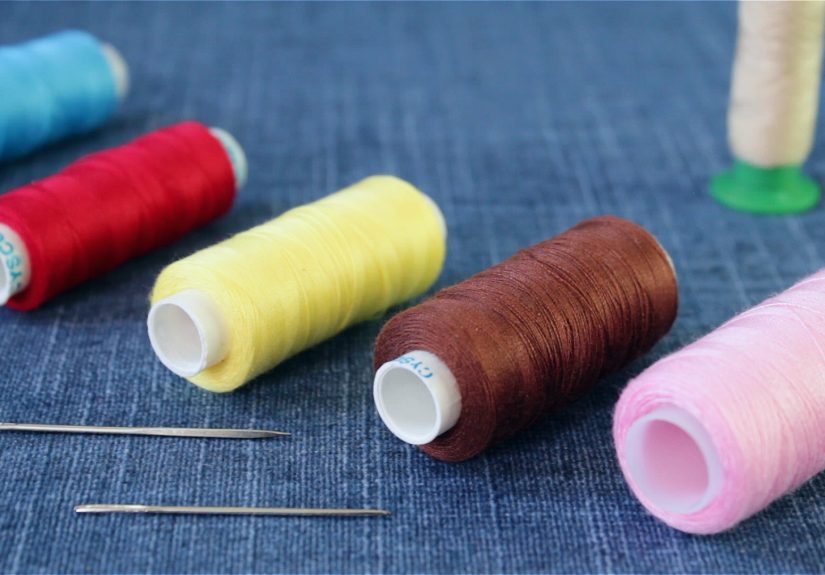
- Heavy-duty or waxed thread: polyester, upholstery thread, or waxed thread for extra friction control
- A thimble or sewing palm: especially useful when pushing through dense layers
- Sharp fabric scissors: dull scissors make everything worse
- Clips or sturdy pins: clips are better for very bulky or coated fabrics
- Tailor’s chalk or washable marker: because “eyeballing it” gets less charming on thick fabric
- An awl, stitching awl, or hole punch: optional, but extremely helpful for extra-thick seams
Quick prep tips
Cut a shorter length of thread than you would for normal sewing. Long thread may seem efficient, but when you are sewing thick fabric, long thread tangles, frays, and drags more easily. A shorter length gives you better control and less irritation.
Also, test your stitch on a scrap first. Thick fabric can behave differently depending on the weave, finish, and number of layers involved. A denim hem and a canvas bag handle may both be “thick,” but they do not feel thick in the same way. One folds like cardboard, the other fights like a gym towel.
Way 1: Use a Running Stitch for Control, Basting, and Light-Duty Thick Seams
The running stitch is the simplest hand-sewing method, and for thick fabric, it works best when you need control more than brute strength. Think of it as the calm, practical friend in the group. It may not be the strongest seam on its own, but it is excellent for positioning, temporary holding, and lighter hand-sewn joins.
Best for
- Basting thick layers before final sewing
- Holding a patch in place on denim or canvas
- Simple repairs on felt or lightly stressed seams
- Hand gathering small areas of heavier fabric
How to do a running stitch on thick fabric
- Thread your needle with a strong thread and knot the end.
- Bring the needle up through the fabric from the back.
- Take small, even stitches by weaving the needle in and out of the fabric.
- Keep the stitch length and the spaces between stitches as even as possible.
- Pull the thread snugly, but do not yank so hard that the fabric puckers.
The trick with thick fabric is to keep the stitches a little shorter if you want more hold. Small stitches distribute stress better than giant ones. A long running stitch is fine for basting, but if the seam needs to do real work, shrink that stitch length and keep it tidy.
This method is especially helpful if you are nervous about working with bulky material. You can also load several stitches onto the needle at once, which speeds things up and feels satisfyingly efficient. Very “I absolutely know what I’m doing,” even if you are sewing a canvas plant tote on your kitchen table.
That said, a running stitch is not usually your forever seam for high-stress areas. It is more of a setup stitch, a helper stitch, or a decent choice for projects that do not take much strain. For stronger seams, your next move is backstitch.
Way 2: Use a Backstitch for Strong, Everyday Hand-Sewn Seams
If the running stitch is the polite warm-up, the backstitch is where the real work begins. This is one of the strongest basic hand-sewing stitches and one of the best ways to sew thick fabric by hand when you want durability without getting overly fancy.
A backstitch forms a solid line of stitching with no gaps between stitches, which gives it far more strength than a standard running stitch. That makes it a great choice for mending denim, repairing seams on canvas bags, attaching patches, closing torn upholstery seams, or hand-sewing projects that need to survive actual use.
Best for
- Mending jeans and workwear
- Repairing torn seams on heavy clothing
- Sewing canvas, twill, and wool seams by hand
- Attaching patches that need to stay attached after laundry day
How to do a backstitch on thick fabric
- Mark your sewing line if precision matters.
- Bring the needle up through the fabric from the back.
- Insert the needle one stitch length behind where the thread came out.
- Bring the needle back up one stitch length ahead of the previous exit point.
- Repeat, always stitching backward into the end of the last stitch.
Done correctly, the top line looks nearly continuous, almost like machine stitching. That is why it is such a favorite for repairs. It is compact, strong, and dependable.
For thick fabric, go slowly and keep your spacing consistent. Use a thimble to push the needle through the layers instead of sacrificing your fingertip to the crafting gods. If the fabric is very dense, grip the needle close to the fabric for better control and angle it slightly rather than trying to force it straight down like a nail.
You can make this stitch even stronger by using waxed thread or doubling your thread if the fabric can handle the added bulk. Just do not go overboard. A too-thick thread in too-small holes creates friction, and friction is how thread starts looking tired before the seam is even finished.
Backstitch is the best all-around answer if someone asks, “How do I sew thick fabric by hand and actually trust the seam afterward?” It is the workhorse stitch. Not glamorous. Not dramatic. Just very, very useful.
Way 3: Use an Awl-Assisted Saddle Stitch for Very Thick Fabric
When the material gets seriously tough, think heavy canvas, bag straps, layered denim seams, waxed fabric, or light leather-like materials, basic hand stitching may need backup. That is where the awl-assisted saddle stitch comes in.
This method sounds more intense than it really is. In plain English, you pre-make the holes with an awl or stitching tool, then sew through those holes with strong thread. It is one of the smartest ways to handle fabric that is simply too dense to pierce comfortably again and again with a regular hand needle.
Best for
- Canvas bags and gear repairs
- Heavy hems or strap reinforcements
- Faux leather and light leather projects
- Places where several layers meet and get bulky fast
How to do an awl-assisted saddle stitch
- Mark a straight stitch line on the fabric.
- Use an awl or stitching tool to make evenly spaced holes along that line.
- Thread a needle on each end of a length of waxed thread.
- Pass one needle through the first hole from one side.
- Pass the second needle through the same hole from the opposite side.
- Pull both sides evenly so the stitch locks in the middle.
- Repeat hole by hole until the seam is complete.
This produces a balanced, strong seam that is especially useful for thick, stubborn materials. Because the holes are already made, you are not forcing the needle through fresh resistance every time. That means cleaner stitches, better spacing, and less hand fatigue.
Waxed thread really shines here. It glides better, tangles less, and tends to hold tension more neatly. If you are working through especially dense layers, a sailmaker’s palm or sturdy metal thimble can make a huge difference. This is not cheating. This is called being smarter than the fabric.
For beginners, this method is perfect for repairs where appearance matters less than strength, such as a tote handle, outdoor cushion seam, camping gear, or a tool roll. Once you get the rhythm, it becomes weirdly satisfying. Punch hole, stitch, pull tight, repeat. It is basically meditation, but with more canvas.
Common Mistakes to Avoid When Sewing Thick Fabric by Hand
Even the best stitch can look rough if the setup is wrong. Here are the mistakes that cause the most frustration when people try to sew thick fabric by hand.
Using the wrong needle
A weak or too-fine needle bends, drags, or snaps. Match the needle to the project. Denim, canvas, upholstery fabric, and leather-like materials often need a stronger, sharper, or more specialized hand-sewing needle.
Using thread that is too weak
Regular all-purpose thread can work for some thick fabrics, but high-stress areas usually need something stronger. Polyester, upholstery thread, or waxed thread are usually better choices when durability matters.
Skipping the thimble
Yes, some people bravely insist they “never use one.” Those people may also have tougher fingertips than the rest of us. A thimble helps you apply even pressure, protects your finger, and makes dense layers much less annoying.
Making stitches too long
Long stitches are faster, but they are often weaker. On thick fabric, shorter and more even stitches usually hold better and look cleaner.
Pulling the thread too hard
Over-tightening causes puckering, distortion, and extra strain on the thread. Pull until the seam is snug, not strangled.
Ignoring seam bulk
If several layers stack up in one area, trim excess seam allowance where appropriate, stagger layers, or flatten the section before sewing. Thick fabric becomes much easier to manage when you reduce the mountain into a hill.
Best Beginner Projects for Practicing on Thick Fabric
If you are new to this, do not start with a full wool coat or a heroic leather satchel. Begin with one of these:
- A denim patch on old jeans
- A canvas tote repair
- A felt storage basket seam
- A cushion corner repair
- A simple hem on heavy cotton twill
These projects give you experience with resistance, tension, stitch spacing, and hand position without requiring the emotional stamina of rebuilding a camping tent from scratch.
Lessons From Real Hand-Sewing Experience
One of the biggest lessons people learn when sewing thick fabric by hand is that force is not the same thing as control. At first, it is tempting to attack the fabric like it insulted your family. You grip harder, push faster, and pull the thread with unnecessary drama. Usually, the result is sore fingers, uneven stitches, and a thread knot that appears from nowhere like a tiny act of sabotage.
Experience changes that. After a few real projects, maybe a ripped denim knee, a split tote handle, or a seat cushion seam that gave up after one too many movie nights, you start noticing that the cleanest results come from slowing down. Thick fabric rewards rhythm. Mark the line. Clip the layers. Use shorter thread. Push with a thimble. Pull evenly. Repeat. It becomes less of a wrestling match and more of a steady routine.
Another thing experience teaches you is that fabric thickness is not always the hardest part. Bulk is often the true villain. A single layer of canvas may be manageable, but four folded layers at a strap attachment can feel like you are trying to sew toast. In those moments, trimming seam allowance, flattening the section, or pre-punching holes can save the project. Beginners often think they need stronger hands. Usually, they just need smarter prep.
There is also a huge difference between a fabric being thick and a seam being stressed. A felt basket made from bulky felt may sew fairly easily because the seam does not take much force. A canvas grocery bag handle, on the other hand, needs to survive weight, motion, and repeated use. That is why choosing the stitch matters so much. Running stitch may be fine for positioning or soft structure, but backstitch and saddle stitch earn their keep when real strain enters the chat.
Many people also discover that waxed thread feels almost magical on thick projects. It behaves better, tangles less, and gives the stitching a more controlled finish. The first time you switch from ordinary thread to waxed thread on a stubborn repair, it feels a bit like upgrading from a butter knife to an actual tool. Not glamorous, but deeply satisfying.
Then there is the psychological side of hand sewing thick fabric, which nobody talks about enough. It can be surprisingly calming once you stop expecting speed. You are not racing. You are building something durable one stitch at a time. There is a nice sense of competence in fixing a heavy seam with your own hands, especially when the item would otherwise be tossed aside. A repaired canvas apron, a patched backpack strap, a sturdier pet bed cover, these are small wins, but they feel solid and useful.
Of course, some mistakes become unforgettable teachers. Maybe you used thread that was too weak and watched it fray halfway through the seam. Maybe you skipped the thimble and spent the next day pressing elevator buttons with one very offended finger. Maybe you stitched a patch beautifully, only to realize it was slightly crooked. Thick fabric has a way of making your errors obvious, but it also makes your improvements obvious. Each project gets cleaner, straighter, and less chaotic.
In the end, the best experience-based tip is simple: do not try to overpower thick fabric. Work with it. Respect the density, use the right tools, and let the stitch do the job it was meant to do. Once that clicks, hand sewing thick material stops feeling intimidating and starts feeling practical, even enjoyable. Still stubborn, yes. But now it is your kind of stubborn.
Conclusion
If you want to sew thick fabric by hand without turning the project into a full-blown finger workout, keep it simple. Use a running stitch when you need control or temporary hold, a backstitch when the seam needs real strength, and an awl-assisted saddle stitch when the fabric is dense enough to put up a fight. Pair those methods with the right needle, strong thread, and a good thimble, and suddenly thick fabric becomes far less intimidating.
The best part is that these skills are practical. You can use them on jeans, canvas bags, home décor, workwear, felt projects, heavy hems, and small repairs that deserve better than a rushed fix. Take your time, practice on scraps, and remember: if the fabric is stubborn, that does not mean the project is impossible. It just means you need a better plan than brute force and optimism.